


Overview
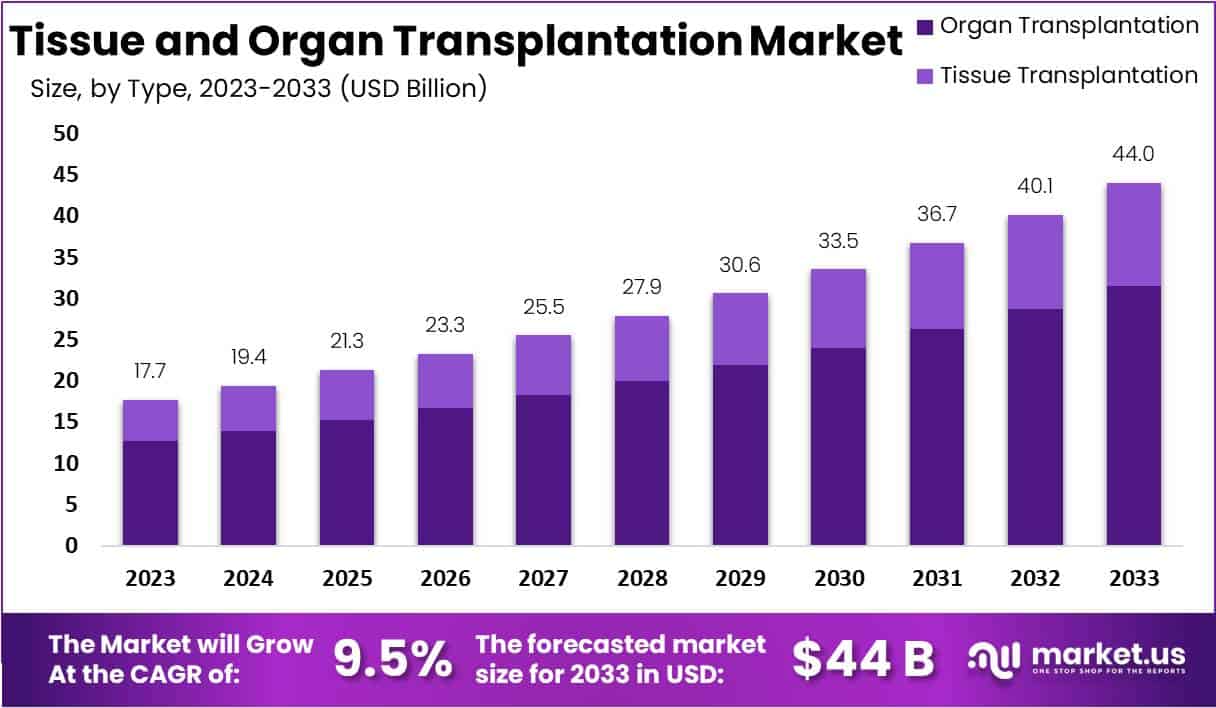
New York, NY – July 22, 2026 – The Tissue And Organ Transplantation Market Size is projected to reach approximately USD 44 billion by 2033, showing significant growth from the 2023 figure of USD 17.7 billion. This represents a Compound Annual Growth Rate (CAGR) of 9.5% anticipated during the forecast period spanning from 2024 to 2033.
Tissue and organ transplantation is a medical procedure in which a healthy organ or tissue is transferred from a donor to a recipient to replace a damaged or non-functioning organ or tissue. Commonly transplanted organs include the kidney, liver, heart, lungs, pancreas, and intestine, while tissues such as corneas, skin, bone, heart valves, and tendons are also widely transplanted. Organ donation can occur from living donors, who may donate a kidney or part of the liver, or from deceased donors following consent and medical evaluation.
Advancements in surgical techniques, organ preservation, and immunosuppressive therapies have significantly improved transplant success rates and long-term patient outcomes. Tissue and organ transplantation plays a vital role in treating end-stage organ failure, severe injuries, congenital disorders, and certain chronic diseases, offering patients improved survival and quality of life.
Despite these advancements, the global demand for donor organs continues to exceed supply, resulting in long waiting lists in many countries. Governments, healthcare organizations, and non-profit institutions are actively promoting public awareness, donor registration, and ethical donation practices to increase organ availability.
Continued investment in transplantation research, donor management, and healthcare infrastructure is expected to further enhance transplantation outcomes. Tissue and organ transplantation remains one of the most effective life-saving medical interventions, contributing significantly to modern healthcare systems and improving the lives of millions of patients worldwide.
Key Takeaways
- Market Growth: The Tissue and Organ Transplantation Market is projected to reach USD 44 billion by 2033, expanding at a CAGR of 9.5% during the forecast period from 2024 to 2033.
- Type Analysis: Organ transplantation accounted for the largest market share of 71.6% in 2023, supported by the increasing prevalence of organ failure and continuous advancements in transplantation procedures.
- Tissue Transplantation Outlook: The tissue transplantation segment is expected to witness significant growth, driven by its expanding use in wound healing, reconstructive procedures, and advancements in tissue engineering and regenerative medicine.
- Product Analysis: Tissue products held the leading market share of 43.2% in 2023, primarily due to the growing adoption of skin grafts for burn care, chronic wound management, and reconstructive applications.
- End-User Analysis: Hospitals represented the largest end-user segment with a 38.7% market share in 2023, owing to their comprehensive transplant capabilities, while transplant centers are anticipated to register strong growth over the forecast period.
- Key Growth Factors: Market expansion is being supported by advancements in transplant technologies, rising demand for organ transplantation, progress in immunosuppressive therapies, and increasing awareness of organ donation.
- Regional Insights: North America accounted for the largest market share of 38.6% in 2023, supported by advanced healthcare infrastructure, high organ donation awareness, favorable reimbursement policies, and well-established regulatory frameworks.
Regional Analysis
In 2023, North America held the leading position in the Tissue and Organ Transplantation Market, accounting for more than 38.6% of the global market and generating USD 6.83 billion in revenue. The region’s dominance is supported by its advanced healthcare infrastructure, which includes specialized transplant centers, modern medical technologies, and a well-established regulatory environment that enables efficient and successful transplantation procedures.
High organ donation rates, driven by strong public awareness initiatives, organized donor networks, and supportive legislation, have improved the availability of transplantable organs. In addition, government funding, favorable healthcare policies, and investments in transplantation research continue to strengthen the regional market.
Collaboration among research institutions, biotechnology companies, and healthcare providers has accelerated the development of innovative transplantation techniques and immunosuppressive therapies. Furthermore, stringent regulatory standards ensure the safety, quality, and effectiveness of transplant procedures, reinforcing patient confidence and supporting the continued growth of the Tissue and Organ Transplantation Market across North America.
Emerging Trends
- Advancements in Xenotransplantation: Genetically modified pigs are advancing xenotransplantation by reducing the risk of immune rejection after organ transplantation. Regulatory approvals have supported their medical use, encouraging further research and development while expanding future opportunities to address organ shortages and improve transplant availability for patients worldwide.
- Artificial Intelligence in Transplantation: Artificial intelligence is improving organ transplantation by enabling early detection of organ failure, enhancing donor-recipient matching accuracy, and supporting organ viability assessments. These capabilities increase transplant success rates, optimize resource utilization, reduce waiting times, and improve overall patient outcomes across healthcare systems.
- Policy Reforms in Organ Donation: Policy reforms are strengthening organ donation systems through improved transparency, equitable organ allocation, and modernization of transplant networks. Government initiatives are enhancing operational efficiency, increasing public trust, reducing disparities in access to transplants, and supporting higher rates of successful organ donations worldwide.
Use Cases
- Bioprinting Organs: Three-dimensional bioprinting technology is enabling the development of complex tissues and organs using living cells. This innovation has the potential to reduce dependence on donor organs, address transplantation shortages, improve patient compatibility, and transform the future of regenerative medicine and transplantation.
- Perfusion Systems: Advanced organ perfusion systems preserve donor organs in near-physiological conditions outside the body, extending their viability before transplantation. These technologies enable longer transportation distances, improve organ quality, increase transplant success rates, and expand access to life-saving procedures for patients globally.
- Increased Organ Donation Rates: Organ donation rates continue to increase due to greater public awareness, improved donor identification, and advances in transplantation technologies. Growing donor availability, combined with enhanced matching processes and clinical practices, has increased successful transplant procedures and improved outcomes for patients awaiting organs.
Frequently Asked Questions on Tissue And Organ Transplantation
- Which organs and tissues are commonly transplanted?
The most commonly transplanted organs include kidneys, liver, heart, lungs, pancreas, and intestines. Frequently transplanted tissues include corneas, skin, bone, tendons, heart valves, and blood vessels. These transplantations are performed to treat various life-threatening diseases and injuries while restoring essential body functions. - Who can become an organ or tissue donor?
Organ and tissue donors can be living individuals or deceased persons who meet established medical and legal eligibility criteria. Living donors commonly donate kidneys or portions of the liver, while deceased donors may provide multiple organs and tissues to benefit several recipients simultaneously. - How does tissue and organ transplantation improve patient outcomes?
Successful transplantation significantly improves survival rates, restores normal organ function, reduces disease-related complications, and enhances the patient’s overall quality of life. Many recipients regain independence, return to work, and participate in routine daily activities following recovery and appropriate medical follow-up. - What technologies are advancing tissue and organ transplantation?
Advancements include organ preservation technologies, machine perfusion systems, robotic-assisted transplant surgeries, improved immunosuppressive therapies, genomic matching techniques, artificial organs, regenerative medicine, and bioprinting research. These innovations aim to increase transplant success, improve donor organ utilization, and reduce complications. - What factors are driving the growth of the tissue and organ transplantation market?
The market is driven by rising incidences of chronic diseases, increasing organ failure cases, growing awareness regarding organ donation, advancements in preservation technologies, improved surgical techniques, and supportive government initiatives. Continuous investments in transplant research and healthcare infrastructure further contribute to market expansion. - Which region dominates the tissue and organ transplantation market?
North America holds a leading position in the tissue and organ transplantation market due to advanced healthcare infrastructure, favorable reimbursement policies, high transplantation volumes, and strong research activities. Europe also represents a significant market, while Asia-Pacific is witnessing rapid growth driven by expanding healthcare investments. - What is the future outlook for the tissue and organ transplantation market?
The market is expected to witness sustained growth due to increasing adoption of advanced preservation technologies, regenerative medicine, artificial organs, precision matching techniques, and digital healthcare solutions. Ongoing research and favorable healthcare investments are anticipated to improve transplantation outcomes and expand market opportunities.
Conclusion
The tissue and organ transplantation market is expected to experience sustained growth, supported by the rising prevalence of organ failure, increasing organ donation awareness, and continuous advancements in transplantation technologies.
Innovations such as artificial intelligence, xenotransplantation, organ perfusion systems, and bioprinting are improving transplant success rates and expanding treatment possibilities. Favorable government initiatives, regulatory reforms, and investments in healthcare infrastructure are further strengthening market development.
North America continues to lead due to its advanced healthcare ecosystem, while emerging regions present significant growth opportunities. Overall, ongoing technological progress and collaborative research efforts are expected to enhance patient outcomes and drive long-term market expansion.
Discuss your needs with our analyst
Please share your requirements with more details so our analyst can check if they can solve your problem(s)




