


Overview
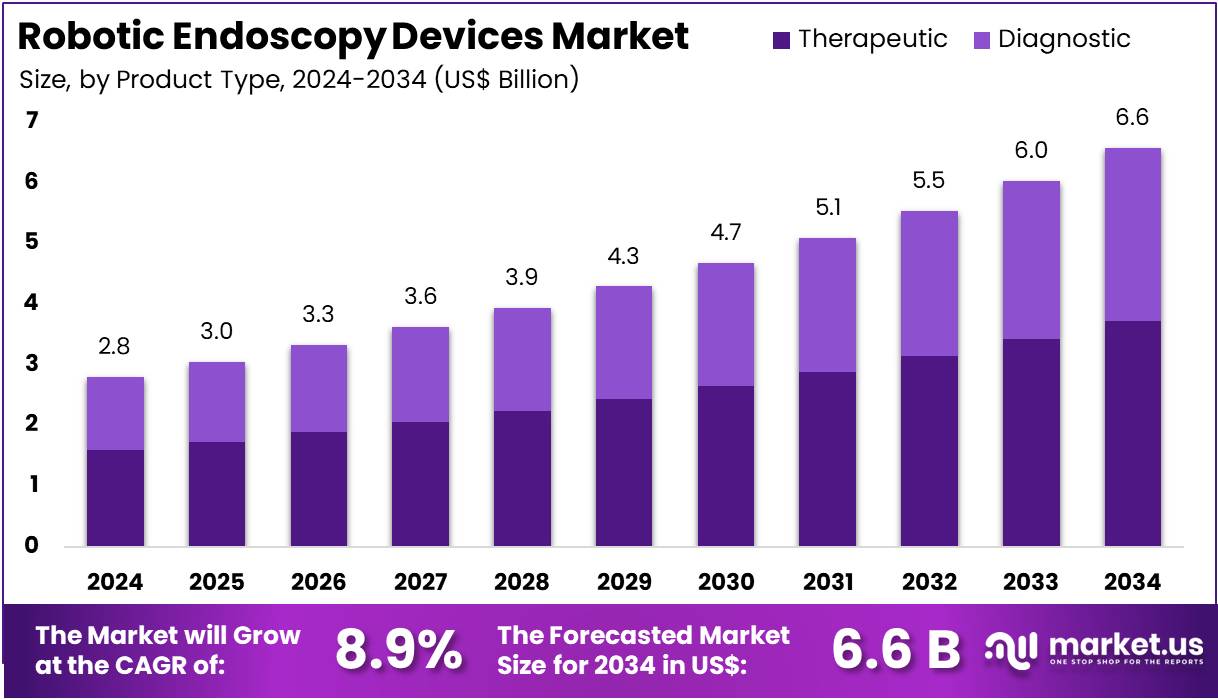
New York, NY – June 09, 2026 – The Robotic Endoscopy Devices Market size is expected to be worth around US$ 6.6 billion by 2034 from US$ 2.8 billion in 2024, growing at a CAGR of 8.9% during the forecast period 2025 to 2034.
Robotic Endoscopy Devices are advanced medical systems designed to enhance the precision, flexibility, and effectiveness of minimally invasive diagnostic and therapeutic procedures. These devices combine robotic technology with endoscopic imaging, enabling physicians to navigate complex anatomical structures with greater control and accuracy than conventional endoscopy systems.
The growing adoption of robotic endoscopy devices is being driven by increasing demand for minimally invasive procedures, rising prevalence of gastrointestinal disorders, colorectal cancer, and other chronic diseases requiring endoscopic intervention. The technology offers several clinical advantages, including improved maneuverability, enhanced visualization, reduced procedural complications, and greater patient comfort. Additionally, robotic assistance helps physicians access difficult-to-reach areas within the body, supporting more accurate diagnosis and treatment outcomes.
Technological advancements such as artificial intelligence integration, high-definition imaging, real-time navigation systems, and improved robotic articulation are further strengthening the capabilities of robotic endoscopy platforms. Healthcare providers are increasingly investing in these systems to improve procedural efficiency and patient care quality.
North America currently represents a significant market for robotic endoscopy devices due to advanced healthcare infrastructure, strong adoption of innovative medical technologies, and increasing healthcare expenditure. Meanwhile, Asia-Pacific is emerging as a high-growth region, supported by expanding healthcare facilities, growing patient populations, and rising awareness of minimally invasive treatment options.
As healthcare systems continue to prioritize precision medicine and improved clinical outcomes, robotic endoscopy devices are expected to play an increasingly important role in the future of endoscopic procedures worldwide.
Key Takeaways
- The robotic endoscopy devices market was valued at US$ 2.8 billion in 2024 and is projected to reach US$ 6.6 billion by 2034, expanding at a CAGR of 8.9% during the forecast period.
- Based on product type, the market is categorized into diagnostic and therapeutic segments. The therapeutic segment dominated the market, accounting for a 56.7% share in 2023.
- By application, the market is segmented into laparoscopy, colonoscopy, bronchoscopy, and others. Laparoscopy emerged as the leading application segment, capturing 38.5% of the market share in 2023.
- In terms of end users, the market is divided into hospitals and outpatient facilities. Hospitals held the largest share of the market, contributing 64.2% of total revenue in 2023.
- North America maintained its leading position in the global robotic endoscopy devices market, representing 41.5% of the overall market share in 2023.
Regional Analysis
North America accounted for the largest share of the robotic endoscopy devices market, representing 41.5% of global revenue. Market growth in the region is supported by the increasing adoption of minimally invasive diagnostic and surgical procedures, along with ongoing advancements in robotic-assisted medical technologies.
The ability of robotic endoscopy systems to provide enhanced visualization, greater procedural precision, and improved physician control has accelerated their acceptance across healthcare facilities. Furthermore, the integration of artificial intelligence into endoscopic platforms is strengthening diagnostic accuracy and workflow efficiency. Growing patient preference for minimally invasive treatments and strong healthcare infrastructure continue to support market expansion across North America.
Asia Pacific is anticipated to register the fastest growth rate during the forecast period. Rising investments in healthcare infrastructure, expanding access to advanced medical technologies, and increasing demand for minimally invasive procedures are key factors driving regional growth. The growing elderly population and rising emphasis on early disease diagnosis are further contributing to market development.
In addition, the rapid expansion of medical tourism in countries such as India, Thailand, and Singapore is creating greater demand for advanced robotic-assisted procedures. Healthcare providers across the region are increasingly adopting robotic endoscopy systems to enhance clinical outcomes and operational efficiency. These factors are expected to support strong and sustained market growth throughout the forecast period.
Emerging Trends
- Flexible and Automated Colonoscopy Systems: Next-generation robotic colonoscopy platforms are becoming softer, slimmer, and self-propelling, reducing the need for manual advancement. These innovations improve patient comfort, minimize procedural discomfort, reduce physician fatigue, and enhance navigation efficiency during diagnostic and therapeutic gastrointestinal examinations.
- Enhanced Maneuverability and Precision: Robotic endoscopy systems provide superior control and flexibility within the gastrointestinal tract, enabling access to complex anatomical regions. The integration of therapeutic capabilities, including biopsy, clipping, and ablation tools, allows diagnosis and treatment to be performed during a single procedure.
- Growing Automation and Semi-Autonomous Functions: Robotic endoscopy technologies are progressing toward higher levels of automation, incorporating semi-autonomous navigation and positioning capabilities. These advancements reduce dependence on manual operation, improve procedural consistency, and support physicians in performing complex endoscopic interventions more efficiently.
- Expansion of Robotic Capsule Endoscopy: Robotic capsule endoscopy is advancing beyond diagnostic imaging, with new systems being developed for therapeutic applications. Future capsule devices are expected to perform targeted interventions such as clip deployment, drug delivery, and tissue repair within the gastrointestinal tract.
- Rising Clinical Adoption and Procedure Volumes: The increasing acceptance of robotic-assisted gastrointestinal procedures is contributing to higher procedural volumes worldwide. Growing physician familiarity, technological improvements, and expanding healthcare investments are accelerating the adoption of robotic endoscopy systems across hospitals and specialized treatment centers.
Use Cases
- Self-Propelled Colonoscopy for Screening: Robotic colonoscopy systems can move through the colon with minimal manual guidance, improving procedural efficiency. These systems help reduce patient discomfort, lower sedation requirements, shorten procedure times, and support more effective colorectal cancer screening and diagnostic evaluations.
- Robotic Capsules for Therapeutic Applications: Advanced capsule endoscopes are being developed to perform therapeutic functions within the gastrointestinal tract. These devices may deliver clips, adhesives, or targeted treatments directly to affected areas, expanding the role of capsule technology beyond diagnostic imaging.
- Precision Biopsy in Complex Anatomy: Robotic flexible endoscopes enable precise navigation through narrow, curved, or difficult-to-access gastrointestinal pathways. Their enhanced control improves lesion targeting and tissue sampling accuracy, supporting more reliable diagnoses and reducing procedural challenges in complex clinical cases.
- Semi-Autonomous Endoscopy Assistance: Semi-autonomous robotic systems can assist with repetitive tasks such as navigation, stabilization, and positioning while remaining under physician supervision. This approach enhances procedural consistency, reduces operator workload, and allows clinicians to focus on critical diagnostic and therapeutic decisions.
- Remote-Assisted Endoscopy and Telesurgery: Emerging remote-controlled endoscopy technologies demonstrate the potential for specialists to perform procedures from distant locations. These systems could improve access to expert care in underserved regions, support emergency medical situations, and expand future telemedicine applications.
Frequently Asked Questions on Robotic Endoscopy Devices
- What factors are driving the growth of the robotic endoscopy devices market?
The market is being driven by increasing demand for minimally invasive procedures, rising prevalence of gastrointestinal and respiratory disorders, technological advancements in robotic systems, and growing adoption of artificial intelligence-enabled imaging solutions that improve diagnostic accuracy and treatment efficiency. - What are the key benefits of robotic endoscopy devices?
Robotic endoscopy devices offer several advantages, including enhanced procedural accuracy, improved access to hard-to-reach anatomical areas, reduced surgical trauma, shorter recovery periods, and better visualization. These benefits contribute to improved patient experiences and greater efficiency for healthcare professionals. - Which application segment holds the largest share of the robotic endoscopy devices market?
Laparoscopy represents the leading application segment in the robotic endoscopy devices market. The widespread use of minimally invasive laparoscopic procedures across multiple surgical specialties has increased demand for robotic-assisted technologies that support greater precision and procedural effectiveness. - Which end-user segment dominates the robotic endoscopy devices market?
Hospitals account for the largest share of the robotic endoscopy devices market due to their advanced healthcare infrastructure, availability of skilled professionals, and increasing investments in robotic-assisted surgical technologies for both diagnostic and therapeutic applications. - Why is North America a leading market for robotic endoscopy devices?
North America leads the market because of its strong healthcare infrastructure, high adoption of advanced medical technologies, growing preference for minimally invasive procedures, favorable reimbursement systems, and continuous investments in robotic-assisted healthcare innovations. - What role does artificial intelligence play in robotic endoscopy devices?
Artificial intelligence enhances robotic endoscopy systems by supporting real-time image analysis, improving lesion detection rates, assisting clinical decision-making, and increasing procedural accuracy. These capabilities help physicians identify abnormalities more effectively and optimize patient outcomes. - What is the future outlook for the robotic endoscopy devices market?
The future outlook remains positive, supported by continuous technological innovation, increasing adoption of robotic-assisted procedures, expanding healthcare investments, and growing demand for minimally invasive treatments. These factors are expected to drive sustained market growth over the coming decade.
Conclusion
In conclusion, robotic endoscopy devices are transforming minimally invasive diagnostics and therapeutic procedures through enhanced precision, improved visualization, and advanced automation capabilities. Growing demand for minimally invasive treatments, increasing prevalence of gastrointestinal disorders, and continuous technological advancements are driving market expansion.
The integration of artificial intelligence, robotic capsule technologies, and semi-autonomous systems is further improving clinical efficiency and patient outcomes. With North America maintaining market leadership and Asia Pacific emerging as the fastest-growing region, the market is expected to witness sustained growth, creating significant opportunities for innovation, healthcare providers, and medical technology manufacturers worldwide.
Discuss your needs with our analyst
Please share your requirements with more details so our analyst can check if they can solve your problem(s)




