


Overview
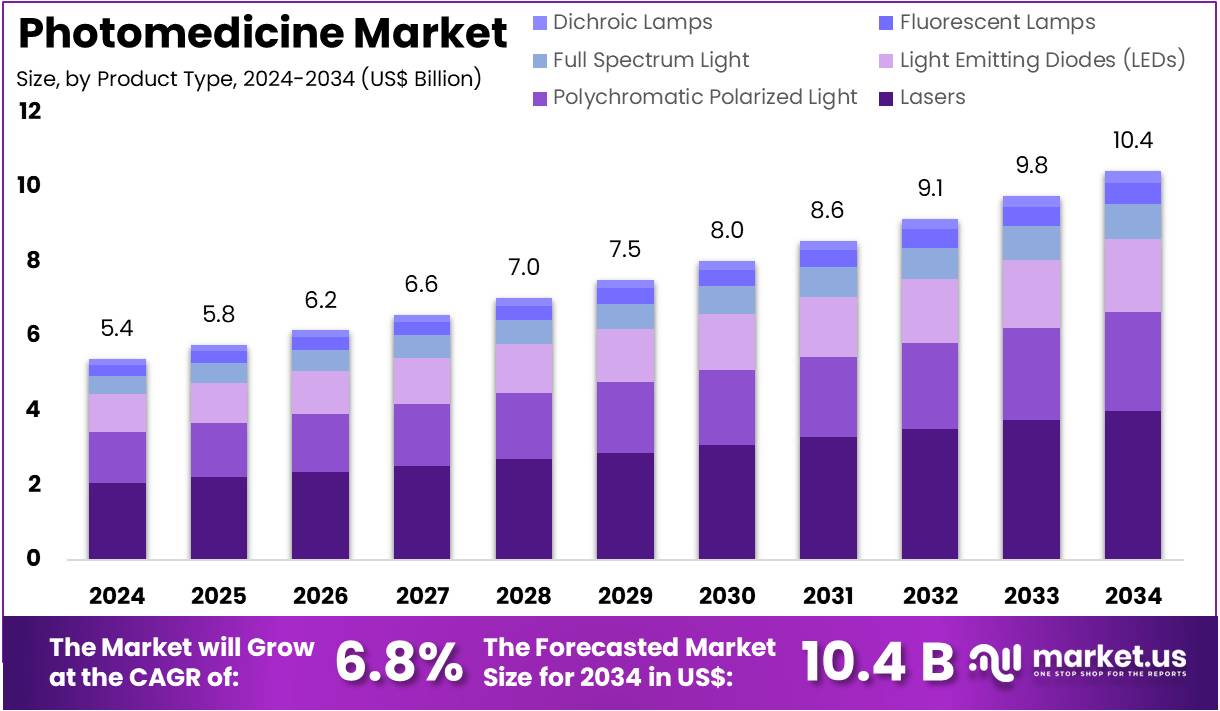
New York, NY – June 25, 2026 – The Photomedicine Market size is expected to be worth around US$ 10.4 billion by 2034 from US$ 5.4 billion in 2024, growing at a CAGR of 6.8% during the forecast period 2025 to 2034.
Photomedicine is an emerging interdisciplinary field that utilizes light-based technologies for the diagnosis, treatment, and prevention of various medical conditions. The growth of this field can be attributed to increasing adoption of non-invasive therapeutic procedures and advancements in optical science and biomedical engineering. Photomedicine applications include laser therapy, photodynamic therapy, dermatology, oncology, wound healing, and pain management. The integration of innovative light sources such as lasers, LEDs, and broadband light systems has expanded clinical capabilities significantly.
Rising prevalence of chronic diseases and increasing demand for minimally invasive treatments are further supporting market expansion. Research and development activities continue to enhance precision, efficacy, and safety of photomedicine-based therapies. Hospitals, clinics, and research institutes are increasingly adopting these technologies due to their improved patient outcomes. The future outlook remains positive, with ongoing innovation expected to drive wider clinical adoption and commercialization.
Photomedicine also plays a significant role in aesthetic procedures including skin rejuvenation, hair removal, and acne treatment, contributing to rising demand in cosmetic dermatology markets across developed and emerging economies where healthcare infrastructure improvements support technology adoption and patient awareness continues to increase. Regulatory support and clinical validation further strengthen confidence in photomedicine applications across global healthcare systems, ensuring safe and effective treatment options for patients driving sustained market growth globally forward.
Key Takeaways
- The global photomedicine market generated revenue of US$ 5.4 billion in 2024 and is projected to expand at a CAGR of 6.8%, reaching an estimated value of US$ 10.4 billion by 2034.
- Based on product type, the photomedicine market is segmented into lasers, polychromatic polarised light, light emitting diodes, full spectrum light, fluorescent lamps, and dichroic lamps. Lasers dominated the segment in 2023, accounting for a market share of 38.5%.
- By application, the photomedicine market is categorized into dermatology, pain management, ophthalmology, oncology, aesthetics, and other applications. Dermatology represented the leading application segment in 2023, holding a significant market share of 40.2%.
- North America emerged as the dominant regional market for photomedicine in 2023, capturing a market share of 43.2% due to advanced healthcare infrastructure, technological adoption, and increasing demand for light-based therapies.
Regional Analysis
North America dominated the photomedicine market with a 43.2% revenue share, supported by technological advancements in light-based therapeutic systems, high adoption across clinical applications, and sustained regulatory facilitation. The National Institutes of Health (NIH) allocated approximately US$47.311 billion in fiscal year 2024, with a portion directed toward research involving light-based diagnostics and treatment technologies.
The U.S. Food and Drug Administration (FDA) continues to approve and clear multiple laser and light-emitting medical devices, reinforcing market expansion. Industry performance further reflects growth, with Hologic reporting US$4.03 billion in 2024 revenue, while Cutera Inc. generated approximately US$ 140–145 million, indicating continued demand for energy-based aesthetic solutions.
The Asia Pacific region is projected to register the highest CAGR during the forecast period, driven by rising healthcare expenditure, increasing awareness of advanced therapies, and government-backed innovation programs. China’s R&D expenditure exceeded CNY 3.6 trillion (approximately US$0.5 trillion) in 2024, supporting medical technology advancement.
Japan’s Agency for Medical Research and Development (AMED) continues to fund clinical innovation, while OECD and WHO reports highlight rising regional healthcare spending. Companies such as Siemens Healthineers are expanding their Advanced Therapies presence in Asia Pacific, reflecting growing commercial adoption of photomedicine technologies, supporting sustained long-term global photomedicine market growth outlook positive.
Emerging Trends in Photomedicine Market
- Shift Toward Non-Invasive Treatments: The growing preference for painless procedures with shorter recovery periods is increasing the adoption of photomedicine. Light-based therapies, including lasers and LEDs, provide effective treatment options without surgical intervention, supporting faster healing, reduced hospital visits, and improved patient comfort.
- Growth in Aesthetic and Cosmetic Procedures: Photomedicine is gaining significant importance in aesthetic and cosmetic applications, including hair removal, wrinkle reduction, scar treatment, and skin rejuvenation. Increasing beauty awareness, rising disposable income, and demand for safe non-invasive procedures are driving the adoption of laser and LED-based treatments.
- Rise in Home-Use Phototherapy Devices: The availability of compact and user-friendly home phototherapy devices is creating new growth opportunities. These devices enable individuals to manage conditions such as acne, psoriasis, and sleep disorders conveniently. Improved affordability, safety features, and technological advancements are increasing consumer adoption.
- Combination Therapies Are Gaining Attention: The integration of photomedicine with other treatment approaches is emerging as a significant trend. Combining light-based therapies with medications or other procedures can improve treatment effectiveness, reduce drug dependency, and provide better outcomes for complex conditions such as cancer, pain, and neurological disorders.
- Increased Use in Mental Health and Neurology: Photomedicine applications are expanding in mental health and neurological treatments. Light therapy is being explored for managing depression, anxiety, and sleep disorders by regulating circadian rhythms and brain functions. Growing demand for drug-free therapies is supporting wider acceptance of these applications.
- Technology Advancements in Light Sources: Continuous innovations in laser and LED technologies are improving photomedicine solutions. Advanced systems offer greater precision, energy efficiency, portability, and safety. These developments are enabling broader applications across healthcare facilities and home environments, supporting market expansion and improved treatment outcomes.
Use Cases of Photomedicine Market
- Skin Conditions: Photomedicine is widely used in dermatology for treating acne, psoriasis, eczema, and vitiligo. Specific light wavelengths help reduce inflammation, promote skin healing, and improve patient outcomes. These non-invasive therapies provide effective alternatives to traditional medications with fewer side effects and recovery requirements.
- Hair Removal and Skin Rejuvenation: Laser-based photomedicine solutions are increasingly used for permanent hair reduction and skin rejuvenation procedures. These technologies target hair follicles and skin imperfections with high accuracy. Growing demand for aesthetic treatments and availability of home-use devices are further supporting market growth.
- Eye Treatments: Photomedicine plays an important role in ophthalmology through laser-based procedures for cataracts, retinal disorders, and vision correction. Light-based therapies also support treatment of dry eyes and inflammation. These precise procedures offer minimal recovery time and improved outcomes for various eye conditions.
- Pain Management: Low-level laser therapy is gaining popularity as a non-invasive approach for managing chronic pain conditions. It helps reduce inflammation, improve blood circulation, and support tissue repair. Increasing use in arthritis, sports injuries, and musculoskeletal disorders is driving demand for photomedicine-based pain management solutions.
- Wound Healing: Photomedicine supports faster wound recovery by stimulating cellular activity, improving tissue regeneration, and reducing infection risks. Light therapy is used for burns, chronic wounds, and post-surgical recovery. Its ability to enhance natural healing processes and minimize scarring is increasing clinical adoption.
- Cancer Treatment Support: Photodynamic therapy is emerging as an effective photomedicine application for cancer treatment. By combining photosensitive drugs with targeted light exposure, it helps destroy cancer cells while limiting damage to surrounding healthy tissues. Growing research and clinical adoption are expanding its oncology applications.
- Mental Health and Sleep Disorders: Bright light therapy is increasingly used for managing seasonal depression and sleep-related disorders. It helps regulate circadian rhythms, improve mood, and restore healthy sleep patterns. Rising awareness of non-drug treatment options is encouraging the adoption of light-based mental health therapies.
Frequently Asked Questions on Photomedicine
- How does Photomedicine work?
Photomedicine works by applying specific wavelengths of light to biological tissues to stimulate therapeutic effects. Light energy can activate photosensitive compounds, reduce inflammation, destroy abnormal cells, promote healing, and improve skin or eye-related conditions through controlled clinical procedures. - What are the major applications of Photomedicine?
Photomedicine is widely applied in dermatology, oncology, ophthalmology, dentistry, wound care, and cosmetic treatments. It is used for treating skin disorders, cancerous tissues, eye diseases, dental conditions, and chronic wounds through advanced light-based therapeutic techniques. - What are the different types of Photomedicine treatments?
Major photomedicine treatments include photodynamic therapy, ultraviolet phototherapy, laser therapy, blue light therapy, and low-level light therapy. These approaches are selected based on medical requirements, targeted conditions, treatment objectives, and patient-specific factors. - What are the key technologies used in the Photomedicine Market?
Key technologies in the photomedicine market include lasers, light-emitting diodes, ultraviolet systems, photodynamic therapy equipment, and advanced imaging technologies. Continuous innovation in wavelength control, device efficiency, and treatment accuracy is supporting market expansion. - Which healthcare sectors are adopting Photomedicine solutions?
Photomedicine solutions are increasingly adopted in hospitals, dermatology clinics, cancer treatment centers, ophthalmology facilities, and aesthetic medicine centers. Growing awareness regarding non-invasive procedures and improved clinical outcomes is encouraging adoption across healthcare sectors globally. - What are the benefits of Photomedicine treatments?
Photomedicine treatments provide benefits such as targeted therapy, reduced invasiveness, faster recovery, fewer side effects, and improved treatment precision. These advantages have increased acceptance among healthcare professionals and patients seeking advanced therapeutic alternatives. - What role does technology advancement play in Photomedicine?
Technological advancements play a significant role in improving photomedicine effectiveness through enhanced device designs, artificial intelligence integration, precision targeting, and improved imaging capabilities. These developments are expanding treatment possibilities and increasing clinical acceptance worldwide. - Which regions are leading the Photomedicine Market?
North America and Europe are among the leading regions in the photomedicine market due to advanced healthcare infrastructure, strong research activities, and early adoption of innovative medical technologies. Asia-Pacific is expected to witness significant growth due to healthcare investments. - What is the future outlook for the Photomedicine Market?
The future outlook of the photomedicine market remains positive due to increasing demand for personalized medicine, rising healthcare innovation, and expanding clinical applications. Advancements in optical technologies and regenerative therapies are expected to create new growth opportunities.
Conclusion
The photomedicine market is experiencing significant growth due to increasing demand for non-invasive treatments, technological advancements, and expanding clinical applications. Valued at US$ 5.4 billion in 2024, the market is projected to reach US$ 10.4 billion by 2034, driven by a CAGR of 6.8%. Rising adoption of laser therapies, photodynamic treatments, and LED-based solutions across dermatology, oncology, aesthetics, and wound care is supporting market expansion.
North America currently leads the market, while Asia Pacific is expected to witness strong growth due to healthcare investments and innovation. Continuous research and development activities are expected to further enhance treatment efficiency, safety, and global adoption of photomedicine technologies.
Discuss your needs with our analyst
Please share your requirements with more details so our analyst can check if they can solve your problem(s)




