


Overview
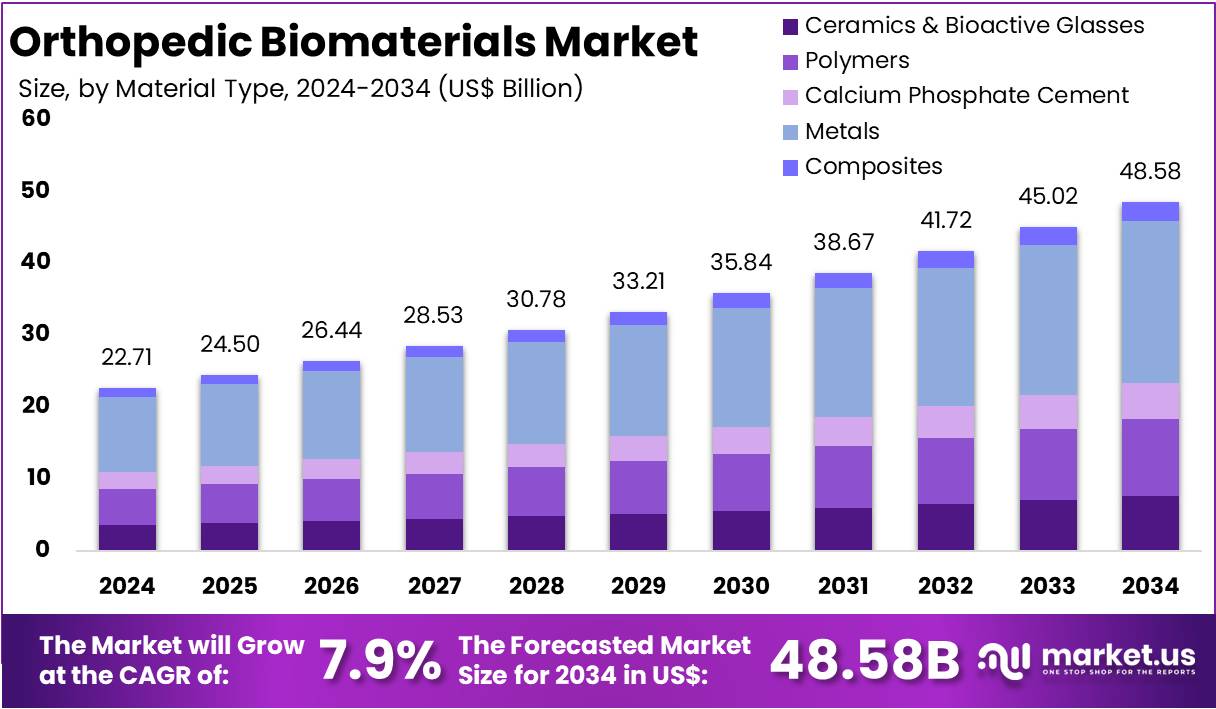
New York, NY – July 20, 2026 – The Global Orthopedic Biomaterials Market Size is expected to be worth around US$ 48.58 Billion by 2034, from US$ 22.71 Billion in 2024, growing at a CAGR of 7.9% during the forecast period from 2025 to 2034. North America held a dominant market position, capturing more than a 37.1% share and holds US$ 8.43 Billion market value for the year.
Orthopedic biomaterials are specialized natural or synthetic materials used to repair, replace, or support damaged bones, joints, ligaments, and other musculoskeletal tissues. These materials play a critical role in orthopedic procedures, including joint replacement, fracture fixation, spinal surgeries, and dental implants. They are designed to be biocompatible, ensuring they interact safely with the human body while promoting tissue healing and long-term implant stability.
Common orthopedic biomaterials include metals such as titanium and stainless steel, ceramics, polymers, and composite materials. Metals are widely used for their strength and durability, while ceramics offer excellent wear resistance and compatibility with bone tissue. Polymers provide flexibility and are often used in soft tissue applications, whereas composite materials combine the advantages of multiple material types to enhance performance.
Advancements in biomaterial science have led to the development of bioactive and biodegradable materials that support faster healing and reduce the need for additional surgeries. Innovations such as 3D-printed implants, surface-modified materials, and regenerative biomaterials are improving patient outcomes by enabling more personalized and effective treatments.
The increasing prevalence of orthopedic disorders, rising aging population, growing incidence of sports injuries and road accidents, and continuous technological advancements are driving the adoption of orthopedic biomaterials worldwide. As healthcare systems continue to focus on improving patient recovery and implant longevity, orthopedic biomaterials remain a vital component of modern orthopedic care and medical innovation.
Key Takeaways
- The global orthopedic biomaterials market was valued at US$ 22.71 billion in 2024 and is projected to reach US$ 48.58 billion by 2034, expanding at a CAGR of 7.9% during the forecast period.
- Based on system type, the market is segmented into Ceramics & Bioactive Glasses, Polymers, Calcium Phosphate Cement, Metals, and Composites. Among these, the Metals segment dominated the market with a 46.3% share in 2024.
- By application, the market is categorized into Orthopedic Implants, Joint Replacement/Reconstruction, Orthobiologics, Viscosupplementation, and Bio-Resorbable Tissue Fixation. The Joint Replacement/Reconstruction segment accounted for the largest share of 40.8% in 2024.
- Based on end user, the market is divided into Hospitals, Specialty Clinics, Ambulatory Surgical Centers, and Others. Hospitals emerged as the leading end-user segment, holding a 55.8% market share in 2024.
- North America dominated the global orthopedic biomaterials market, accounting for the largest regional share of 37.1% in 2024.
Regional Analysis
North America accounted for the largest share of the orthopedic biomaterials market, representing 37.1% of the global market in 2024. The region’s leadership is supported by its advanced healthcare infrastructure, high healthcare expenditure, and widespread adoption of innovative orthopedic technologies. A large volume of orthopedic procedures, including joint replacement, spinal surgery, and fracture fixation, is performed each year, driving consistent demand for high-performance biomaterials.
The growing elderly population and the increasing prevalence of musculoskeletal disorders, osteoarthritis, and osteoporosis continue to support market expansion across the region. Favorable reimbursement policies and broad access to specialized orthopedic care further encourage the adoption of advanced treatment options.
North America also benefits from the presence of leading orthopedic device manufacturers and biomaterial innovators, fostering continuous product development and technological advancements. Significant investments in research and development, combined with strong regulatory support for medical innovation, enable the introduction of next-generation biomaterials, reinforcing the region’s dominant position in the global orthopedic biomaterials market.
Emerging Trends
- 3D Printing for Custom Implants: 3D printing enables patient-specific orthopedic implants designed from medical imaging data. These implants provide improved anatomical fit, reduce surgical complications, enhance implant stability, and support faster recovery. Growing affordability and technological advancements are encouraging wider adoption across hospitals for complex orthopedic procedures and personalized treatments.
- Smart and Responsive Materials: Smart orthopedic biomaterials incorporate responsive components, including iron oxide nanoparticles, that stimulate bone regeneration through external magnetic fields. These materials actively assist healing, shorten recovery periods, and improve implant performance. Ongoing research focuses on enhancing safety, efficiency, and broader clinical applications.
- Bioactive Coatings and Surface Modifications: Bioactive coatings improve implant integration by enhancing cell adhesion and stimulating bone formation. Surface treatments using plasma technology and biological proteins strengthen implant fixation, reduce failure risks, and improve durability. These innovations benefit patients requiring joint replacements, dental implants, and fracture repairs.
- Nanotechnology in Biomaterials: Nanotechnology enhances orthopedic biomaterials through nanoscaffolds and bioactive glasses that closely mimic natural bone. These materials promote cell growth, controlled release of regenerative factors, improved mechanical strength, and faster tissue healing, supporting better recovery and long-term orthopedic implant performance for patients.
- Functionally Graded Materials (FGMs): Functionally graded materials feature gradual compositional changes that resemble natural bone, improving stress distribution across implants. They enhance durability, reduce fracture risks, promote stronger bone integration, and deliver long-term performance in load-bearing orthopedic applications such as hip and knee replacements.
Use Cases
- Joint Replacement and Reconstruction: Orthopedic biomaterials, including PEEK and polyurethanes, are widely used in joint replacement procedures. They provide durability, biocompatibility, and natural joint movement while reducing pain, improving mobility, minimizing complications, and supporting long-term implant performance for patients affected by arthritis or joint damage.
- Bone Grafting and Spinal Implants: Bioactive glasses and hydroxyapatite composites support bone grafting and spinal implant applications by promoting bone regeneration and structural stability. These biomaterials improve healing, reduce recovery time, integrate effectively with natural bone, and enhance outcomes in spinal fusion and fracture repair procedures.
- Bio-Resorbable Tissue Fixation: Bioresorbable orthopedic biomaterials, including magnesium alloys, provide temporary fixation for ligament and tendon repairs before safely degrading within the body. They eliminate implant removal surgeries, reduce inflammation, encourage natural tissue regeneration, and improve recovery outcomes in pediatric and sports injury treatments.
- Trauma and Sports Injury Management: Advanced polymers and metal alloys are extensively used for treating fractures, ligament injuries, and sports-related trauma. These biomaterials provide strong stabilization, promote faster healing, reduce infection risks, and improve patient recovery, supporting increasing demand driven by rising global injury and accident rates.
Frequently Asked Questions on Orthopedic Biomaterials
- What are orthopedic biomaterials?
Orthopedic biomaterials are specialized natural or synthetic materials used to repair, replace, or regenerate bones, joints, ligaments, and other musculoskeletal tissues. They are designed to be biocompatible, ensuring safe interaction with the human body while providing mechanical strength, durability, and support for tissue healing in orthopedic procedures. - What factors are driving the growth of the orthopedic biomaterials market?
Market growth is driven by the rising prevalence of orthopedic disorders, increasing aging population, growing incidence of sports injuries and road accidents, and continuous advancements in biomaterial technologies. Greater adoption of minimally invasive procedures and expanding healthcare investments also contribute to sustained market expansion. - Which types of orthopedic biomaterials are commonly used?
Common orthopedic biomaterials include metals such as titanium and stainless steel, ceramics, polymers, calcium phosphate cement, and composite materials. Each material offers unique properties, including strength, wear resistance, flexibility, or bioactivity, making them suitable for different orthopedic applications and implant requirements. - What are the major applications of orthopedic biomaterials?
Orthopedic biomaterials are widely used in joint replacement, orthopedic implants, orthobiologics, bio-resorbable tissue fixation, and viscosupplementation. These applications improve implant stability, promote tissue regeneration, reduce recovery time, and enhance long-term clinical outcomes for patients with musculoskeletal conditions. - Which region dominates the orthopedic biomaterials market?
North America is the leading regional market due to its advanced healthcare infrastructure, high volume of orthopedic surgeries, favorable reimbursement systems, and strong presence of major medical device manufacturers. Continuous investment in research and technological innovation further strengthens the region’s market leadership. - Who are the primary end users of orthopedic biomaterials?
Hospitals represent the largest end-user segment, followed by specialty clinics and ambulatory surgical centers. Hospitals perform a significant share of orthopedic surgeries and are equipped with advanced surgical technologies, experienced healthcare professionals, and comprehensive postoperative care facilities that support biomaterial adoption. - What are the future trends in the orthopedic biomaterials market?
Future trends include the development of bioactive and biodegradable materials, increasing use of 3D-printed implants, personalized orthopedic solutions, and regenerative medicine technologies. These innovations are expected to improve implant performance, accelerate healing, and enhance long-term patient outcomes while supporting market growth.
Conclusion
The global orthopedic biomaterials market is expected to witness steady growth, supported by the rising prevalence of musculoskeletal disorders, an aging population, and increasing demand for advanced orthopedic procedures. Continuous innovations in biomaterials, including bioactive, biodegradable, and 3D-printed implants, are improving implant performance, accelerating healing, and enhancing long-term patient outcomes.
Metals remain the leading material segment, while joint replacement continues to be the primary application area. North America maintains its market leadership due to its advanced healthcare ecosystem and strong research capabilities. Overall, ongoing technological advancements and expanding clinical applications will continue to drive sustained market growth through 2034.
Discuss your needs with our analyst
Please share your requirements with more details so our analyst can check if they can solve your problem(s)




