


Overview
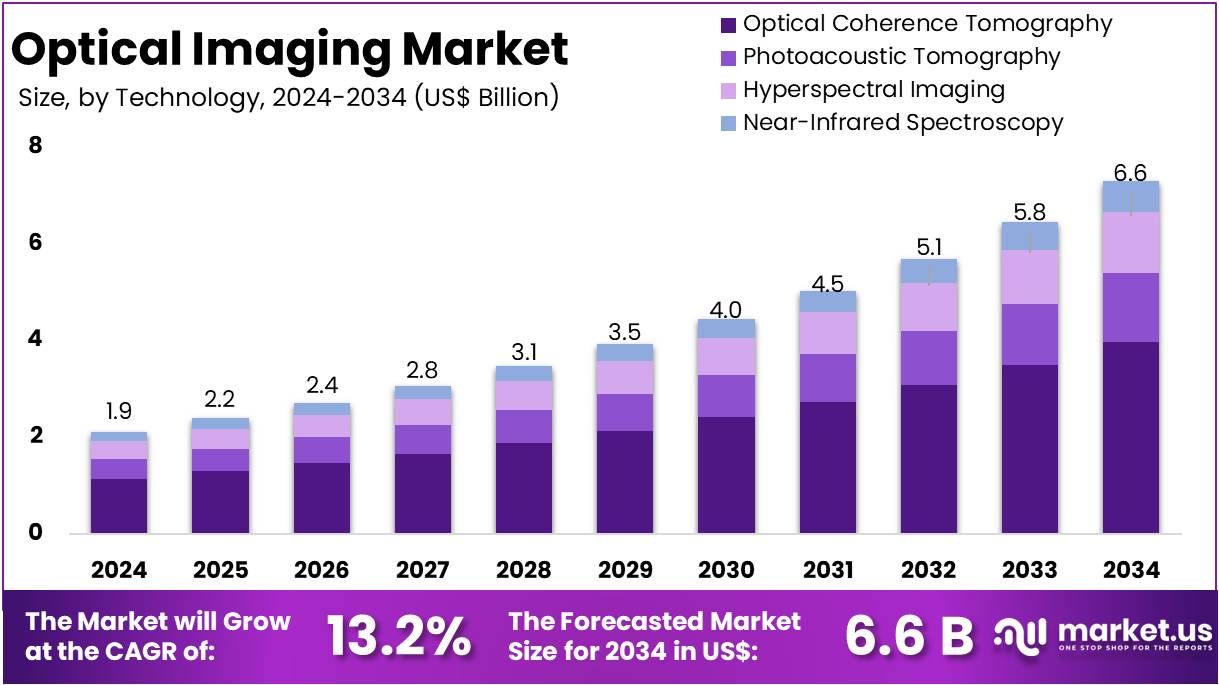
New York, NY – May 21, 2026 – The Global Optical Imaging Market Size is expected to be worth around US$ 6.6 Billion by 2034, from US$ 1.9 Billion in 2024, growing at a CAGR of 13.2% during the forecast period from 2025 to 2034. North America held a dominant market position, capturing more than a 36.4% share and holds US$ 0.6 Billion market value for the year.
The field of Optical Imaging is gaining significant attention across healthcare, life sciences, industrial inspection, and research applications due to its ability to provide high-resolution, non-invasive visualization of internal structures and biological processes. Optical imaging utilizes light, including visible, ultraviolet, and near-infrared wavelengths, to capture detailed images for diagnostic, analytical, and monitoring purposes.
The technology is widely used in medical diagnostics, preclinical research, ophthalmology, oncology, and surgical guidance. Increasing demand for early disease detection, advancements in imaging sensors, and the growing adoption of minimally invasive diagnostic techniques are supporting market expansion. In addition, the integration of artificial intelligence, machine learning, and advanced software analytics is improving image accuracy, processing speed, and clinical decision-making capabilities.
Optical imaging systems include technologies such as fluorescence imaging, optical coherence tomography, hyperspectral imaging, and photoacoustic imaging. These solutions are increasingly being adopted in hospitals, diagnostic laboratories, pharmaceutical research, and biotechnology companies.
North America currently represents a major market for optical imaging technologies due to strong healthcare infrastructure, ongoing research activities, and high investment in medical imaging innovation. Meanwhile, the Asia-Pacific region is expected to witness substantial growth owing to rising healthcare expenditure, expanding research capabilities, and increasing awareness regarding advanced diagnostic technologies.
The market outlook for optical imaging remains positive, supported by continuous technological advancements and growing applications across multiple industries.
Key Takeaways
- The global Optical Imaging market is anticipated to reach approximately US$ 6.6 billion by 2034, increasing from US$ 1.9 billion in 2024.
- The market is projected to register a strong CAGR of 13.2% during the forecast period from 2025 to 2034.
- In 2024, Optical Coherence Tomography (OCT) dominated the technology segment, accounting for more than 60.3% of the overall market share.
- The optical imaging systems segment emerged as the leading product category in 2024, holding over 58.4% share due to growing adoption across clinical and research applications.
- Pharmaceutical and biotechnology companies represented the largest end-user segment in 2024, capturing more than 43.5% of the market share.
- Among therapeutic applications, oncology led the market in 2024, contributing over 32.2% of the total optical imaging market revenue.
- North America accounted for the largest regional share in 2024, representing more than 36.4% of the global market, with a market value of nearly US$ 0.6 billion.
Regional Analysis
In 2024, North America accounted for the leading share of the global Optical Imaging market, capturing more than 36.4% of total revenue and reaching a market value of approximately US$ 0.6 billion. The regional market growth has been primarily supported by the early adoption of advanced optical imaging technologies across healthcare, research, and industrial sectors. Healthcare providers in the United States and Canada increasingly utilize non-invasive imaging solutions for accurate and real-time diagnostics, supporting wider clinical adoption.
Strong healthcare infrastructure, availability of skilled professionals, and growing demand for precision diagnostics have further strengthened market expansion across the region. In addition, government support, research funding, and investments by academic and research institutions have accelerated innovation in optical imaging systems. The technology is widely used for early disease detection, particularly in oncology and neurological disorders, due to its ability to provide detailed imaging while minimizing invasive procedures.
The presence of major industry participants and continuous product innovation also contribute to regional market leadership. Favorable regulatory frameworks, high healthcare expenditure, and rising patient demand for efficient diagnostic technologies are expected to support continued growth. As a result, North America is projected to maintain its dominant position in the global optical imaging market over the forecast period.
Emerging Trends
- Rise of Non-Invasive Imaging Solutions: Optical imaging is increasingly preferred in hospitals due to its non-invasive nature. It provides real-time internal body images without surgery, improving patient comfort and reducing complications. The technology supports faster diagnosis, shorter hospital stays, and enhanced safety in areas such as oncology and ophthalmology.
- Growing Demand in Early Disease Detection: Optical imaging supports early diagnosis of diseases such as cancer, cardiovascular disorders, and eye conditions. It delivers fast and detailed visuals that help doctors begin treatment sooner. Growing focus on preventive healthcare is increasing adoption across both developed and emerging healthcare markets worldwide.
- Integration with AI and Machine Learning: Artificial intelligence is enhancing optical imaging by improving image analysis speed and accuracy. AI-powered systems can identify patterns quickly, reducing human error and supporting better clinical decisions. Hospitals and research institutions are increasingly adopting these technologies to manage growing medical imaging data efficiently.
- Miniaturization and Portable Devices: Optical imaging devices are becoming smaller, lightweight, and portable, enabling use in remote clinics and home healthcare settings. Despite compact designs, these devices maintain high image quality. The trend is improving healthcare accessibility, supporting faster diagnostics, and expanding services in underserved regions globally.
- Use in Personalized Medicine: Optical imaging is supporting personalized medicine by enabling doctors to monitor individual patient responses in real time. It helps create targeted treatment plans, especially for cancer and neurological disorders. This approach improves treatment effectiveness, reduces side effects, and enhances overall patient care outcomes significantly.
- Wider Use Beyond Healthcare: Optical imaging is expanding beyond healthcare into industries such as agriculture, manufacturing, and security. It is used for plant monitoring, product quality inspection, and facial recognition systems. Increasing cross-industry adoption is driving technological innovation and creating new commercial opportunities for imaging solution providers.
Use Cases
- Eye Disease Diagnosis (Ophthalmology): Optical imaging is widely used in ophthalmology to diagnose glaucoma, macular degeneration, and diabetic eye diseases. Technologies such as Optical Coherence Tomography provide detailed retinal images without surgery. This enables early detection, accurate monitoring, and improved patient comfort during routine eye examinations and treatments.
- Cancer Detection and Monitoring: Optical imaging helps detect tumors and monitor cancer treatment progress through detailed tissue and blood flow visualization. It supports diagnosis of breast, skin, and oral cancers while reducing the need for invasive biopsies. The technology improves treatment planning and enhances patient safety during cancer care.
- Heart and Blood Vessel Analysis (Cardiology): In cardiology, optical imaging technologies such as OCT provide high-resolution images inside blood vessels and arteries. These images help identify blockages, guide stent placement, and support heart procedures in real time. The technology improves surgical precision and reduces the risk of treatment complications significantly.
- Brain Imaging and Neuroscience: Optical imaging enables real-time monitoring of brain activity by tracking oxygen levels and blood flow. It supports research and diagnosis of neurological conditions such as epilepsy, Alzheimer’s disease, stroke, and brain injuries. The technology provides safe, high-resolution insights for both clinical and research applications.
- Dental Imaging: Dental professionals use optical imaging to detect tooth decay, gum disease, and hidden infections without harmful radiation exposure. The technology offers detailed views of teeth and soft tissues, improving diagnostic accuracy. It also enhances patient safety, comfort, and treatment planning in modern dental practices.
- Surgical Guidance: Optical imaging assists surgeons during procedures by providing real-time visualization of internal tissues and organs. It helps distinguish healthy tissue from diseased areas, especially in cancer surgeries. This improves surgical precision, reduces repeat operations, shortens recovery time, and supports better patient treatment outcomes overall.
- Skin Disease and Wound Monitoring: Optical imaging is used to monitor wounds, burns, and skin disorders by capturing detailed skin structure and blood flow images. It helps doctors assess healing progress and adjust treatments effectively. The technology supports non-invasive diagnosis and management of conditions such as eczema and psoriasis.
Frequently Asked Questions on Optical Imaging
- What are the major applications of optical imaging?
Optical imaging is extensively applied in oncology, ophthalmology, cardiology, neurology, and dermatology for disease detection and monitoring. The technology is also used in biotechnology research, drug discovery, industrial quality control, and advanced manufacturing processes because of its high-resolution visualization capabilities. - What factors are driving the growth of the optical imaging market?
The growth of the optical imaging market is primarily driven by increasing demand for non-invasive diagnostic technologies, rising prevalence of chronic diseases, and technological advancements in imaging systems. Growing healthcare investments and expanding research activities are also contributing significantly to market expansion globally. - What are the main types of optical imaging technologies?
Major optical imaging technologies include optical coherence tomography, hyperspectral imaging, near-infrared spectroscopy, fluorescence imaging, and photoacoustic imaging. These technologies are designed to provide enhanced visualization, accurate diagnostics, and improved imaging depth for various medical, industrial, and scientific applications. - Which regions dominate the optical imaging market?
North America dominates the optical imaging market due to strong healthcare infrastructure, high research funding, and rapid technological adoption. Europe also holds a significant market share, while Asia-Pacific is witnessing rapid growth because of expanding healthcare investments and increasing medical awareness. - How is artificial intelligence influencing optical imaging technologies?
Artificial intelligence is improving optical imaging technologies through automated image analysis, faster diagnostics, and enhanced accuracy in disease detection. AI-powered systems can process large imaging datasets efficiently, enabling healthcare providers and researchers to achieve improved clinical outcomes and operational productivity. - How does optical imaging support pharmaceutical and biotechnology research?
Optical imaging supports pharmaceutical and biotechnology research by enabling visualization of cellular activities, molecular interactions, and drug responses in real time. Researchers use these imaging technologies to accelerate drug discovery processes, improve experimental accuracy, and enhance overall biomedical research efficiency. - What impact does technological advancement have on the optical imaging market?
Technological advancements are significantly enhancing the performance, accuracy, and portability of optical imaging systems across multiple industries. Innovations such as AI integration, miniaturized devices, and advanced sensors are increasing adoption rates while improving diagnostic capabilities and overall operational efficiency.
Conclusion
The global optical imaging market is witnessing strong growth due to rising demand for non-invasive diagnostic technologies, increasing prevalence of chronic diseases, and continuous advancements in imaging systems. The integration of artificial intelligence, portable devices, and high-resolution imaging technologies is improving diagnostic accuracy and expanding clinical applications.
Optical imaging is gaining significant adoption across oncology, ophthalmology, cardiology, neuroscience, and pharmaceutical research. North America continues to dominate the market, while Asia-Pacific is emerging as a high-growth region. With expanding healthcare investments and technological innovation, the optical imaging market is expected to experience substantial growth and broader industry adoption over the forecast period.
Discuss your needs with our analyst
Please share your requirements with more details so our analyst can check if they can solve your problem(s)




