


Overview
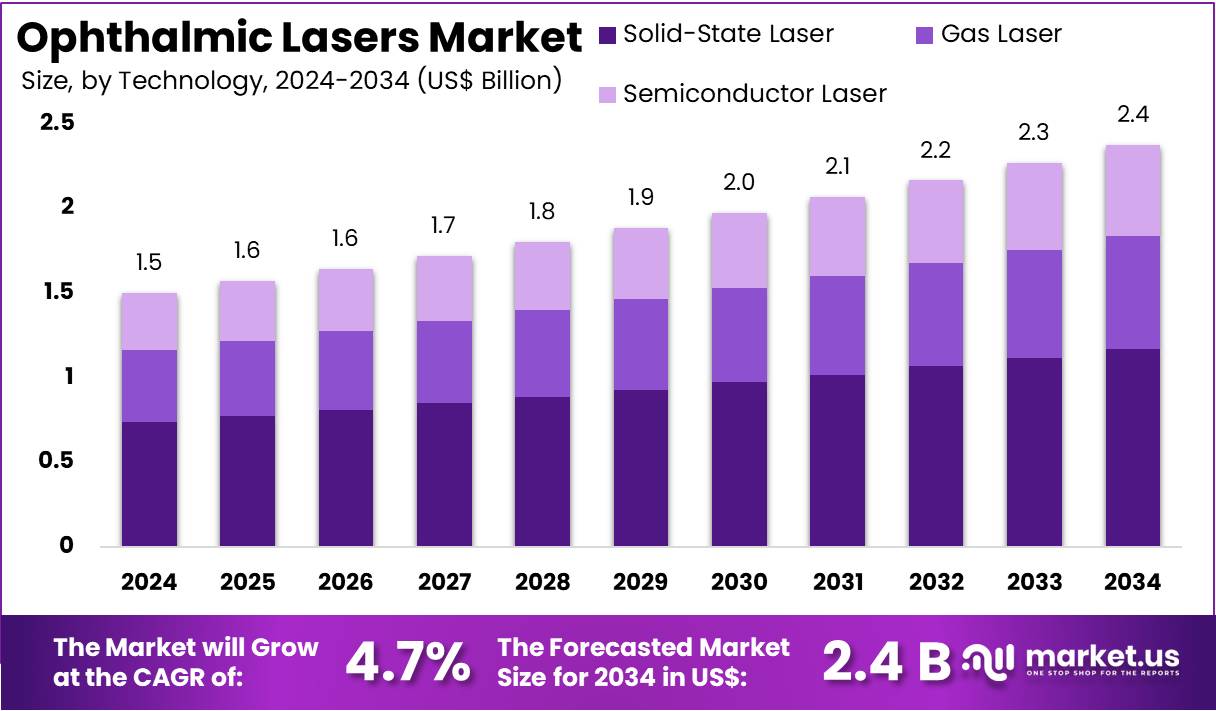
New York, NY – May 08, 2026 –The Ophthalmic Lasers Market size is expected to be worth around US$ 2.4 billion by 2034 from US$ 1.5 billion in 2024, growing at a CAGR of 4.7% during the forecast period 2025 to 2034.
The global market for ophthalmic lasers is witnessing steady growth due to the rising prevalence of eye disorders, increasing aging population, and growing adoption of advanced laser-based eye treatment procedures.
Ophthalmic lasers are medical devices used in ophthalmology for the diagnosis and treatment of various eye conditions, including cataracts, glaucoma, diabetic retinopathy, age-related macular degeneration, and refractive vision disorders. These systems provide high precision, reduced recovery time, and minimally invasive treatment benefits, which have significantly improved patient outcomes.
Technological advancements in femtosecond lasers, excimer lasers, and selective laser trabeculoplasty systems are supporting market expansion. The increasing demand for laser-assisted surgeries such as LASIK and cataract procedures is further contributing to industry growth. Additionally, the growing awareness regarding early eye disease diagnosis and the expansion of healthcare infrastructure in emerging economies are creating favorable opportunities for manufacturers.
Hospitals, ophthalmology clinics, and ambulatory surgical centers remain the primary end users of ophthalmic laser systems. North America currently holds a significant share of the market owing to advanced healthcare facilities and high adoption of innovative technologies, while Asia-Pacific is expected to witness rapid growth due to increasing healthcare investments and a large patient population.
Leading industry participants are focusing on product innovation, strategic partnerships, and regulatory approvals to strengthen their market presence and expand their global customer base.
Key Takeaways
- In 2024, the global ophthalmic lasers market was valued at US$ 1.5 billion and is projected to reach US$ 2.4 billion by 2034, expanding at a CAGR of 4.7% during the forecast period.
- Based on product type, the market is segmented into YAG laser, femtosecond laser, diode laser, and argon laser. Among these, the femtosecond laser segment dominated the market in 2024, accounting for a revenue share of 41.9%.
- By technology, the market is categorized into gas laser, solid-state laser, and semiconductor laser. The solid-state laser segment held the largest market share of 49.2% in 2024.
- In terms of application, the market is divided into laser eye surgery, cataract surgery, retinal procedures, and glaucoma treatment. The cataract surgery segment emerged as the leading application area, capturing 46.4% of the overall market revenue.
- Based on end user, the market is segmented into ophthalmology clinics, hospitals, and ambulatory surgical centers. Hospitals accounted for the highest revenue share of 49.5% in 2024.
- North America dominated the global ophthalmic lasers market in 2024, securing a market share of 39.1%.
Regional Analysis
North America accounted for the largest share of the ophthalmic lasers market in 2024, driven by the increasing demand for advanced laser technologies for the treatment of eye disorders such as glaucoma, cataracts, and diabetic retinopathy. The growing aging population, which is more susceptible to vision-related diseases, has significantly increased the need for minimally invasive and highly effective treatment solutions.
Rising awareness regarding the benefits of laser-based procedures, including improved precision, reduced complications, and faster recovery times, has further supported market growth. In addition, continuous technological advancements, including AI-integrated laser systems, have enhanced treatment accuracy and patient outcomes.
Strategic initiatives by market participants have also strengthened regional growth. For instance, in March 2021, Lumenis Ltd. partnered with the AdventHealth Nicholson Center to establish an advanced medical training facility for physicians.
Asia Pacific is projected to register the fastest CAGR during the forecast period due to rising healthcare investments, improving healthcare infrastructure, and growing awareness of advanced ophthalmic treatments. Increasing prevalence of cataracts and glaucoma, coupled with supportive government initiatives and regulatory approvals, is expected to accelerate the adoption of ophthalmic laser technologies across the region.
Emerging Trends
- Rise of Patterned and Multispot Laser Delivery: Modern multispot laser systems treat multiple retinal areas quickly, reducing treatment time, patient discomfort, heat exposure, and tissue damage while improving precision, efficiency, and safety in diabetic retinopathy and retinal disease management.
- Femtosecond Laser Expansion: Femtosecond lasers deliver ultra-short, precise pulses for cataract surgery, glaucoma treatment, corneal transplants, and LASIK procedures, improving surgical accuracy, reducing manual errors, accelerating healing, and enhancing patient outcomes in ophthalmology.
- New Approaches in Glaucoma Laser Treatment: Advanced glaucoma laser therapies, including excimer laser trabeculostomy and micropulse transscleral therapy, provide minimally invasive, repeatable treatments with faster recovery, lower discomfort, and improved effectiveness for patients resistant to conventional medications.
- Emergence of Advanced Imaging Lasers: Advanced laser imaging systems enable detailed visualization of retinal blood flow, supporting earlier detection, monitoring, and management of diabetic retinopathy and macular degeneration through accurate, non-invasive, real-time retinal assessments.
Use Cases
- Vision Correction (LASIK, PRK, SMILE): Ophthalmic lasers correct refractive errors by reshaping the cornea during LASIK, PRK, and SMILE procedures, offering precise treatment, rapid recovery, minimal discomfort, and long-term reduction in dependence on glasses or contact lenses.
- Treatment of Retinal Disorders: Laser photocoagulation and subthreshold laser therapies treat retinal disorders by sealing leaking blood vessels, slowing disease progression, preserving vision, reducing tissue damage, and offering safer treatment for chronic retinal conditions.
- Managing Glaucoma: Laser therapies for glaucoma improve fluid drainage and lower intraocular pressure using trabeculoplasty, micropulse, and excimer lasers, providing safe, repeatable, minimally invasive treatment options that delay invasive surgical interventions.
- Eye Imaging and Blood Flow Monitoring: Laser-based imaging technologies provide non-invasive visualization of retinal blood flow, enabling early disease detection, accurate monitoring, improved diagnosis, and better long-term management of diabetic retinopathy and macular degeneration.
Frequently Asked Questions on Ophthalmic Lasers
- What are the major applications of ophthalmic lasers?
Ophthalmic lasers are widely utilized for cataract surgery, retinal photocoagulation, refractive vision correction, glaucoma management, and diabetic retinopathy treatment. Their increasing adoption in hospitals and specialty eye clinics is driven by accuracy, minimally invasive procedures, and improved patient treatment outcomes globally. - Which types of ophthalmic lasers are commonly available in the market?
Commonly used ophthalmic lasers include femtosecond lasers, excimer lasers, Nd:YAG lasers, diode lasers, and argon lasers. Each laser type is designed for specific ophthalmic applications, including refractive surgery, retinal treatment, posterior capsulotomy, and glaucoma management across healthcare facilities worldwide. - Why is the demand for femtosecond lasers increasing?
Demand for femtosecond lasers is increasing due to their superior precision, reduced surgical complications, and improved patient recovery rates. These lasers are extensively used in cataract and refractive surgeries, supporting enhanced surgical outcomes and increasing acceptance among ophthalmologists and healthcare institutions globally. - Which regions dominate the ophthalmic lasers market?
North America dominates the ophthalmic lasers market due to advanced healthcare infrastructure, high healthcare spending, and rapid adoption of innovative technologies. Meanwhile, Asia-Pacific is witnessing substantial growth because of increasing patient awareness, expanding medical tourism, and rising investments in ophthalmic healthcare services. - How do ophthalmic lasers improve patient outcomes?
Ophthalmic lasers improve patient outcomes by enabling highly precise and minimally invasive procedures with lower risk of infection and shorter recovery times. These technologies also reduce surgical trauma, enhance treatment accuracy, and support faster visual rehabilitation for patients with eye disorders. - Who are the key end users in the ophthalmic lasers market?
Major end users in the ophthalmic lasers market include hospitals, ophthalmology clinics, ambulatory surgical centers, and specialty eye care institutions. Increasing patient inflow for vision correction and retinal treatments continues to strengthen demand for advanced ophthalmic laser systems globally.
Conclusion
The global ophthalmic lasers market is expected to witness stable growth due to the increasing prevalence of eye disorders, rising aging population, and growing preference for minimally invasive laser-based treatments.
Technological advancements in femtosecond, excimer, and imaging laser systems are improving surgical precision, treatment safety, and patient recovery outcomes. Expanding applications in cataract surgery, glaucoma management, retinal treatment, and vision correction continue to strengthen market demand.
North America remains the leading regional market, while Asia-Pacific is projected to record the fastest growth. Strategic product innovation, healthcare investments, and increasing awareness regarding advanced ophthalmic care are expected to support long-term market expansion.
Discuss your needs with our analyst
Please share your requirements with more details so our analyst can check if they can solve your problem(s)




