


Overview
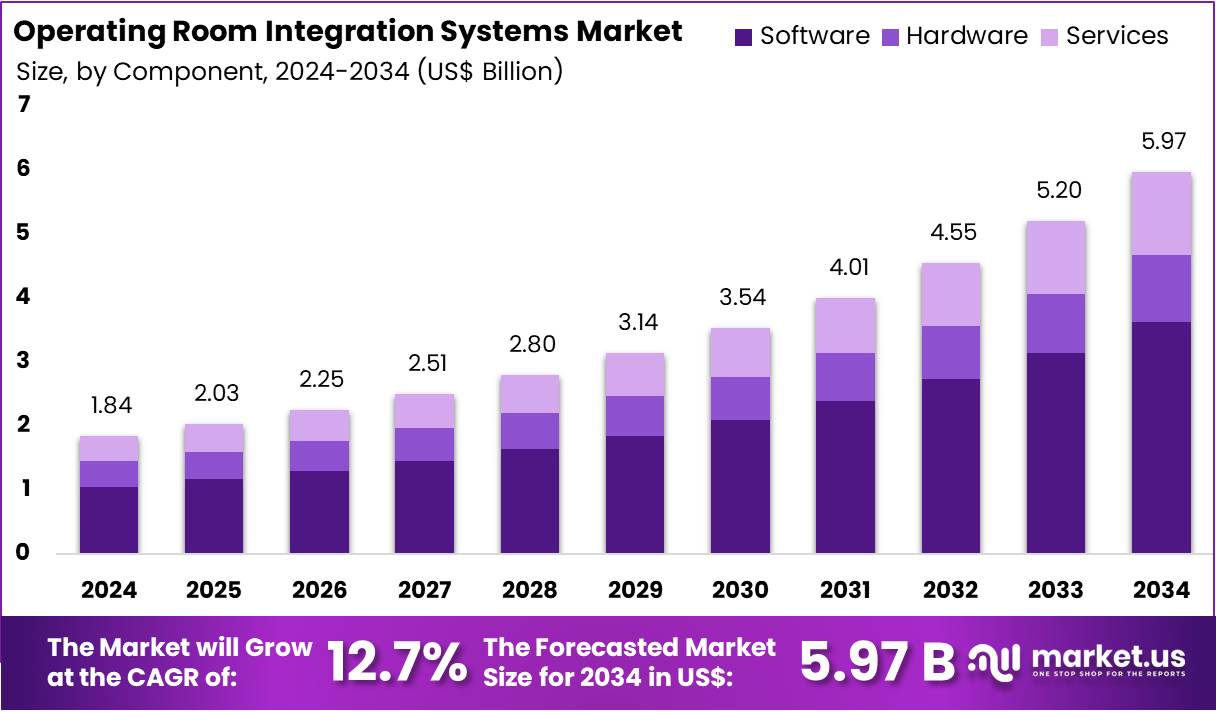
New York, NY – July 15, 2026 – Global Operating Room Integration Systems Market size is expected to be worth around US$ 5.97 billion by 2034 from US$ 1.84 billion in 2024, growing at a CAGR of 12.7% during the forecast period 2025 to 2034.
Operating Room (OR) Integration Systems are advanced technology platforms designed to connect and manage the various medical devices, imaging systems, audiovisual equipment, and digital information used during surgical procedures. These systems enable seamless communication between equipment within the operating room, allowing surgeons and clinical staff to access, control, and share critical data through a centralized interface. As a result, workflow efficiency is improved, surgical precision is enhanced, and better coordination among healthcare professionals is supported.
Modern OR integration solutions typically combine surgical displays, cameras, lighting controls, patient monitoring systems, imaging equipment, and electronic medical records into a single, integrated environment. They also facilitate real-time video streaming, recording, and collaboration, enabling remote consultations, medical education, and documentation.
The increasing adoption of minimally invasive and image-guided surgeries, coupled with the growing focus on hospital digitalization, has accelerated the demand for OR integration systems. Healthcare providers are investing in these solutions to optimize operating room utilization, reduce procedure times, improve patient safety, and enhance overall surgical outcomes.
Operating Room Integration Systems are widely implemented in hospitals, ambulatory surgical centers, and specialty clinics across multiple surgical disciplines, including orthopedic, cardiovascular, neurosurgical, and general surgery. Continuous advancements in medical imaging, artificial intelligence, cloud connectivity, and interoperability are expected to further strengthen the capabilities and adoption of these systems, supporting the ongoing transformation of modern surgical environments.
Key Takeaways
- In 2024, the market was valued at US$ 0.84 billion and is projected to reach US$ 5.97 billion by 2034, registering a CAGR of 12.7% during the forecast period.
- By component, the Software segment accounted for the largest market share of 57.1% in 2024.
- By OR type, the Hybrid ORs segment held the leading market share of 52.6% in 2024.
- By surgery type, the General Surgery segment represented the highest revenue share of 29.0% in 2024.
- By end user, the Hospitals segment dominated the market, accounting for 62.8% of total revenue in 2024.
- North America led the global market in 2024, capturing a 37.5% revenue share.
Regional Analysis
North America accounted for the largest share of the Operating Room Integration Systems Market, representing 37.5% in 2024. The region’s leadership is supported by advanced healthcare infrastructure, widespread adoption of digital surgical technologies, favorable reimbursement policies, and continuous hospital modernization. Rising surgical volumes, driven by the growing prevalence of chronic diseases and an ageing population, are increasing demand for integrated operating rooms that improve workflow and efficiency.
In the United States, approximately 790,000 knee replacements and 544,000 hip replacements are performed annually, highlighting the need for advanced surgical environments. Major investments, including the USD 1.62 billion modernization initiative at UCSF Children’s Hospital Oakland, further strengthen regional growth.
Meanwhile, Asia Pacific is projected to register the fastest CAGR during the forecast period, supported by rapid healthcare infrastructure development, expanding hospital construction, and increasing surgical demand. Large-scale healthcare investments and efforts to improve access to surgical care across emerging economies are accelerating the adoption of operating room integration systems.
Emerging Trends
- Black Box Technology in Surgery: Black box technology is increasingly being integrated into operating rooms to record surgical procedures, environmental conditions, equipment performance, and team communication. The collected data enables hospitals to analyze workflows, identify safety gaps, reduce preventable errors, enhance surgical performance, and improve overall patient outcomes through continuous quality improvement initiatives.
- Robotic Assistance in Operating Rooms: Robotic technologies are becoming an essential component of modern operating rooms by supporting surgeons with enhanced precision, stability, and control during complex procedures. These systems reduce physical fatigue, improve procedural accuracy, assist with repetitive tasks, and contribute to better surgical outcomes and faster patient recovery.
- Internet of Things (IoT) Connectivity: The adoption of Internet of Things (IoT) technology is enhancing operating room integration by enabling seamless communication between medical devices, monitoring systems, and hospital networks. Real-time data exchange improves workflow coordination, equipment management, clinical decision-making, and overall operational efficiency while supporting high-quality patient care.
- Advanced Visualization and Control Systems: Advanced visualization and centralized control systems are transforming operating rooms by integrating high-definition imaging, audiovisual technologies, and medical data into a single platform. Surgeons gain immediate access to patient information, remote consultations, and equipment controls, improving procedural accuracy, collaboration, and clinical efficiency.
Use Cases
- Efficiency in Surgical Procedures: Operating Room Integration Systems improve surgical efficiency by automating workflows, coordinating connected devices, and reducing preparation time between procedures. Centralized control enables surgical teams to manage equipment effectively, minimize delays, optimize operating room utilization, and increase the number of successful procedures performed each day.
- Enhanced Surgical Training and Collaboration: Operating Room Integration Systems support surgical education through real-time procedure recording, live streaming, and remote collaboration capabilities. Experienced surgeons can provide guidance during operations, while trainees gain valuable learning opportunities, improving clinical skills, knowledge transfer, and multidisciplinary collaboration across healthcare institutions.
- Improvement in Patient Safety and Outcomes: These systems enhance patient safety by integrating real-time monitoring, automated documentation, and comprehensive procedure recording throughout surgeries. The collected information supports performance evaluation, protocol optimization, and early identification of improvement opportunities, ultimately reducing medical errors and improving overall clinical outcomes for patients.
- Data-Driven Decision Making: Operating Room Integration Systems continuously collect and analyze clinical, operational, and equipment data throughout surgical procedures. Healthcare providers use these insights to optimize workflows, improve resource allocation, refine surgical protocols, monitor performance indicators, and support evidence-based decisions that enhance healthcare quality and operational efficiency.
- Reduced Surgical Risks: Operating Room Integration Systems reduce surgical risks by continuously monitoring equipment performance, patient status, and operating room activities during procedures. Early detection of potential issues enables timely interventions, minimizes complications, strengthens compliance with safety protocols, and improves overall patient care and surgical reliability.
Frequently Asked Questions on Operating Room Integration Systems
- What are the primary benefits of Operating Room Integration Systems?
Operating Room Integration Systems improve surgical workflow by integrating multiple devices and data sources into a single platform. They reduce manual tasks, improve communication among healthcare professionals, enhance operating room efficiency, minimize errors, and contribute to better patient outcomes while supporting effective resource utilization. - Which technologies are commonly integrated into Operating Room Integration Systems?
Operating Room Integration Systems commonly integrate surgical imaging systems, endoscopy equipment, patient monitoring devices, electronic health records, audiovisual communication tools, lighting controls, and surgical navigation technologies. This centralized integration enables healthcare professionals to access and manage critical information efficiently throughout surgical procedures. - Which healthcare facilities use Operating Room Integration Systems?
Operating Room Integration Systems are widely adopted in hospitals, ambulatory surgical centers, specialty surgical clinics, and academic medical institutions. These facilities utilize integrated operating rooms to improve workflow coordination, support minimally invasive procedures, optimize equipment management, and enhance overall surgical efficiency and patient care. - What factors are driving the growth of the Operating Room Integration Systems Market?
The growth of the Operating Room Integration Systems Market is supported by rising demand for advanced surgical infrastructure, increasing healthcare digitalization, growing investments in smart hospitals, expanding adoption of minimally invasive surgeries, and continuous technological innovations that improve operational efficiency and patient safety. - Which regions dominate the Operating Room Integration Systems Market?
North America currently leads the Operating Room Integration Systems Market due to advanced healthcare infrastructure and high technology adoption. Europe follows with significant investments in hospital modernization, while Asia-Pacific is experiencing rapid growth driven by expanding healthcare infrastructure and increasing surgical procedure volumes. - Who are the major participants in the Operating Room Integration Systems Market?
The Operating Room Integration Systems Market includes global medical technology companies specializing in surgical equipment, healthcare IT, and integrated operating room solutions. Market participants focus on product innovation, strategic collaborations, mergers, acquisitions, and geographic expansion to strengthen their competitive position and customer reach. - What opportunities exist in the Operating Room Integration Systems Market?
The market offers opportunities through the expansion of smart hospitals, increasing adoption of artificial intelligence, cloud-based healthcare platforms, telemedicine integration, and growing investments in emerging healthcare markets. These developments are expected to support long-term demand for integrated surgical environments worldwide. - What is the future outlook for the Operating Room Integration Systems Market?
The Operating Room Integration Systems Market is expected to experience steady growth as healthcare providers prioritize digital transformation, workflow optimization, and advanced surgical capabilities. Continuous technological innovation, rising healthcare expenditure, and increasing demand for connected operating rooms are anticipated to sustain market expansion over the coming years.
Conclusion
The global Operating Room Integration Systems Market is positioned for robust growth, driven by increasing healthcare digitalization, rising adoption of minimally invasive procedures, and continuous advancements in connected surgical technologies. Hospitals and healthcare providers are investing in integrated operating room solutions to enhance workflow efficiency, improve patient safety, and optimize surgical outcomes.
North America continues to lead the market due to its advanced healthcare infrastructure, while Asia Pacific is expected to witness the fastest growth supported by expanding healthcare investments. Ongoing innovations in artificial intelligence, IoT, robotics, and cloud-based connectivity are expected to further strengthen market adoption and transform modern surgical environments worldwide.
Discuss your needs with our analyst
Please share your requirements with more details so our analyst can check if they can solve your problem(s)




