


Overview
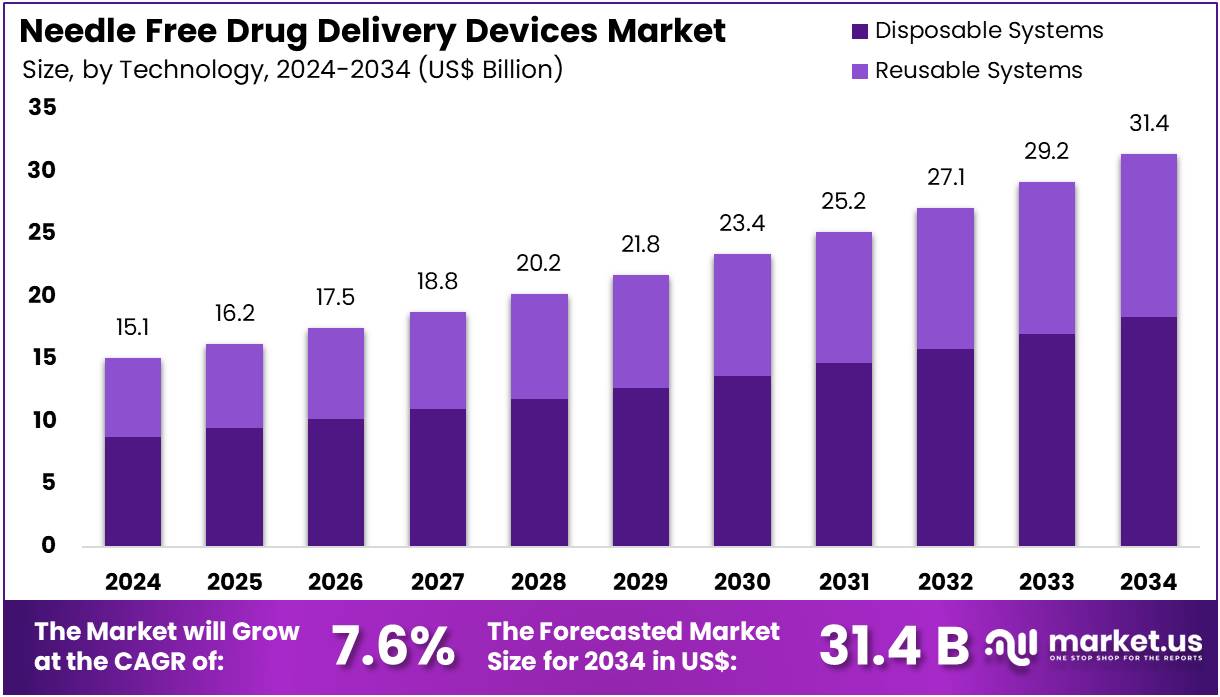
New York, NY – June 11, 2026 – The Needle Free Drug Delivery Devices Market Size is expected to be worth around US$ 31.4 billion by 2034 from US$ 15.1 billion in 2024, growing at a CAGR of 7.6% during the forecast period 2025 to 2034.
Needle-free drug delivery devices are advanced medical technologies designed to administer medications without the use of conventional hypodermic needles. These systems utilize mechanisms such as jet injectors, inhalers, transdermal patches, and other innovative technologies to deliver drugs through the skin, lungs, or mucosal tissues. The growing preference for painless and convenient drug administration is contributing significantly to the adoption of these devices across healthcare settings.
The increasing prevalence of chronic diseases, including diabetes, cardiovascular disorders, and respiratory conditions, has accelerated the demand for efficient drug delivery solutions. Needle-free devices help improve patient compliance by reducing pain, minimizing needle-related anxiety, and lowering the risk of needlestick injuries and infections. These benefits make them particularly attractive for self-administration and home healthcare applications.
Technological advancements in drug delivery systems, coupled with ongoing investments in healthcare infrastructure, are further supporting market expansion. Manufacturers are focusing on developing user-friendly, portable, and highly precise devices capable of delivering a wide range of biologics, vaccines, and therapeutic drugs.
North America currently represents a significant market due to strong healthcare expenditure and rapid adoption of advanced medical technologies, while Asia-Pacific is expected to witness substantial growth driven by expanding healthcare access and increasing awareness of innovative treatment options. As healthcare providers continue to prioritize patient comfort and safety, needle-free drug delivery devices are expected to play an increasingly important role in modern healthcare delivery.
Key Takeaways
- The global needle-free drug delivery devices market was valued at US$ 15.1 billion in 2024 and is projected to reach US$ 31.4 billion by 2034, expanding at a CAGR of 7.6% during the forecast period.
- Based on product type, the market is categorized into jet injectors, inhalers, transdermal patches, microneedle patches, oral needle-free systems, and novel needle-free technologies. Among these, jet injectors dominated the market with a 39.5% share in 2023.
- By technology, the market is segmented into disposable systems and reusable systems. Disposable systems accounted for the largest market share of 58.4%.
- In terms of application, the market is divided into vaccine delivery, oncology therapies, insulin delivery, pain management, and pediatric injections. The vaccine delivery segment emerged as the leading application, capturing 46.3% of the total market revenue.
- Based on end users, the market is segmented into hospitals & clinics, home-care settings, and others. Hospitals & clinics held the dominant position, contributing 55.1% of the overall market revenue.
- North America remained the leading regional market, accounting for 38.9% of the global market share in 2023.
Regional Analysis
North America accounted for the largest share of the needle-free drug delivery devices market, representing 38.9% of total revenue. This dominance is driven by a strong emphasis on patient safety, pain-free treatment options, and the increasing adoption of self-administration technologies. Concerns regarding needlestick injuries among healthcare workers continue to support market growth.
According to EPINet data from 40 U.S. hospitals, 29.2 occupational needlestick injuries were reported per 100 average daily census days in 2022, encouraging healthcare providers to adopt safer needle-free alternatives. The rising prevalence of chronic diseases, particularly diabetes, has further increased demand for convenient drug delivery systems.
Reflecting this trend, Insulet Corporation reported a 20.6% increase in U.S. Omnipod revenue, reaching US$1.5 billion in 2024. Regulatory approvals have also strengthened market expansion, with the FDA approving ARS Pharmaceuticals’ neffy epinephrine nasal spray in 2024 and 2025, offering a needle-free solution for emergency treatment.
Meanwhile, the Asia Pacific region is projected to register the fastest growth rate during the forecast period. Factors such as a rapidly aging population, increasing chronic disease burden, and improving healthcare infrastructure are driving demand. China’s diabetes population reached 233.03 million in 2023, while rising healthcare expenditure in countries such as India is supporting the adoption of advanced and patient-friendly drug delivery technologies across the region.
Emerging Trends
- Rising Demand for Painless Treatment: The demand for needle-free drug delivery devices is increasing as patients seek painless and less stressful treatment options. These systems reduce discomfort, anxiety, and needle-related fears, particularly among children and individuals requiring frequent injections. Improved patient comfort supports better treatment adherence across healthcare and home-care settings.
- Advancements in Technology: Continuous technological advancements are enhancing the effectiveness of needle-free drug delivery devices. Innovations such as microneedle patches, jet injectors, and laser-assisted systems improve drug absorption, dosing accuracy, and patient safety. These developments simplify administration procedures and expand the range of therapies suitable for needle-free delivery.
- Focus on Self-Use and Home Care: The growing preference for home-based healthcare is driving demand for needle-free drug delivery solutions. Patients with chronic conditions can administer treatments independently, reducing reliance on healthcare facilities. User-friendly designs, improved safety features, and greater convenience are supporting the expansion of self-care and remote treatment management.
- Use of Eco-Friendly and Reusable Devices: Sustainability is becoming an important focus in healthcare, encouraging the adoption of reusable and environmentally friendly needle-free drug delivery devices. These solutions help reduce medical waste, lower long-term treatment costs, and support global environmental goals while maintaining effective and reliable medication delivery for patients.
Use Cases
- Vaccination Campaigns: Needle-free drug delivery devices are increasingly utilized in vaccination campaigns to improve patient comfort and reduce needle-related concerns. Their ease of use, rapid administration capabilities, and lower risk of accidental injuries make them highly effective for large-scale immunization programs in both urban and rural populations.
- Diabetes and Insulin Delivery: Needle-free insulin delivery systems provide a convenient alternative for diabetes patients requiring frequent injections. These devices reduce pain, improve treatment adherence, and support safe self-administration. Their user-friendly operation enhances daily disease management, particularly among children, elderly individuals, and patients with needle-related anxiety.
- Hormone and Allergy Therapy: Needle-free delivery devices are widely used for hormone replacement treatments and allergy therapies requiring regular medication administration. These systems enable convenient home-based treatment, reduce dependence on clinical visits, and improve patient compliance by eliminating needle discomfort while ensuring accurate and effective drug delivery.
- Emergency and Military Use: Needle-free drug delivery devices are valuable in emergency response and military environments where rapid treatment is essential. Their portability, ease of use, and ability to deliver medications quickly without specialized training make them suitable for disaster relief operations, battlefield care, and other critical situations.
Frequently Asked Questions on Needle Free Drug Delivery Devices
- How do needle free drug delivery devices work?
Needle free drug delivery devices operate by delivering medications through the skin, lungs, nasal passages, or other routes without puncturing tissue with a conventional needle. Technologies such as high-pressure jets, ultrasonic waves, and micro-projection systems enable precise and controlled drug administration for various therapeutic applications. - What are the key benefits of needle free drug delivery devices?
The primary benefits include improved patient comfort, reduced risk of needle-stick injuries, enhanced treatment adherence, and minimized cross-contamination. These devices also support self-administration, making them particularly valuable for chronic disease management and large-scale vaccination programs. - Which therapeutic areas commonly use needle free drug delivery devices?
Needle free drug delivery devices are widely used in diabetes management, vaccine administration, pain management, hormone therapies, and respiratory diseases. Their versatility allows healthcare providers to deliver medications effectively across a broad range of medical conditions and treatment settings. - Are needle free drug delivery devices safe for patients?
Needle free drug delivery devices are generally considered safe when used according to manufacturer guidelines. Regulatory approvals, clinical evaluations, and technological advancements have improved device reliability, dosage accuracy, and patient safety, making them a trusted alternative to conventional injection methods. - What technologies are used in needle free drug delivery systems?
Common technologies include jet injection systems, transdermal delivery patches, inhalation devices, nasal sprays, and microneedle arrays. These innovations enable targeted drug delivery while improving absorption rates, patient convenience, and overall treatment effectiveness across various healthcare applications. - Which regions are leading the needle free drug delivery devices market?
North America currently leads the market due to advanced healthcare infrastructure, strong research investments, and high adoption of innovative medical technologies. Europe and Asia-Pacific are also experiencing significant growth, supported by expanding healthcare access and increasing healthcare expenditures. - What is the future outlook for the needle free drug delivery devices market?
The market is expected to witness sustained growth due to increasing healthcare modernization, expanding immunization initiatives, and rising demand for patient-centric treatment solutions. Ongoing technological advancements and supportive regulatory environments are likely to drive further market expansion over the coming years.
Conclusion
The needle-free drug delivery devices market is positioned for steady growth, driven by rising demand for painless, safe, and patient-friendly treatment solutions. Increasing prevalence of chronic diseases, expanding vaccination programs, and growing adoption of self-administration technologies are supporting market expansion worldwide.
Continuous innovations in jet injectors, microneedle patches, inhalers, and transdermal systems are improving drug delivery efficiency and patient compliance. North America remains the leading market, while Asia-Pacific is expected to witness the fastest growth due to improving healthcare infrastructure and increasing disease burden. Overall, needle-free technologies are expected to play a critical role in the future of modern healthcare.
Discuss your needs with our analyst
Please share your requirements with more details so our analyst can check if they can solve your problem(s)




