


Overview
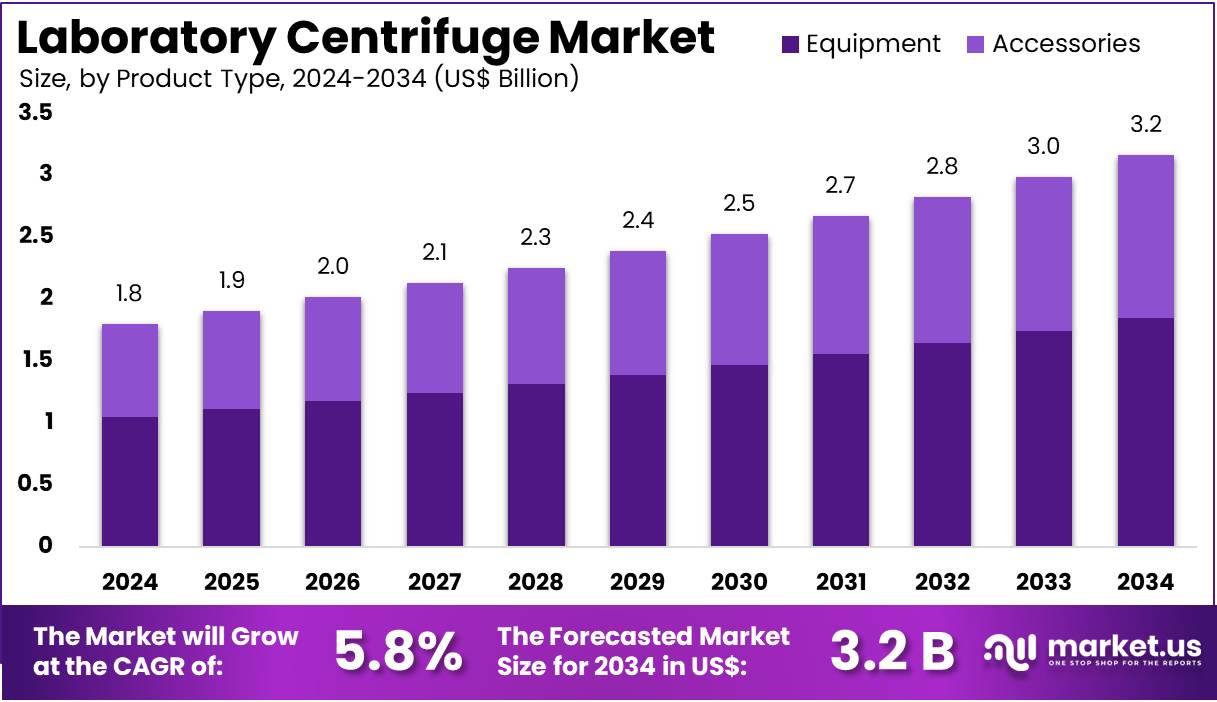
New York, NY – May 18, 2026 – The Laboratory Centrifuge Market Size is expected to be worth around US$ 3.2 billion by 2034 from US$ 1.8 billion in 2024, growing at a CAGR of 5.8% during the forecast period 2025 to 2034. North America held a dominant market position, capturing more than a 41.1% share, and holds a US$ 0.7 Billion market value for the year.
The global demand for laboratory centrifuges continues to increase due to the expanding use of advanced diagnostic and research technologies across healthcare, biotechnology, pharmaceutical, and academic sectors. A laboratory centrifuge is an essential scientific instrument used to separate substances of different densities by applying rapid rotational force. The equipment plays a critical role in clinical diagnostics, blood sample processing, molecular biology, cell culture research, and pharmaceutical development.
Modern laboratory centrifuges are available in various configurations, including benchtop centrifuges, high-speed centrifuges, ultracentrifuges, refrigerated centrifuges, and microcentrifuges. These systems are designed to support a wide range of laboratory applications requiring precision, reliability, and operational efficiency. Technological advancements such as digital control systems, automated balancing features, energy-efficient motors, and enhanced safety mechanisms have further improved equipment performance and user convenience.
The growth of the laboratory centrifuge market is being supported by rising investments in life sciences research, increasing diagnostic testing volumes, and the expansion of biopharmaceutical manufacturing activities worldwide. In addition, growing demand for personalized medicine and advanced clinical research is contributing to higher adoption of sophisticated laboratory equipment.
North America and Europe remain major markets due to strong healthcare infrastructure and research funding, while Asia-Pacific is emerging as a rapidly growing region driven by expanding healthcare facilities and increasing research activities in countries such as China, India, and Japan.
Key Takeaways
- In 2024, the laboratory centrifuge market was valued at US$ 1.8 billion and is projected to reach US$ 3.2 billion by 2033, expanding at a CAGR of 5.8% during the forecast period.
- Based on product type, the market is segmented into equipment and accessories. The equipment segment dominated the market in 2024, accounting for a revenue share of 58.3%.
- By technology, the market is categorized into floor-standing centrifuges and benchtop centrifuges. Among these, floor-standing centrifuges emerged as the leading segment with a market share of 62.5% in 2024.
- In terms of application, the market is divided into microbiology, proteomics, diagnostics, genomics, and others. The microbiology segment held the largest share of 47.3% in 2024.
- Based on end use, the market is segmented into preclinical centrifuges, general purpose centrifuges, and clinical centrifuges. The clinical centrifuges segment led the market with a revenue share of 55.2%.
- North America accounted for the largest regional share in the laboratory centrifuge market, capturing 41.1% of the global market revenue in 2024.
Regional Analysis
North America accounted for the largest share of the laboratory centrifuge market in 2024, supported by strong demand from biomedical research, pharmaceutical manufacturing, and clinical diagnostics sectors. Increased investments in life sciences research and laboratory modernization have accelerated the adoption of advanced centrifuge systems across the region.
Growing approvals of biologics and biosimilars, along with expanding applications in pathogen analysis, vaccine development, and precision medicine, have further strengthened market growth. In addition, research institutions and healthcare organizations across the United States and Canada continue to increase spending on high-performance laboratory equipment, contributing to sustained regional market expansion.
Asia Pacific is expected to register the fastest CAGR during the forecast period owing to rapid healthcare infrastructure development, expanding pharmaceutical production, and rising investments in biotechnology and genomics research. Countries such as China, India, Japan, and Australia are significantly increasing funding for biomedical and life sciences research, which is driving the demand for technologically advanced centrifugation systems.
Government initiatives aimed at strengthening laboratory capabilities and research infrastructure are also supporting market growth. Furthermore, the growing focus on drug discovery, personalized medicine, and clinical research activities is expected to create substantial opportunities for laboratory centrifuge manufacturers across the Asia Pacific region.
Emerging Trends
- Automation and Smart Features Are Gaining Popularity: Laboratories are increasingly adopting automated centrifuges equipped with digital controls, programmable settings, and touchscreen interfaces. These systems reduce human error, improve workflow efficiency, and ensure consistent sample processing. Smart features also simplify technician training and support higher productivity in modern laboratories.
- Demand for High-Speed and Ultra-Speed Centrifuges: High-speed and ultra-speed centrifuges are gaining demand for advanced applications involving DNA, proteins, and viruses. These systems provide rapid and precise separation of microscopic particles, supporting molecular biology, virology, and nanotechnology research where speed, accuracy, and reliable sample handling are essential.
- Growth of Portable and Compact Models: Compact and portable centrifuges are becoming popular in small laboratories, clinics, and mobile healthcare units. Their space-saving design and easy installation make them suitable for routine testing. Despite smaller sizes, these models deliver efficient performance, supporting the growing demand for point-of-care diagnostics.
- Increased Use in Molecular Biology and Genetics: The expansion of molecular biology and genetic research is increasing demand for specialized centrifuges with precise speed and temperature controls. These systems support DNA analysis, protein separation, and gene sequencing applications, helping biotechnology firms and research laboratories advance personalized medicine and genomic studies.
- Eco-Friendly and Energy-Efficient Designs: Laboratories are increasingly selecting energy-efficient centrifuges that reduce electricity consumption and heat generation. Modern systems include eco-friendly technologies such as auto shut-off features to minimize operational costs. These sustainable designs support environmental goals while helping laboratories comply with evolving energy efficiency standards globally.
- Customization for Industry-Specific Needs: Manufacturers are developing customized centrifuges designed for specific industry requirements, including pharmaceutical, forensic, and food testing applications. Features such as specialized rotors, cooling systems, and speed settings improve workflow efficiency, sample safety, and testing accuracy across diverse laboratory environments and operational needs.
Use Cases
- Clinical Diagnostics: Clinical laboratories and hospitals use centrifuges to separate blood components for diagnostic testing. This process supports disease detection, diabetes monitoring, and anemia diagnosis. Faster sample processing improves emergency response times, while accurate separation ensures reliable results for routine health assessments and advanced medical diagnostics.
- Pharmaceutical Research: Pharmaceutical companies use centrifuges to separate, purify, and test chemical compounds during drug development and manufacturing. These systems improve formulation accuracy, support quality control, and ensure product safety. Centrifuges also help researchers prepare samples efficiently for clinical trials and pharmaceutical production processes.
- Biotechnology and Genetic Testing: Biotechnology and genetic testing laboratories rely on centrifuges to isolate DNA, RNA, proteins, and cells from biological samples. These systems support vaccine development, gene therapy, personalized medicine, and cell-based research by providing precise sample preparation for complex genomic and molecular biology applications.
- University and Academic Research: Universities and research institutions use centrifuges for educational experiments and scientific studies in biology, chemistry, and medicine. These systems help students and researchers separate microscopic materials for analysis, supporting laboratory training, academic research projects, and advancements in life sciences and healthcare innovation.
- Food and Beverage Testing: Food and beverage laboratories use centrifuges to analyze product purity, nutritional content, and contamination levels. These systems separate liquids and solids efficiently, supporting quality assurance and food safety compliance. Accurate testing helps manufacturers maintain product consistency and meet growing consumer health expectations.
- Environmental Testing: Environmental laboratories use centrifuges to analyze water, soil, and air samples for pollution and contamination studies. These systems separate suspended particles and harmful substances, enabling accurate environmental monitoring. Faster testing supports public health initiatives, conservation efforts, and regulatory compliance in pollution management programs.
- Forensic Science: Forensic laboratories use centrifuges to process blood, tissue, and toxicology samples for criminal investigations. These systems assist in DNA identification, drug detection, and evidence preparation for advanced testing methods. Accurate and contamination-free sample separation supports reliable forensic analysis and faster criminal case resolution.
Frequently Asked Questions on Laboratory Centrifuge
- What factors are driving the growth of the laboratory centrifuge market?
The growth of the laboratory centrifuge market is primarily driven by increasing investments in biotechnology research, rising demand for diagnostic testing, and expanding pharmaceutical manufacturing activities. Technological advancements and automation in laboratory equipment are also supporting market expansion worldwide. - Which industries are the primary end users of laboratory centrifuges?
The healthcare, biotechnology, pharmaceutical, academic research, and food testing industries represent the primary end users of laboratory centrifuges. Clinical laboratories and research institutes are increasingly adopting high-performance centrifuge systems to improve operational efficiency and testing accuracy. - What are the different types of laboratory centrifuges available in the market?
The market includes benchtop centrifuges, high-speed centrifuges, ultracentrifuges, refrigerated centrifuges, and microcentrifuges. Each type is designed for specific laboratory applications, depending on sample volume, temperature sensitivity, and rotational speed requirements across research and diagnostic operations. - Why is refrigerated centrifuge demand increasing globally?
The demand for refrigerated centrifuges is increasing because temperature-sensitive biological samples require stable cooling during separation processes. Pharmaceutical research, molecular biology studies, and clinical diagnostics are major sectors driving the adoption of refrigerated laboratory centrifuge systems worldwide. - Which region dominates the laboratory centrifuge market?
North America dominates the laboratory centrifuge market due to strong healthcare infrastructure, advanced biotechnology research, and significant pharmaceutical investments. However, the Asia-Pacific region is experiencing rapid growth because of expanding healthcare facilities, rising research funding, and increasing laboratory modernization initiatives. - How is technological advancement influencing the laboratory centrifuge market?
Technological advancements are improving centrifuge efficiency, automation, safety, and digital monitoring capabilities. Manufacturers are increasingly introducing smart centrifuge systems with touchscreen interfaces, programmable controls, and energy-efficient operations to enhance laboratory productivity and reduce operational errors. - How are automation trends impacting laboratory centrifuge adoption?
Automation trends are positively impacting laboratory centrifuge adoption by improving workflow efficiency, reducing manual intervention, and minimizing processing errors. Automated centrifuge systems are increasingly preferred in high-throughput laboratories where operational speed and consistency are essential for productivity. - What is the future outlook for the laboratory centrifuge market?
The laboratory centrifuge market is expected to witness steady growth due to increasing healthcare expenditures, expanding biotechnology research, and rising diagnostic testing demand. Continuous product innovation and growing laboratory automation trends are anticipated to create significant market opportunities over the forecast period.
Conclusion
The laboratory centrifuge market is expected to witness steady growth due to rising demand for advanced diagnostic testing, biotechnology research, and pharmaceutical manufacturing worldwide. Increasing adoption of automated, energy-efficient, and high-performance centrifuge systems is improving laboratory productivity and operational accuracy.
Growing investments in life sciences research, personalized medicine, and genomics are further supporting market expansion across healthcare and research sectors. North America continues to dominate the market, while Asia-Pacific is emerging as a high-growth region driven by healthcare infrastructure development and research funding. Continuous technological advancements and expanding application areas are expected to create significant long-term growth opportunities.
Discuss your needs with our analyst
Please share your requirements with more details so our analyst can check if they can solve your problem(s)




