


Overview
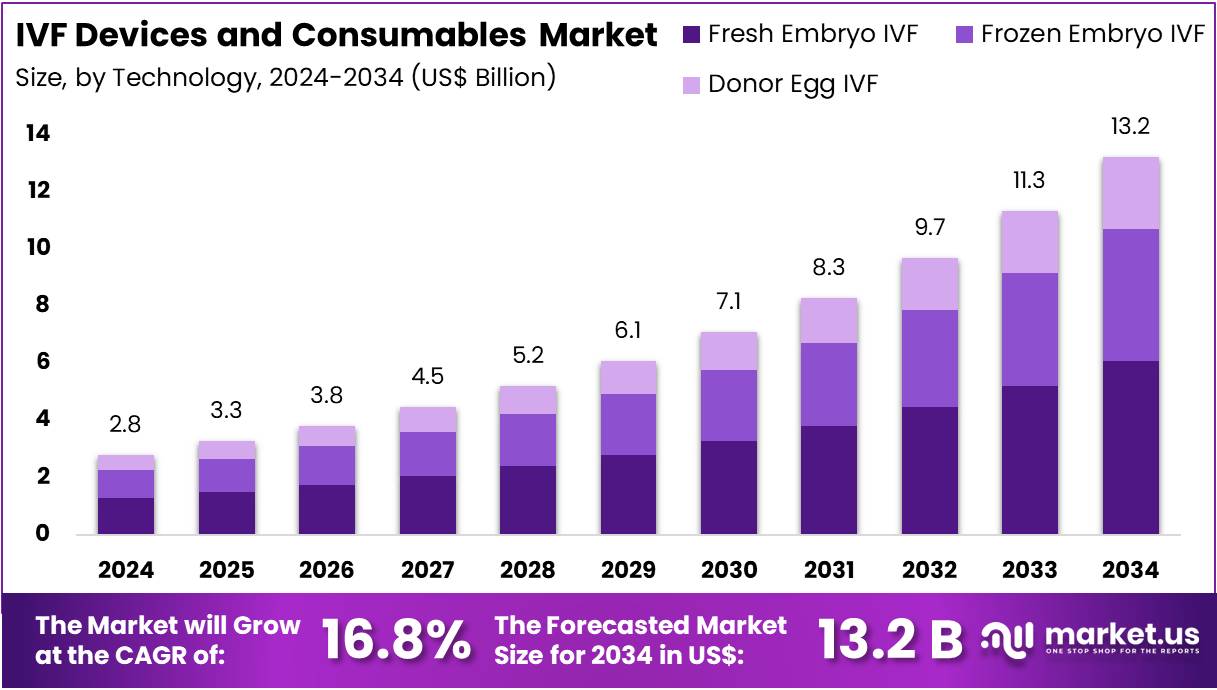
New York, NY – May 22, 2026 – The Global IVF Devices and Consumables Market Size is expected to be worth around US$ 13.2 Billion by 2034, from US$ 2.8 Billion in 2024, growing at a CAGR of 16.8% during the forecast period from 2025 to 2034. North America held a dominant market position, capturing more than a 44.5% share and holds US$ 1.2 Billion market value for the year.
The global In Vitro Fertilization (IVF) devices and consumables market is experiencing steady growth, supported by the increasing prevalence of infertility, delayed parenthood trends, and continuous advancements in assisted reproductive technologies. IVF devices and consumables are essential components used in fertility clinics and laboratories to support procedures such as egg retrieval, fertilization, embryo culture, cryopreservation, and embryo transfer.
The market includes a wide range of products such as imaging systems, sperm separation devices, incubators, ovum aspiration pumps, micromanipulator systems, cryosystems, culture media, catheters, disposable labware, and reagents. Consumables account for a significant share of the market due to their repeated use during IVF cycles and rising procedure volumes worldwide.
Growing awareness regarding fertility treatment options, improving healthcare infrastructure, and increasing acceptance of assisted reproductive technologies are contributing to market expansion. In addition, supportive government initiatives and favorable reimbursement policies in several developed countries are encouraging more couples to seek fertility treatments.
Technological innovations, including time-lapse embryo imaging, AI-based embryo selection, and advanced cryopreservation techniques, are further enhancing IVF success rates and improving patient outcomes. North America and Europe currently represent major regional markets due to advanced fertility care infrastructure, while Asia-Pacific is emerging as a high-growth region driven by increasing healthcare investments and rising infertility rates.
Overall, the IVF devices and consumables market is expected to witness sustained growth over the coming years.
Key Takeaways
- In 2024, the global IVF devices and consumables market generated revenue of US$ 2.8 billion and is projected to reach US$ 13.8 billion by 2034, expanding at a CAGR of 16.8% during the forecast period.
- Based on product type, the market is segmented into instruments, accessories, disposables, reagents, and media. Among these, accessories and disposables dominated the market in 2023, accounting for a revenue share of 43.2%.
- By technology type, the market is categorized into fresh embryo IVF, frozen embryo IVF, and donor egg IVF. The fresh embryo IVF segment held a prominent market share of 38.2%.
- In terms of end users, the market is segmented into clinical research institutes, fertility clinics, hospitals, and surgical centers. Fertility clinics emerged as the leading segment, capturing 42.3% of the overall market revenue.
- North America dominated the global IVF devices and consumables market in 2024, securing a market share of 44.5%.
Regional Analysis
North America continues to lead the IVF devices and consumables market due to its well-established healthcare infrastructure, increasing infertility rates, and strong adoption of advanced fertility technologies. Factors such as delayed pregnancies, lifestyle changes, and rising stress levels have significantly increased the demand for assisted reproductive treatments across the region.
Technological advancements in embryo culture systems and cryopreservation methods have improved IVF success rates, further supporting market expansion. Favorable reimbursement policies and broader insurance coverage for fertility treatments are also enhancing patient access to IVF procedures.
In the United States, the number of assisted reproductive technology procedures has increased substantially over the past decade, with a growing number of births occurring through IVF treatments. The presence of leading fertility clinics and research institutions across states such as California, Texas, New York, and Massachusetts continues to strengthen regional market growth.
Meanwhile, the Asia-Pacific region is projected to register the fastest CAGR during the forecast period. Rapid healthcare investments, rising disposable incomes, and growing awareness regarding fertility treatments are driving demand across countries such as China and India. Increasing infertility prevalence and supportive government initiatives are further accelerating market growth. India has also emerged as a major destination for international IVF treatments due to its affordability and high treatment success rates.
Emerging Trends
- Shift Towards Advanced Automation in IVF Labs: IVF clinics are adopting automated systems with AI-enabled sensors to monitor temperature, humidity, and gas levels in real time. These technologies improve consistency, reduce contamination risks, minimize manual intervention, and enhance embryo development conditions, making IVF procedures more accurate, efficient, and reliable across modern fertility laboratories worldwide.
- Rising Demand for Personalized IVF Solutions: Personalized IVF treatments are gaining popularity as clinics use genetic screening and customized hormone therapies based on patient-specific conditions. Advanced data analysis helps create tailored treatment plans, improving IVF success rates, enhancing patient satisfaction, and allowing fertility centers to offer more targeted and effective reproductive care solutions.
- Increased Focus on Disposable Consumables for Safety: IVF clinics are increasingly using disposable consumables such as pipettes, catheters, and culture dishes to maintain sterility and prevent cross-contamination. Single-use products reduce infection risks during sensitive IVF procedures and ensure hygiene standards, driving demand for innovative, high-quality consumables that support safe reproductive treatments.
- Mini-IVF and Low-Stimulation IVF Methods Gaining Attention: Mini-IVF and low-stimulation IVF methods are becoming popular due to lower medication use, reduced side effects, and improved affordability. Clinics are adopting specialized tools, compact incubators, and simplified consumables designed for these procedures, meeting growing patient demand for less invasive and emotionally manageable fertility treatments.
- Integration of AI and Imaging Technologies: Artificial intelligence and advanced imaging technologies are transforming IVF procedures by analyzing embryo development through time-lapse imaging. AI systems identify high-quality embryos more accurately than manual observation, improving implantation success rates, reducing selection errors, and helping clinics enhance decision-making and overall fertility treatment outcomes for patients.
- Remote Monitoring and Cloud-Based Systems: Cloud-based IVF monitoring systems allow doctors and embryologists to track incubator performance and lab conditions remotely through digital platforms. These technologies improve operational efficiency, enable faster emergency responses, support data logging and trend analysis, and ensure consistency across multiple fertility clinic locations worldwide.
- Growing Role of Male Fertility Devices: Male fertility devices are gaining importance in IVF treatments as clinics focus on improving sperm quality and selection. Advanced tools help identify healthy sperm, remove low-motility samples, and increase fertilization success rates. This growing emphasis on male reproductive health is driving innovation in sperm analysis technologies.
Use Cases
- Helping Couples with Infertility: IVF devices and consumables support couples struggling with infertility by assisting in fertilization, embryo culture, egg retrieval, and embryo transfer procedures. Tools such as incubators, culture dishes, and catheters maintain sterile conditions and improve pregnancy success rates, increasing demand for advanced fertility treatment solutions globally.
- Supporting Fertility Preservation: Fertility preservation technologies help individuals store eggs, sperm, or embryos for future pregnancy planning. IVF consumables like vitrification kits, cryoprotectants, and storage containers protect reproductive cells during freezing, benefiting cancer patients, career-focused individuals, and people delaying parenthood for personal or medical reasons.
- Assisting Single Parents and LGBTQ+ Families: IVF technologies enable single parents and LGBTQ+ individuals to build families using donor sperm, donor eggs, surrogacy, and advanced fertilization techniques. Specialized devices such as ICSI tools and embryo transfer catheters support inclusive fertility treatments, increasing access to parenthood opportunities across diverse family structures globally.
- Improving IVF Outcomes with Preimplantation Genetic Testing (PGT): Preimplantation genetic testing helps identify embryos free from inherited genetic disorders before implantation. IVF labs use biopsy pipettes, culture media, and specialized testing consumables to improve healthy pregnancy outcomes, reduce miscarriage risks, and provide reassurance to couples with genetic health concerns or hereditary disease histories.
- Training and Simulation in Medical Schools: Medical schools and fertility training centers use IVF simulation tools and practice consumables to educate embryologists and fertility specialists. Mock labs, training catheters, and procedure kits allow trainees to safely practice IVF techniques, improve clinical skills, and reduce operational errors before handling real patient procedures.
- Boosting Efficiency in High-Volume IVF Clinics: High-volume IVF clinics use automated embryo culture systems, time-lapse imaging incubators, and disposable consumables to improve workflow efficiency. These technologies reduce manual tasks, minimize sterilization time, improve embryo monitoring accuracy, and help fertility centers manage large patient volumes while maintaining high treatment success rates.
Frequently Asked Questions on IVF Devices and Consumables
- What factors are driving the growth of the IVF devices and consumables market?
The growth of the IVF devices and consumables market is primarily driven by increasing infertility rates, delayed pregnancies, rising awareness regarding assisted reproductive technologies, and technological advancements in fertility treatment systems. Expanding healthcare infrastructure and supportive government initiatives are also contributing significantly to market expansion. - Which consumables are commonly used in IVF procedures?
Common IVF consumables include culture media, sperm separation media, catheters, cryopreservation straws, pipettes, petri dishes, embryo transfer sets, and disposable laboratory accessories. These consumables are essential for maintaining sterile conditions and ensuring effective fertilization, embryo culture, and storage processes. - What are the major types of IVF devices available in the market?
Major IVF devices include incubators, imaging systems, micromanipulators, sperm analyzers, cryosystems, ovum aspiration pumps, and laser systems. These devices are designed to improve laboratory precision, embryo monitoring, and treatment outcomes while enhancing operational efficiency in fertility clinics. - Why is the demand for IVF treatments increasing globally?
The global demand for IVF treatments is increasing due to rising infertility prevalence, lifestyle-related reproductive disorders, delayed parenthood, and growing acceptance of fertility treatments. Improved success rates, increasing healthcare spending, and wider accessibility of assisted reproductive technologies are further supporting market demand. - How do technological advancements impact the IVF devices market?
Technological advancements improve the accuracy, efficiency, and success rates of IVF procedures through innovations such as time-lapse imaging, artificial intelligence-based embryo assessment, advanced cryopreservation systems, and automated laboratory equipment. These developments help fertility clinics optimize procedures and enhance patient outcomes. - How is artificial intelligence influencing IVF procedures?
Artificial intelligence is improving IVF procedures by supporting embryo grading, treatment planning, and laboratory workflow optimization. AI-based systems analyze embryo development patterns and patient data to assist fertility specialists in selecting high-quality embryos and improving overall treatment outcomes. - Why are disposable consumables important in IVF laboratories?
Disposable consumables are important in IVF laboratories because they help maintain sterile conditions, reduce contamination risks, and ensure procedural consistency. The increasing preference for single-use laboratory products is supporting demand for high-quality consumables across fertility treatment facilities worldwide. - How are government initiatives supporting the IVF market?
Government initiatives are supporting the IVF market through fertility awareness programs, favorable healthcare policies, funding for reproductive health services, and improved insurance coverage in selected countries. These measures are helping increase patient access to assisted reproductive technologies and fertility treatment services.
Conclusion
The global IVF devices and consumables market is expected to witness strong and sustained growth over the forecast period, driven by rising infertility rates, delayed parenthood trends, and increasing acceptance of assisted reproductive technologies worldwide. Technological advancements such as AI-based embryo selection, time-lapse imaging, and advanced cryopreservation systems are significantly improving IVF success rates and operational efficiency in fertility clinics.
Consumables continue to represent a major revenue contributor due to their recurring usage in IVF procedures. Additionally, expanding healthcare infrastructure, supportive government initiatives, and growing awareness regarding fertility treatments are further accelerating market expansion across both developed and emerging economies globally.
Discuss your needs with our analyst
Please share your requirements with more details so our analyst can check if they can solve your problem(s)




