


Overview
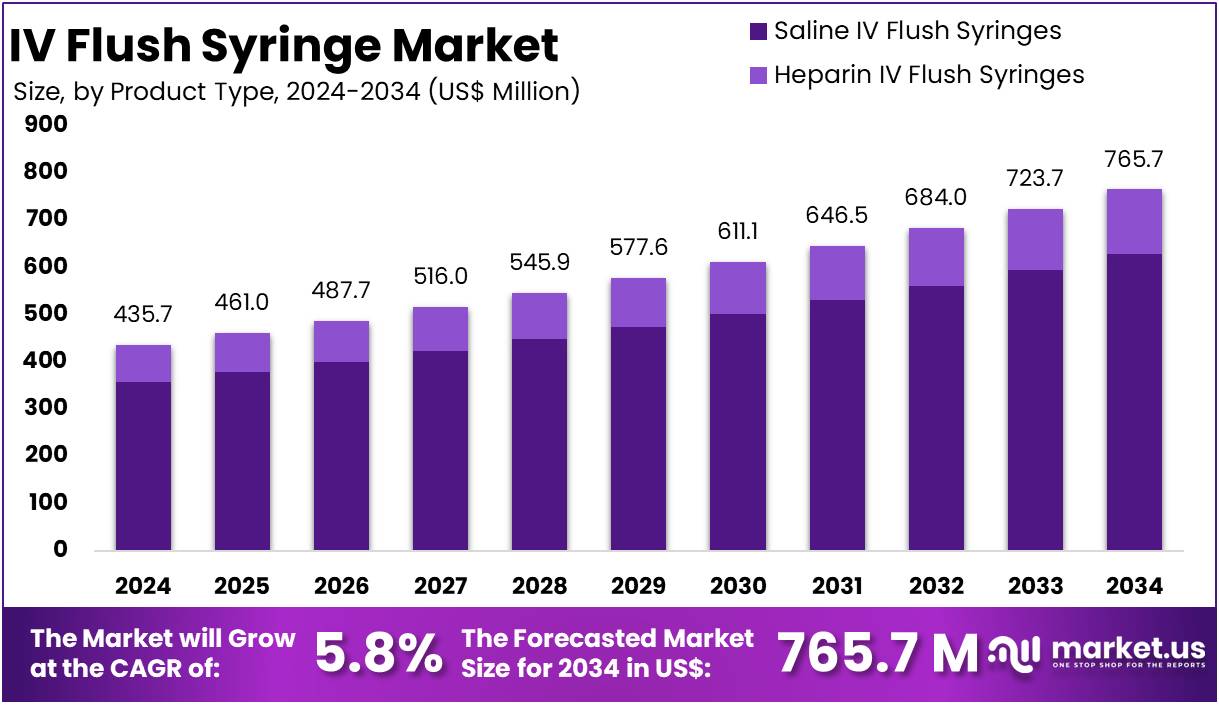
New York, NY – July 13, 2026 – Global IV Flush Syringe Market size is expected to be worth around US$ 765.7 million by 2034 from US$ 435.7 million in 2024, growing at a CAGR of 5.8% during the forecast period 2025 to 2034.
The IV Flush Syringe Market refers to the industry involved in the production and supply of prefilled syringes used to flush intravenous (IV) lines and maintain catheter patency. These syringes are commonly filled with sterile saline or heparin solutions and are used in hospitals, clinics, ambulatory surgical centers, and home healthcare settings.
The market is witnessing steady growth due to the rising number of hospital admissions, increasing prevalence of chronic diseases, and growing demand for safe and efficient intravenous therapy. IV flush syringes help prevent catheter blockage, reduce the risk of contamination, and support proper medication administration, making them an essential component of patient care.
Key factors driving market expansion include the growing adoption of prefilled syringes, advancements in syringe design, and heightened awareness regarding infection prevention and patient safety. Healthcare providers are increasingly preferring ready-to-use flush syringes because they reduce preparation time, minimize dosing errors, and improve workflow efficiency.
Key Takeaways
- The IV Flush Syringe market generated revenue of US$ 435.7 million in 2024 and is projected to reach US$ 765.7 million by 2034, expanding at a CAGR of 5.8% during the forecast period.
- By product type, the market is segmented into Saline IV Flush Syringes and Heparin IV Flush Syringes. Saline IV Flush Syringes dominated the market in 2023, accounting for 82.1% of the total market share.
- Based on capacity, the market is categorized into 3 mL Syringes, 5 mL Syringes, 10 mL Syringes, and Others. Among these, 10 mL Syringes held the largest share, representing 62.3% of the market.
- In terms of end users, the market is segmented into Hospitals and Clinics, Home-care Settings, and Ambulatory Surgical Centers and Others. Hospitals and Clinics emerged as the leading end-user segment, contributing 55.6% of the total market revenue.
- North America led the IV Flush Syringe market in 2023, capturing a 40.9% market share.
Regional Analysis
North America remains the leading region in the IV Flush Syringe Market, accounting for more than 40.9% of the global market share in 2024. The region is expected to maintain steady growth, supported by ongoing technological advancements, a growing aging population, and the increasing adoption of home-based healthcare services. These factors continue to strengthen the demand for IV flush syringes across hospitals, clinics, and home-care settings.
A key driver of North America’s market dominance is its well-established healthcare infrastructure, which enables efficient delivery of advanced medical devices and patient care solutions. The presence of major market players, coupled with strong funding support for research and innovation, further contributes to regional growth.
For example, in April 2025, Sharps Technology, Inc. announced a US$ 400,000 purchase order from a U.S. leader in IV flushing solutions. This order marked the first transaction under the previously announced US$50 million supply agreement signed in July 2024, highlighting continued investment and commercial expansion in the North American IV flush syringe market.
Emerging Trends
- Shift Toward Safety-Engineered Prefilled Syringes: Healthcare systems worldwide are increasingly adopting safety-engineered prefilled saline flush syringes. This shift, encouraged by the World Health Organization, aims to reduce needle-stick injuries and contamination by removing manual filling steps from the flushing process.
- Increasing Use of Closed Flush Systems: Closed flush systems are gaining wider acceptance because they maintain catheter patency through continuous infusion rather than repeated syringe injections. Their use has been associated with fewer line entries and a lower risk of central line-associated bloodstream infections.
- Stronger Manufacturing Quality Controls: Manufacturers have enhanced quality assurance measures for prefilled flush syringes in response to FDA-reported issues such as plunger resistance and leakage. These measures include more rigorous inspections of silicone coatings to ensure smooth and consistent plunger movement.
- Greater Emphasis on Single-Use Syringe Policies: Single-use syringe guidelines are being reinforced in accordance with CDC injection-safety recommendations, which prohibit syringe and needle reuse between patients. This is especially important given the billions of therapeutic injections administered globally each year.
- Rising Adoption of Prefilled Flush Syringes: Hospitals and outpatient care facilities are increasingly using commercially available prefilled 0.9% sodium chloride flush syringes. These products improve workflow efficiency, reduce medication-preparation errors, and have become standard practice in many U.S. intensive care units.
Use Cases
- Maintaining Peripheral IV Patency: A 5–10 mL saline flush is commonly administered after medication delivery to clear blood and drug residue from peripheral intravenous lines. This practice helps prevent occlusion and supports accurate medication dosing.
- Reducing Central Line-Associated Bloodstream Infections: Consistent flushing protocols play an important role in preventing CLABSIs. The use of closed flush systems and strict aseptic syringe techniques helps reduce infection risk in acute care settings.
- Maintaining Heparin Locks: For implanted venous ports and central catheters, a small heparin-saline flush is typically administered at regular intervals to maintain line patency. This approach has been shown to decrease thrombotic occlusions in long-term catheter users.
- Supporting Pressure Monitoring and Hemodynamic Lines: In critical care environments, pressure transducer systems are maintained with continuous saline infusion through closed flush systems. This method reduces the need for manual syringe entries and lowers the potential risk of infection.
- Providing Emergency Saline Boluses: Prefilled 10 mL flush syringes are widely used in emergency departments and pediatric units for rapid saline bolus administration. Ready-to-use devices support timely interventions and are particularly valuable in high-frequency flushing environments such as pediatric intensive care units.
Frequently Asked Questions on IV Flush Syringe
- Why is an IV flush syringe used?
IV flush syringes are used to clear residual medication, blood, or fluids from intravenous lines after medication administration. Proper flushing helps ensure accurate drug delivery, prevents line occlusion, and supports safe and effective patient care. - What solution is commonly used in IV flush syringes?
The most commonly used solution in IV flush syringes is sterile normal saline, containing 0.9% sodium chloride. In some clinical settings, heparinized saline may be used for specific catheter types, depending on institutional protocols and patient requirements. - Are IV flush syringes sterile?
Yes, IV flush syringes are manufactured and packaged under sterile conditions to prevent contamination. Prefilled syringes are designed for single-use applications, helping healthcare providers maintain aseptic technique and reduce the risk of healthcare-associated infections. - What are the advantages of prefilled IV flush syringes?
Prefilled IV flush syringes offer convenience, standardized dosing, and reduced preparation time for healthcare professionals. They also minimize the risk of medication errors, contamination, and wastage compared with manually prepared flush syringes. - What factors are driving market growth?
Market growth is driven by increasing hospitalization rates, rising prevalence of chronic diseases, and greater adoption of intravenous therapies. Demand for infection prevention, medication safety, and efficient clinical workflows also supports the expansion of the IV flush syringe market. - Which type of IV flush syringe is most commonly used?
Prefilled saline flush syringes are the most commonly used type in healthcare settings. Their popularity is attributed to ease of use, reduced preparation errors, improved sterility assurance, and compatibility with a wide range of intravenous catheter applications. - Who are the major end users in the IV flush syringe market?
Hospitals are the primary end users of IV flush syringes because of the high volume of intravenous procedures performed daily. Other significant end users include ambulatory surgical centers, clinics, home healthcare providers, and long-term care facilities. - What trends are shaping the IV flush syringe market?
Key market trends include increasing preference for prefilled syringes, adoption of safety-engineered syringe designs, and stricter infection control regulations. Manufacturers are also focusing on sustainable materials, improved packaging, and enhanced product reliability to meet evolving healthcare demands.
Conclusion
The IV Flush Syringe Market is expected to maintain steady growth, driven by rising healthcare utilization, increasing chronic disease prevalence, and the expanding adoption of intravenous therapies. Prefilled saline flush syringes dominate the market due to their convenience, sterility, and ability to reduce preparation errors.
Hospitals and clinics remain the primary end users, while North America continues to lead the market because of its advanced healthcare infrastructure and strong presence of industry participants. Emerging trends such as safety-engineered syringe designs, closed flush systems, enhanced quality controls, and reinforced single-use policies are further supporting market expansion by improving patient safety and operational efficiency.
Discuss your needs with our analyst
Please share your requirements with more details so our analyst can check if they can solve your problem(s)




