


Overview
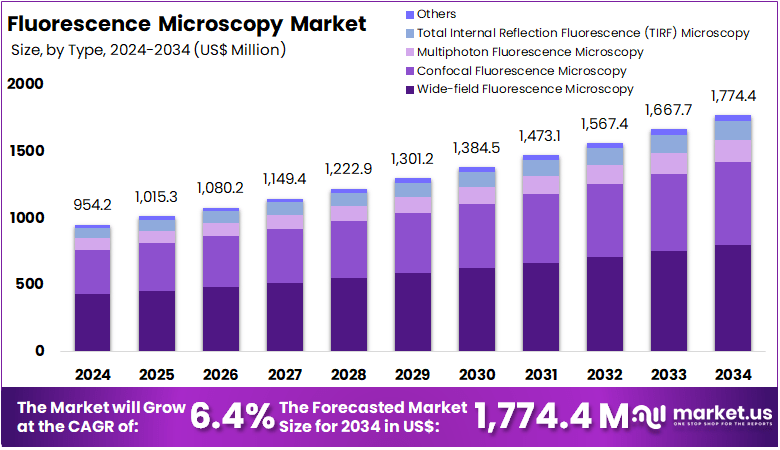
New York, NY – June 10, 2026 – The Fluorescence Microscopy Market Size is expected to be worth around US$ 1,774.4 million by 2034 from US$ 954.2 million in 2024, growing at a CAGR of 6.4% during the forecast period 2025 to 2034.
Fluorescence microscopy is an advanced imaging technique widely used in life sciences, medical diagnostics, biotechnology, and materials research. The technology enables scientists and researchers to visualize specific structures, molecules, and biological processes with high sensitivity and contrast. It operates by using fluorescent dyes, proteins, or probes that absorb light at a particular wavelength and emit light at a longer wavelength, creating detailed images of targeted samples.
The growing adoption of fluorescence microscopy is driven by increasing investments in biomedical research, drug discovery, and disease diagnostics. The technique plays a critical role in studying cellular functions, protein interactions, gene expression, and pathogen detection. Its ability to provide real-time visualization of biological processes has significantly enhanced research capabilities across academic institutions, pharmaceutical companies, and healthcare laboratories.
Recent technological advancements, including super-resolution imaging, automated image analysis, and integration with artificial intelligence, have further improved the performance and accuracy of fluorescence microscopy systems. These innovations enable researchers to obtain higher-resolution images and generate deeper insights into complex biological mechanisms.
Fluorescence microscopy continues to be an essential tool in modern scientific research, supporting breakthroughs in cancer studies, neuroscience, immunology, and molecular biology. As demand for precision diagnostics and advanced life science research grows, the adoption of fluorescence microscopy is expected to expand steadily across global research and healthcare sectors.
Key Takeaways
- The global fluorescence microscopy market was valued at US$ 954.2 million in 2024 and is projected to reach US$ 1,774.4 million by 2034, expanding at a CAGR of 6.4% during the forecast period.
- By type, the market is segmented into Wide-field Fluorescence Microscopy, Confocal Fluorescence Microscopy, Multiphoton Fluorescence Microscopy, Total Internal Reflection Fluorescence (TIRF) Microscopy, and Others. Wide-field Fluorescence Microscopy accounted for the largest market share of 45.2% in 2023.
- Based on component, the market is categorized into Microscopes, Cameras, Illuminators & Light Sources, Filters, Lenses & Objectives, and Software and Accessories. The Microscopes segment dominated the market with a revenue share of 48.7%.
- By application, the market is divided into Cell Biology, Neuroscience, Cancer Research, Immunology, Microbiology, Developmental Biology, and Other Applications. Cell Biology emerged as the leading application segment, capturing 44.7% of the market revenue.
- In terms of end user, the market comprises Academic & Research Institutes, Pharmaceutical & Biotechnology Companies, Hospitals & Diagnostic Laboratories, Contract Research Organizations (CROs), and Others. Academic & Research Institutes held the highest revenue share of 39.5%.
- North America dominated the global fluorescence microscopy market in 2023, accounting for 50.0% of the overall market share.
Regional Analysis
North America dominates the global fluorescence microscopy market, accounting for approximately 42.5% of total revenue. The region’s leadership is supported by a well-established healthcare system, extensive research infrastructure, and substantial investments in life sciences and biomedical research. The United States remains the primary contributor to regional growth, driven by continuous technological advancements and widespread adoption of advanced imaging techniques across research and clinical settings.
The presence of leading pharmaceutical companies, biotechnology firms, academic institutions, and research organizations has significantly strengthened market demand for fluorescence microscopy systems. These organizations rely on advanced imaging technologies for applications ranging from cell biology and molecular research to drug discovery and disease diagnostics.
North America is also home to several globally recognized research institutions, including Harvard University, the National Institutes of Health (NIH), and the University of California, Berkeley. These institutions actively utilize fluorescence microscopy to investigate complex biological mechanisms, including cancer progression, neurological disorders, immunological responses, and cellular interactions.
In addition, strong government support for scientific innovation continues to foster market expansion. Significant funding allocated to biomedical and life science research by organizations such as the NIH encourages the adoption of sophisticated microscopy platforms. As research activities continue to expand and demand for high-resolution imaging grows, North America is expected to maintain its leading position in the fluorescence microscopy market.
Emerging Trends
- Rapid Adoption of Janus Kinase (JAK) Inhibitors: The hair loss treatment landscape is evolving with increasing adoption of JAK inhibitors for alopecia areata. In 2024, FDA approval of Leqselvi and expanded use of Baricitinib provided effective systemic treatment options, demonstrating significant scalp-hair regrowth and improving outcomes for patients with severe autoimmune hair loss.
- Safety Scrutiny of Compounded Topical Therapies: Growing demand for compounded topical finasteride products has intensified regulatory attention regarding safety and efficacy. Reports of adverse events, including local irritation and systemic side effects, have prompted increased scrutiny, which may influence future product development, labeling requirements, and approval pathways for topical hormonal therapies.
- Exploration of Regenerative and Cell-Derived Therapies: Research activity is expanding around regenerative treatments utilizing mesenchymal stem cells, exosomes, and cell-derived biologics. Multiple ongoing clinical studies are evaluating their ability to stimulate hair follicle regeneration and improve hair density, potentially introducing innovative therapeutic approaches beyond traditional pharmaceutical interventions.
Use Cases
- Severe Alopecia Areata: JAK inhibitors are increasingly used for managing severe alopecia areata in patients experiencing extensive scalp hair loss. Clinical studies have demonstrated substantial hair regrowth and improved scalp coverage, supporting their integration into dermatology treatment guidelines and establishing a targeted approach for autoimmune-driven hair loss conditions.
- Male Androgenetic Alopecia: Oral finasteride remains a widely prescribed treatment for male androgenetic alopecia. By inhibiting 5α-reductase activity and reducing dihydrotestosterone production, the therapy effectively slows progressive hair thinning and supports hair regrowth, making it a foundational treatment option for long-term hair loss management.
- Investigational Regenerative Therapies: Emerging regenerative therapies, including stem cell and exosome-based injections, are being evaluated for treating androgenetic alopecia. Early-stage clinical trials are assessing their impact on hair density, follicle health, and patient satisfaction, potentially expanding future treatment options for individuals unresponsive to conventional drug therapies.
Frequently Asked Questions on Fluorescence Microscopy
- How does fluorescence microscopy work?
Fluorescence microscopy works by illuminating a sample with light of a specific wavelength, which excites fluorescent molecules. These molecules emit light at a longer wavelength, and the emitted signal is captured to generate highly detailed images of targeted structures within the sample. - What are the main applications of fluorescence microscopy?
Fluorescence microscopy is widely used in cell biology, molecular biology, microbiology, neuroscience, and medical diagnostics. It supports the visualization of proteins, nucleic acids, cellular organelles, and pathogens, enabling researchers to study biological mechanisms with high specificity and sensitivity. - What are the advantages of fluorescence microscopy?
The technique offers exceptional sensitivity, high image contrast, and the ability to selectively visualize specific molecules. It also enables real-time observation of biological processes, multiplex imaging, and detailed analysis of complex cellular interactions that are not visible through traditional microscopy methods. - What types of fluorescence microscopy are commonly used?
Common types include widefield fluorescence microscopy, confocal microscopy, total internal reflection fluorescence microscopy (TIRF), multiphoton microscopy, and super-resolution microscopy. Each technique is designed to address specific imaging requirements, including depth, resolution, and live-cell observation capabilities. - Why are fluorescent dyes important in microscopy?
Fluorescent dyes and labels are essential because they bind to specific biological targets and emit detectable light signals. This selective labeling capability allows researchers to identify, track, and analyze cellular components, proteins, and molecular interactions with remarkable precision. - Which industries are the primary users of fluorescence microscopy systems?
The primary users include pharmaceutical and biotechnology companies, academic research institutes, clinical diagnostic laboratories, hospitals, and contract research organizations. These sectors rely on fluorescence microscopy for biological research, disease analysis, and drug development activities. - Which region dominates the fluorescence microscopy market?
North America holds a significant market share due to strong research infrastructure, substantial funding for life sciences, and the presence of leading biotechnology and pharmaceutical companies. Europe and Asia-Pacific also represent important growth regions with expanding research investments.
Conclusion
The fluorescence microscopy market is experiencing steady growth, driven by rising investments in biomedical research, drug discovery, and advanced diagnostic applications. The technology has become an essential tool for visualizing complex biological structures and processes with high precision, supporting advancements across cell biology, neuroscience, cancer research, and immunology.
Continuous innovations in super-resolution imaging, automation, and artificial intelligence are enhancing system capabilities and expanding application areas. North America remains the leading regional market due to its strong research infrastructure and funding support. As demand for high-resolution imaging and precision research continues to increase, the fluorescence microscopy market is expected to witness sustained expansion over the coming decade.
Discuss your needs with our analyst
Please share your requirements with more details so our analyst can check if they can solve your problem(s)




