


Overview
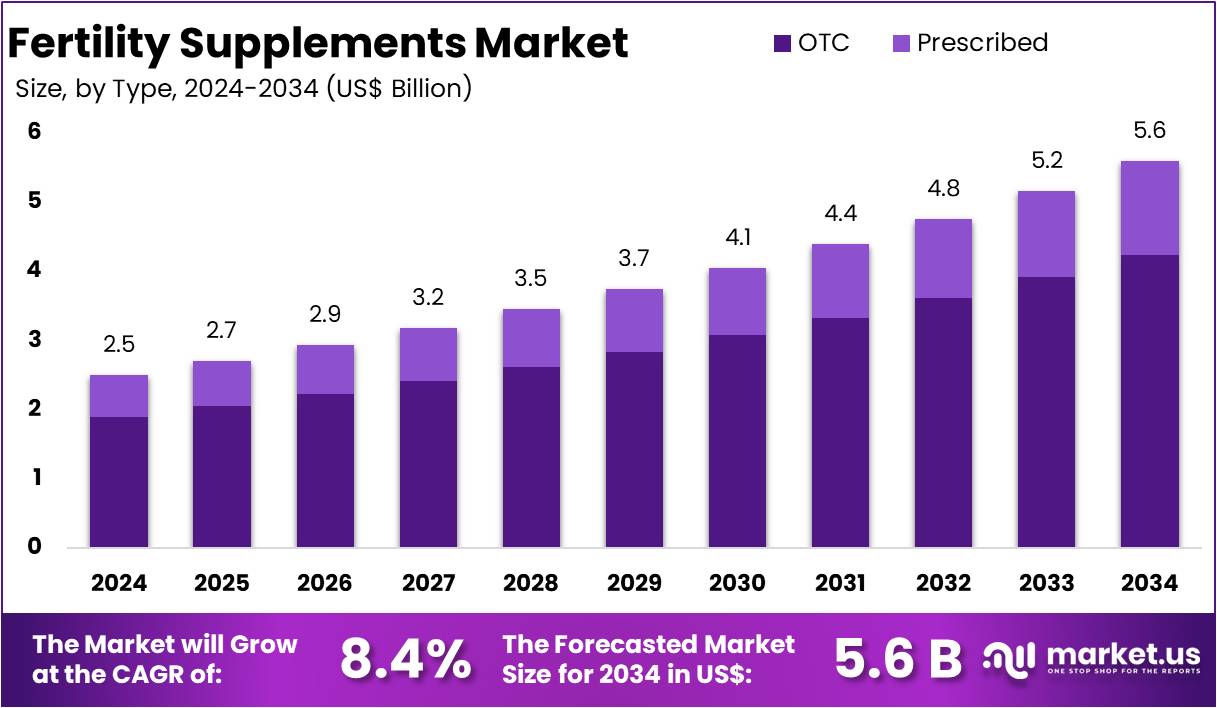
New York, NY – July 13, 2026 – Global Fertility Supplements Market size is forecasted to be valued at US$ 5.6 billion by 2034 from US$ 2.5 billion in 2024, growing at a CAGR of 8.4% during the forecast period 2025 to 2034.
Fertility supplements are dietary products formulated to support reproductive health in women and men. These supplements typically contain vitamins, minerals, antioxidants, and other nutrients that may help maintain normal reproductive function and overall wellness.
Common ingredients found in fertility supplements include folic acid, vitamin D, zinc, selenium, omega-3 fatty acids, and coenzyme Q10 (CoQ10). Folic acid is widely recognized for its role in supporting healthy fetal development when taken before and during early pregnancy. Antioxidants such as CoQ10 may help protect cells from oxidative stress, while minerals such as zinc and selenium are associated with normal reproductive processes in men and women.
The growing awareness of reproductive health, changing lifestyle patterns, and increased interest in preventive wellness have contributed to rising consumer interest in fertility supplements. These products are available in various forms, including capsules, tablets, powders, and gummies, and are often marketed for preconception support.
It is important to note that fertility supplements are not intended to diagnose, treat, cure, or prevent infertility or any medical condition. Individuals considering fertility supplements should consult healthcare professionals to determine the most appropriate approach based on their personal health status and reproductive goals. Overall, fertility supplements represent a supportive wellness category aimed at providing essential nutrients that may contribute to reproductive health.
Key Takeaways
- The global fertility supplements market generated US$ 2.5 billion in revenue in 2024 and is projected to reach US$ 5.6 billion by 2034, expanding at a CAGR of 8.4% during the forecast period.
- Within the product category, vitamins emerged as the leading segment, accounting for 35.2% of the market share in 2024.
- Based on form, capsules represented the largest revenue-generating segment, holding a 33.7% share in 2024.
- The natural ingredient segment secured a significant market share of 39.5% in 2024.
- By type, over-the-counter (OTC) supplements dominated the market, capturing 75.8% of the total share in 2024.
- Women constituted the largest end-user group, contributing 53.6% of the market revenue in 2024.
- Among distribution channels, pharmacies accounted for the largest share, representing 31.0% of the market in 2024.
- Regionally, North America led the global fertility supplements market with a 34.2% share in 2024.
Regional Analysis
North America led the global fertility supplements market in 2024, accounting for 34.2% of total revenue. The region’s dominance is supported by high consumer awareness, advanced healthcare infrastructure, and easy access to over-the-counter (OTC) fertility supplements.
In the United States, increasing concerns related to delayed childbearing, lifestyle changes, and reproductive health conditions such as PCOS and endometriosis have contributed to strong demand for fertility-support products. Consumers in North America are also showing a growing preference for natural, organic, and personalized fertility solutions, supported by a regulatory environment focused on product safety and efficacy.
Asia Pacific is expected to register the highest CAGR during the forecast period. Rapid urbanization, rising infertility rates, changing dietary patterns, stress, and environmental pollution are key factors driving market growth in countries such as China and India. Increasing awareness of reproductive health, improving healthcare access, and the growing availability of fertility supplements through retail outlets and e-commerce platforms are further accelerating market expansion across the region.
Fertility supplement statistics
- Evidence-based ingredients: Only 22% of the 90 ingredients evaluated in male fertility supplements (20 ingredients) have evidence showing an effect on sperm quality or birth outcomes.
- Positive sperm health effects: Just 17% of the ingredients studied (15 out of 90) demonstrated measurable benefits for sperm health in rigorous scientific studies.
- Ingredient diversity: The fertility supplements analyzed contained between 1 and 46 ingredients per product.
- Effectiveness rating: While the maximum possible effectiveness score was 5.0, the average score across products was only 1.66.
Global fertility trends and insights
- Worldwide infertility prevalence: About 17.5% of adults globally experience infertility, underscoring the need for broader access to fertility care.
- Income-related differences: Lifetime infertility prevalence is estimated at 17.8% in high-income countries and 16.5% in low- and middle-income countries.
- United States fertility trend: The general fertility rate in the United States declined by 3% between 2021 and 2022, continuing a longer-term downward trend.
- Western Europe projections: Fertility rates in Western Europe are projected to decrease from 1.44 in 2050 to 1.37 by 2100.
- Sub-Saharan Africa outlook: By 2100, more than half of all global live births are expected to occur in sub-Saharan Africa.
Emerging trends
- Growing demand for natural ingredients: Consumers are increasingly choosing fertility supplements made with natural ingredients due to their perceived health benefits, better absorption, and lower risk of side effects. This reflects the broader shift toward organic and natural wellness products.
- Product innovation and sustainable packaging: Companies are introducing innovative fertility supplement products with convenient, portable, and environmentally friendly packaging. These advancements improve consumer experience while addressing growing sustainability concerns.
- Expanded accessibility through OTC products: Over-the-counter fertility supplements are becoming more popular, especially in emerging economies, because they are affordable and do not require a prescription. Wider availability through pharmacies and online channels has further improved consumer access.
- Targeted supplements for male fertility: Increased awareness of male infertility is driving the development of supplements specifically designed to support male reproductive health. These products address conditions such as hypogonadism and varicoceles, reflecting a more inclusive approach to fertility care.
- Growth of e-commerce distribution: Online platforms are playing a significant role in expanding the reach of fertility supplements. E-commerce provides consumers with convenience, detailed product information, and user reviews, enabling more informed purchasing decisions.
Use cases
- Supporting ovulation and egg quality: Fertility supplements are commonly used to support regular ovulation and improve egg quality in women. Antioxidants such as Coenzyme Q10 help reduce oxidative stress, which can negatively affect fertility.
- Enhancing male fertility: Male fertility supplements are formulated to improve sperm quality, motility, and overall reproductive health. Nutrients such as zinc and folic acid are important for supporting healthy sperm development.
- Complementing fertility treatments: Fertility supplements are often used alongside assisted reproductive treatments such as IVF and IUI. Their antioxidant properties may help protect reproductive cells from oxidative stress and support better treatment outcomes.
- Promoting preconception health: Couples preparing for pregnancy frequently use fertility supplements as part of a comprehensive preconception health strategy. These supplements provide essential nutrients and work alongside healthy lifestyle practices such as balanced nutrition and regular exercise.
Frequently Asked Questions on Fertility Supplements
- What are fertility supplements?
Fertility supplements are dietary products formulated to support reproductive health in men and women. They commonly contain vitamins, minerals, antioxidants, and herbal extracts that may help improve hormonal balance, egg quality, sperm quality, and overall fertility-related wellness. - How do fertility supplements work?
Fertility supplements work by providing nutrients that support reproductive processes, hormone production, and cellular health. Ingredients such as folic acid, CoQ10, zinc, and omega-3 fatty acids may contribute to improved egg maturation and sperm function. - Who can benefit from fertility supplements?
Fertility supplements may benefit individuals or couples trying to conceive, especially those with nutritional deficiencies, lifestyle-related fertility challenges, or age-related reproductive concerns. They are also commonly used by people seeking to improve preconception health. - Are fertility supplements safe to use?
Most fertility supplements are considered safe when used according to recommended dosages. However, safety depends on the specific ingredients, individual health conditions, and concurrent medications. Consulting a healthcare professional before use is strongly advised. - How long does it take for fertility supplements to show results?
The time required to observe potential benefits from fertility supplements varies among individuals. In many cases, noticeable changes in reproductive health markers may take several weeks to a few months of consistent use, depending on overall health and fertility status. - What factors are driving market growth?
Market growth is driven by rising infertility rates, increasing awareness of reproductive health, delayed parenthood, and growing consumer interest in preventive healthcare. Expanding availability through pharmacies, online platforms, and healthcare providers also supports demand. - Which product types are common in the market?
Common fertility supplement products include multivitamins, antioxidant formulations, herbal blends, amino acid supplements, and mineral-based products. These products are often formulated to address specific reproductive health needs, such as ovulation support or sperm quality enhancement. - Which regions show strong market demand?
North America and Europe currently represent significant markets due to high awareness, established healthcare infrastructure, and consumer spending on wellness products. Asia-Pacific is also experiencing rapid growth, supported by increasing healthcare access and rising fertility concerns.
Conclusion
The fertility supplements market is growing steadily as awareness of reproductive health and preventive wellness increases worldwide. These supplements provide vitamins, minerals, antioxidants, and other nutrients that may support reproductive function and preconception health in both men and women. Market expansion is driven by rising infertility concerns, delayed parenthood, demand for natural ingredients, and greater accessibility through OTC products and e-commerce platforms.
North America currently leads the market, while Asia Pacific is expected to witness the fastest growth. Although some ingredients show potential benefits, fertility supplements should be used with professional medical guidance and realistic expectations regarding their effectiveness.
Discuss your needs with our analyst
Please share your requirements with more details so our analyst can check if they can solve your problem(s)




