


Overview
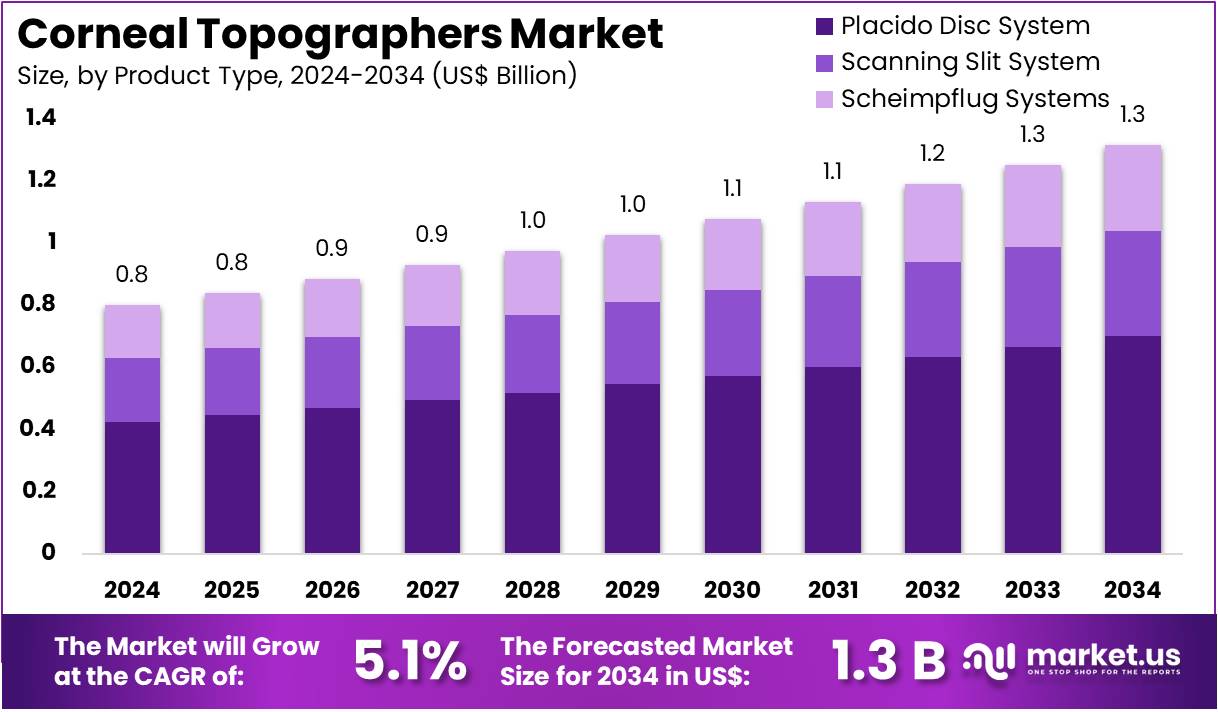
New York, NY – July 13, 2026 – Global Corneal Topographers Market Size is expected to be worth around US$ 1.3 billion by 2034 from US$ 0.8 billion in 2024, growing at a CAGR of 5.1% during the forecast period 2025 to 2034.
Corneal topographers are advanced ophthalmic diagnostic devices used to map the surface curvature of the cornea, the clear outer layer at the front of the eye. These instruments generate detailed color-coded images that help eye care professionals evaluate corneal shape, detect abnormalities, and support the planning of refractive and cataract surgeries.
By capturing thousands of measurement points across the corneal surface, corneal topographers provide precise data on curvature, elevation, and irregularities. This information is valuable in diagnosing conditions such as keratoconus, corneal astigmatism, and post-surgical corneal changes. The technology also assists in fitting contact lenses, particularly specialty lenses designed for patients with irregular corneas.
Modern corneal topography systems often use Placido disc, Scheimpflug imaging, or optical coherence tomography technologies to deliver high-resolution corneal maps. These systems enable clinicians to monitor disease progression and assess treatment outcomes with greater accuracy.
The growing demand for advanced eye care diagnostics, increasing prevalence of refractive errors, and rising adoption of minimally invasive ophthalmic procedures are contributing to the broader use of corneal topographers in hospitals, ophthalmology clinics, and specialty eye care centers. As precision and efficiency continue to shape ophthalmic practice, corneal topography remains an essential tool for improving diagnostic confidence and supporting better patient outcomes.
Key Takeaways
- The corneal topographers market generated US$ 0.8 billion in revenue in 2024 and is projected to reach US$ 1.3 billion by 2034, growing at a CAGR of 5.1% during the forecast period.
- By product type, the market is segmented into Placido disc systems, scanning slit systems, and Scheimpflug systems. Among these, Placido disc systems held the leading position in 2023, accounting for 53.2% of the market share.
- Based on application, the market is categorized into refractive surgery evaluation, cataract surgery evaluation, corneal disorder diagnosis, contact lens fitting, and other applications. Refractive surgery evaluation represented the largest application segment, with a 45.6% market share.
- In terms of end users, the market is divided into hospitals, ambulatory surgery centers, and ophthalmic clinics. Hospitals emerged as the dominant end-user segment, capturing 56.5% of the market revenue.
- Regionally, North America dominated the corneal topographers market in 2023, securing a market share of 41.4%.
Regional Analysis
North America led the corneal topographers market with a 41.4% share in 2023, supported by the rising prevalence of corneal disorders such as keratoconus and astigmatism, growing demand for refractive surgeries, and continuous advancements in ophthalmic imaging technologies.
The increasing adoption of procedures such as LASIK and PRK has heightened the need for precise corneal mapping devices, as accurate topographical data is essential for surgical planning and improved patient outcomes. Strong demand for advanced diagnostic solutions has also been reflected in the performance of major ophthalmic equipment manufacturers, including Carl Zeiss Meditec and Johnson & Johnson Vision.
Asia Pacific is expected to register the highest CAGR during the forecast period. Market growth in the region is driven by a large and aging population, rising incidence of refractive errors and corneal diseases, expanding healthcare infrastructure, and increasing access to specialized eye care services. Government-led eye health initiatives and the strategic expansion of ophthalmic companies are further supporting the adoption of advanced corneal topography systems.
Emerging Trends
- Advancements in Imaging Technology: Manufacturers are improving corneal imaging devices by combining multiple imaging techniques into advanced topographers. These systems create detailed, accurate corneal maps, enabling faster diagnosis, improved precision, fewer errors, and better patient outcomes. Faster imaging also increases efficiency in clinics worldwide.
- Integration with Other Eye Diagnostic Tools: Corneal topography is increasingly integrated with diagnostic tools such as optical coherence tomography. Combining multiple data sources in one device provides a comprehensive view of eye health, improves treatment planning, reduces separate testing, saves time, and supports more accurate diagnoses.
- Portable and User-Friendly Devices: Portable corneal topographers are becoming increasingly important for smaller clinics and remote healthcare settings. These compact devices are designed for easy operation, rapid results, and reliable accuracy. Their portability expands access to eye screening and diagnostic services in underserved regions.
- Use of Artificial Intelligence and Software Improvements: Artificial intelligence is enhancing corneal topography by enabling automatic analysis of corneal data. AI-powered software helps detect abnormalities, improves diagnostic accuracy, accelerates decision-making, and provides clearer visualization of results. These advancements support clinicians in delivering more informed patient care.
- Focus on Customized Vision Correction: Corneal topographers support personalized eye care by providing detailed corneal maps for customized vision correction. They assist in designing tailored contact lenses and planning refractive surgeries such as LASIK, leading to improved visual outcomes and higher patient satisfaction.
- Expansion in Emerging Markets: Growing awareness of eye health in developing regions is increasing demand for corneal topographers. Manufacturers are focusing on affordable, durable devices suited to challenging environments. Expanding diagnostic access in these markets can help reduce preventable blindness worldwide.
Use Cases
- Diagnosing Corneal Diseases: Corneal topographers are essential for diagnosing diseases such as keratoconus by creating detailed maps of the cornea’s shape. These maps help detect early abnormalities, guide treatment planning, monitor disease progression, and improve long-term management of corneal conditions.
- Planning Refractive Surgery: Before procedures such as LASIK or PRK, corneal topographers provide precise measurements of corneal shape and thickness. This information enables surgeons to customize treatment plans, improve surgical safety, reduce complications, and achieve better vision correction outcomes.
- Contact Lens Fitting: Corneal topographers provide accurate measurements required for fitting specialized contact lenses, including rigid gas permeable and scleral lenses. Precise fitting improves comfort, enhances vision quality, reduces irritation, and helps protect the eye from complications caused by poorly fitted lenses.
- Post-Surgery Monitoring: After corneal surgery, corneal topographers are used to monitor healing by tracking changes in corneal shape. This ongoing evaluation helps detect complications such as scarring or irregular healing early, allowing timely intervention and supporting successful recovery outcomes.
- Research and Clinical Trials: Corneal topographers play an important role in eye research and clinical trials by providing detailed measurements of corneal properties. Researchers use this data to evaluate treatment effectiveness, study disease progression, and support the development of improved ophthalmic therapies.
- Screening for Eye Health in Routine Checkups: In routine eye examinations, corneal topography can help detect early corneal abnormalities before symptoms become noticeable. Regular screening supports timely diagnosis, enables earlier treatment, improves overall eye health management, and provides reassurance regarding corneal health status.
Frequently Asked Questions on Corneal Topographers
- How does a corneal topographer work?
Corneal topographers use optical technologies such as Placido disc systems, Scheimpflug imaging, or scanning slit systems to capture corneal data. The device analyzes reflected light patterns to create a detailed map of corneal curvature. - What conditions can corneal topographers help diagnose?
Corneal topographers assist in diagnosing conditions such as keratoconus, corneal astigmatism, and irregular corneal surfaces. They also help monitor post-surgical corneal changes and assess the progression of corneal disorders. - Why are corneal topographers important in refractive surgery?
These devices are essential in refractive surgery because they provide precise corneal measurements needed for procedures such as LASIK and PRK. Accurate topographical data helps surgeons plan treatments and improve surgical outcomes. - Are corneal topography procedures safe and painless?
Corneal topography is a non-invasive, painless, and quick diagnostic procedure. The test does not require direct contact with the eye in most cases, making it comfortable and safe for patients undergoing routine eye evaluations. - What is driving the growth of the corneal topographers market?
Market growth is driven by the rising prevalence of corneal disorders, increasing demand for refractive surgeries, and advancements in ophthalmic imaging technologies. Greater awareness of early diagnosis also supports the adoption of corneal topographers. - Which product type leads the corneal topographers market?
Placido disc systems are the leading product type in the corneal topographers market. They held a dominant market share of 53.2% in 2023 due to their widespread use in corneal surface mapping and diagnostic evaluations. - Which application segment holds the largest market share?
Refractive surgery evaluation is the largest application segment in the corneal topographers market. It accounted for 45.6% of the market share, reflecting the increasing demand for precise corneal assessments before vision correction procedures. - Which region dominates the corneal topographers market?
North America dominates the corneal topographers market, holding a 41.4% market share in 2023. The region’s leadership is supported by advanced healthcare infrastructure, high adoption of ophthalmic technologies, and growing demand for refractive surgeries.
Conclusion
The corneal topographers market is positioned for steady growth, supported by rising demand for precise ophthalmic diagnostics and advanced vision correction procedures. These devices play a critical role in mapping corneal curvature, diagnosing corneal disorders, guiding refractive and cataract surgeries, and improving contact lens fitting.
Technological advancements, including integrated imaging systems, artificial intelligence, and portable user-friendly designs, are enhancing diagnostic accuracy and expanding accessibility. North America currently leads the market, while Asia Pacific is expected to witness the fastest growth due to improving healthcare infrastructure and increasing awareness of eye health. Overall, corneal topography remains essential for better clinical decision-making and patient outcomes.
Discuss your needs with our analyst
Please share your requirements with more details so our analyst can check if they can solve your problem(s)




