


Overview
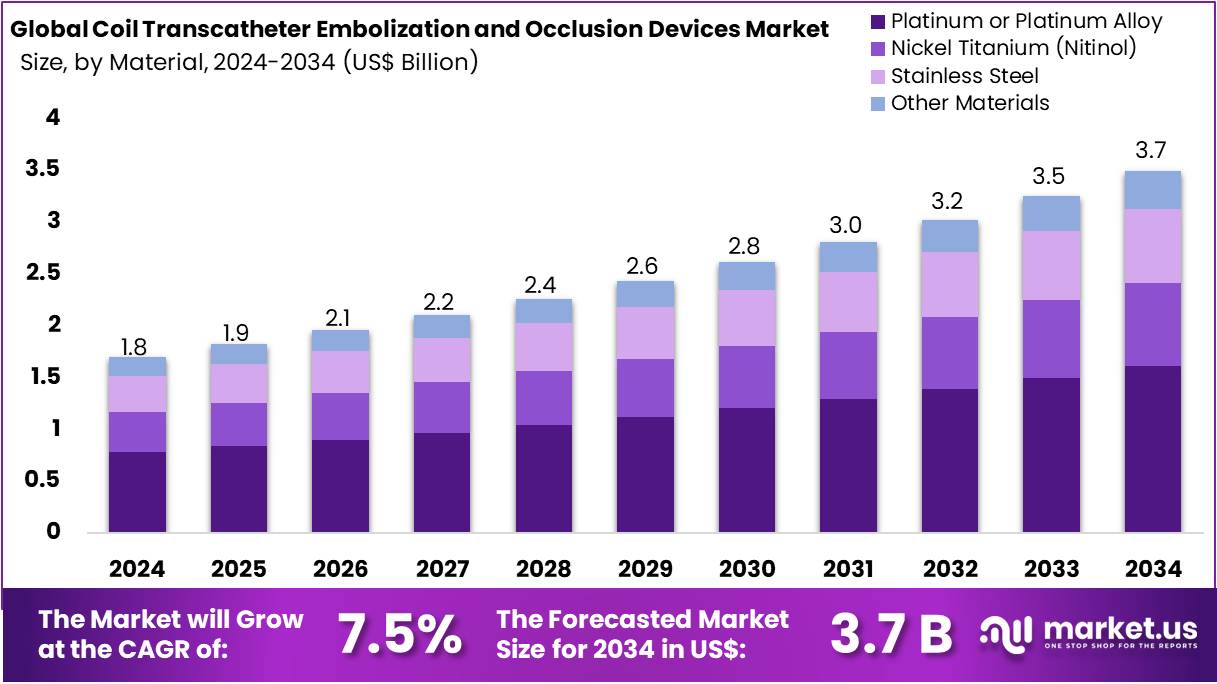
New York, NY – May 04, 2026 – The Global Coil Transcatheter Embolization and Occlusion Devices Market size is expected to be worth around US$ 3.7 Billion by 2034, from US$ 1.8 Billion in 2024, growing at a CAGR of 7.5% during the forecast period from 2025 to 2034. North America held a dominant market position, capturing more than a 43% share and holds US$ 0.7 Billion market value for the year.
Coil transcatheter embolization and occlusion devices are minimally invasive medical tools used to block or reduce blood flow in targeted vessels. These devices are widely utilized in interventional radiology and cardiology procedures to manage conditions such as aneurysms, arteriovenous malformations (AVMs), tumors, and internal bleeding. The procedure involves the insertion of a catheter through a small incision, typically in the groin or wrist, which is then guided to the treatment site under imaging support.
The embolization coils, commonly made from platinum or stainless steel, are deployed through the catheter into the affected vessel. Once positioned, the coils induce clot formation, leading to vessel occlusion. This controlled blockage helps prevent rupture in aneurysms or limits blood supply to abnormal tissues such as tumors, thereby supporting therapeutic outcomes.
These devices are favored due to their precision, reduced recovery time, and lower procedural risks compared to open surgical alternatives. Technological advancements have led to the development of detachable coils, hydrogel-coated coils, and complex-shaped designs, enhancing placement accuracy and treatment efficacy.
The increasing prevalence of vascular disorders and the growing adoption of minimally invasive procedures are contributing to market expansion. Additionally, improvements in imaging technologies and catheter-based delivery systems are supporting wider clinical adoption. As healthcare systems continue to prioritize patient safety and cost-effective treatments, coil embolization devices are expected to remain a critical component in modern interventional therapies.
Key Takeaways
- The global coil transcatheter embolization and occlusion devices market was valued at USD 1.8 billion in 2024 and is projected to reach USD 3.7 billion by 2034, expanding at a CAGR of 7.5%.
- Detachable coils dominated the market in 2024, accounting for 56.3% of the overall revenue share.
- The hemorrhage control application segment emerged as the leading category, contributing 23.6% of total market revenue.
- Platinum and platinum alloy materials held the largest share in 2024, representing 43.4% of the market.
- Hospitals remained the primary end users, capturing 56.9% of the total revenue share.
- North America led the global market, holding a revenue share of over 43% in 2024.
Regional Analysis
North America led the coil transcatheter embolization and occlusion devices market, accounting for over 43% of the global share, with an estimated value of approximately USD 0.7 billion in 2024. Market growth in the region is being driven by rising healthcare expenditure, ongoing technological advancements, and increasing preference for minimally invasive procedures.
A well-developed healthcare infrastructure, coupled with a high prevalence of vascular conditions such as aneurysms, arteriovenous malformations, and gastrointestinal bleeding, is supporting demand for advanced embolization solutions. The growing adoption of interventional radiology across the United States and Canada has further accelerated market expansion due to improved clinical outcomes and reduced recovery times.
Advancements in device technology, including enhanced precision and biocompatibility, are strengthening product adoption. Additionally, favorable reimbursement frameworks and the presence of leading manufacturers are supporting market competitiveness. Increasing awareness among healthcare professionals and patients, along with an aging population, is expected to sustain regional market growth.
Emerging Trends
- The preference for minimally invasive procedures is increasing, as coil embolization reduces pain, shortens recovery time, and minimizes complications, leading to wider adoption across hospitals focused on efficient, outcome-driven patient care delivery.
- Technological advancements in coil design, including thinner, flexible structures and improved materials, are enhancing placement accuracy, procedural control, and safety, enabling physicians to manage complex vascular conditions with greater precision.
- Utilization in neurology is expanding, particularly for brain aneurysm treatment, as improved imaging and coil technologies enhance procedural confidence, enabling safe intervention in delicate cerebral regions requiring high precision.
- Bioabsorbable coils are gaining traction due to their ability to dissolve naturally, reducing long-term complications and eliminating removal procedures, thereby improving patient safety and supporting innovation in next-generation embolization therapies.
- Integration with advanced imaging technologies such as real-time fluoroscopy, CT, and MRI enhances procedural accuracy, enabling precise coil placement, reducing risks, and improving outcomes, especially in complex and high-risk vascular interventions.
- Applications in oncology are expanding, with coil embolization increasingly used to block tumor blood supply, particularly in liver, kidney, and lung cancers, supporting combined therapies and improving targeted treatment effectiveness.
- Demand for customized, patient-specific coil solutions is rising, as tailored designs improve anatomical fit, placement precision, and treatment outcomes, particularly in complex vascular cases requiring individualized therapeutic approaches.
Use Cases
- Coil embolization is widely used to treat brain aneurysms by filling the bulge with coils, preventing blood flow, promoting clot formation, reducing rupture risk, and offering a safer alternative to invasive brain surgery.
- The procedure is effective in controlling internal bleeding caused by trauma or surgery, as coils block affected vessels quickly, reducing the need for open surgery and providing a fast, minimally invasive emergency treatment solution.
- In cancer care, coils are used to block tumor-feeding vessels, often combined with chemotherapy, enhancing drug concentration at the tumor site while limiting systemic exposure and supporting tumor shrinkage and growth control.
- Arteriovenous malformations are treated using coil embolization by blocking abnormal vessel connections, reducing rupture risk, and offering a minimally invasive alternative to surgery, especially in cases involving high-risk anatomical locations.
- Coil embolization helps preserve organ function by selectively blocking blood flow to damaged areas, such as in spleen injuries, preventing further bleeding while avoiding complete organ removal and maintaining physiological functionality.
- Pre-surgical embolization uses coils to reduce blood flow to targeted areas, minimizing intraoperative bleeding, improving surgical visibility, and enhancing safety during complex procedures involving tumors or highly vascular anatomical regions.
Frequently Asked Questions on Coil Transcatheter Embolization and Occlusion
- How does the procedure work?
The procedure involves inserting a catheter into the vascular system, typically via the femoral artery, and guiding it to the target site. Coils are then deployed, promoting clot formation and vessel occlusion, thereby preventing further blood flow to the affected area. - What are the common clinical applications?
This technique is frequently applied in treating cerebral aneurysms, gastrointestinal bleeding, arteriovenous malformations, and certain tumors. Its versatility and precision have made it a preferred option in interventional radiology and endovascular therapy across multiple medical specialties. - What are the advantages of this procedure?
Key benefits include reduced surgical risk, shorter hospital stays, minimal scarring, and faster recovery times compared to open surgery. Additionally, the procedure offers high precision, allowing targeted treatment while preserving surrounding healthy tissues and minimizing complications. - Are there any risks or complications?
Although generally safe, potential risks include infection, coil migration, non-target embolization, and allergic reactions to contrast agents. However, advancements in imaging and device technology have significantly reduced complication rates, enhancing overall procedural safety and outcomes. - What is driving the growth of the coil embolization market?
Market growth is primarily driven by the increasing prevalence of vascular diseases, rising demand for minimally invasive procedures, and technological advancements in embolization devices. Additionally, expanding healthcare infrastructure in emerging economies is contributing to broader adoption rates globally. - Which regions dominate the market?
North America holds a significant share due to advanced healthcare systems, high procedure volumes, and strong presence of key manufacturers. However, Asia-Pacific is expected to witness the fastest growth, supported by improving healthcare access and rising patient awareness. - Who are the key players in the market?
The market is characterized by the presence of major medical device companies focusing on innovation and strategic collaborations. Leading players invest heavily in research and development to introduce advanced coil technologies with improved safety, flexibility, and delivery precision.
Conclusion
The coil transcatheter embolization and occlusion devices market is demonstrating steady growth, supported by increasing adoption of minimally invasive procedures and rising prevalence of vascular disorders. Technological advancements in coil design, imaging integration, and catheter delivery systems are enhancing treatment precision and safety. Strong demand across neurology, oncology, and emergency care applications is further expanding clinical utility.
North America remains the leading regional market, while emerging economies are showing significant growth potential. With continued innovation and focus on patient-specific solutions, the market is expected to maintain a positive trajectory, reinforcing its critical role in modern interventional healthcare practices globally.
Discuss your needs with our analyst
Please share your requirements with more details so our analyst can check if they can solve your problem(s)




