


Overview
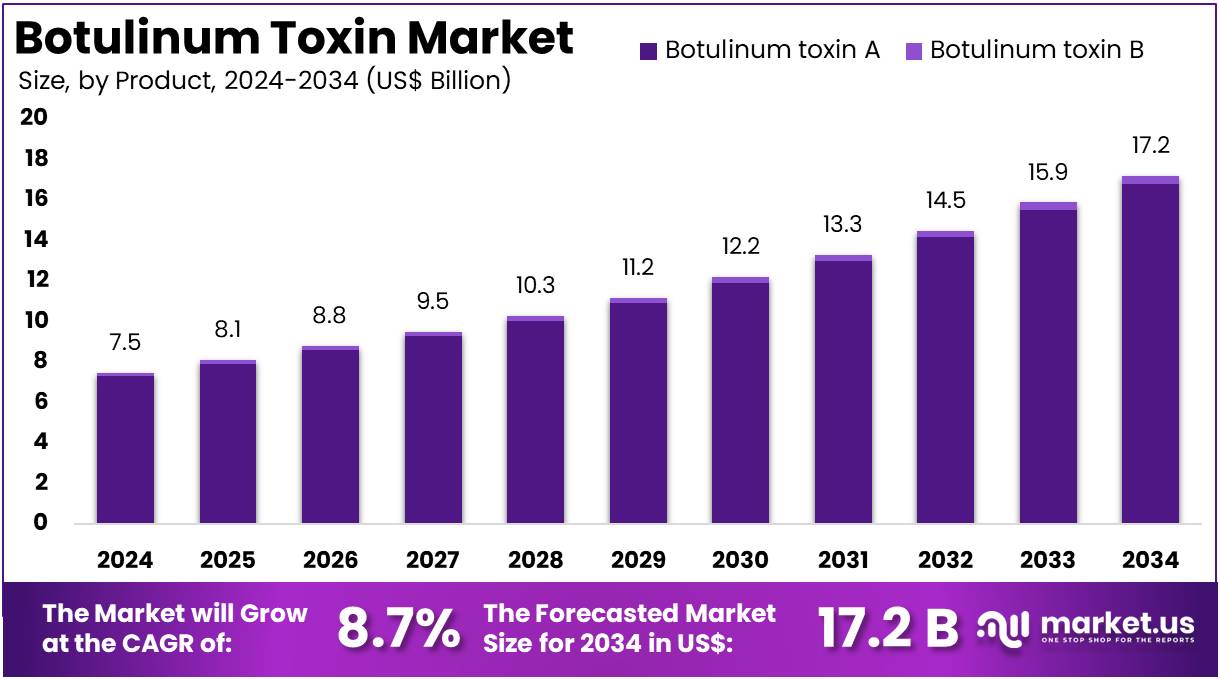
New York, NY – April 28, 2026 – The Global Botulinum Toxin Market Size is expected to be worth around US$ 17.2 Billion by 2034, from US$ 7.5 Billion in 2024, growing at a CAGR of 8.7% during the forecast period from 2025 to 2034.
Botulinum toxin is a neurotoxic protein produced by the bacterium *Clostridium botulinum*. Despite its origin, it has been widely utilized in controlled medical and aesthetic applications due to its ability to temporarily inhibit nerve activity. When administered in small, purified doses, botulinum toxin blocks the release of acetylcholine at neuromuscular junctions, resulting in reduced muscle contraction.
Clinically, botulinum toxin has been approved for the treatment of several neurological and muscular conditions, including chronic migraine, cervical dystonia, blepharospasm, and spasticity. Its application has also expanded into dermatology and cosmetic medicine, where it is used to reduce the appearance of dynamic wrinkles, particularly in the forehead and periocular regions.
The global botulinum toxin market has demonstrated steady growth, driven by increasing demand for minimally invasive procedures and rising awareness regarding aesthetic treatments. Advancements in formulation and delivery techniques have further enhanced safety profiles and treatment outcomes.
Regulatory authorities emphasize that administration should be performed by trained healthcare professionals to ensure efficacy and minimize potential side effects, which may include localized pain, swelling, or temporary muscle weakness.
Ongoing research continues to explore new therapeutic indications, reinforcing botulinum toxin’s position as a versatile and valuable tool in modern medicine.
Key Takeaways
- The global botulinum toxin market was valued at USD 7.5 billion in 2024 and is projected to reach approximately USD 17.2 billion by 2034, expanding at a CAGR of 8.7%.
- Botulinum toxin A dominated the product segment in 2024, accounting for 97.8% of the overall revenue share.
- By application, the aesthetic segment held a leading position, contributing around 46% of the market share.
- The aesthetic segment further strengthened its dominance, capturing 54.9% of the total global revenue.
- North America emerged as the leading regional market, representing more than 74.68% of the total revenue share.
Regional Analysis
In 2024, North America maintained a dominant position in the botulinum toxin market, accounting for over 74.68% of the total share and generating approximately USD 5.3 billion in revenue. This leadership is supported by a high concentration of major market participants, continuous product innovations, and increasing consumer acceptance of both therapeutic and aesthetic procedures.
The region has also witnessed a steady rise in procedure volumes. Data from the American Society of Plastic Surgeons indicates that botulinum toxin-based procedures have been widely adopted, while the International Society of Aesthetic Plastic Surgery reported nearly 3.95 million procedures performed in the United States in 2022.
Furthermore, ongoing product launches and regulatory approvals have strengthened market growth. A notable development includes the approval of Letybo, a botulinum toxin formulation by Hugel America, Inc., for treating moderate-to-severe glabellar lines, with its commercial launch anticipated in late 2024.
Emerging Trends
- Diverse Applications in Healthcare and Beauty: Botulinum toxin is increasingly utilized across medical and aesthetic fields, treating conditions such as muscle spasticity and chronic migraines, while also reducing wrinkles, thereby expanding its adoption and strengthening overall market penetration globally.
- Technological Advances in Cosmetic Treatments: Continuous innovation in neuromodulators and dermal fillers is improving the accuracy, safety, and durability of botulinum toxin procedures, enhancing patient outcomes and increasing demand for minimally invasive cosmetic treatments worldwide.
- Increased Global Healthcare Investment: Rising healthcare expenditure across developed and emerging economies is supporting the adoption of advanced therapies, including botulinum toxin, enabling improved infrastructure, treatment accessibility, and broader patient reach in both public and private sectors.
- Growth in the Asia Pacific Market: The Asia Pacific region is witnessing rapid growth due to increasing demand for aesthetic procedures, expanding middle-class population, and strong presence of countries such as China, Japan, and South Korea driving regional market expansion.
- Rising Popularity of Combination Therapies: Combination treatments integrating botulinum toxin with dermal fillers and other procedures are gaining traction, as they deliver enhanced, longer-lasting results and address multiple aesthetic concerns, meeting evolving consumer preferences for comprehensive solutions.
- Improved Market Accessibility via Regulatory Approvals: Frequent regulatory approvals for new botulinum toxin products are improving market accessibility, ensuring safety and efficacy standards while enabling broader commercialization and affordability, which contributes to increased consumer adoption globally.
Use Cases
- Chronic Migraines Management: Botulinum toxin is widely used to manage chronic migraines by inhibiting neurotransmitters responsible for pain transmission, reducing headache frequency and severity, and providing a preventive treatment approach that enhances patient quality of life significantly.
- Muscle Spasticity Relief: Botulinum toxin is effective in treating muscle spasticity associated with neurological disorders by relaxing overactive muscles, improving mobility, reducing stiffness, and supporting rehabilitation efforts, thereby enhancing functional outcomes and patient comfort.
- Treatment for Hyperhidrosis: Botulinum toxin is utilized to treat excessive sweating by blocking nerve signals that stimulate sweat glands, significantly reducing perspiration in targeted areas and improving comfort and confidence among individuals unresponsive to conventional treatments.
- Aesthetic Enhancements: Botulinum toxin is widely applied in cosmetic procedures to reduce facial wrinkles and fine lines by relaxing targeted muscles, offering a non-invasive solution that delivers visible, temporary results with minimal downtime for patients.
- Enhanced Results with Combination Treatments: Botulinum toxin is increasingly combined with aesthetic procedures such as fillers and skin treatments to deliver comprehensive outcomes, improving treatment effectiveness, extending result duration, and addressing multiple cosmetic concerns through personalized treatment approaches.
Frequently Asked Questions on Botulinum Toxin
- How does botulinum toxin work?
The mechanism of action involves blocking the release of acetylcholine at neuromuscular junctions. This inhibition prevents muscle contraction, leading to temporary muscle relaxation. The effects are localized and reversible, typically lasting for several months depending on dosage and treatment area. - What are the medical applications of botulinum toxin?
Botulinum toxin is used in treating conditions such as chronic migraines, cervical dystonia, hyperhidrosis, and muscle spasticity. Its therapeutic benefits are supported by clinical research, making it a widely accepted intervention across neurology, dermatology, and rehabilitation medicine. - Is botulinum toxin safe for cosmetic use?
When administered by qualified professionals, botulinum toxin is considered safe and effective for cosmetic procedures. Regulatory approvals and standardized dosing protocols have contributed to its widespread adoption, though minor side effects such as swelling or bruising may occasionally occur. - How long do the effects of botulinum toxin last?
The duration of effect typically ranges from three to six months, depending on individual metabolism, dosage, and treatment area. Repeat treatments are often required to maintain results, contributing to consistent demand within both therapeutic and aesthetic segments. - What are the key drivers of market growth?
Market growth is primarily driven by increasing disposable income, aging populations, and growing acceptance of cosmetic procedures. Additionally, the expansion of medical indications and improved product accessibility are contributing to higher adoption rates globally. - Which regions dominate the botulinum toxin market?
North America holds a significant market share due to advanced healthcare infrastructure and high procedure volumes. However, Asia-Pacific is emerging as a high-growth region, supported by rising medical tourism, urbanization, and increasing aesthetic consciousness among consumers. - Who are the major players in the market?
The market is characterized by the presence of established pharmaceutical companies focusing on product innovation and strategic collaborations. Competitive dynamics are shaped by research investments, regulatory approvals, and efforts to expand product portfolios across therapeutic and cosmetic segments.
Conclusion
The botulinum toxin market is demonstrating sustained growth, supported by expanding therapeutic applications and rising demand for minimally invasive aesthetic procedures. Strong market performance is driven by technological advancements, increasing healthcare investments, and favorable regulatory developments.
North America remains dominant, while Asia Pacific is emerging as a high-growth region. The widespread adoption across medical and cosmetic segments highlights its versatility and clinical value.
Additionally, ongoing research and product innovation are expected to unlock new treatment indications. Overall, the market outlook remains positive, with consistent demand anticipated due to evolving consumer preferences and improving accessibility to advanced treatment solutions.
Discuss your needs with our analyst
Please share your requirements with more details so our analyst can check if they can solve your problem(s)




