


Overview
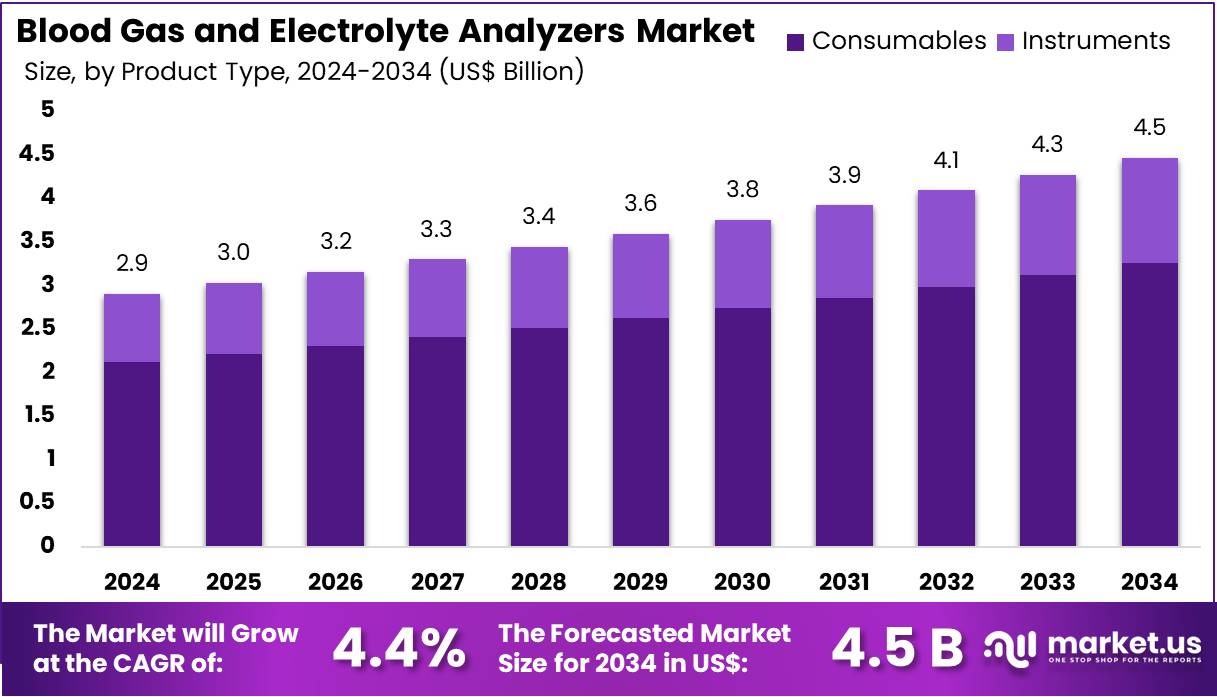
New York, NY – May 13, 2026 – The Global Blood Gas and Electrolyte Analyzers Market size is expected to be worth around US$ 4.5 Billion by 2034, from US$ 2.9 Billion in 2024, growing at a CAGR of 4.4% during the forecast period from 2025 to 2034. North America held a dominant market position, capturing more than a 43% share and holds US$ 1.3 Billion market value for the year.
The global market for Blood Gas and Electrolyte Analyzers is witnessing steady growth due to the increasing demand for rapid diagnostic testing across hospitals, emergency care units, and intensive care settings. Blood gas and electrolyte analyzers are advanced diagnostic instruments used to measure critical parameters such as pH, oxygen, carbon dioxide, sodium, potassium, calcium, and other electrolytes in blood samples. These analyzers support quick clinical decision-making and are widely utilized in critical care, respiratory care, and surgical procedures.
The rising prevalence of chronic diseases, including respiratory disorders, kidney diseases, and cardiovascular conditions, has significantly increased the need for accurate point-of-care diagnostics. In addition, the growing number of intensive care unit admissions and emergency cases is contributing to market expansion. Technological advancements such as automated calibration, compact analyzer systems, connectivity integration, and faster turnaround times are further enhancing product adoption across healthcare facilities.
North America currently holds a significant share of the market owing to advanced healthcare infrastructure and high adoption of diagnostic technologies. Meanwhile, the Asia-Pacific region is expected to witness notable growth due to expanding healthcare investments, increasing patient awareness, and improving access to diagnostic services.
Leading manufacturers are focusing on product innovation, strategic collaborations, and expansion into emerging markets to strengthen their competitive position and address the growing demand for efficient diagnostic solutions.
Key Takeaways
- The global Blood Gas and Electrolyte Analyzers market was valued at US$ 2.9 billion in 2023 and is projected to reach US$ 4.5 billion by 2033, expanding at a CAGR of 4.4% during the forecast period.
- Based on product type, the market is segmented into instruments and consumables. The consumables segment dominated the market in 2023, accounting for a 73% share.
- By end user, the market is categorized into point-of-care, clinical laboratories, diagnostic centers, and others. Among these, the clinical laboratories segment held a leading market share of 35% in 2023.
- North America emerged as the leading regional market, capturing 43.2% of the global market share in 2023.
Regional Analysis
North America accounted for the largest share of the Blood Gas and Electrolyte Analyzers market in 2023, supported by advanced healthcare infrastructure, increasing incidence of chronic diseases, and growing demand for rapid point-of-care diagnostic solutions. The region captured 43.2% of the global market revenue due to the strong presence of leading healthcare providers and continuous technological advancements in diagnostic equipment.
The rising prevalence of respiratory and kidney-related disorders has significantly contributed to market demand. Increasing cases of chronic obstructive pulmonary disease (COPD), acute kidney injury, and cardiovascular conditions have accelerated the need for regular blood gas and electrolyte monitoring across hospitals and emergency care settings. In addition, the growing number of emergency room visits and intensive care admissions has further strengthened the adoption of advanced analyzers.
Technological innovation remains a key growth driver in the region. Major companies are increasingly integrating artificial intelligence and automation into analyzer systems to improve diagnostic accuracy, efficiency, and turnaround time. Regulatory approvals for new analyzer models and favorable reimbursement policies for diagnostic testing have also supported market expansion.
Furthermore, the rising adoption of portable and home-based diagnostic analyzers is creating new growth opportunities, reinforcing North America’s leading position in the global market.
Emerging Trends
- Shift Toward Point-of-Care Testing (POCT): Healthcare facilities are increasingly adopting point-of-care testing using portable analyzers at the patient bedside. These devices deliver rapid results, reducing dependence on central laboratories. Faster diagnosis improves emergency response, supports efficient workflows, and enhances patient outcomes across ICUs, operating rooms, ambulances, and clinics worldwide.
- Integration with Electronic Health Records (EHR): Modern analyzers are integrated with electronic health record systems, enabling automatic result storage and real-time data sharing. This minimizes manual entry errors and improves workflow efficiency. Healthcare professionals can quickly access patient information, supporting faster clinical decisions and better coordination across hospital departments.
- Growing Demand for Compact and Portable Devices: Healthcare providers are increasingly preferring compact and portable analyzers due to their convenience and flexibility. These devices are ideal for space-constrained settings such as emergency rooms, intensive care units, and mobile clinics. Battery-powered functionality and rapid testing capabilities support efficient patient management anywhere.
- Automation and Reduced Human Error: Advanced analyzers now feature automation technologies such as self-calibration, touch-screen controls, and automated cleaning systems. These innovations reduce human error, improve testing accuracy, and simplify operation for healthcare staff. Automation also enhances laboratory productivity by enabling faster processing and consistent diagnostic performance.
- Rising Focus on Critical Care Monitoring: The increasing demand for critical care services is driving the adoption of blood gas and electrolyte analyzers. These devices provide rapid assessment of oxygen, carbon dioxide, pH, and electrolyte levels, helping clinicians manage severe conditions such as sepsis, respiratory failure, and trauma with greater precision.
- Sustainability and Eco-Friendly Consumables: Healthcare organizations are placing greater emphasis on sustainability and environmentally responsible practices. Manufacturers are responding by developing recyclable cartridges and low-waste reagent systems. These eco-friendly consumables help reduce medical waste, support regulatory compliance, and align healthcare operations with long-term environmental sustainability goals.
Use Cases
- Emergency Rooms (ER): Blood gas and electrolyte analyzers play a critical role in emergency departments by enabling rapid assessment of life-threatening conditions. They provide immediate measurements of oxygen, carbon dioxide, and acid-base balance, helping physicians make timely treatment decisions for trauma, overdose, and respiratory emergencies.
- Intensive Care Units (ICU): In intensive care units, analyzers support continuous monitoring of critically ill patients. They measure electrolyte levels, blood gases, and pH balance in real time, allowing healthcare professionals to quickly adjust medications, ventilator settings, and fluid therapy for patients with unstable medical conditions.
- Operating Rooms (Surgery): During surgical procedures, blood gas analyzers help monitor oxygenation, carbon dioxide levels, and acid-base status under anesthesia. Real-time data enables surgeons and anesthesiologists to maintain stable patient conditions, reduce surgical risks, and promptly address imbalances during complex heart, brain, or lung surgeries.
- Neonatal and Pediatric Care: Blood gas analyzers are widely used in neonatal and pediatric care for monitoring respiratory and metabolic conditions. These devices require only small blood samples, making them suitable for infants and premature babies. Rapid testing supports early intervention and reduces complications in vulnerable patients.
- Dialysis and Kidney Care: Patients undergoing dialysis require regular monitoring of electrolyte and acid-base balance. Blood gas and electrolyte analyzers provide accurate measurements of sodium, potassium, and bicarbonate levels, helping healthcare providers optimize dialysis treatment, manage medications, and reduce complications associated with chronic kidney disease.
- Respiratory Therapy: In respiratory therapy, blood gas analyzers assess lung function by measuring oxygen and carbon dioxide levels in the blood. These insights help clinicians manage conditions such as asthma, COPD, and respiratory infections while guiding oxygen therapy, ventilation support, and ongoing treatment effectiveness monitoring.
Frequently Asked Questions on Blood Gas and Electrolyte Analyzers
- How do blood gas and electrolyte analyzers work?
Blood gas and electrolyte analyzers operate using electrochemical sensors and selective electrodes that evaluate blood samples. The analyzers provide accurate measurements within minutes, enabling clinicians to assess respiratory function, acid-base balance, hydration levels, and electrolyte abnormalities during patient treatment procedures. - Where are blood gas and electrolyte analyzers commonly used?
Blood gas and electrolyte analyzers are widely used in hospitals, intensive care units, emergency departments, operating rooms, and diagnostic laboratories. These devices are particularly important during critical care management, surgical procedures, and monitoring patients suffering from respiratory or metabolic disorders. - What are the major advantages of blood gas and electrolyte analyzers?
The major advantages of blood gas and electrolyte analyzers include rapid test results, improved clinical decision-making, reduced turnaround time, and enhanced patient monitoring. Compact analyzer designs and automated workflows also contribute to operational efficiency and increased diagnostic accuracy in healthcare facilities. - Which parameters are measured using blood gas and electrolyte analyzers?
Blood gas and electrolyte analyzers measure several critical parameters including pH, partial pressure of oxygen, partial pressure of carbon dioxide, bicarbonate concentration, sodium, potassium, calcium, chloride, and glucose. These measurements assist physicians in evaluating overall physiological and metabolic conditions effectively. - What is driving the growth of the blood gas and electrolyte analyzers market?
The growth of the blood gas and electrolyte analyzers market is primarily driven by increasing critical care admissions, rising prevalence of chronic respiratory diseases, growing demand for point-of-care diagnostics, and continuous technological advancements that improve analyzer accuracy, portability, and operational efficiency. - What trends are shaping the blood gas and electrolyte analyzers market?
Key trends shaping the blood gas and electrolyte analyzers market include increasing adoption of portable analyzers, integration of digital connectivity solutions, rising focus on point-of-care testing, and development of automated systems that improve workflow efficiency and minimize manual intervention during diagnostic procedures.
Conclusion
The global Blood Gas and Electrolyte Analyzers market is expected to witness steady growth driven by rising demand for rapid and accurate diagnostic solutions in critical care settings. Increasing prevalence of respiratory, kidney, and cardiovascular diseases, along with growing ICU admissions and emergency cases, continues to support market expansion.
Technological advancements such as portable analyzers, automation, EHR integration, and point-of-care testing are improving diagnostic efficiency and patient outcomes. North America remains the leading regional market, while Asia-Pacific presents significant growth opportunities due to expanding healthcare infrastructure and increasing healthcare investments. Continuous innovation and strategic expansion will remain key competitive priorities.
Discuss your needs with our analyst
Please share your requirements with more details so our analyst can check if they can solve your problem(s)




