


Overview
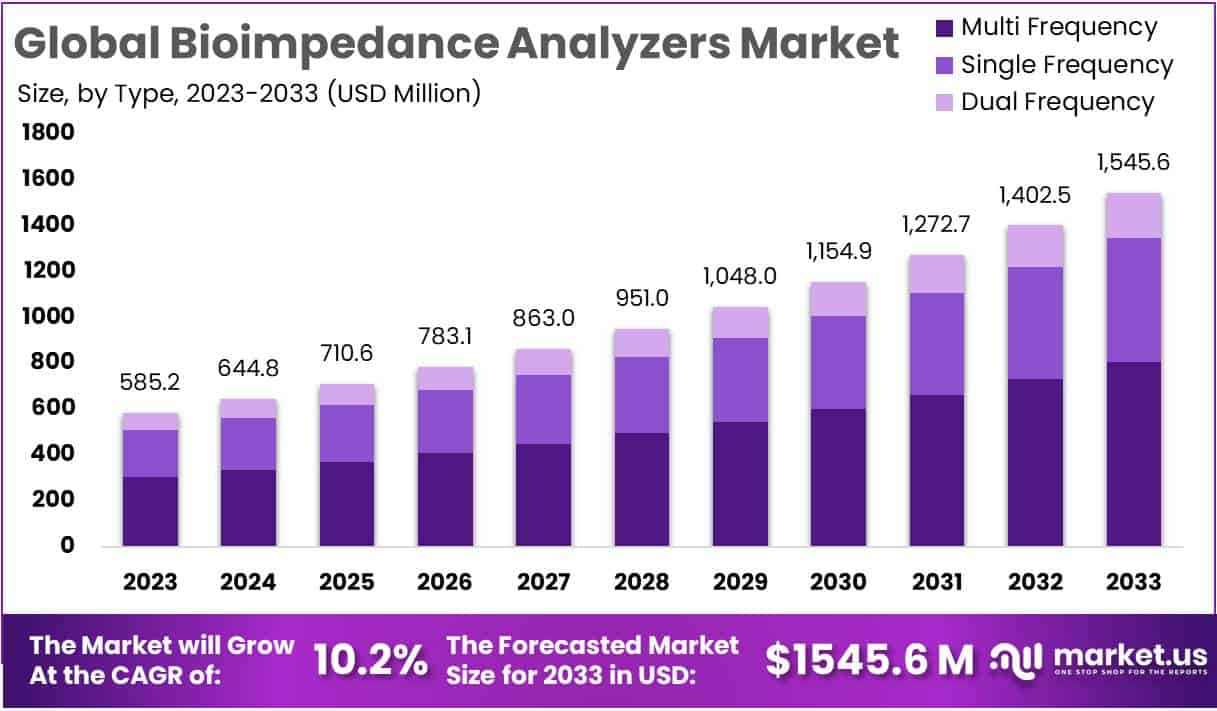
New York, NY – July 22, 2026 – The Global Bioimpedance Analyzers Market Size is projected to witness substantial growth, with an anticipated value of approximately USD 1545.6 Million by the year 2033, compared to USD 585.2 Million in 2023. This growth is forecasted to occur at a CAGR of 10.2% throughout the forecast period spanning from 2024 to 2033.
Bioimpedance analyzers are advanced diagnostic devices designed to assess body composition by measuring the resistance and reactance of body tissues to a safe, low-level electrical current. These analyzers provide detailed information on body fat percentage, muscle mass, body water distribution, visceral fat, bone mass, and other key health indicators. They are widely used in hospitals, clinics, fitness centers, sports science laboratories, research institutions, and wellness facilities for nutritional assessment, disease management, and physical performance monitoring.
The growing emphasis on preventive healthcare, personalized nutrition, and fitness tracking has significantly increased the adoption of bioimpedance analyzers across both clinical and non-clinical settings. Healthcare professionals use these devices to monitor patients with obesity, diabetes, cardiovascular diseases, kidney disorders, and other chronic conditions, while fitness professionals rely on them to develop customized training and nutrition programs.
Technological advancements, including multi-frequency bioelectrical impedance analysis (MF-BIA), segmental body composition analysis, cloud-based data management, and integration with digital health platforms, have improved the accuracy, efficiency, and accessibility of these systems. Portable and user-friendly designs have further expanded their application in home healthcare and remote patient monitoring.
As demand for evidence-based health assessment and personalized wellness solutions continues to rise, bioimpedance analyzers are expected to play an increasingly important role in supporting informed clinical decisions, preventive healthcare initiatives, and long-term health management worldwide.
Key Takeaways
- Market Growth Projection: The Bioimpedance Analyzers Market is projected to reach USD 1,545.6 million by 2033, expanding at a CAGR of 10.2% during 2024–2033.
- Type Analysis: The Multi Frequency segment accounted for the largest market share of 52.1% in 2023, supported by its broad analytical capabilities.
- Application Analysis: The Segmental Body Measurement segment dominated the market with a 63.2% share in 2023, reflecting strong demand for detailed body composition assessment.
- End-User Analysis: Hospitals emerged as the leading end-user segment, securing a 63.2% market share in 2023, driven by extensive clinical adoption.
- Regional Analysis: North America led the global market with a 43.5% share in 2023, reaching a market value of USD 254.5 million, supported by advanced healthcare infrastructure and high technology adoption.
Regional Analysis
In 2023, North America accounted for the largest share of the Bioimpedance Analyzers Market, representing 43.5% of the global market and reaching a value of USD 254.5 million. The region’s leadership is supported by its advanced healthcare infrastructure, which enables the widespread adoption of innovative diagnostic technologies across hospitals, clinics, and research institutions.
High healthcare expenditure and the presence of well-equipped medical facilities have further accelerated the use of bioimpedance analyzers for body composition and fluid status assessment. Additionally, stringent regulatory standards have strengthened confidence in the accuracy, safety, and reliability of these devices, encouraging their integration into routine clinical practice.
Rising awareness among healthcare professionals and patients regarding the clinical benefits of bioimpedance analysis has also contributed to market expansion. Ongoing educational initiatives and product innovations by leading manufacturers continue to support adoption. Looking ahead, North America is expected to retain its leading position, driven by continued technological advancements, digital healthcare integration, and increasing demand for precision diagnostic solutions.
Emerging Trends
- Integration with Digital Health Technologies: Bioimpedance analyzers increasingly connect with mobile applications, cloud platforms, and wearable devices to enable continuous health monitoring. This integration supports remote patient care, personalized health management, real-time body composition tracking, and preventive healthcare while improving communication between patients and healthcare professionals.
- Advancements in Technology: Technological advancements, including multi-frequency analysis and bioimpedance spectroscopy, are improving measurement accuracy for body composition and hydration. Enhanced sensitivity enables better assessment of fat, muscle, and fluid distribution, supporting earlier disease detection and more reliable diagnostics across clinical and home healthcare settings.
- Portability and Accessibility: Portable and wearable bioimpedance analyzers make body composition monitoring more convenient and accessible. Compact designs support continuous health tracking outside clinical settings, benefiting remote populations, reducing healthcare costs, encouraging preventive care, and enabling wider adoption of non-invasive health monitoring solutions worldwide.
- Use in Clinical Research: Bioimpedance analyzers are increasingly used in clinical research to evaluate body composition, nutrition, obesity, and chronic diseases. Their non-invasive nature supports long-term studies, generating reliable data that advances personalized medicine, public health research, disease prevention strategies, and evidence-based healthcare innovations.
- Economic Impact and Innovation: Growing demand for bioimpedance analyzers is driving investments, technological innovation, and employment across healthcare and medical device industries. Increasing competition encourages product improvements, affordability, and expanded adoption, supporting digital healthcare transformation, preventive medicine, and sustainable market growth across global healthcare systems.
Use Cases
- Health Monitoring and Management: Bioimpedance analyzers help monitor body fat, muscle mass, and hydration levels to support routine health assessments. Healthcare providers use these measurements to develop personalized treatment plans, detect health risks early, monitor patient progress, and improve long-term disease management and preventive care.
- Fitness and Wellness Tracking: Fitness professionals and individuals use bioimpedance analyzers to measure body composition, monitor training progress, and optimize workout programs. Accurate insights into fat, muscle, and hydration levels support personalized fitness plans, performance improvement, motivation, and healthier lifestyle decisions over time.
- Medical Diagnostics: Bioimpedance analyzers assist healthcare professionals in diagnosing and monitoring conditions including malnutrition, dehydration, lymphedema, kidney disease, and heart failure. Their non-invasive measurements provide valuable information on fluid balance and body composition, supporting timely treatment decisions and improved patient management.
- Research Applications: Researchers use bioimpedance analyzers to evaluate body composition changes in clinical studies, nutrition programs, sports science, and public health research. Reliable measurements support investigations into obesity, hydration, muscle development, treatment outcomes, and evidence-based healthcare practices across diverse population groups.
- Remote Patient Monitoring: Wearable bioimpedance analyzers enable continuous remote monitoring of body composition, hydration, and fluid balance for patients with chronic conditions. Real-time data supports telemedicine, early disease detection, personalized care, reduced hospital visits, and improved health outcomes through proactive medical intervention.
Frequently Asked Questions on Bioimpedance Analyzers
- What is driving the growth of the Bioimpedance Analyzers Market?
The Bioimpedance Analyzers Market is expanding due to the rising prevalence of obesity and chronic diseases, increasing demand for preventive healthcare, growing awareness of body composition analysis, and continuous technological advancements. Expanding healthcare infrastructure and the integration of digital health solutions are also supporting long-term market growth. - Which type of bioimpedance analyzer is most widely used?
Multi-frequency bioimpedance analyzers are the most widely adopted type because they provide more accurate and detailed body composition measurements than single-frequency devices. Their ability to assess intracellular and extracellular fluids makes them suitable for clinical diagnostics, sports medicine, and advanced healthcare applications. - Which application dominates the Bioimpedance Analyzers Market?
Segmental body measurement represents the leading application in the Bioimpedance Analyzers Market because it provides detailed analysis of individual body regions. This capability supports improved diagnosis, personalized treatment planning, rehabilitation monitoring, and fitness assessments, making it highly valuable in both clinical and wellness settings. - Which end-user segment accounts for the largest market share?
Hospitals account for the largest share of the Bioimpedance Analyzers Market due to the extensive use of these devices in patient diagnosis, nutritional assessment, fluid management, and chronic disease monitoring. Their availability of advanced healthcare infrastructure further supports widespread adoption across clinical departments. - Which region leads the Bioimpedance Analyzers Market?
North America leads the Bioimpedance Analyzers Market owing to its advanced healthcare infrastructure, high healthcare spending, favorable reimbursement environment, and rapid adoption of innovative medical technologies. Strong research activities and the presence of leading manufacturers further strengthen the region’s dominant market position. - What industries use bioimpedance analyzers besides healthcare?
Apart from healthcare, bioimpedance analyzers are widely used in sports and fitness, wellness centers, academic research, pharmaceutical studies, nutrition consulting, and corporate wellness programs. These industries utilize the technology to monitor body composition, evaluate health outcomes, and improve performance management strategies. - Who are the key customers for bioimpedance analyzers?
The primary customers include hospitals, diagnostic centers, rehabilitation clinics, research organizations, fitness centers, sports institutions, and home healthcare users. Growing demand for personalized healthcare and preventive health monitoring continues to expand the customer base across both medical and consumer markets. - What is the future outlook for the Bioimpedance Analyzers Market?
The Bioimpedance Analyzers Market is expected to witness steady growth over the coming years, supported by technological innovations, increasing adoption of digital healthcare, expanding applications in disease management, and rising demand for non-invasive diagnostic solutions. Continuous product development is expected to create additional growth opportunities globally.
Conclusion
The Bioimpedance Analyzers Market is expected to experience sustained growth, driven by increasing demand for preventive healthcare, personalized nutrition, and non-invasive body composition assessment. Continuous technological advancements, including multi-frequency analysis, digital health integration, and portable device development, are expanding clinical and consumer applications.
Hospitals remain the primary end users, while adoption is also rising across fitness, research, and home healthcare settings. North America continues to lead the market due to its advanced healthcare infrastructure and strong technology adoption. As awareness of health monitoring and chronic disease management grows, bioimpedance analyzers are expected to play an increasingly important role in global healthcare and wellness.
Discuss your needs with our analyst
Please share your requirements with more details so our analyst can check if they can solve your problem(s)




