


Overview
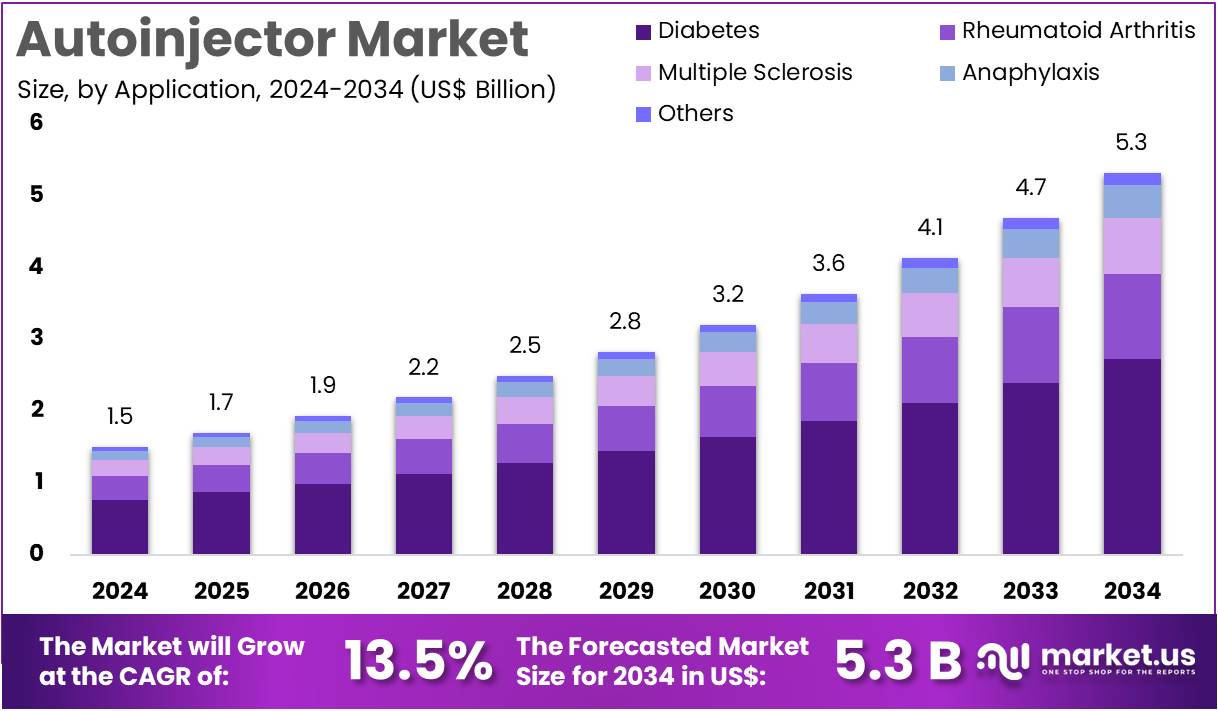
New York, NY – May 28, 2026 – The Global Autoinjector Market Size is expected to be worth around US$ 5.3 Billion by 2034, from US$ 1.5 Billion in 2024, growing at a CAGR of 13.5% during the forecast period from 2025 to 2034.
Autoinjectors are advanced medical devices designed to deliver a pre-measured dose of medication quickly and safely with minimal user intervention. These devices are widely used in emergency treatment applications, including anaphylaxis, rheumatoid arthritis, multiple sclerosis, diabetes, and migraine management. Autoinjectors improve patient convenience, reduce administration errors, and support self-administration, making them increasingly important in modern healthcare systems.
The growing prevalence of chronic diseases and the rising demand for home-based healthcare solutions are contributing significantly to the expansion of the global autoinjector market. Technological advancements such as ergonomic designs, needle safety mechanisms, reusable injectors, and connected smart devices are further enhancing product adoption across hospitals, clinics, and homecare settings.
Pharmaceutical and biotechnology companies are increasingly investing in the development of patient-friendly drug delivery systems to improve treatment adherence and patient outcomes. In addition, favorable regulatory approvals and increasing awareness regarding self-injection therapies are supporting market growth worldwide.
North America currently holds a substantial share of the market due to strong healthcare infrastructure and high adoption of advanced medical technologies, while Asia-Pacific is expected to witness notable growth owing to expanding healthcare access and rising healthcare expenditure.
The autoinjector market is expected to experience steady growth in the coming years, driven by innovation, increasing healthcare awareness, and growing demand for efficient drug delivery systems.
Key Takeaways
- The global autoinjector market was valued at US$ 1.5 billion in 2023 and is projected to reach US$ 5.3 billion by 2033, expanding at a CAGR of 13.5% during the forecast period.
- Based on product type, the market is categorized into disposable and reusable autoinjectors. The disposable segment dominated the market in 2023, accounting for a revenue share of 61.5%.
- By application, the market is segmented into rheumatoid arthritis, diabetes, multiple sclerosis, anaphylaxis, and others. Among these, the diabetes segment held the largest market share of 51.2% in 2023.
- In terms of end users, the market is divided into hospitals & clinics, homecare settings, and ambulatory surgical centers. Hospitals & clinics emerged as the leading segment, capturing 58.3% of the overall market revenue in 2023.
- North America accounted for the highest regional share in the global autoinjector market, representing 42.1% of the total market revenue in 2023.
Regional Analysis
North America accounted for the largest share of the autoinjector market in 2023, driven by the rising prevalence of chronic diseases such as diabetes and rheumatoid arthritis, along with the presence of advanced healthcare infrastructure. The region benefits from strong insurance coverage, increasing adoption of self-administration therapies, and the availability of technologically advanced autoinjector products. In addition, the presence of major pharmaceutical and medical device manufacturers continues to support market expansion across the region.
Meanwhile, Asia Pacific is anticipated to register the fastest CAGR during the forecast period due to the growing burden of chronic diseases and increasing healthcare investments. Rising awareness regarding self-injection therapies, improving healthcare accessibility, and expanding home healthcare services are accelerating market growth in the region. Furthermore, the increasing adoption of biologic drugs for autoimmune disorders and the large diabetic patient population are expected to create significant growth opportunities for the autoinjector market across Asia Pacific.
Emerging Trends
- Smart Autoinjectors with Connectivity: Smart autoinjectors are gaining popularity due to Bluetooth connectivity and mobile app integration. These devices provide dose reminders, treatment tracking, and remote monitoring features. The technology improves medication adherence, supports digital healthcare trends, and helps patients manage chronic conditions more efficiently at home.
- Rise in Home-Based Treatments: The shift toward home-based healthcare is increasing demand for autoinjectors. Patients with chronic conditions can safely self-administer treatments without frequent hospital visits. These devices improve convenience, reduce healthcare costs, and support independent care, aligning with the rapid growth of telehealth and remote patient management.
- Focus on Needle Safety and Comfort: Manufacturers are developing autoinjectors with hidden needles and smoother injection systems to reduce patient anxiety and discomfort. User-friendly designs improve treatment adherence, especially among children and first-time users. Enhanced safety features also lower accidental injury risks and support a better injection experience overall.
- Custom Designs for Different Drugs: Companies are increasingly designing customized autoinjectors tailored to specific drug requirements, including injection speed, needle size, and pressure levels. These specialized devices improve drug compatibility, ensure accurate dosing, and support the growing demand for biologic and biosimilar therapies across multiple therapeutic applications.
- Eco-Friendly and Recyclable Devices: Sustainability is becoming an important focus in the autoinjector market, leading manufacturers to develop reusable and recyclable devices. Reduced plastic usage and refillable cartridge systems help minimize medical waste while lowering long-term treatment costs, supporting environmentally responsible healthcare practices and growing consumer preference for greener products.
Use Cases
- Insulin Delivery for Diabetes Patients: Autoinjectors provide diabetes patients with a fast, accurate, and convenient method for insulin administration. These devices simplify multiple daily injections, reduce dosing errors, and improve treatment adherence. Their ease of use also supports better blood sugar management and greater confidence among patients with active lifestyles.
- Emergency Treatment for Allergic Reactions: Epinephrine autoinjectors play a critical role in managing severe allergic reactions by delivering emergency medication quickly and accurately. Their portable and easy-to-use design allows rapid treatment in public places, schools, or homes, helping reduce life-threatening complications associated with anaphylaxis and severe allergic responses.
- Multiple Sclerosis (MS) Injections: Autoinjectors help multiple sclerosis patients manage regular disease-modifying drug injections more comfortably at home. These devices provide steady medication delivery, reduce injection discomfort, and improve treatment consistency. Advanced features such as reminder systems also help minimize missed doses and support long-term disease management.
- Arthritis Treatment at Home: Autoinjectors support rheumatoid arthritis patients by simplifying self-injection procedures and reducing hand strain caused by traditional syringes. Easy-grip designs and button-based operation improve independence, helping patients continue treatments consistently while managing pain, stiffness, and mobility limitations effectively from home settings.
- Hormone Therapy Treatments: Autoinjectors are widely used for hormone therapies, including fertility and growth hormone treatments, due to their accuracy and convenience. Features such as dose counters, safety caps, and easy self-administration improve treatment adherence while providing patients with greater comfort, privacy, and control over therapy routines.
- Migraine Relief Injections: Migraine autoinjectors enable patients to administer fast-acting medication quickly during sudden migraine attacks. Their portable and easy-to-use design supports immediate treatment without requiring clinical assistance. Rapid symptom relief helps reduce migraine-related disruptions and improves overall quality of life for chronic migraine sufferers.
Frequently Asked Questions on Autoinjector
- What factors are driving the growth of the autoinjector market?
The autoinjector market is growing due to the increasing prevalence of chronic diseases, rising demand for self-administration devices, and expanding home healthcare services. Technological advancements, improved patient compliance, and increasing adoption of biologic therapies are also supporting market expansion globally. - Which applications commonly use autoinjectors?
Autoinjectors are widely used for treating conditions such as diabetes, rheumatoid arthritis, multiple sclerosis, anaphylaxis, and migraine disorders. Their ability to provide rapid and accurate drug delivery has increased their adoption across hospitals, clinics, and homecare settings worldwide. - Why are disposable autoinjectors gaining popularity?
Disposable autoinjectors are gaining popularity because they are user-friendly, reduce contamination risks, and eliminate the need for maintenance or cartridge replacement. These devices are preferred in emergency care and chronic disease treatment due to their convenience and safety features. - Which region dominates the autoinjector market?
North America currently dominates the autoinjector market due to advanced healthcare infrastructure, high healthcare spending, and strong adoption of self-injection therapies. The presence of leading pharmaceutical companies and increasing chronic disease cases further contributes to regional market growth. - Who are the major end users in the autoinjector market?
Hospitals and clinics represent the largest end-user segment in the autoinjector market because of the high volume of patient treatments and emergency care procedures. However, homecare settings are also witnessing significant adoption due to the convenience of self-administration devices. - What technological advancements are influencing the autoinjector market?
Technological innovations such as smart autoinjectors, reusable devices, ergonomic designs, and safety needle mechanisms are improving patient experience and treatment adherence. These advancements are helping manufacturers develop more efficient and patient-friendly drug delivery systems for various medical applications.
Conclusion
The global autoinjector market is witnessing strong growth due to the increasing prevalence of chronic diseases, rising demand for self-administration therapies, and continuous advancements in drug delivery technologies. The growing adoption of disposable and smart autoinjectors, along with expanding home healthcare services, is further supporting market expansion.
North America continues to dominate the market owing to its advanced healthcare infrastructure, while Asia Pacific is expected to register the fastest growth due to increasing healthcare investments and a large patient population. Ongoing innovations in safety features, connectivity, and eco-friendly designs are expected to enhance patient convenience and improve treatment outcomes, creating significant opportunities for manufacturers and healthcare providers in the coming years.
Discuss your needs with our analyst
Please share your requirements with more details so our analyst can check if they can solve your problem(s)




