


Overview
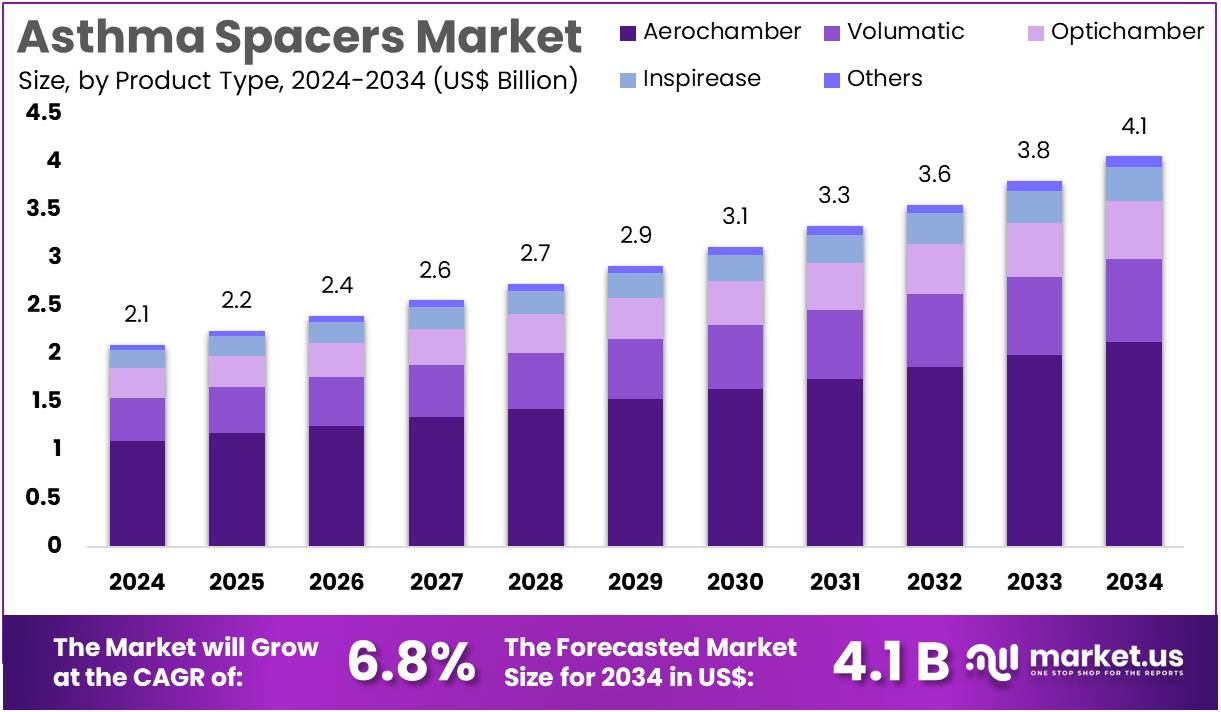
New York, NY – May 28, 2026 – The Global Asthma Spacers Market size is expected to be worth around US$ 4.1 billion by 2034 from US$ 2.1 billion in 2024, growing at a CAGR of 6.8% during the forecast period 2025 to 2034.
Asthma spacers are essential medical devices designed to improve the delivery of inhaled medication for patients suffering from asthma and other respiratory disorders. Used in combination with metered-dose inhalers (MDIs), spacers help ensure that medication reaches the lungs more effectively while reducing deposition in the mouth and throat. These devices are particularly beneficial for children, elderly patients, and individuals who experience difficulty coordinating inhaler activation with breathing.
The increasing global prevalence of asthma and chronic respiratory diseases has significantly contributed to the demand for asthma spacers. According to healthcare organizations, rising air pollution levels, smoking habits, and changing lifestyles are key factors driving respiratory health concerns worldwide. In response, healthcare providers are increasingly recommending spacer devices as part of standard asthma management practices.
Technological advancements in spacer design, including anti-static materials, portable models, and user-friendly masks, are further supporting market growth. In addition, growing awareness campaigns regarding proper inhaler techniques are encouraging wider adoption of these devices across hospitals, clinics, and homecare settings.
North America and Europe currently represent major markets due to strong healthcare infrastructure and high awareness levels, while Asia-Pacific is expected to witness notable growth driven by expanding healthcare access and increasing respiratory disease incidence.
Key Takeaways
- The global asthma spacers market was valued at US$ 4.1 billion in 2024 and is projected to expand at a CAGR of 6.8% during the forecast period through 2034.
- Based on product type, the market is segmented into aerochamber, volumatic, optichamber, inspirease, and others. Among these, the aerochamber segment dominated the market in 2024, accounting for a 52.5% share.
- By end-user, the market is categorized into hospitals, home care, and outpatient facilities. The hospitals segment emerged as the leading contributor, holding a market share of 58.7% in 2024.
- North America accounted for the largest regional share in the global asthma spacers market, representing 39.7% of the total market revenue in 2024.
Regional Analysis
North America accounted for the largest share of the Asthma Spacers Market in 2024, driven by the high prevalence of asthma and the presence of advanced healthcare infrastructure across the region. The growing number of asthma patients in the United States continues to generate strong demand for effective respiratory care devices, including asthma spacers.
In addition, favorable reimbursement policies and broad insurance coverage for respiratory support equipment are improving patient accessibility to these products. Awareness programs conducted by healthcare organizations to encourage proper inhaler usage and spacer adoption are further supporting market growth. The strong presence of major manufacturers and established distribution networks also contributes to the region’s market leadership.
Meanwhile, the Asia Pacific region is anticipated to register the fastest CAGR during the forecast period. Rising awareness regarding asthma management, increasing healthcare expenditure, and improving medical infrastructure are key factors accelerating regional growth.
Countries such as China and India are witnessing a growing burden of respiratory diseases due to urbanization, pollution, and changing lifestyles, which is increasing demand for asthma management solutions. Government initiatives aimed at expanding respiratory healthcare access and the growing middle-class population with higher healthcare spending capacity are expected to further support market expansion across the region.
Emerging Trends
- Smart Spacers Are Gaining Popularity: Smart asthma spacers are gaining popularity as they include sensors that track inhaler usage and monitor correct techniques. Connected mobile apps provide reminders and treatment reports, helping improve medication adherence and asthma control, especially among children and elderly patients requiring continuous respiratory monitoring.
- More Focus on Anti-Static Spacer Materials: Manufacturers are increasingly using anti-static materials in asthma spacers to reduce medicine sticking inside the chamber. This improves drug delivery efficiency and ensures more medication reaches the lungs. The trend supports better treatment outcomes, particularly for children and elderly patients with inhaler coordination difficulties.
- Increased Use in Home-Based Care: Asthma spacers are witnessing higher adoption in home-based care due to their simplicity, safety, and convenience. Patients can manage respiratory conditions effectively without frequent hospital visits. Rising preference for home healthcare is increasing demand for user-friendly spacers across pediatric, adult, and geriatric patient groups.
- Child-Friendly Spacer Designs Are in Demand: Demand for child-friendly asthma spacers is increasing as companies develop colorful, soft, and easy-to-use products for pediatric patients. Features such as comfortable face masks and attractive cartoon designs improve treatment cooperation, helping children receive accurate medication doses and supporting better long-term asthma management.
Use Cases
- Improving Medicine Delivery in Children: Asthma spacers improve medicine delivery in children by reducing inhaler coordination challenges and allowing more medication to reach the lungs effectively. These devices minimize drug loss in the mouth and throat, making asthma treatment safer, easier, and more efficient for young patients requiring respiratory support.
- Managing Severe Asthma in Elderly Patients: Spacers help elderly asthma patients by simplifying inhaler usage and reducing coordination difficulties during medication delivery. Improved drug absorption supports better symptom control and lowers the risk of side effects. Healthcare providers increasingly recommend spacers to enhance daily respiratory care among aging populations.
- Supporting Emergency Asthma Treatment in Hospitals: Hospitals are increasingly using asthma spacers during emergency treatments because they provide fast, cost-effective bronchodilator delivery. Compared to nebulizers, spacers require less setup time and equipment. Their ease of use improves patient comfort and helps accelerate recovery during mild to moderate asthma attacks.
- Helping Patients During Physical Activity: Asthma spacers support active individuals by improving medicine delivery before physical exercise and reducing breathing difficulties during workouts. Athletes and fitness enthusiasts use spacers to lower asthma-related disruptions during sports activities, helping maintain performance and enabling safer participation in outdoor and high-intensity exercises.
Frequently Asked Questions on Asthma Spacers
- How do asthma spacers improve inhaler effectiveness?
Asthma spacers slow down the speed of aerosol medication released from inhalers, allowing patients to inhale medicine more efficiently. This process enhances drug deposition into the lungs, minimizes coordination errors, and supports more effective asthma management among users. - Who commonly uses asthma spacers?
Asthma spacers are widely used by children, elderly individuals, and patients experiencing difficulty coordinating inhaler usage. Healthcare professionals often recommend these devices for individuals requiring improved medication delivery, particularly in chronic asthma and respiratory care management. - What are the major types of asthma spacers available?
The asthma spacer market includes valved holding chambers, non-valved spacers, and anti-static spacers. These products are available in different sizes and materials to meet varying patient requirements, healthcare standards, and respiratory treatment preferences across global markets. - Which regions dominate the asthma spacers market?
North America currently dominates the asthma spacers market because of advanced healthcare infrastructure, higher asthma diagnosis rates, and strong awareness regarding respiratory treatment. Europe and Asia-Pacific are also witnessing considerable growth due to improving healthcare accessibility and rising patient populations. - How are technological advancements influencing asthma spacers?
Technological innovations are improving spacer design, portability, and anti-static performance, enhancing patient convenience and medication efficiency. Manufacturers are increasingly focusing on user-friendly products and sustainable materials to strengthen product adoption and maintain competitive positioning within the market. - What role do hospitals and pharmacies play in the asthma spacers market?
Hospitals, retail pharmacies, and online distribution channels play a vital role in expanding asthma spacer accessibility. These channels support patient education, product availability, and healthcare consultations, thereby contributing to stronger product penetration and increasing market demand globally. - How do government healthcare programs influence the asthma spacers market?
Government healthcare programs support the asthma spacers market through awareness campaigns, respiratory disease management initiatives, and improved healthcare access. Favorable reimbursement policies and public health investments encourage wider adoption of asthma management devices across various patient populations. - What materials are commonly used in manufacturing asthma spacers?
Asthma spacers are commonly manufactured using plastic, silicone, and anti-static materials to improve durability and medication delivery performance. Manufacturers increasingly focus on lightweight, reusable, and environmentally sustainable materials to align with evolving healthcare and regulatory requirements.
Conclusion
The global asthma spacers market is witnessing steady growth due to the increasing prevalence of asthma and respiratory disorders worldwide. Rising awareness regarding effective inhaler techniques, growing adoption of home healthcare solutions, and technological advancements such as smart and anti-static spacers are significantly supporting market expansion.
North America continues to dominate the market owing to strong healthcare infrastructure and high patient awareness, while Asia-Pacific is emerging as a high-growth region driven by increasing healthcare access and pollution-related respiratory conditions. With continuous product innovation and supportive government healthcare initiatives, the asthma spacers market is expected to experience sustained demand and long-term growth during the forecast period.



