


Overview
New York, NY – Sep 15, 2026 –The Global Fungal Testing Kits Market size is expected to reach around US$ 5.3 Billion by 2034, up from US$ 2.0 Billion in 2024, growing at a CAGR of 10.2% during the forecast period 2025 to 2034. In 2024, North America led the market, achieving over 39.9% market share with revenue of US$ 0.8 Billion.
Fungal testing kits are experiencing significant expansion due to the increasing incidence of fungal infections, growing healthcare expenditure, and rising demand for rapid and accurate diagnostic technologies. The market includes molecular testing kits, antigen detection kits, culture-based testing solutions, and other advanced diagnostic platforms used for identifying fungal pathogens.
Industry analysis indicates that the global fungal testing kits market was valued at approximately USD 1.4–1.6 billion in 2024 and is expected to reach around USD 2.8–3.2 billion by 2032, registering a CAGR of nearly 8–9% during 2025–2032. The increasing burden of fungal diseases is a major growth factor, with global estimates suggesting that over 6 million people are affected annually by serious invasive fungal infections, resulting in more than 3.7 million deaths worldwide each year.
The demand for fungal diagnostic kits is rising as healthcare providers focus on early detection and improved treatment outcomes. PCR-based testing kits account for a substantial share of the market due to their high sensitivity, rapid turnaround time, and ability to detect infections within hours compared with traditional culture methods that may require 2–7 days for results.
Hospitals and diagnostic laboratories represent key end users, contributing significantly to market revenue. North America currently holds a leading position, supported by advanced healthcare infrastructure, while Asia-Pacific is projected to grow at a faster pace with increasing healthcare investments, expanding diagnostic facilities, and rising awareness of infectious disease testing.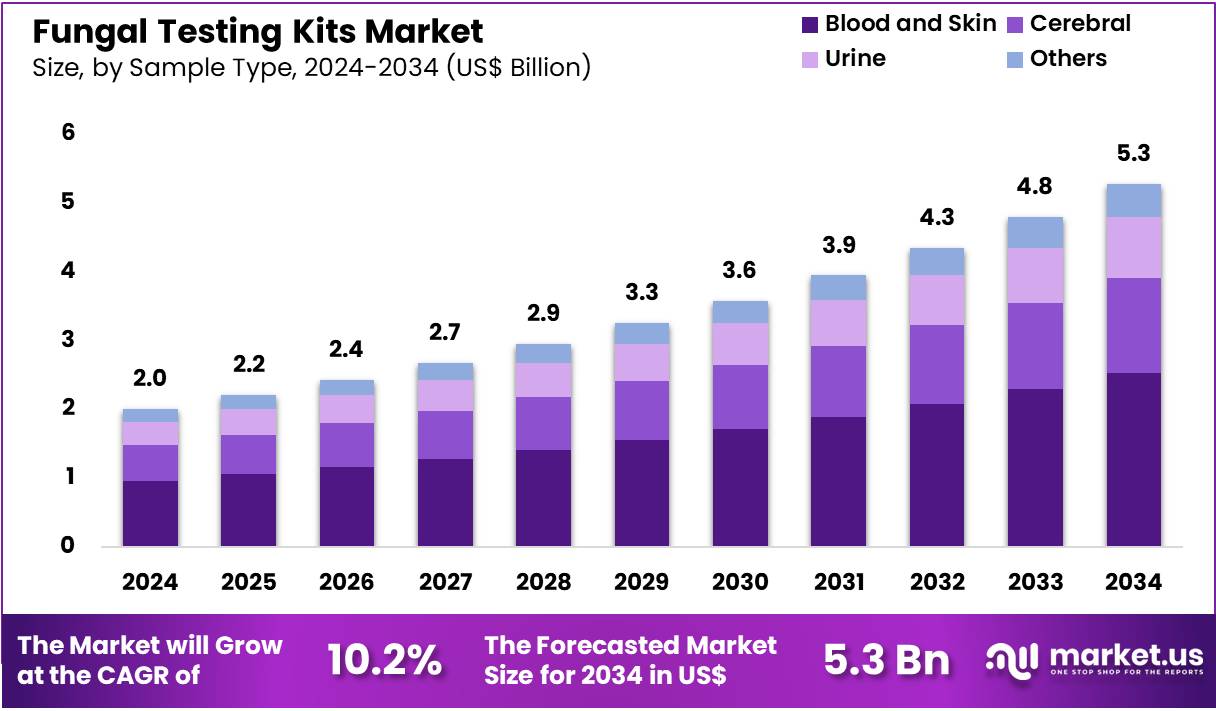
Key Takeaways
- In 2024, the fungal testing kits market generated a revenue of US$ 2.0 billion and is projected to expand at a CAGR of 10.2%, reaching an estimated US$ 5.3 billion by 2034.
- Based on test type, the market is segmented into molecular testing, chromogenic testing, and other testing methods. Among these, molecular testing dominated the market in 2024, accounting for the largest share of 52.6%.
- By sample type, the market is categorized into blood & skin, cerebral, urine, and other sample types. The blood & skin segment emerged as the leading category in 2024, capturing a significant market share of 47.9%.
- In terms of application, the market is divided into research, medical diagnosis, susceptibility testing, and other applications. The research segment held the dominant position, contributing the highest revenue share of 44.7% in 2024.
- Based on end users, the market is segmented into diagnostic laboratories, hospitals, research & academic institutes, and pharmaceutical companies. The diagnostic laboratory segment led the market, accounting for a revenue share of 49.1% in 2024.
- Regionally, North America dominated the global fungal testing kits market in 2024, securing a market share of 39.9%, supported by advanced healthcare infrastructure, increasing diagnostic adoption, and strong research activities.
Market Segmentation Overview
- Test Type Analysis: Molecular testing dominated the market in 2024 with a 52.6% share and is expected to maintain leadership due to high sensitivity, faster results, and accurate detection of difficult-to-identify fungal pathogens. Increasing cases of candidiasis and aspergillosis, rising demand for PCR-based diagnostics, and adoption of multiplex molecular panels are driving segment growth.
- Sample Type Analysis: Blood and skin samples accounted for 47.9% of the market share in 2024, making them the leading sample type due to their clinical relevance and easy collection. Growing cases of bloodstream fungal infections, skin mycoses, and increasing use of molecular and chromogenic kits support continued demand across hospitals and diagnostic laboratories.
- Application Analysis: Research applications held the largest market share of 44.7% in 2024, driven by increasing studies on fungal genomics, antifungal resistance, and emerging fungal pathogens. Rising investments in infectious disease research, genome sequencing projects, and collaborations between pharmaceutical companies and academic institutions are increasing the adoption of advanced fungal testing kits for research purposes.
- End-User Analysis: Diagnostic laboratories dominated the end-user segment with a 49.1% revenue share in 2024 due to their high testing volume and critical role in fungal infection identification. Growing patient screening needs, adoption of automated diagnostic systems, and demand for rapid molecular and chromogenic testing solutions continue to strengthen laboratory adoption worldwide.
Statistical Information
- Rising Burden of Fungal Infections Increasing Demand for Diagnostic Testing: The increasing prevalence of fungal infections is creating greater demand for reliable diagnostic solutions. In the United States, fungal diseases contribute significantly to healthcare challenges, with the CDC reporting approximately 13 million outpatient visits, 75,000 hospitalizations, and around 7,300 deaths annually linked to fungal diseases. The growing disease burden is encouraging healthcare systems to strengthen fungal detection and laboratory testing capabilities.
- Rising Candida auris Cases Driving Need for Advanced Diagnostic Testing: The rapid spread of drug-resistant Candida auris is increasing the need for specialized fungal testing technologies. CDC surveillance data shows that reported U.S. clinical cases increased from 48 cases in 2016 to 6,304 cases in 2024, with a total of 17,091 clinical cases reported between 2016 and 2024. The difficulty in identifying and controlling this pathogen has increased reliance on advanced laboratory diagnostics.
- Increasing Aspergillus Infections Creating Demand for Early Detection Methods: The growing impact of Aspergillus infections is supporting demand for improved fungal diagnostic technologies. CDC data shows that invasive aspergillosis-related hospitalizations in the United States reached nearly 15,000 cases in 2014, with hospitalization numbers increasing by an average of 3% annually between 2000 and 2013. High-risk groups such as transplant recipients and immunocompromised patients require faster fungal identification.
- Growing Burden of Invasive Candidiasis Supporting Advanced Testing Adoption: Invasive candidiasis remains a major healthcare challenge and requires rapid laboratory confirmation for effective treatment. CDC estimates show that invasive or severe candidiasis causes approximately 61,120 hospitalizations annually in the United States, while total candidiasis accounts for more than 63,000 hospitalizations and 3.8 million outpatient visits each year
- Increased fungal testing adoption through point‑of‑care models: Point‑of‑care (POC) tests for infectious diseases, including invasive fungal infections, significantly raise testing rates. For comparison, rapid malaria tests increased suspected case testing in parts of Africa from below 5% in 2000 to 45% by 2010. Similar POC principles applied to fungal kits suggest multi‑fold increases in diagnostic coverage when rapid tests are broadly deployed.
- T2Candida FDA‑approved assay sensitivity and specificity: A 2024 molecular diagnostics review reports that the FDA‑approved T2Candida assay for invasive candidiasis achieved 90–91% sensitivity and 98–99% specificity across multiple evaluations. It is the only Candida PCR assay with extensive clinical validation and inclusion in EORTC/MSGERC criteria for probable invasive candidiasis, underscoring strong performance metrics for a leading fungal testing kit.
- Fungitell assay meta‑analysis sensitivity and specificity ranges: A 2023 review reports meta‑analysis data for serum β‑D‑glucan via Fungitell: sensitivity 75–80% and specificity 60–80% for invasive candidiasis; for deep‑seated candidiasis, sensitivity and specificity were 65% and 75%. Other analyses show sensitivity 69.9–100% and specificity 73–97.3% for invasive candidiasis and aspergillosis, quantifying robust but imperfect performance for this FDA‑approved fungal biomarker kit.
Regional Analysis
North America led the market by securing a market share of 39.9% in 2024.
North America dominated the Fungal Testing Kits Market, accounting for 39.9% of the global market in 2024. The region benefits from advanced healthcare infrastructure, well-established clinical laboratories, and widespread adoption of molecular and antigen-based fungal diagnostics.
Rising cases of invasive fungal infections, including Candida, Aspergillus, and Candida auris, have increased demand for rapid and accurate testing kits. According to the U.S. CDC, fungal diseases contribute to approximately 130,000 hospitalizations and 7,300 deaths annually, supporting greater diagnostic testing across hospitals and laboratories.
Continuous investments in infectious disease surveillance and laboratory modernization further strengthen market growth. Asia Pacific is expected to register the fastest CAGR during the forecast period due to expanding healthcare infrastructure, increasing awareness of fungal infections, and growing laboratory capacity.
Rising prevalence of diabetes, cancer, and immunocompromising conditions, combined with government initiatives to improve infectious disease surveillance and diagnostic access, is accelerating the adoption of fungal testing kits across China, India, Japan, South Korea, and Southeast Asia.
Business Opportunities
The Fungal Testing Kits Market offers significant business opportunities as healthcare systems prioritize early diagnosis of invasive fungal infections. Manufacturers can expand their portfolios by developing rapid point-of-care and molecular diagnostic kits with improved accuracy and shorter turnaround times. Rising investments in hospital laboratories and infectious disease surveillance programs create opportunities for partnerships with healthcare providers and public health agencies.
Emerging economies across Asia Pacific, Latin America, and the Middle East present strong growth potential due to improving healthcare infrastructure and increasing access to diagnostic services. Companies can also benefit by introducing multiplex testing kits capable of detecting multiple fungal pathogens, reducing laboratory workload and improving patient management.
Expansion of distribution networks, strategic collaborations with research institutions, and investments in automated diagnostic platforms further support market growth. In addition, increasing awareness of antifungal resistance and the growing number of immunocompromised patients are driving demand for advanced fungal testing solutions, creating long-term revenue opportunities for diagnostic manufacturers and technology developers worldwide.
Emerging Trends
- Growing Adoption of Molecular Diagnostics: Hospitals and clinical laboratories are increasingly adopting PCR and other molecular diagnostic technologies because they provide faster and more accurate detection of fungal pathogens than conventional culture methods. WHO highlights that rapid diagnostics are essential, particularly for invasive fungal infections where mortality can reach 88% for critical-priority fungal pathogens.
- Increasing Focus on Candida auris Detection: The rapid spread of multidrug-resistant Candida auris is driving demand for specialized fungal testing kits. According to the CDC, the United States reported 6,304 clinical cases of Candida auris in 2024, encouraging healthcare facilities to strengthen routine screening and surveillance programs.
- Expansion of Point-of-Care Testing: Healthcare providers are seeking portable and rapid fungal testing solutions that deliver results closer to patients. WHO emphasizes the need for affordable point-of-care diagnostics, especially in low- and middle-income countries where access to advanced laboratory facilities remains limited.
- Integration of Automated Laboratory Platforms: Clinical laboratories are integrating automated molecular analyzers and high-throughput testing systems to improve efficiency and reduce reporting time. Automation supports faster diagnosis, better infection control, and increased testing capacity as fungal disease surveillance expands worldwide.
- Rising Investment in Antifungal Resistance Surveillance: Growing antifungal resistance is increasing investments in laboratory surveillance and susceptibility testing. The CDC reports increasing drug-resistant candidiasis, encouraging healthcare providers to use laboratory-guided treatment and expand fungal diagnostic testing for improved antimicrobial stewardship.
Use Cases
- Hospital Diagnosis of Invasive Fungal Infections: Hospitals use fungal testing kits for rapid diagnosis of invasive infections in intensive care units and transplant centers. Early identification of pathogens such as Candida and Aspergillus helps clinicians initiate timely antifungal therapy and improve patient outcomes.
- Screening for Candida auris in Healthcare Facilities: Healthcare facilities routinely screen high-risk patients for Candida auris colonization to prevent hospital outbreaks. The CDC recommends screening and surveillance because confirmed U.S. clinical cases reached 6,304 in 2024, highlighting the importance of rapid diagnostic kits.
- Reference Laboratory Testing: Reference laboratories use molecular fungal testing kits for confirmatory diagnosis and species identification when conventional methods are inconclusive. Advanced testing improves diagnostic accuracy and supports appropriate antifungal treatment decisions for complex fungal infections.
- Public Health Surveillance Programs: Government agencies and public health laboratories employ fungal testing kits to monitor outbreaks, antimicrobial resistance, and emerging fungal pathogens. Surveillance data help guide infection prevention strategies and strengthen national disease control programs.
- Research and Clinical Studies: Academic institutions and pharmaceutical researchers use fungal testing kits to evaluate new diagnostic technologies, monitor antifungal resistance, and study fungal epidemiology. WHO estimates over 6.5 million invasive fungal infections and 3.8 million associated deaths annually, supporting continued research investment.
Recent Development
- In February 2026, Thermo Fisher Scientific, Inc. launched an advanced multiplex molecular fungal testing solution that enables simultaneous detection of multiple fungal pathogens. The system improves diagnostic accuracy, reduces laboratory turnaround time, and supports hospitals in managing invasive fungal infections through faster clinical decision-making.
- In March 2026, bioMérieux SA introduced a next-generation fungal identification assay designed for clinical microbiology laboratories. The solution enhances pathogen detection accuracy, streamlines laboratory workflows, and helps healthcare professionals diagnose fungal infections earlier for improved patient treatment outcomes.
- In April 2026, Merck KGaA expanded its microbiology manufacturing capabilities to meet rising global demand for fungal diagnostic reagents. The investment strengthens supply reliability, supports research laboratories and healthcare institutions, and improves availability of high-quality fungal testing products worldwide.
- In May 2026, PerkinElmer, Inc. launched an automated molecular diagnostics platform with enhanced fungal detection capabilities. The system supports high-throughput laboratory testing, improves workflow efficiency, and enables rapid identification of fungal pathogens for clinical and research applications.
- In June 2026, ELITech Group introduced a real-time PCR-based fungal diagnostic kit for detecting major invasive fungal pathogens. The new solution provides faster results, improves diagnostic confidence, and assists healthcare providers in delivering timely antifungal treatment for high-risk patients.
- In July 2026, GenMark Diagnostics, Inc. expanded its multiplex infectious disease testing portfolio by incorporating fungal pathogen detection. The enhancement allows laboratories to identify bacterial, viral, and fungal infections simultaneously, improving diagnostic efficiency and supporting comprehensive patient care.
Frequently Asked Questions on Fungal Testing Kits
- What factors are driving the growth of the Fungal Testing Kits Market?
The market is expanding due to rising fungal infections, increasing immunocompromised populations, growing awareness of antimicrobial resistance, improved diagnostic technologies, and greater investments in healthcare infrastructure and infectious disease surveillance programs across developed and developing countries. - Which product segment dominates the Fungal Testing Kits Market?
Molecular fungal testing kits dominate because they provide rapid, highly sensitive, and accurate detection of fungal pathogens. Their widespread adoption in clinical laboratories has improved diagnosis of invasive fungal infections and supported faster treatment decisions. - Which region dominates the Fungal Testing Kits Market?
North America leads the market because of advanced healthcare infrastructure, strong laboratory networks, high adoption of molecular diagnostics, increasing fungal disease awareness, and continuous investment in infectious disease monitoring and diagnostic technologies. - What technologies are commonly used in fungal testing kits?
Common technologies include PCR, antigen detection, immunoassays, culture-based diagnostics, and nucleic acid amplification methods. Molecular technologies are increasingly preferred because they offer greater sensitivity, shorter turnaround times, and accurate fungal pathogen identification. - Why is early fungal diagnosis important?
Early diagnosis enables timely antifungal treatment, reduces complications, lowers hospitalization rates, and improves survival among patients with invasive fungal infections. Rapid testing also helps healthcare providers prevent disease transmission and optimize patient management. - How does antifungal resistance affect the market?
The increasing prevalence of antifungal-resistant fungal species has created greater demand for advanced diagnostic kits that accurately identify resistant pathogens, helping clinicians select appropriate therapies while supporting antimicrobial stewardship and infection control efforts. - What challenges does the Fungal Testing Kits Market face?
The market faces challenges including high diagnostic costs, limited laboratory infrastructure in low-income regions, shortage of trained laboratory personnel, and difficulty in detecting rare fungal species using conventional diagnostic techniques. - What opportunities exist in the Fungal Testing Kits Market?
Growth opportunities include expanding point-of-care diagnostics, multiplex molecular assays, laboratory automation, AI-assisted diagnostics, and stronger collaborations between diagnostic manufacturers, healthcare providers, and research institutions to improve fungal disease detection. - How are hospitals benefiting from fungal testing kits?
Hospitals use fungal testing kits to rapidly diagnose invasive fungal infections, reduce diagnostic delays, improve treatment accuracy, shorten hospital stays, and strengthen infection prevention programs for high-risk and immunocompromised patients.
Conclusion
The Fungal Testing Kits Market is expected to witness steady growth as healthcare systems increasingly focus on early detection and effective management of fungal infections. Rising cases of invasive fungal diseases, expanding immunocompromised populations, and growing awareness of antifungal resistance are driving demand for rapid and accurate diagnostic solutions.
Advances in molecular diagnostics, point-of-care testing, and laboratory automation continue to improve diagnostic efficiency and clinical outcomes. North America remains the leading regional market, while Asia Pacific is expected to record the fastest growth due to expanding healthcare infrastructure and diagnostic capabilities. Continuous innovation and strategic investments will support long-term market expansion.
Discuss your needs with our analyst
Please share your requirements with more details so our analyst can check if they can solve your problem(s)




