


Overview
The Global Extraction Kits Market size is expected to be worth around US$ 3.9 Billion by 2034 from US$ 1.9 Billion in 2024, growing at a CAGR of 7.5% during the forecast period 2025 to 2034. In 2024, North America led the market, achieving over 37.9% share with a revenue of US$ 0.7 Billion.
The global Extraction Kits market is experiencing steady growth as laboratories, hospitals, research institutes, and diagnostic centers increasingly rely on high-quality nucleic acid and protein extraction for accurate testing and research. Extraction kits are widely used to isolate DNA, RNA, proteins, plasmids, and other biomolecules from clinical, environmental, food, and forensic samples. Their role has become increasingly important with the expansion of molecular diagnostics, genomic research, infectious disease surveillance, and precision medicine.
The growing adoption of polymerase chain reaction (PCR), next-generation sequencing (NGS), and other molecular testing technologies is driving demand for reliable extraction kits that deliver high purity and reproducible results. Automated extraction platforms are also gaining popularity, helping laboratories reduce manual errors, improve workflow efficiency, and process large sample volumes. The increasing prevalence of infectious diseases, genetic disorders, and cancer has further strengthened the need for advanced sample preparation solutions.
According to the World Health Organization (WHO), more than 3.5 billion diagnostic tests are performed each year globally, while the National Institutes of Health (NIH) continues to invest billions of dollars annually in biomedical research, supporting the expanding demand for molecular biology reagents and extraction technologies. Additionally, DNA sequencing costs have declined by more than 99% over the past two decades, making genomic applications more accessible across clinical and research settings.
With continuous product innovation, automation, and increasing investments in life science research, the Extraction Kits market is expected to witness sustained growth, supported by rising demand for fast, accurate, and high-throughput sample preparation solutions across healthcare, biotechnology, pharmaceutical, and academic research sectors.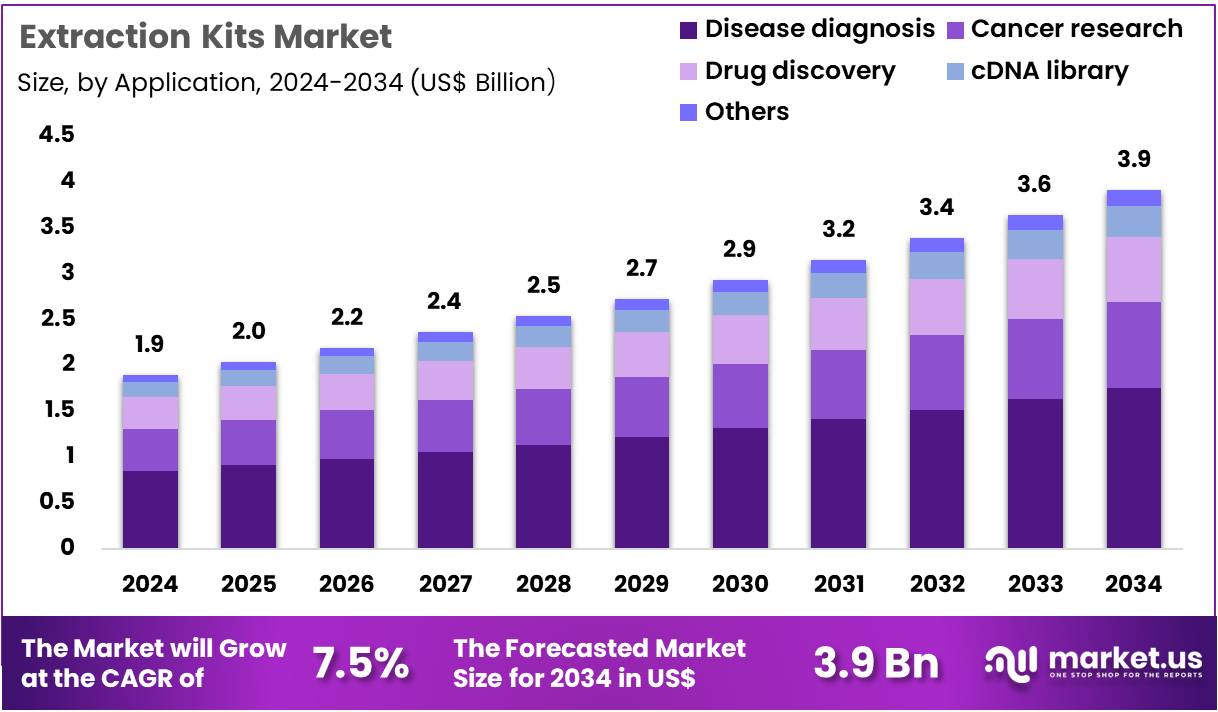
Key Takeaways
- In 2024, the global market was valued at US$ 1.9 billion and is projected to reach US$ 3.9 billion by 2034, expanding at a CAGR of 7.5% during the forecast period.
- By product type, the market is segmented into DNA extraction kits, Total Nucleic Acid (RNA + DNA) extraction kits, and RNA extraction kits. DNA extraction kits dominated the segment, accounting for 48.7% of the market share in 2023.
- Based on application, the market is categorized into disease diagnosis, drug discovery, cDNA library, cancer research, and others. Disease diagnosis emerged as the leading application, capturing 44.8% of the market share.
- By end user, the market is segmented into hospitals, pharmaceutical & biotechnology companies, diagnostic laboratories, clinical research organizations (CROs), and academic & research institutes. Hospitals held the largest share, contributing 46.1% of the market revenue.
- North America dominated the global market, holding a 37.9% market share in 2023.
Statistical Information
- A magnetic silica bead-based nucleic acid extraction method developed in 2025 completed DNA/RNA extraction in just 6–7 minutes, while recovering nearly all nucleic acid from the sample.
- In the same 2025 study, optimization of the extraction chemistry achieved approximately 100% nucleic acid recovery, demonstrating very high extraction efficiency compared with conventional workflows.
- New England Biolabs updated its Monarch® Spin gDNA Extraction Kit protocol in November 2025 by eliminating the 1,000 × g low-speed centrifugation step, reducing workflow time while reporting no loss in DNA yield or performance.
- A 2025 forensic evaluation reported that the AccuPrep Genomic DNA Extraction Kit produced a median RNA yield of 38.20 ng/µL from 400 µL saliva samples, the highest among the three extraction kits evaluated.
- In the same study, the AccuPrep kit still recovered measurable RNA from only 25 µL saliva, with a median yield of 1.50 ng/µL, demonstrating performance on very small sample volumes.
- The 2025 comparison evaluated extraction performance across five sample input volumes (400, 200, 100, 50 and 25 µL), showing extraction kit performance remained measurable throughout the tested range.
- A 2025 evaluation of four commercial DNA extraction kits for nanopore sequencing found the QIAGEN DNeasy Blood & Tissue Kit achieved a 100% whole-genome sequencing success rate (24 of 24 samples).
- In the same study, another commercial extraction kit achieved only 87.5% sequencing success (21 of 24 samples), highlighting measurable differences between extraction technologies.
Regional Analysis
North America dominated the global Extraction Kits market in 2024, accounting for 37.9% of total revenue. The region benefits from advanced biotechnology infrastructure, strong government funding, and widespread adoption of molecular diagnostics.
Continued investments by the National Institutes of Health (NIH) and the National Human Genome Research Institute (NHGRI) have strengthened genomic research, precision medicine, and next-generation sequencing programs, all of which require high-quality DNA and RNA extraction technologies.
Growing use of extraction kits in infectious disease surveillance, cancer diagnostics, and academic research has further supported market expansion. In addition, established biotechnology companies and favorable regulatory frameworks continue to drive product innovation and commercialization.
Asia Pacific is projected to register the fastest growth during the forecast period. Increasing government investments in genomics, biotechnology, and precision healthcare across China, India, South Korea, and Southeast Asia are accelerating demand for extraction kits.
Expanding sequencing initiatives, improving laboratory infrastructure, and rising adoption of molecular testing are expected to create significant opportunities, making the region a key future growth hub for extraction technologies.
Emerging Trends
- Rising adoption of large-scale genomics research: Government-funded genome projects are increasing the demand for DNA and RNA extraction kits. In 2026, the NIH All of Us Research Program reported 747,000+ participants and 535,000+ whole-genome sequences, requiring high-quality nucleic acid extraction for reliable sequencing and precision medicine research.
- Standardization of nucleic acid extraction workflows: Healthcare organizations are promoting standardized extraction methods to improve laboratory consistency. In 2025, WHO reported that its genomic reference materials support approximately 250 DNA extraction kits and 65+ bioinformatics pipelines, helping laboratories achieve more accurate and reproducible genomic analysis.
- Growth in molecular diagnostic testing: Hospitals and clinical laboratories continue expanding PCR- and sequencing-based diagnostics. The U.S. FDA supports the use of validated nucleic acid-based tests, increasing demand for efficient extraction kits that deliver high-purity DNA and RNA for infectious disease and genetic testing.
- Increased laboratory automation: High-throughput laboratories are adopting automated extraction systems to improve speed and reduce manual errors. WHO laboratory guidance includes automated extraction platforms capable of processing 32, 48, 192, 250, and 576 samples per extraction workflow, supporting large-scale testing.
- Stronger focus on biosecurity and sample quality: Government agencies are strengthening oversight of genetic research. During 2024–2025, NIH introduced updated procurement requirements for synthetic DNA and RNA materials, encouraging laboratories to implement secure, traceable, and high-quality extraction workflows for research and diagnostics.
Use Cases
- Precision medicine and genomic sequencing: Extraction kits isolate high-quality DNA and RNA before sequencing. The NIH All of Us program now contains genomic information from 747,000+ participants, enabling researchers to study disease-related genetic variations and support personalized healthcare.
- Infectious disease molecular diagnostics: Clinical laboratories use extraction kits before PCR and other nucleic acid tests to detect viruses and bacteria. High-quality extraction improves test sensitivity, helping healthcare providers deliver faster and more accurate diagnoses.
- Antimicrobial resistance surveillance: Public health laboratories extract bacterial DNA before whole-genome sequencing to identify antimicrobial resistance genes. WHO states that standardized genomic reference materials support around 250 extraction methods and 65+ analysis pipelines, improving consistency in AMR surveillance.
- Cancer biomarker testing: Hospitals use extraction kits to isolate DNA and RNA from blood or tissue samples for cancer mutation analysis. High-quality extraction improves the accuracy of PCR and next-generation sequencing, supporting targeted therapy and disease monitoring.
- Biobanking and clinical research: Biobanks use extraction kits to preserve high-quality genetic material for long-term research. The NIH All of Us database includes 535,000+ whole-genome sequences, demonstrating the growing need for reliable extraction technologies in large-scale biomedical research.
Frequently Asked Questions on Extraction Kits
- What factors are driving the growth of the Extraction Kits Market?
The market is expanding because of increasing molecular diagnostic testing, growing investments in genomics, rising adoption of precision medicine, and higher demand for rapid sample preparation. Advancements in automation and high-throughput sequencing technologies also encourage laboratories to use advanced extraction kits for consistent and accurate results. - Which industries use extraction kits the most?
Extraction kits are widely used in hospitals, diagnostic laboratories, pharmaceutical companies, biotechnology firms, academic research institutes, forensic laboratories, food safety testing facilities, and environmental monitoring organizations. Their broad applications make them essential tools for biological sample preparation and molecular analysis. - What types of extraction kits are available?
Extraction kits are available for DNA extraction, RNA extraction, total nucleic acid extraction, plasmid purification, viral nucleic acid isolation, protein extraction, and cell-free DNA extraction. Manufacturers also offer specialized kits for human, animal, plant, microbial, and environmental samples to meet different research needs. - Why are extraction kits important in molecular diagnostics?
Extraction kits ensure high-quality nucleic acid isolation, which directly affects the accuracy of PCR, sequencing, and other molecular diagnostic tests. Clean and concentrated samples reduce contamination risks, improve test sensitivity, and enable healthcare professionals to make faster and more reliable clinical decisions. - Which region leads the Extraction Kits Market?
North America currently holds a leading position due to strong biotechnology infrastructure, significant government funding for life science research, advanced healthcare systems, and widespread adoption of molecular diagnostics. Europe and the Asia-Pacific are also experiencing steady growth through expanding genomic research and healthcare investments. - What challenges does the Extraction Kits Market face?
The market faces challenges such as high costs of advanced extraction technologies, strict regulatory requirements, supply chain disruptions, and the need for standardized protocols. Laboratories must also ensure compatibility between extraction kits and downstream analytical instruments to achieve reliable performance. - How is automation influencing the Extraction Kits Market?
Automation is transforming the market by reducing manual handling, minimizing human error, and increasing laboratory efficiency. Automated extraction systems enable faster processing of large sample volumes while delivering consistent results, making them valuable for clinical laboratories, research centers, and pharmaceutical companies. - What is the future outlook for the Extraction Kits Market?
The Extraction Kits Market is expected to grow steadily over the coming years as genomic medicine, infectious disease surveillance, cancer diagnostics, and precision healthcare continue to expand. Ongoing innovation in automated, high-yield, and rapid extraction technologies will further strengthen market demand across research and clinical applications.
Conclusion
The Extraction Kits Market is experiencing consistent growth as laboratories and healthcare organizations increasingly rely on high-quality sample preparation for accurate molecular analysis. Growing applications in clinical diagnostics, infectious disease surveillance, cancer research, forensic science, and agricultural biotechnology are strengthening market demand.
Continuous improvements in extraction efficiency, automation, and compatibility with advanced sequencing technologies are further enhancing product adoption. Increasing investments in life science research and expanding diagnostic testing capacities across developing economies are creating new growth opportunities.
With ongoing innovation and broader use of molecular testing worldwide, the market is expected to maintain positive momentum, supported by the rising need for rapid, reproducible, and contamination-free nucleic acid extraction solutions across research and clinical environments.
Discuss your needs with our analyst
Please share your requirements with more details so our analyst can check if they can solve your problem(s)




