


Overview
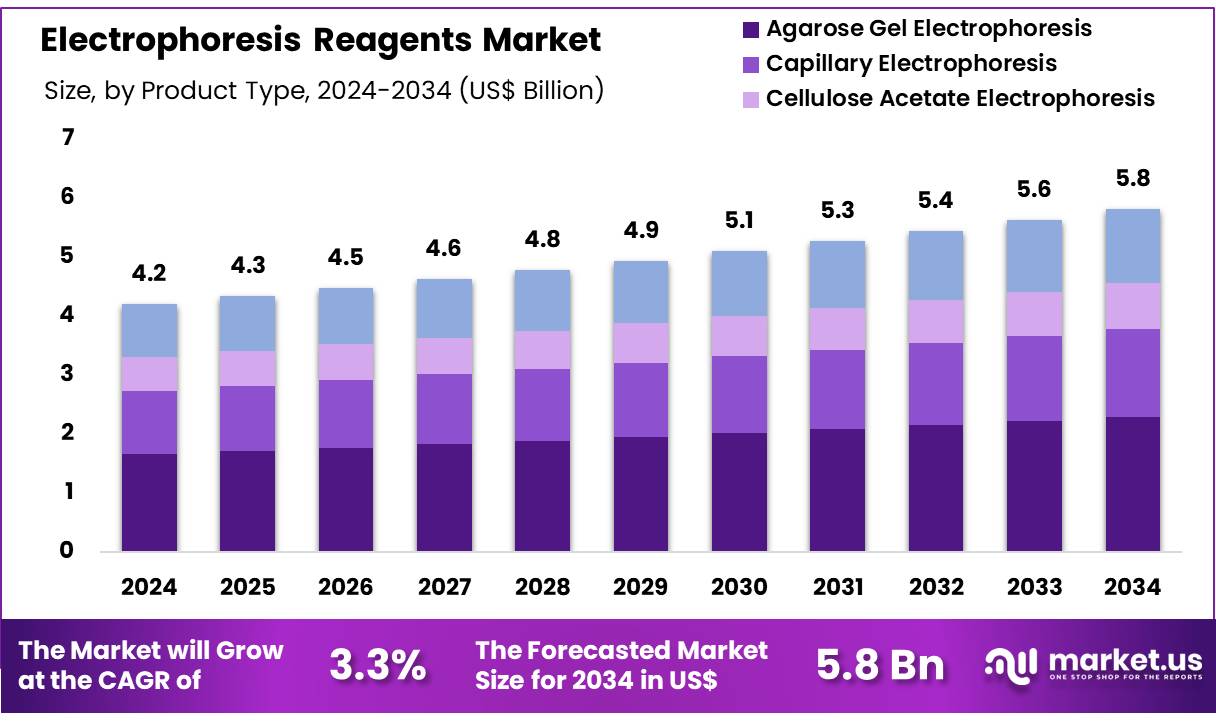
New York, NY – July 28, 2026 – The Global Electrophoresis Reagents Market size is expected to be worth around US$ 5.8 Billion by 2034 from US$ 4.2 Billion in 2024, growing at a CAGR of 3.3% during the forecast period 2025 to 2034. In 2024, North America led the market, achieving over 39.7% share with a revenue of US$ 1.7 Billion.
The electrophoresis reagents market is experiencing steady growth driven by increasing demand for molecular biology research, personalized medicine, genomics, proteomics, and pharmaceutical quality testing. Electrophoresis reagents play a critical role in separating and analyzing DNA, RNA, and proteins, making them essential tools in research laboratories, biotechnology companies, academic institutions, and diagnostic applications.
Rising investments in life science research and the expansion of precision medicine initiatives are increasing the need for reliable and high-performance reagents. Regulatory developments, including stricter laboratory testing standards, are encouraging laboratories to adopt high-quality reagents from established suppliers that ensure accuracy, consistency, and compliance.
Technological advancements are further transforming the market landscape. Innovations such as environmentally friendly staining solutions, automated electrophoresis platforms, capillary electrophoresis systems, and AI-supported gel analysis tools are improving laboratory efficiency and reducing manual errors. These advancements are expanding the application scope of electrophoresis reagents across genetic testing, disease research, drug development, and biopharmaceutical manufacturing.
The market is also witnessing increased strategic activities among major industry participants as companies focus on expanding product portfolios and strengthening integrated workflow solutions. Partnerships, acquisitions, and investments in biotechnology infrastructure are supporting the development of advanced separation and analytical technologies.
Key Takeaways
- In 2024, the electrophoresis reagents market generated revenue of US$ 4.2 billion, growing at a CAGR of 3.3%, and is projected to reach US$ 5.8 billion by 2034.
- Based on product type, the market is segmented into agarose gel electrophoresis, capillary electrophoresis, cellulose acetate electrophoresis, and polyacrylamide gel electrophoresis. Agarose gel electrophoresis dominated the segment in 2023, accounting for a 49.4% market share.
- Based on technology, the market is categorized into buffers, chemicals, dyes, and precast gels. Buffers held a leading position, capturing a significant market share of 40.2%.
- Based on application, the market is segmented into DNA analysis, RNA analysis, quality control, and protein analysis. DNA analysis emerged as the dominant application segment, representing the largest revenue share of 36.1%.
- Based on end users, the market is divided into academic research, pharmaceuticals, clinical diagnostics, and biotechnology. The academic research segment led the market with a revenue share of 43.5%.
- North America dominated the electrophoresis reagents market in 2023, holding a market share of 39.7%.
Statistical Information
- FDA Strengthens Laboratory-Developed Test Regulations: In May 2024, the U.S. FDA introduced a final rule increasing regulatory oversight of laboratory-developed tests (LDTs), including requirements for registration, quality systems, reporting, and premarket review.
- Higher Compliance Requirements Increase Demand for Quality Reagents: The FDA estimated that compliance costs associated with the LDT final rule could range from US$ 566 million to US$ 3.56 billion over the analysis period, encouraging laboratories to adopt validated and high-quality testing materials.
- Growing Adoption of Molecular Diagnostic Testing: The FDA highlights that in vitro diagnostic tests are used to detect biological markers such as DNA and proteins, supporting disease diagnosis, monitoring, and treatment decisions.
- Increasing Use of Electrophoresis in DNA and Protein Research: Electrophoresis workflows continue to support molecular biology applications, including DNA separation, RNA analysis, protein characterization, and laboratory verification studies.
- Bioprocessing Investments Support Analytical Technology Demand: Thermo Fisher Scientific announced a US$ 4.1 billion acquisition agreement in February 2025 for Solventum’s Purification & Filtration business to expand its bioprocessing and biologics capabilities.
- NIH Funding Supports Molecular Biology Research: The National Institutes of Health (NIH) funds biomedical research programs focused on genomics, molecular biology, and protein science, supporting continued laboratory demand for molecular analysis tools.
- Pharmaceutical Quality Regulations Support Analytical Testing Demand: FDA Current Good Manufacturing Practice (CGMP) regulations require pharmaceutical manufacturers to maintain analytical controls for ensuring drug identity, strength, quality, and purity
Regional Analysis
North America dominated the electrophoresis reagents market in 2023, holding a market share of 39.7%.
North America remains a major hub for electrophoresis reagent demand due to significant investments in biomedical research, genomics, and biotechnology. The National Institutes of Health (NIH) invests nearly US$48 billion annually in medical research, with around 82% of funding supporting extramural research programs across universities and research institutions. This strong research ecosystem supports continuous demand for molecular biology tools, including electrophoresis reagents used in DNA, RNA, and protein analysis.
The region also faces increasing demand for advanced diagnostics due to emerging healthcare challenges, including antimicrobial-resistant infections. The CDC reported 6,304 clinical cases of Candida auris in the U.S. in 2024, highlighting the need for improved laboratory detection and surveillance capabilities. Asia Pacific is witnessing increasing demand for electrophoresis reagents due to expanding biotechnology research, healthcare infrastructure development, and genomic initiatives.
The WHO reported that neglected tropical diseases affect more than 1 billion people globally, creating continued demand for improved diagnostic capabilities in affected regions. Countries across Asia are strengthening life science research capacity through investments in biotechnology, genetic studies, and pharmaceutical manufacturing, supporting the adoption of molecular analysis technologies such as electrophoresis.
Emerging Trends
- Growing Role in Genomics and Precision Medicine: NIH invests approximately US$ 48 billion annually in biomedical research, supporting genomics, molecular biology, and precision medicine projects where electrophoresis reagents are used for DNA and protein analysis.
- Increasing Adoption of Automated Electrophoresis Systems: Advanced electrophoresis platforms, including capillary and microfluidic systems, are improving laboratory speed, accuracy, and workflow efficiency for applications in genomics, proteomics, and clinical research.
- Rising Demand from Biopharmaceutical Testing: FDA pharmaceutical quality standards require manufacturers to maintain analytical controls for drug identity, strength, purity, and quality, increasing the use of electrophoresis methods in biologic product testing.
- Integration of AI and Digital Laboratory Analysis: AI-based image analysis tools are being developed to improve electrophoresis gel interpretation, reduce manual errors, and enhance reproducibility in molecular research workflows. NIH’s Bridge2AI program supports the development of AI-ready biomedical datasets.
- Expansion of Clinical Molecular Testing Applications: Electrophoresis remains an important laboratory method for analyzing DNA, RNA, and proteins in disease research, biomarker studies, and molecular diagnostic workflows.
Use Cases
- DNA Analysis and Genetic Testing: Electrophoresis reagents are widely used for DNA separation, fragment analysis, and genetic research. NIH-supported genomic studies continue increasing demand for reliable molecular analysis techniques.
- Protein Characterization in Drug Development: Biotechnology and pharmaceutical laboratories use electrophoresis reagents for protein identification, purity testing, and biologic drug evaluation during research and manufacturing processes.
- Academic and Biomedical Research Applications: Universities and research institutions use electrophoresis reagents in molecular biology experiments. NIH supports biomedical research through funding programs involving thousands of research institutions across the United States.
- Clinical Diagnostics and Biomarker Research: Electrophoresis techniques support analysis of molecular markers, proteins, and genetic materials associated with disease detection and monitoring in laboratory settings.
- Pharmaceutical Quality Control Testing: Electrophoresis reagents are applied in pharmaceutical manufacturing for evaluating protein structure, impurities, and product consistency. FDA CGMP regulations require manufacturers to maintain validated analytical testing processes.
Frequently Asked Questions on Electrophoresis Reagents
- What factors are driving the growth of the electrophoresis reagents market?
The market growth is supported by increasing genomic research, rising demand for molecular diagnostics, expansion of biotechnology and pharmaceutical industries, growth of precision medicine, and adoption of advanced laboratory technologies for DNA and protein analysis. - What are the major applications of electrophoresis reagents?
Electrophoresis reagents are used in DNA analysis, RNA analysis, protein characterization, genetic testing, biomarker research, pharmaceutical quality control, and biotechnology applications. These reagents help researchers analyze molecular structures and support laboratory testing procedures. - Why is DNA analysis an important application for electrophoresis reagents?
DNA analysis represents a key application because electrophoresis enables separation and visualization of DNA fragments. It supports genetic research, mutation studies, sequencing workflows, and molecular diagnostic testing in academic, clinical, and biotechnology laboratories. - How are pharmaceutical companies using electrophoresis reagents?
Pharmaceutical companies use electrophoresis reagents for protein characterization, biologic drug development, impurity detection, and quality control testing. These applications help ensure the safety, consistency, and quality of complex biological medicines such as antibodies and therapeutic proteins. - How is automation affecting the electrophoresis reagents market?
Automation is improving electrophoresis processes by reducing manual operations, increasing testing efficiency, and improving result accuracy. Automated platforms with digital imaging and analysis software enable laboratories to perform faster and more reliable molecular testing. - What role does electrophoresis play in precision medicine?
Electrophoresis supports precision medicine by enabling researchers to study genetic materials and proteins associated with diseases. These techniques help identify biomarkers, understand disease pathways, and support development of targeted treatments based on molecular characteristics. - Which industries use electrophoresis reagents?
Electrophoresis reagents are used by academic institutions, biotechnology companies, pharmaceutical manufacturers, clinical diagnostic laboratories, and research organizations. These industries rely on molecular separation techniques for research, diagnostics, drug development, and quality assessment. - What are the emerging trends in the electrophoresis reagents market?
Key trends include automated laboratory workflows, AI-based gel analysis, environmentally friendly reagents, advanced capillary electrophoresis systems, and increasing demand for molecular testing technologies in genomics, proteomics, and pharmaceutical research. - What is the future outlook for the electrophoresis reagents market?
The future outlook is supported by continued investments in genomics, biotechnology, and healthcare research. Increasing demand for accurate molecular analysis, personalized medicine, and advanced diagnostic solutions is expected to encourage further innovation in electrophoresis reagent technologies.
Conclusion
The electrophoresis reagents market is witnessing steady development due to increasing demand for molecular analysis, genomics research, precision medicine, and pharmaceutical quality testing. Growing investments in biomedical research, biotechnology advancements, and the expansion of diagnostic applications are strengthening the adoption of electrophoresis technologies.
Innovations such as automation, AI-based analysis, and advanced separation techniques are improving laboratory efficiency and accuracy. North America continues to benefit from strong research infrastructure, while Asia Pacific is expanding through growing life science investments. Overall, the market is expected to maintain growth as researchers and healthcare organizations increasingly rely on reliable molecular testing solutions.
Discuss your needs with our analyst
Please share your requirements with more details so our analyst can check if they can solve your problem(s)




