


Overview
New York, NY – July 24, 2026 – The Global ECG Telemetry Devices Market size is expected to be worth around US$ 6.8 Billion by 2034 from US$ 3.1 Billion in 2024, growing at a CAGR of 8.1% during the forecast period 2025 to 2034. In 2024, North America led the market, achieving over 39.4% market share with revenue of US$1.2 Billion.
The global ECG telemetry devices market is witnessing significant growth due to the increasing prevalence of cardiovascular diseases, rising geriatric population, and growing demand for continuous cardiac monitoring solutions. These devices enable real-time tracking of heart activity, allowing healthcare professionals to detect abnormalities early and provide timely interventions. The rising adoption of remote patient monitoring, telehealth platforms, and digital healthcare solutions is further accelerating market expansion.
Healthcare systems worldwide are shifting toward patient-centric and preventive care models, increasing the demand for advanced ECG telemetry technologies. Wearable ECG monitors, wireless telemetry systems, and AI-enabled cardiac monitoring devices are gaining popularity due to their ability to improve diagnostic accuracy, enhance patient convenience, and support home-based healthcare. The integration of artificial intelligence and cloud-based analytics is helping clinicians analyze large volumes of cardiac data and make faster, data-driven decisions.
The growing burden of cardiovascular diseases remains a major factor driving market demand. According to the World Health Organization (WHO), cardiovascular diseases cause approximately 17.9 million deaths annually worldwide, emphasizing the need for effective cardiac monitoring solutions. Additionally, healthcare providers are increasingly adopting ECG telemetry devices to reduce hospital readmissions, improve chronic disease management, and optimize healthcare resources.
Increasing investments in healthcare infrastructure, particularly in emerging economies, along with advancements in wireless communication technologies, are creating new growth opportunities. As healthcare continues to move toward personalized medicine and remote care delivery, ECG telemetry devices are expected to play a vital role in improving cardiac health outcomes and expanding access to continuous monitoring solutions globally.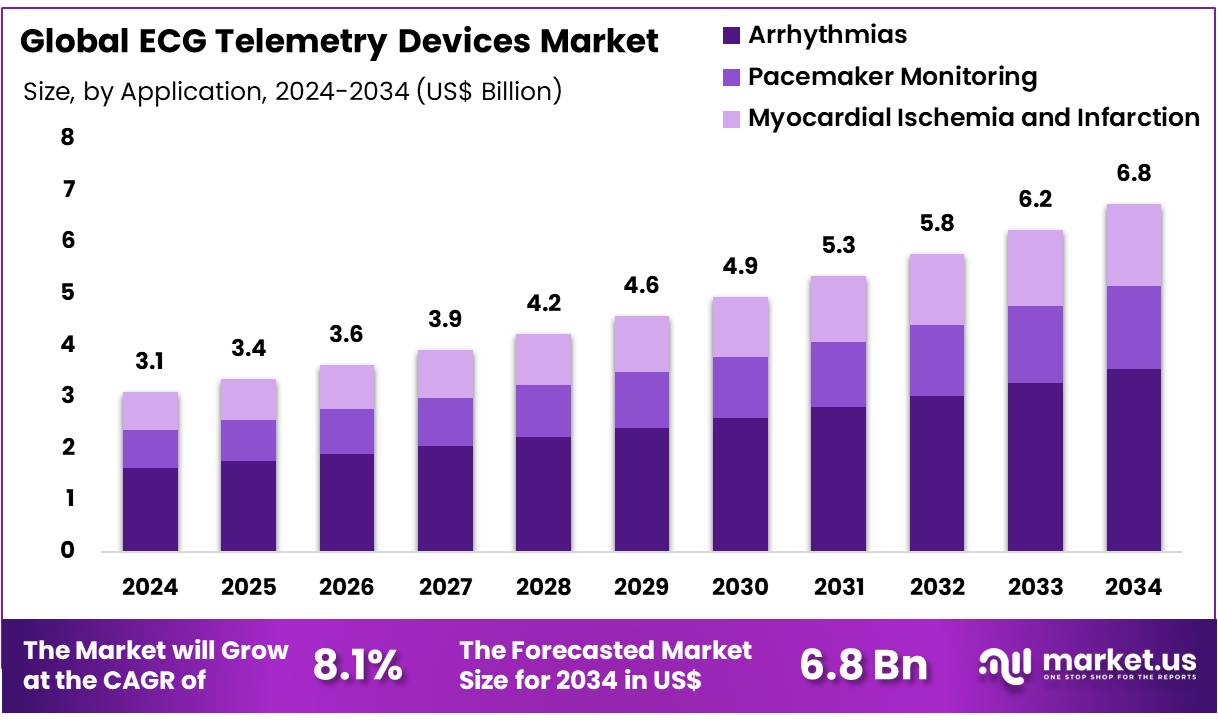
Key Takeaways
- In 2024, the global ECG telemetry devices market generated revenue of US$ 3.1 Billion and is projected to grow at a CAGR of 8.1%, reaching US$ 6.8 Billion by 2034.
- Based on product type, the ECG telemetry devices market is segmented into resting ECG devices, stress ECG devices, Holter monitors, event monitoring systems, and ECG management systems. Among these, resting ECG devices dominated the market in 2023, accounting for a 40.3% share.
- By application, the market is categorized into arrhythmias, pacemaker monitoring, and myocardial ischemia and infarction. The arrhythmias segment held a leading position with a 52.4% market share.
- Based on end user, the ECG telemetry devices market is segmented into hospitals, home healthcare, and clinics. The hospitals segment dominated the market, capturing the largest revenue share of 56.1%.
- Regionally, North America led the global ECG telemetry devices market in 2023, accounting for a 39.4% market share.
Statistical Information
- Global Burden of Cardiovascular Disease Driving ECG Monitoring: Cardiovascular disease is the leading cause of death worldwide, accounting for an estimated 17.9 million deaths per year, representing 32% of all global deaths.
- Growth in Implantable Cardiac Monitors: An analysis of implantable cardiac monitor (ICM) use from 2011–2018 found that the incidence rate of ICM placements per 1,000,000 person‑quarters increased across all six clinical indication groups during the study period.
- Cost Savings from Eliminating Inappropriate Telemetry: A utilization review of 250 consecutive hospitalized patients found that removing inappropriate telemetry days would save an estimated USD 37,007 for those 250 patients.
- Telemetry Overuse and Guideline-Based Monitoring Frequency: The American Heart Association’s practice standards update notes overuse of arrhythmia monitoring and specifies that for certain high‑risk patients, QTc intervals are monitored via telemetry every 8 hours, with notification thresholds such as QTc ≥ 500 milliseconds or ≥ 25% increase from baseline.
- Waste in U.S. Healthcare and Telemetry as a Savings Target: The cost‑savings study notes that about one‑third of U.S. healthcare spending is considered waste, and identifies unnecessary cardiac telemetry as one specific area where numeric savings (tens of thousands per few hundred patients, over half‑a‑million per year) can be realized.
- Number of Outpatient Cardiac Monitoring Devices Approved by Health Canada: A Health Canada–linked appendix lists outpatient cardiac monitoring devices, including insertable cardiac monitors, external loop recorders, ambulatory Holter systems, and external mobile cardiac telemetry devices.
- Growth in Implantable Cardiac Monitors: An analysis of implantable cardiac monitor (ICM) use from 2011–2018 found that the incidence rate of ICM placements per 1,000,000 person‑quarters increased across all six clinical indication groups during the study period.
Regional Analysis
North America remains a major region for ECG telemetry devices due to its advanced healthcare infrastructure, high cardiovascular disease burden, and strong adoption of digital health technologies. In the United States, heart disease continues to be the leading cause of death, creating demand for continuous cardiac monitoring solutions.
The CDC reports that about 805,000 people experience a heart attack annually in the U.S., highlighting the need for early diagnosis and monitoring technologies. Government support for telehealth, remote patient monitoring, and cardiovascular care programs is further strengthening market adoption. Asia Pacific is witnessing increasing demand for ECG telemetry devices due to rising cardiovascular disease cases, expanding healthcare facilities, and growing adoption of remote monitoring solutions.
The Australian Institute of Health and Welfare reported that cardiovascular diseases accounted for 11% of hospitalizations in 2021–22, emphasizing the need for advanced cardiac monitoring. Japan’s aging population and high cardiovascular disease burden are also supporting regional growth.
Emerging Trends
- Growing Adoption of Wearable ECG Monitoring Devices: Wearable ECG devices are gaining popularity as healthcare shifts toward continuous monitoring outside hospitals. The FDA recognizes sensor-based digital health technologies that collect patient data remotely. Increasing adoption of portable ECG patches and smart devices supports early rhythm detection and improves patient involvement in cardiac care.
- Artificial Intelligence Integration in ECG Analysis: AI-powered ECG solutions are improving cardiac diagnosis by automatically analyzing ECG signals and identifying abnormal patterns. FDA-authorized AI medical devices are helping clinicians interpret complex cardiac data faster. These technologies support early diagnosis, predictive monitoring, and improved decision-making in cardiovascular care.
- Expansion of Remote Cardiac Monitoring Solutions: Remote ECG telemetry is becoming an important healthcare trend due to increasing demand for home-based monitoring. The WHO reports that cardiovascular diseases cause approximately 17.9 million deaths annually worldwide, increasing the need for continuous monitoring technologies that support early intervention and preventive care.
- Increasing Focus on Arrhythmia Detection Technologies: ECG telemetry devices are increasingly used for detecting irregular heart rhythms such as atrial fibrillation. The CDC estimates that approximately 6.7 million adults in the United States have atrial fibrillation, creating demand for long-term ECG monitoring systems that enable accurate diagnosis and treatment planning.
- Growth of Hospital-Based Continuous Monitoring Systems: Hospitals are expanding the use of ECG telemetry systems to monitor high-risk cardiovascular patients continuously. The AHRQ identifies heart failure as one of the major causes of hospital readmissions, increasing the importance of technologies that support timely detection and better patient management.
Use Cases
- Arrhythmia Monitoring and Diagnosis: ECG telemetry devices are widely used for continuous monitoring of abnormal heart rhythms, including atrial fibrillation and other arrhythmias. These systems capture real-time ECG signals, helping physicians detect irregularities that may be missed during short-term clinical examinations and supporting faster treatment decisions.
- Remote Patient Monitoring for Chronic Cardiac Conditions: ECG telemetry devices enable healthcare providers to monitor patients with chronic heart diseases from home. Telehealth expansion supported by HHS has increased the use of remote monitoring solutions, allowing clinicians to track heart activity, reduce hospital visits, and provide timely medical interventions.
- Post-Heart Attack Patient Monitoring: ECG telemetry systems help monitor patients after cardiac events such as heart attacks and surgeries. The CDC reports that about 805,000 people in the U.S. experience a heart attack annually, creating demand for continuous ECG monitoring to identify complications and improve recovery outcomes.
- Pacemaker and Implantable Cardiac Device Monitoring: ECG telemetry technology supports monitoring of patients with pacemakers and implantable cardiac devices. Remote data transmission allows healthcare professionals to evaluate device performance, detect abnormalities, and improve long-term management of patients requiring cardiac rhythm support.
- Preventive Cardiac Screening and Early Detection: ECG telemetry devices are increasingly used for preventive cardiac screening among high-risk individuals. According to WHO, cardiovascular diseases account for around 32% of global deaths, increasing the need for early detection technologies that help identify heart-related risks before severe complications occur.
Frequently Asked Questions on ECG Telemetry Devices
- What factors are driving the growth of the ECG telemetry devices market?
The ECG telemetry devices market is growing due to increasing cardiovascular disease cases, rising demand for remote patient monitoring, aging populations, and advancements in wearable healthcare technologies. Growing adoption of telehealth and digital health solutions is further supporting market expansion. - Why are ECG telemetry devices important in cardiovascular care?
ECG telemetry devices provide continuous monitoring of heart activity, enabling early detection of arrhythmias, ischemic events, and other cardiac abnormalities. These systems help physicians make faster treatment decisions, improve patient outcomes, and reduce risks associated with delayed diagnosis. - Which product segment dominates the ECG telemetry devices market?
The resting ECG devices segment holds a significant position in the ECG telemetry devices market due to its widespread use in hospitals, clinics, and diagnostic centers. These systems are commonly preferred because they provide quick and reliable cardiac assessments. - How is artificial intelligence impacting the ECG telemetry devices market?
Artificial intelligence is improving ECG telemetry devices by enabling automated signal analysis, faster detection of abnormal heart patterns, and predictive cardiac risk assessment. AI-based solutions help healthcare providers manage large amounts of ECG data more efficiently and accurately. - How are wearable technologies influencing ECG telemetry devices adoption?
Wearable ECG technologies are increasing patient access to continuous heart monitoring through portable devices such as patches and smart sensors. These solutions support home-based healthcare, improve patient engagement, and allow healthcare providers to monitor cardiac conditions remotely. - What role does remote patient monitoring play in the ECG telemetry devices market?
Remote patient monitoring allows healthcare providers to track cardiac activity outside traditional clinical settings. ECG telemetry devices support this approach by transmitting real-time patient data, helping reduce hospital visits, improve chronic disease management, and enable timely medical intervention. - Which region dominates the ECG telemetry devices market?
North America dominates the ECG telemetry devices market due to advanced healthcare infrastructure, high cardiovascular disease prevalence, strong adoption of digital health technologies, and favorable reimbursement systems. The region’s focus on remote monitoring solutions continues to support market growth. - What are the future opportunities in the ECG telemetry devices market?
Future opportunities include AI-powered ECG analysis, advanced wearable monitoring systems, cloud-based cardiac data platforms, and expansion of remote healthcare services. Increasing demand for personalized medicine and preventive cardiac care will continue creating new growth opportunities.
Conclusion
The ECG telemetry devices market is experiencing strong growth due to the rising burden of cardiovascular diseases, increasing demand for continuous monitoring, and rapid adoption of digital healthcare solutions. Advancements in wearable technology, artificial intelligence, and remote patient monitoring are transforming cardiac care by enabling early detection and personalized treatment.
Hospitals, clinics, and home healthcare providers are increasingly adopting these devices to improve patient outcomes and reduce healthcare costs. With supportive healthcare infrastructure, growing telehealth adoption, and increasing focus on preventive care, ECG telemetry devices are expected to play a significant role in the future of cardiovascular disease management.
Discuss your needs with our analyst
Please share your requirements with more details so our analyst can check if they can solve your problem(s)




