


Overview
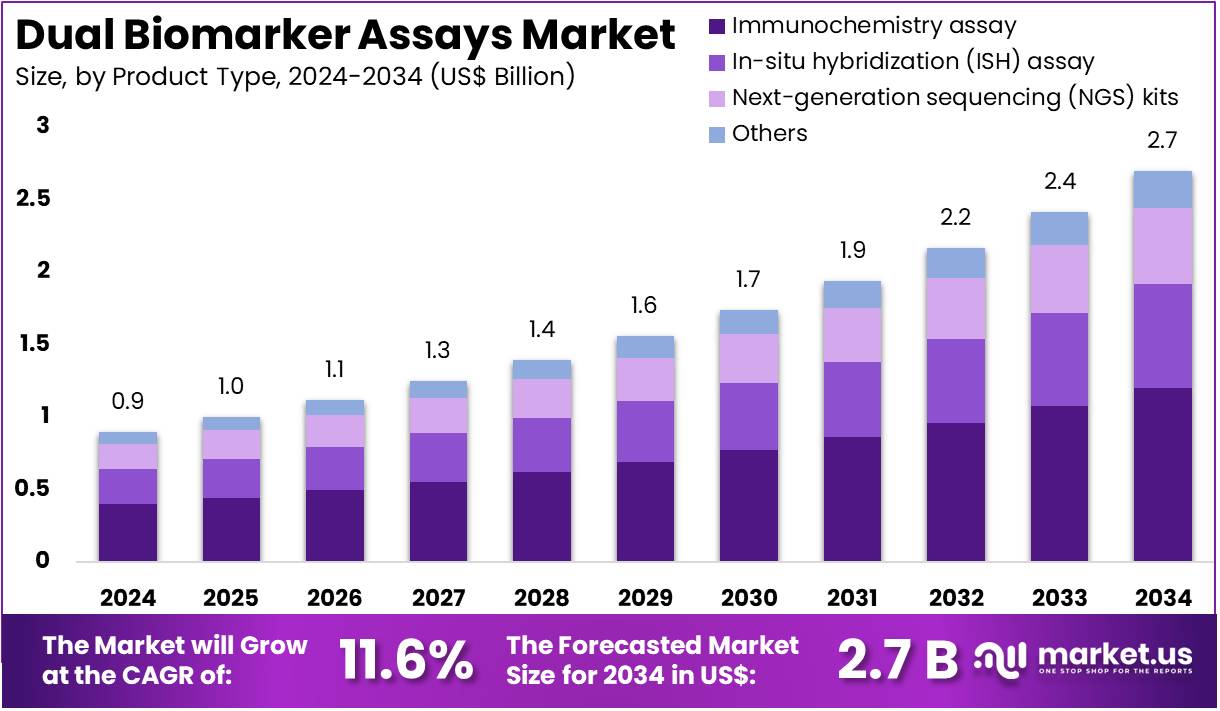
The Dual Biomarker Assays Market Size is expected to be worth around US$ 2.7 Billion by 2034 from US$ 0.9 Billion in 2024, growing at a CAGR of 11.6% during the forecast period 2025 to 2034. North America held a dominant market position, capturing more than a 39.3% share and holds US$ 0.4 Billion market value for the year.
The Dual Biomarker Assays Market is witnessing significant growth as healthcare systems increasingly adopt advanced diagnostic solutions that measure two biological markers simultaneously for improved disease detection, patient stratification, and treatment monitoring.
These assays combine biomarkers such as proteins, nucleic acids, or other molecular indicators to enhance diagnostic accuracy compared with single-marker testing, particularly in oncology, cardiovascular diseases, infectious diseases, and precision medicine applications.Growing demand for early disease diagnosis, personalized therapies, and companion diagnostics is driving market expansion.
According to healthcare data, cancer remains a major application area, with the World Health Organization reporting approximately 20 million new cancer cases and 9.7 million cancer-related deaths globally in 2022, increasing the need for reliable multi-biomarker testing approaches. In addition, cardiovascular diseases account for nearly 17.9 million deaths annually worldwide, supporting demand for advanced biomarker-based diagnostics.
Technological advancements in multiplex immunoassays, molecular diagnostics, and automated laboratory platforms are improving testing efficiency and clinical adoption. Modern dual biomarker platforms enable simultaneous analysis of multiple disease indicators, reducing turnaround time and improving decision-making in clinical settings. The increasing integration of artificial intelligence, digital pathology, and precision medicine approaches is further supporting market opportunities.
North America represents a major market due to strong healthcare infrastructure, high adoption of advanced diagnostic technologies, and extensive research activities. Meanwhile, the Asia-Pacific is expected to experience rapid growth due to rising healthcare investments, expanding diagnostic facilities, and increasing awareness of early disease detection.
Overall, the Dual Biomarker Assays Market is positioned for steady growth as healthcare providers prioritize accurate, efficient, and personalized diagnostic solutions.
Key Takeaways
- In 2024, the market recorded revenue of US$ 0.9 billion, expanding at a CAGR of 11.6%, and is projected to reach US$ 2.7 billion by 2034.
- Based on product type, the market is segmented into immunochemistry assays, in-situ hybridization (ISH) assays, next-generation sequencing (NGS) kits, and others. The immunochemistry assay segment dominated in 2023, accounting for a 44.5% market share.
- By application, the market is categorized into cancer, non-small cell lung cancer (NSCLC), human papillomavirus (HPV), glioma, gastrointestinal cancer, breast cancer, B-cell lymphoma, and Alzheimer’s disease. The cancer segment held the leading position, capturing a 49.6% share.
- Based on end users, the market is segmented into hospitals, specialty clinics, diagnostic laboratories, and cancer research institutes. The hospital segment emerged as the largest contributor, representing 47.3% of the market revenue share.
- North America dominated the global market in 2023, holding a 39.3% market share due to advanced healthcare infrastructure, strong diagnostic capabilities, and increased adoption of biomarker-based testing.
Statistical Information
- A 2026 dual-biomarker point-of-care assay for ovarian cancer detected CA125 and HE4 simultaneously in 3 minutes, combining dual biomarker measurement with smartphone-based AI analysis; clinical validation included 360 samples and achieved an AUC of 0.914.
- A 2026 dual-mode cardiovascular biomarker sensor measured three cardiac biomarkers (cTnI, CK-MB, and NT-proBNP) using 50 µL of serum and produced results within 23 minutes at the point of care.
- The same dual-mode cardiovascular assay achieved a quantitative correlation of Pearson’s r >0.96 compared with reference assays when tested on 92 patient serum samples.
- The dual-mode optical biomarker platform demonstrated a dynamic detection range spanning approximately 6 orders of magnitude, enabling measurement of both low- and high-abundance biomarkers in a single system.
- A 2025 dual-biomarker tuberculosis assay using LAM and Ag85B biomarkers evaluated 576 individuals across multiple countries and achieved 98% specificity with 45% overall sensitivity.
- A 2026 Alzheimer’s dual-target lateral flow immunoassay detecting Aβ42 oligomers and phosphorylated tau biomarkers delivered results within 25 minutes, achieving 86.7% sensitivity and an AUC of 0.933 in clinical evaluation.
- A 2026 plasma biomarker comparison study using automated assay platforms evaluated 157 patients and reported diagnostic accuracy with AUC values of 0.923 for both tested platforms.
- In the same plasma biomarker evaluation, rule-out and rule-in testing thresholds achieved ≥95% sensitivity and ≥95% specificity, supporting high-confidence clinical interpretation of biomarker measurements.
Regional Analysis
North America Leads the Dual Biomarker Assays Market
North America accounted for a significant share of the dual biomarker assays market in 2024, supported by strong research infrastructure, advanced diagnostic adoption, and regulatory support for precision medicine. The region benefits from increasing use of multiplex technologies that combine protein and genetic biomarkers for applications such as Alzheimer’s disease, oncology, and cardiovascular diagnostics.
Research institutions and healthcare providers are expanding biomarker-based testing to improve early disease detection and patient monitoring. The presence of advanced laboratory networks, funding from organizations such as the National Institutes of Health (NIH), and growing clinical validation programs are accelerating adoption. Rising demand for personalized therapies and companion diagnostics further strengthens regional growth.
Asia Pacific Shows Strong Growth Potential
Asia Pacific is expected to register notable growth during the forecast period due to increasing healthcare investments, aging populations, and rising prevalence of chronic diseases. Countries including China, Japan, South Korea, and India are expanding precision medicine programs and supporting biomarker research initiatives.
Government funding, improving laboratory infrastructure, and collaborations between research institutes and diagnostic companies are encouraging adoption of dual biomarker assays. The region is increasingly focusing on early cancer detection, neurological disease screening, and integration of diagnostic data into digital healthcare systems. These developments are expected to create significant opportunities for multi-analyte diagnostic technologies across Asia Pacific.
Emerging Trends
- Rising Adoption of Blood-Based Dual Biomarker Tests: The market is witnessing a shift toward blood-based dual biomarker assays that measure combinations such as amyloid-beta and phosphorylated tau (p-tau217). In 2025, FDA cleared a blood test supporting Alzheimer’s diagnosis in adults aged 55 years and older, improving access to early detection.
- Growth of Multiplex Biomarker Platforms: Multiplex dual biomarker platforms are becoming popular because they analyze multiple disease indicators from a single patient sample. Research shows that combining biomarkers such as p-tau217, neurofilament light chain (NfL), and GFAP can improve prediction accuracy, with studies reporting performance above 70% in dementia risk assessment.
- Integration of Artificial Intelligence in Biomarker Analysis: Artificial intelligence is increasingly being combined with dual biomarker assays to improve interpretation and clinical decision-making. AI models analyze biomarker levels with patient information to predict disease progression, with recent NIH-supported research evaluating biomarker-based prediction models using data from more than 600 older adults.
- Increasing Focus on Early Disease Detection: Healthcare systems are prioritizing early diagnosis using dual biomarker assays because biological changes often occur years before symptoms appear. Blood-based biomarker technologies are being developed to identify early Alzheimer’s-related changes and support faster intervention compared with traditional imaging-based approaches.
- Expansion of Precision Medicine Applications: Dual biomarker assays are supporting personalized healthcare by helping physicians classify patients according to biological characteristics. In clinical research, combined biomarker testing is being used for patient selection, therapy monitoring, and evaluation of treatment effectiveness in neurological and oncology studies.
Use Cases
- Alzheimer’s Disease Diagnosis and Monitoring: A major application of dual biomarker assays is Alzheimer’s disease detection using combinations of amyloid and tau biomarkers. These tests help identify brain pathology through blood samples, reducing dependence on PET scans and cerebrospinal fluid procedures while supporting earlier diagnosis among high-risk populations.
- Clinical Trial Patient Selection: Pharmaceutical companies and research organizations use dual biomarker assays to identify suitable participants for clinical trials. Biomarker-based screening improves patient grouping and helps evaluate drug effectiveness. Alzheimer’s clinical studies increasingly use p-tau biomarkers to recruit participants with confirmed disease-related changes.
- Treatment Response Monitoring: Dual biomarker assays are used to monitor how patients respond to disease-modifying therapies. By tracking changes in biomarker levels over time, researchers can evaluate whether treatments are affecting disease pathways. This approach supports precision medicine strategies and improves clinical trial outcomes.
- Risk Prediction and Disease Progression Analysis: Healthcare providers are exploring dual biomarker assays for predicting disease progression before severe symptoms develop. Combining two biomarkers provides more complete biological information than single-marker tests. Studies using blood biomarkers have demonstrated improved ability to estimate future cognitive decline risks.
- Oncology and Other Disease Applications: Beyond neurological disorders, dual biomarker assays are being developed for cancer and infectious disease applications. Combining two molecular signals can improve diagnostic confidence, treatment selection, and monitoring. Advances in immunoassay and molecular technologies are expanding the potential use of dual biomarker platforms across healthcare.
Frequently Asked Questions on Dual Biomarker Assays
- How do Dual Biomarker Assays improve disease diagnosis?
Dual biomarker assays improve disease diagnosis by combining information from two biomarkers, increasing sensitivity and specificity. This approach helps identify diseases at earlier stages, reduces diagnostic uncertainty, and enables clinicians to make more informed decisions regarding treatment planning and patient management. - What are the key advantages of Dual Biomarker Assays?
The key advantages of dual biomarker assays include higher diagnostic accuracy, faster testing processes, reduced sample requirements, and improved disease monitoring. These assays provide combined biological insights, allowing healthcare providers to evaluate disease conditions more effectively and support personalized treatment approaches. - Which industries use Dual Biomarker Assays?
Dual biomarker assays are used across healthcare, biotechnology, pharmaceutical research, and clinical diagnostics industries. Pharmaceutical companies use these assays for drug development and clinical trials, while diagnostic laboratories use them for detecting diseases and monitoring patient responses to therapies. - What factors are driving the Dual Biomarker Assays Market?
The dual biomarker assays market is driven by rising demand for precision medicine, increasing prevalence of chronic diseases, advancements in diagnostic technologies, and growing research in biomarker discovery. Healthcare systems are adopting these solutions to achieve earlier diagnosis and improve treatment outcomes. - What role do Dual Biomarker Assays play in personalized medicine?
Dual biomarker assays support personalized medicine by providing detailed information about individual disease characteristics. By analyzing multiple biomarkers together, these tests help doctors select suitable therapies, predict treatment responses, and develop patient-specific healthcare strategies for improved clinical outcomes. - What technologies are commonly used in Dual Biomarker Assays?
Common technologies used in dual biomarker assays include immunoassays, molecular diagnostic platforms, multiplex testing systems, and next-generation sequencing methods. These technologies enable accurate detection of multiple biomarkers while improving testing efficiency, scalability, and reliability in clinical and research applications. - How will technological advancements impact the Dual Biomarker Assays Market?
Technological advancements such as artificial intelligence, automation, and multiplex diagnostic platforms are expected to accelerate the dual biomarker assays market. These innovations can improve biomarker identification, enhance testing accuracy, reduce processing time, and expand applications across various medical research and diagnostic fields. - What is the future potential of the Dual Biomarker Assays Market?
The future potential of the dual biomarker assays market is strong due to increasing demand for early disease detection and targeted therapies. Continuous innovation in diagnostics, growing healthcare investments, and expansion of precision medicine are expected to create new opportunities for market growth.
Conclusion
The Dual Biomarker Assays Market is expected to experience strong growth, supported by increasing demand for early diagnosis, personalized medicine, and accurate disease monitoring. Advancements in multiplex immunoassays, molecular diagnostics, automation, and artificial intelligence are enhancing testing efficiency and clinical utility.
Oncology, cardiovascular diseases, neurological disorders, and precision medicine are expected to remain key application areas. North America currently leads the market due to advanced healthcare infrastructure and strong research capabilities, while Asia Pacific is expected to witness rapid expansion. Overall, continued technological innovation, rising healthcare investments, and growing adoption of multi-biomarker testing are expected to create significant opportunities through 2034.
Discuss your needs with our analyst
Please share your requirements with more details so our analyst can check if they can solve your problem(s)




