


Overview
New York, NY – Aug 06, 2026 – The Global Dental Hygiene Instrument Market Size is expected to be worth around US$ 7.7 billion by 2034 from US$ 4.9 billion in 2024, growing at a CAGR of 4.6% during the forecast period 2025 to 2034. North America held a dominant market position, capturing more than a 39.8% share and holding a US$ 2 billion market value for the year.
The global dental hygiene instrument market is witnessing steady growth due to the rising burden of oral diseases, increasing awareness of preventive dentistry, and growing demand for advanced dental care solutions. Dental hygiene instruments, including hand scalers, curettes, ultrasonic scalers, polishing devices, and home-care tools, are widely used for maintaining oral hygiene, preventing periodontal diseases, and improving dental treatment outcomes.
According to the World Health Organization (WHO), oral diseases affect nearly 3.5 billion people globally, making them one of the most widespread health conditions worldwide. Severe periodontal diseases impact more than 1 billion individuals, creating a strong need for effective dental cleaning and maintenance instruments. The increasing focus on early diagnosis and preventive dental practices is encouraging dental clinics and consumers to adopt advanced hygiene solutions.
Technological advancements are also transforming the market, with manufacturers introducing ergonomic, automated, and portable dental hygiene instruments. Smart toothbrushes, water flossers, and digital dental cleaning devices are gaining popularity as consumers increasingly prioritize home-based oral care. The growing recognition of the connection between oral health and systemic diseases, including diabetes and cardiovascular disorders, is further strengthening demand for preventive dental solutions.
In the United States, data from the National Center for Health Statistics (NCHS) indicates that approximately 47% of adults aged 30 years and above have some form of periodontal disease, highlighting the continued requirement for professional dental hygiene services. Rising healthcare investments, expanding dental care access, and continuous product innovation are expected to support the long-term growth of the dental hygiene instrument market.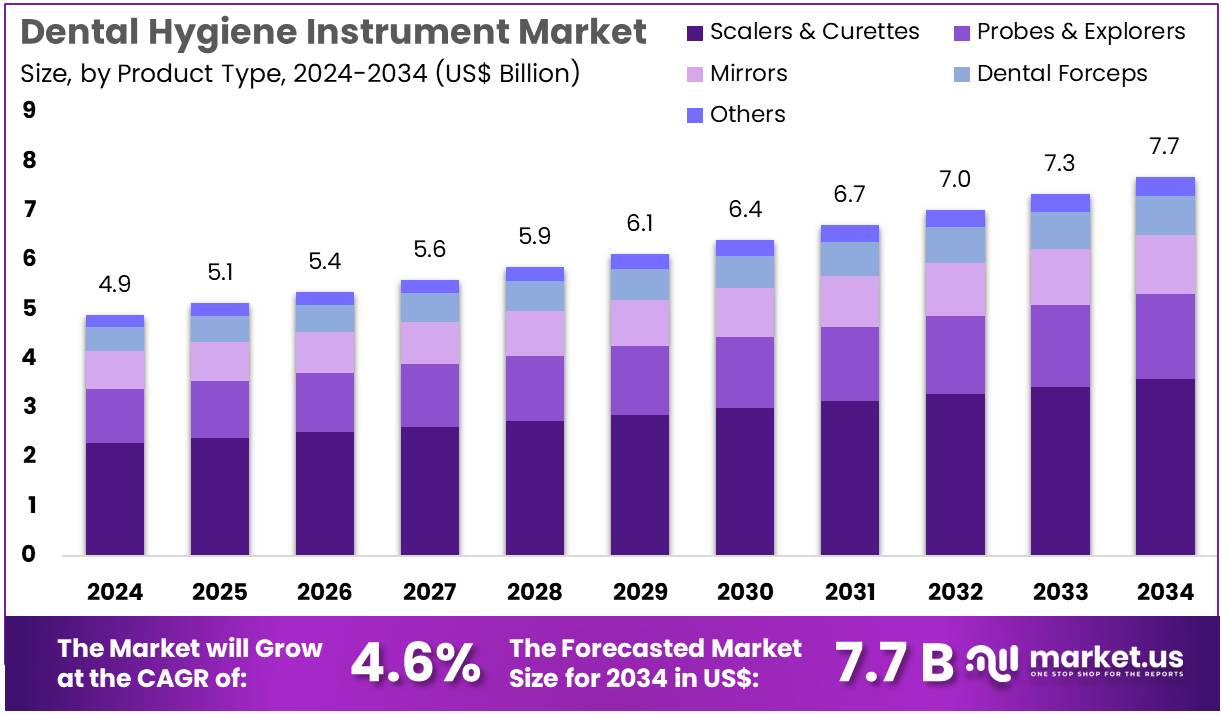
Key Takeaways
- In 2024, the dental hygiene instrument market generated revenue of US$ 4.9 billion and is projected to grow at a CAGR of 4.6%, reaching an estimated US$ 7.7 billion by 2034.
- Based on product type, the market is segmented into scalers & curettes, probes & explorers, mirrors, dental forceps, and others. Among these, scalers & curettes dominated the market in 2024, accounting for a 46.8% share.
- By application, the dental hygiene instrument market is categorized into plaque & tartar removal, oral surgery, orthodontics, preventive dental care, and others. The plaque & tartar removal segment held the largest share of 48.7% in 2024.
- Regionally, North America emerged as the leading market in 2024, capturing a 39.8% market share due to advanced dental care infrastructure, high adoption of preventive dentistry practices, and strong healthcare expenditure.
Statistical Information
- Global Oral Disease Burden Driving Demand for Dental Hygiene Instruments: Oral diseases remain one of the most common health challenges globally, creating continuous demand for professional dental hygiene instruments such as scalers, curettes, probes, and preventive cleaning devices. The WHO reported that nearly 3.5 billion people worldwide are affected by oral diseases, representing around 45% of the global population. Untreated dental caries affects approximately 2.5 billion people, while severe periodontal disease impacts more than 1 billion people globally.
- High Prevalence of Periodontal Disease Increases Need for Professional Cleaning Tools: Periodontal disease is a major factor increasing the adoption of dental hygiene instruments used for plaque and tartar removal. According to the U.S. Centers for Disease Control and Prevention (CDC), approximately 42% of adults aged 30 years and older in the United States have periodontitis, while around 8% have severe periodontitis. This highlights the ongoing requirement for professional dental cleaning procedures.
- Rising Dental Caries Cases Support Preventive Dentistry Adoption: Dental caries continues to drive demand for preventive dental care products and instruments. Data from the National Institute of Dental and Craniofacial Research (NIDCR) shows that nearly 90% of U.S. adults aged 20–64 years have experienced dental caries in permanent teeth. Additionally, approximately 1 in 5 adults (21%) aged 20–64 years has untreated tooth decay, increasing the need for regular dental examinations and hygiene procedures.
- Regular Dental Visits Influence Demand for Professional Hygiene Instruments: Routine dental visits are an important factor supporting the use of dental hygiene instruments for examinations, cleaning, and preventive procedures. According to the CDC, only around 63% of adults aged 18 years and older in the United States visited a dentist in 2023, showing continued opportunities to improve preventive dental care participation.
- Untreated Oral Conditions Create Continuous Need for Dental Cleaning Solutions: Untreated oral diseases contribute to pain, infection, and reduced quality of life, increasing the need for dental hygiene procedures. The National Institute of Dental and Craniofacial Research (NIDCR) reports that approximately 26% of U.S. adults aged 20–64 years have untreated dental caries, highlighting the importance of preventive cleaning and professional dental care.
- Gum Disease Prevention Drives Adoption of Scaling Instruments: Scaling instruments such as hand scalers and ultrasonic scalers are widely used for removing plaque and calculus associated with periodontal disease. The CDC reports that periodontal disease affects about 47.2% of adults aged 30 years and older in the United States, creating sustained demand for periodontal maintenance procedures.
- Children’s Oral Health Needs Increase Preventive Dentistry Demand: Early oral healthcare programs are increasing the use of preventive dental instruments in pediatric dentistry. CDC data indicates that more than half (52%) of children aged 6–8 years have had a cavity in at least one primary tooth, emphasizing the need for regular dental examinations and preventive interventions.
- Dental Sealant and Preventive Programs Support Dental Instrument Usage: Government-supported preventive dental programs are increasing the importance of dental hygiene procedures among children and adolescents. The CDC reports that dental sealants can prevent approximately 80% of cavities in the back teeth, supporting preventive dental practices that require examination and cleaning instruments.
- Diabetes Population Growth Increases Need for Periodontal Management: Diabetes increases the risk of developing periodontal disease, creating additional demand for oral hygiene procedures. The CDC reports that approximately 38.4 million people in the United States have diabetes, representing about 11.6% of the population, requiring greater attention toward preventive dental care.
Regional Analysis
North America led the market by securing a market share of 39.8% in 2024.
North America remains a significant region for dental hygiene instruments due to advanced dental infrastructure, high awareness of preventive oral care, and strong demand for professional cleaning procedures. The United States continues to experience a substantial oral disease burden, with CDC data showing that 13.2% of children aged 5–19 years had untreated dental caries, while 65.5% of adults aged 18 years and older received a dental examination or cleaning in 2023.
Canada also faces a high prevalence of gum disease, with the Canadian Dental Association reporting that 7 out of 10 Canadians may experience gum disease during their lifetime, supporting the need for scaling, cleaning, and periodontal care instruments. Asia Pacific is expected to witness strong growth due to increasing oral health awareness, improving healthcare access, and rising dental service adoption.
WHO highlights a high burden of oral diseases across the region, encouraging preventive dental practices. Growing dental infrastructure, increasing dentist availability, and government-supported oral health initiatives are contributing to higher demand for professional hygiene instruments.
Emerging Trends
- Increasing Adoption of Advanced Ultrasonic Dental Scalers: Dental clinics are increasingly adopting ultrasonic scalers due to their effectiveness in removing plaque and calculus during periodontal procedures. Advanced powered scalers improve treatment efficiency and patient comfort. The FDA regulates dental devices to ensure safety and performance standards for clinical use.
- Growing Focus on Preventive Dentistry and Early Oral Care: Preventive dental care is becoming a major healthcare priority as oral diseases continue to affect populations worldwide. WHO reports that oral diseases impact nearly 3.5 billion people globally, including more than 1 billion people affected by severe periodontal disease, increasing demand for hygiene instruments.
- Integration of Digital Technologies in Dental Hygiene Procedures: Digital dentistry solutions are improving oral health assessment, diagnosis, and treatment planning. Dental professionals are adopting digital imaging, electronic patient records, and smart dental technologies to provide personalized preventive care. These advancements support better monitoring of oral conditions and treatment outcomes.
- Rising Demand for Ergonomic and Patient-Friendly Instruments: Dental instrument manufacturers are focusing on lightweight and ergonomic designs to improve handling efficiency and reduce professional fatigue. Advanced instrument designs support longer procedures, especially for periodontal treatments where repeated scaling and cleaning procedures are required.
- Expansion of Home-Based Oral Hygiene Solutions: Consumers are increasingly adopting advanced oral care products such as electric toothbrushes and water flossers due to growing awareness of preventive hygiene. CDC recommends daily brushing, interdental cleaning, and regular dental visits as key measures for maintaining oral health.
Use Cases
- Plaque and Tartar Removal During Professional Cleanings: Dental hygiene instruments such as scalers and curettes are primarily used for removing plaque and hardened tartar deposits. WHO identifies plaque accumulation as a major contributor to dental caries and gum disease, creating continuous demand for professional cleaning procedures.
- Periodontal Disease Management and Gum Care: Dental hygiene instruments support periodontal treatments, including scaling and root planing procedures. CDC data shows that approximately 47% of adults aged 30 years and older in the United States have some form of periodontal disease, increasing the need for professional periodontal care.
- Preventive Dental Care in Children and Adults: Hygiene instruments are widely used during routine dental examinations, preventive cleanings, and early disease detection. CDC reports that more than 50% of children aged 6–8 years have experienced cavities in primary teeth, highlighting the importance of preventive dental services.
- Supporting Oral Care for Aging Populations: Aging populations require greater dental hygiene support due to increased risks of periodontal disease, tooth loss, and oral complications. WHO highlights that oral health challenges increase with age, creating demand for professional cleaning and maintenance procedures.
- Improving Oral-Systemic Health Management: Dental hygiene instruments are increasingly used in preventive healthcare approaches that recognize the connection between oral and overall health. Management of periodontal inflammation is gaining importance as healthcare providers focus on reducing risks associated with chronic conditions such as diabetes.
Frequently Asked Questions on Dental Hygiene Instrument
- What factors are driving the growth of the dental hygiene instrument market?
The dental hygiene instrument market is driven by rising oral disease prevalence, increasing awareness of preventive dentistry, growing dental service utilization, technological advancements, and increasing demand for professional cleaning procedures to manage periodontal disease and dental caries. - What are the major types of dental hygiene instruments available?
Major product categories include scalers and curettes, probes and explorers, dental mirrors, dental forceps, ultrasonic instruments, and other specialized tools. These instruments support dental examination, plaque removal, periodontal treatment, and preventive oral healthcare procedures. - Which product segment dominates the dental hygiene instrument market?
Scalers and curettes represent a leading product segment due to their extensive use in professional dental cleaning procedures. These instruments help remove plaque and calculus deposits, manage periodontal conditions, and support routine preventive dental care practices. - What is the primary application of dental hygiene instruments?
The primary application of dental hygiene instruments is plaque and tartar removal during professional dental cleanings. They are also used for periodontal treatment, orthodontic procedures, oral examinations, preventive dentistry, and maintaining long-term oral health. - How does periodontal disease impact demand for dental hygiene instruments?
Periodontal disease increases demand for dental hygiene instruments because professional cleaning procedures are required to remove plaque and tartar buildup. The high prevalence of gum disease worldwide creates continuous demand for effective diagnostic and treatment instruments. - Which region holds a significant share of the dental hygiene instrument market?
North America holds a significant position due to advanced dental infrastructure, high awareness of oral healthcare, strong adoption of preventive services, and increasing demand for advanced dental technologies across hospitals, clinics, and dental practices. - What opportunities exist in the dental hygiene instrument market?
Growth opportunities include smart dental device development, expansion of preventive oral healthcare programs, increasing dental clinic networks, adoption of minimally invasive procedures, and rising demand for portable and user-friendly instruments for professional and personal oral hygiene. - What is the future outlook for the dental hygiene instrument market?
The dental hygiene instrument market is expected to expand due to rising oral disease burden, increasing preventive healthcare adoption, technological innovations, and improved dental infrastructure. Focus on early diagnosis and professional oral care will continue supporting market development.
Conclusion
The dental hygiene instrument market is experiencing steady growth due to the rising global burden of oral diseases, increasing awareness of preventive dentistry, and growing demand for professional dental care services. The widespread prevalence of periodontal disease and dental caries is driving the adoption of advanced instruments such as scalers, curettes, and ultrasonic devices.
Technological innovations, ergonomic designs, and digital dental solutions are improving treatment efficiency and patient comfort. North America continues to hold a strong position due to advanced healthcare infrastructure, while emerging regions are creating new growth opportunities through improved dental access and awareness. The market is expected to expand with continued focus on preventive oral healthcare.
Discuss your needs with our analyst
Please share your requirements with more details so our analyst can check if they can solve your problem(s)




