


Overview
New York, NY – Aug 18, 2026 – The Global Dental Braces Market size is expected to reach around US$ 9.21 Billion by 2034, up from US$ 4.77 Billion in 2024, growing at a CAGR of 6.8% during the forecast period from 2025 to 2034. North America held a dominant market position, capturing more than a 38.5% share and valued at US$ 1.84 billion.
The global dental braces market is witnessing steady growth as orthodontic treatment demand increases due to rising cases of malocclusion, oral diseases, and growing awareness of dental aesthetics. The market includes traditional metal braces, ceramic braces, lingual braces, and advanced clear aligner systems used for correcting tooth alignment and improving oral function.
According to the World Health Organization (WHO), oral diseases affect approximately 3.5–3.7 billion people worldwide, creating a significant need for preventive and corrective dental care. Malocclusion remains a major orthodontic concern, with studies reporting that around 35% of children in China experience upper tooth crowding and 31% experience lower tooth crowding, highlighting a large potential patient base.
Government-supported dental programs are also strengthening market expansion. In the United Kingdom, the National Health Service (NHS) uses the Index of Orthodontic Treatment Need (IOTN) to prioritize publicly funded orthodontic care for high-need patients. In the United States, Federally Qualified Health Centers expanded oral healthcare services by nearly 40% between 2009 and 2014, increasing dental service users from 3.4 million to 4.8 million.
Workforce development further supports orthodontic service delivery. U.S. health centers reported an increase in dental assistants per dentist from 1.85 in 2011 to 1.91 in 2014, improving treatment capacity. Additionally, WHO initiatives promoting oral health integration into universal healthcare frameworks are encouraging broader access to orthodontic services. These factors are expected to sustain demand for dental braces and digital orthodontic solutions globally.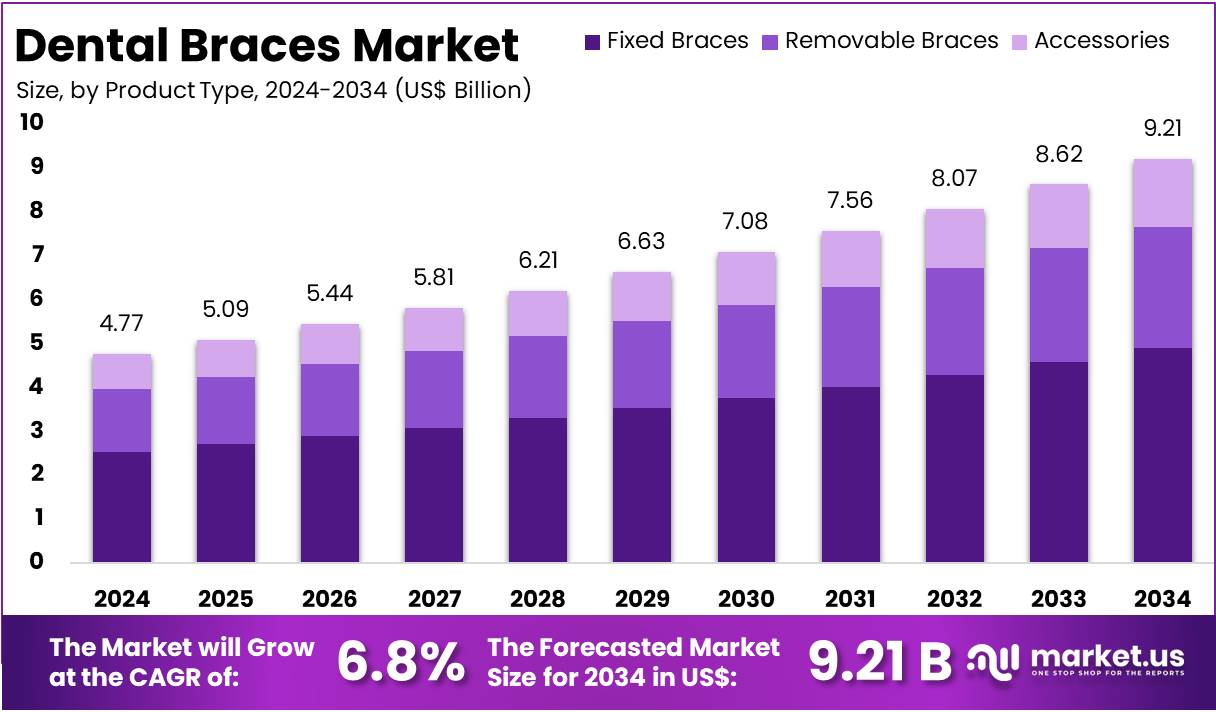
Key Takeaways
- The global dental braces market is expected to expand from USD 4.77 billion in 2024 to around USD 9.21 billion by 2034, registering a CAGR of 6.8% during the forecast period.
- Fixed braces dominated the product type segment in 2024, accounting for more than 53.2% of the global market share, supported by their proven effectiveness in orthodontic correction.
- Ceramic braces led the material segment in 2024, capturing over 53.9% market share, driven by increasing demand for aesthetic and less-visible orthodontic solutions.
- External braces held the leading position in the position segment in 2024, contributing more than 65.5% of global revenue share due to their widespread clinical adoption.
- Teenagers aged 13–19 years represented the largest end-user segment in 2024, accounting for more than 61.3% market share, as early orthodontic treatment becomes increasingly common.
- North America dominated the global dental braces market in 2024, reaching a market value of USD 1.84 billion and holding more than 38.5% of total market share.
Statistical Information
- Global Oral Disease Burden Creates a Large Patient Base for Orthodontic Care: The rising burden of oral diseases continues to support long-term demand for orthodontic procedures, including dental braces. According to the World Health Organization (WHO), oral diseases affect approximately 3.5 billion people globally, representing nearly 45% of the world’s population. Untreated dental caries affects around 2.5 billion people, while severe periodontal disease affects approximately 1 billion people worldwide. This high prevalence increases the need for comprehensive dental correction and preventive treatments.
- Teenagers Represent the Largest Patient Group for Orthodontic Treatment: Teenagers remain a major consumer segment for dental braces because orthodontic correction is frequently started between ages 13 and 19 years after most permanent teeth have erupted. According to the U.S. Centers for Disease Control and Prevention (CDC), approximately 88% of adolescents aged 12–17 years received a dental examination or cleaning in 2020, supporting early diagnosis of orthodontic issues and referral to orthodontists.
- Aesthetic Preferences Increase Demand for Ceramic Braces and Clear Aligners: According to company-reported operational data, Align Technology’s Invisalign system treated more than 17 million patients globally by 2024, demonstrating significant adoption of clear aligner technology. The company also reported 605,100 clear aligner case shipments in Q1 2024, showing continued demand for aesthetic orthodontic solutions.
- Untreated Cavities and Dental Conditions Increase Preventive Orthodontic Awareness: Dental problems during childhood can influence future oral development and increase the need for corrective procedures. CDC data shows that more than 50% of children aged 6–8 years have experienced cavities in their primary teeth, while untreated cavities remain common among adults. Increasing awareness among parents regarding early dental intervention supports orthodontic consultations and braces adoption among children and teenagers.
- Clear Aligners and Aesthetic Orthodontic Solutions Are Gaining Consumer Acceptance: Consumer preference is shifting toward discreet orthodontic options such as ceramic braces and clear aligners. Align Technology reported strong demand for its Invisalign clear aligner system, with 605,100 clear aligner cases reported in Q1 2024. The company also reported Q1 2024 revenue of USD 997.4 million, supported by increased adoption of clear aligner treatments among teenagers and younger patients.
- Dental Healthcare Utilization Supports Orthodontic Referrals in North America: North America has strong dental infrastructure supported by high dental visit rates. CDC data shows that approximately 65.5% of U.S. adults aged 18–64 years visited a dentist in 2019, demonstrating significant engagement with dental healthcare services. Higher dental service utilization increases opportunities for identifying orthodontic conditions requiring braces or aligner treatment.
- Oral Health Inequality Creates Additional Demand for Expanded Dental Services: WHO reports that oral diseases create a significant economic and healthcare burden, with more than US$380 billion spent globally on major oral diseases in 2019. Around 3 out of 4 people affected by oral diseases live in middle-income countries, highlighting continuing unmet treatment needs.
- Malocclusion Prevalence Among School Children Creates a Large Future Patient Pool: Clinical studies show that malocclusion is highly prevalent among children and adolescents, supporting early orthodontic intervention. A school-based epidemiological study involving 1,200 children aged 10–15 years reported that 53.7% had malocclusion, while 32.8% required orthodontic treatment based on treatment-need assessment.
- Adolescent Orthodontic Need Remains High Due to Bite and Alignment Problems: A large Brazilian adolescent oral health assessment involving 16,833 teenagers found that 53.2% required orthodontic treatment due to malocclusion severity. The study identified orthodontic need as a major public health challenge among adolescents.
Regional Analysis
North America Dominated the Dental Braces Market with More Than 38.5% Share in 2024
North America remains a leading region for the dental braces market, supported by high dental spending, strong healthcare infrastructure, insurance coverage, and increasing orthodontic awareness. According to the U.S. Centers for Medicare & Medicaid Services (CMS), U.S. dental care spending reached USD 173.8 billion in 2023, accounting for nearly 4% of national health expenditure. Dental service utilization remains strong, with studies showing that 63.7% of U.S. adults aged 65 years and above visited a dentist in 2022.
The region also benefits from government-supported dental access programs. Medicaid and CHIP provide dental benefits for eligible children, improving orthodontic screening and treatment access. In Canada, the Canadian Dental Care Plan (CDCP) has expanded dental coverage to millions of residents, increasing preventive dental visits and referrals. Rising demand for aesthetic orthodontic solutions, including ceramic braces and clear aligners, further supports market growth across North America.
Emerging Trends
- Growing Adoption of Digital Orthodontics and 3D Treatment Planning: Digital orthodontic technologies are transforming braces treatment through intraoral scanners, artificial intelligence, and 3D simulations. According to the American Dental Association, digital technologies are increasingly integrated into dental practices. Align Technology reported more than 100,000 iTero scanner systems installed globally, improving personalized orthodontic planning and patient experience.
- Rising Preference for Aesthetic Braces and Clear Aligners: Patients are increasingly choosing less-visible orthodontic options, including ceramic braces and clear aligners, due to cosmetic preferences. According to Align Technology, its Invisalign system has been used by more than 17 million patients worldwide, reflecting strong acceptance of discreet orthodontic solutions among teenagers and adults seeking improved appearance.
- Increasing Early Orthodontic Screening Among Children: Early orthodontic evaluation is becoming more common as healthcare providers focus on preventing severe alignment problems. The American Association of Orthodontists recommends children receive an orthodontic check-up by age 7 years. Early diagnosis helps identify crowding, bite issues, and jaw development problems before they worsen.
- Expansion of Public Dental Programs Supporting Orthodontic Access: Government dental programs are improving access to orthodontic care, especially among children and underserved populations. In the United States, Medicaid and CHIP provide dental coverage for eligible children, while CMS reported Medicaid and CHIP enrollment exceeded 80 million people, supporting broader dental service utilization and referrals.
- Increasing Demand from Teenagers Due to High Malocclusion Rates: Teenagers remain a major user group for braces because orthodontic correction is commonly started during adolescence. Clinical studies show malocclusion prevalence among adolescents can exceed 50%, creating a large treatment population. Increased dental visits among children support early identification and orthodontic referrals.
Use Cases
- Correction of Dental Crowding and Tooth Misalignment: Dental braces are widely used to correct crowded teeth, spacing problems, and irregular tooth positioning. WHO reports oral diseases affect nearly 3.7 billion people globally, creating significant demand for corrective dental procedures. Braces improve alignment, oral function, cleaning ability, and long-term dental health outcomes.
- Treatment of Bite Problems Including Overbite and Underbite: Orthodontic braces are commonly used for correcting bite abnormalities such as overbite, underbite, and crossbite. Research studies indicate that malocclusion affects a large proportion of children and adolescents, with many requiring orthodontic intervention to improve chewing efficiency, speech, and facial balance.
- Cosmetic Smile Enhancement Among Adults and Teenagers: Braces and clear aligners are increasingly used for cosmetic smile improvement. Growing awareness of appearance and confidence has increased orthodontic consultations among adults. Align Technology reported treating more than 17 million Invisalign patients globally, demonstrating expanding demand for aesthetic orthodontic treatments.
- Preventive Orthodontic Care to Reduce Future Dental Complications: Orthodontic treatment helps prevent future dental issues by improving tooth positioning and reducing areas where plaque accumulates. The CDC highlights that untreated oral conditions remain common, with 1 in 4 adults aged 20–64 years having untreated cavities, increasing the importance of preventive dental care.
- Digital Monitoring and Remote Orthodontic Follow-Up: Remote orthodontic monitoring is emerging as a growing use case, allowing dentists to track treatment progress using digital platforms and patient images. These technologies reduce unnecessary clinic visits and improve treatment convenience. Digital orthodontic systems support personalized care through continuous monitoring and data-based adjustments.
Frequently Asked Questions on Dental Braces
- What are the major factors driving the dental braces market growth?
The market is driven by rising cases of malocclusion, increasing dental awareness, growing demand for aesthetic orthodontic solutions, improved insurance coverage, and advancements in digital orthodontic technologies. Higher adoption of clear aligners and personalized treatment planning also supports market expansion. - Why are teenagers the largest consumer group for dental braces?
Teenagers represent the largest user segment because orthodontic treatment is commonly initiated during adolescence when permanent teeth develop. Early diagnosis of crowding, spacing, and bite problems allows effective correction, improving dental function and preventing future oral health complications. - What are the different types of dental braces available?
Dental braces are available in multiple types, including traditional metal braces, ceramic braces, lingual braces, and clear aligners. Metal braces provide effective correction, while ceramic and clear options are preferred by patients seeking less-visible and aesthetically appealing orthodontic treatments. - How are digital technologies influencing the dental braces market?
Digital technologies are transforming orthodontic care through intraoral scanners, 3D imaging, artificial intelligence-based planning, and virtual monitoring systems. These solutions improve treatment accuracy, reduce planning time, and provide patients with better visualization of expected orthodontic outcomes. - What role do clear aligners play in the dental braces market?
Clear aligners are gaining popularity as an alternative to traditional braces because they are removable, comfortable, and less visible. Increasing cosmetic awareness among teenagers and adults has accelerated demand for clear orthodontic solutions, supporting innovation and competition within the braces market. - Which region dominates the dental braces market?
North America leads the dental braces market due to strong dental infrastructure, high healthcare spending, insurance coverage, and advanced orthodontic adoption. The region benefits from increased demand for cosmetic dentistry, government-supported dental programs, and widespread availability of orthodontic specialists. - How do government programs support the dental braces market?
Government healthcare programs improve orthodontic access by supporting dental services for eligible populations. Programs such as Medicaid and CHIP in the United States provide dental benefits for children, increasing early screening, referrals, and access to necessary orthodontic treatments. - What is the future outlook for the dental braces market?
The future of the dental braces market is expected to be shaped by digital orthodontics, personalized treatment solutions, aesthetic braces, and expanding dental access programs. Increasing awareness of oral health and demand for improved smiles will continue supporting market development.
Conclusion
The dental braces market is experiencing steady growth due to rising orthodontic needs, increasing awareness of oral health, and growing demand for aesthetic dental solutions. High prevalence of malocclusion, expanding dental care access, and advancements in digital orthodontic technologies are strengthening market adoption across age groups.
Teenagers remain a major consumer segment, while adults are increasingly adopting clear aligners and cosmetic braces. Supportive healthcare programs, improved dental infrastructure, and innovations in treatment planning continue to enhance accessibility. With increasing focus on personalized, comfortable, and less-visible orthodontic solutions, the dental braces market is expected to maintain positive growth globally.
Discuss your needs with our analyst
Please share your requirements with more details so our analyst can check if they can solve your problem(s)




