


Overview
New York, NY – Aug 19, 2026 – The Global Creatine Kinase Reagent Market size is expected to be worth around US$ 1039.7 Million by 2034 from US$ 376.2 Million in 2024, growing at a CAGR of 10.7% during the forecast period 2025 to 2034. In 2024, North America led the market, achieving over 39.9% share with a revenue of US$ 150.1 Million.
The global Creatine Kinase (CK) Reagent Market is witnessing significant growth due to increasing demand for clinical chemistry diagnostics, cardiovascular monitoring, and muscle disorder detection.
CK reagents are widely used in laboratories to measure creatine kinase enzyme activity, supporting the diagnosis of myocardial injury, muscular dystrophy, rhabdomyolysis, and other skeletal muscle conditions. The rising burden of cardiovascular diseases, responsible for approximately 17.9 million deaths annually worldwide, is increasing the need for accurate biomarker testing solutions.
The market is benefiting from rapid advancements in automated laboratory technologies. Modern clinical chemistry analyzers can process hundreds of samples per hour, improving diagnostic efficiency and reducing turnaround time.
Growing healthcare expenditure, expansion of diagnostic laboratories, and increased adoption of in-vitro diagnostic testing are further supporting market growth. The global diagnostic testing industry performs billions of laboratory tests annually, creating continuous demand for reliable reagent solutions.
The rising elderly population is another important factor, with the global population aged 60 years and above projected to reach 2.1 billion by 2050, increasing the need for monitoring age-related cardiovascular and muscular disorders.
Hospitals, research institutes, and diagnostic centers are increasingly adopting advanced CK reagent formulations, including liquid stable and ready-to-use reagents, to enhance accuracy and workflow efficiency.
North America and Europe remain key markets due to advanced healthcare infrastructure and high adoption of automated diagnostic platforms. Meanwhile, emerging healthcare systems are expanding laboratory capabilities. Increasing focus on early disease detection, preventive healthcare, and precision diagnostics is expected to drive sustained growth in the Creatine Kinase Reagent Market.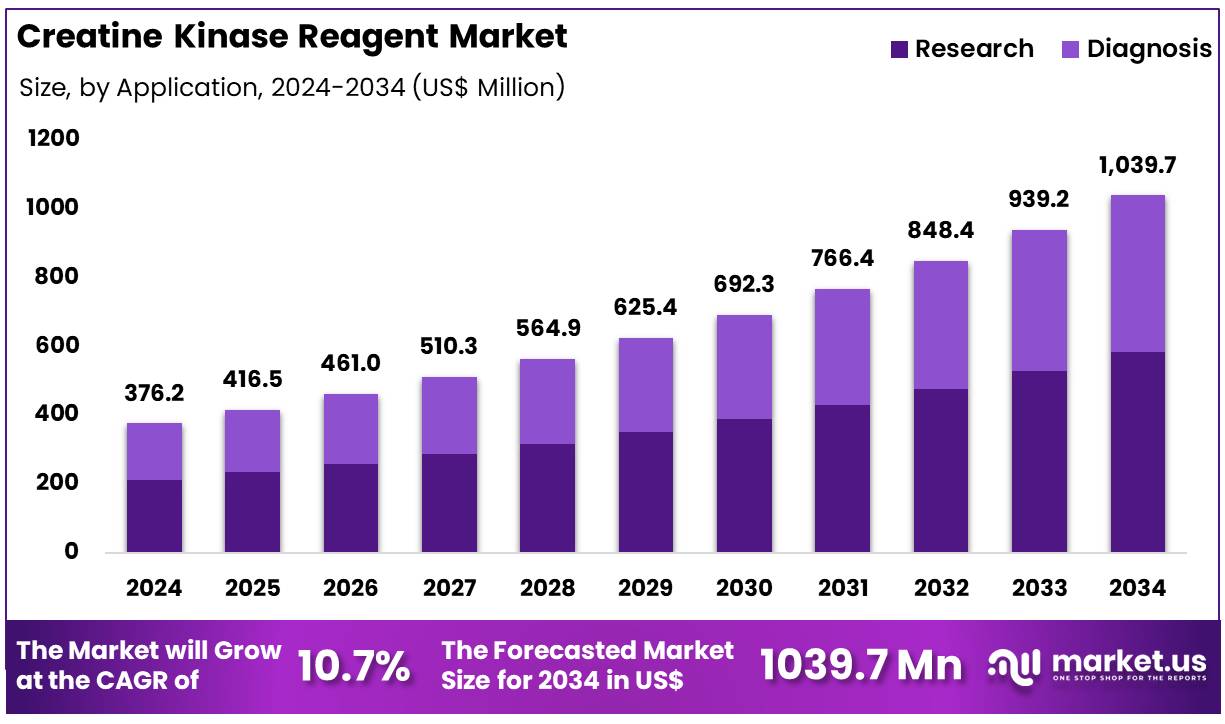
Key Takeaways
- In 2024, the Creatine Kinase Reagent Market generated revenue of US$ 376.2 million and is projected to grow at a CAGR of 10.7%, reaching approximately US$ 1,039.7 million by 2034.
- Based on product type, the market is segmented into reagents, instruments, and kits. The reagents segment dominated the market in 2023, accounting for a leading 51.8% market share due to high demand for laboratory testing solutions.
- Based on test type, the market includes enzymatic tests, point-of-care tests, ELISA-based tests, colorimetric assay-based tests, and others. The enzymatic tests segment held a significant market share of 48.5% in 2023.
- Based on application, the market is categorized into research and diagnosis. The research segment emerged as the leading segment, capturing the highest revenue share of 56.2% due to increasing use of CK reagents in biomedical studies.
- Based on end users, the market is divided into hospitals & clinics, diagnostic laboratories, academic research institutes, and others. The hospitals & clinics segment led the market with a revenue share of 38.9%.
- North America dominated the Creatine Kinase Reagent Market in 2023, accounting for a market share of 39.9%, supported by advanced healthcare infrastructure, high diagnostic testing volumes, and widespread adoption of laboratory automation technologies.
Statistical Information
- Increasing Adoption of Automated Clinical Chemistry Analyzers: Automation is improving the efficiency of CK reagent testing in hospitals and diagnostic laboratories. Roche’s cobas c 703 clinical chemistry analyzer supports high-throughput testing with the capability to process up to 2,000 tests per hour and supports more than 110 clinical chemistry applications, including enzyme measurements.
- Cardiovascular Disease Burden Driving CK-MB Diagnostic Demand: Cardiac biomarker testing remains an important application area for creatine kinase reagents, particularly CK-MB assays used in evaluating myocardial injury. In the United States, cardiovascular disease caused 919,032 deaths in 2023, accounting for approximately 1 in every 3 deaths. The high burden of heart-related conditions supports continued demand for biochemical diagnostic testing.
- High-Throughput Clinical Chemistry Systems Increasing Reagent Consumption: Modern automated chemistry analyzers are increasing laboratory testing capacity and reagent utilization. Roche’s cobas c 703 analytical unit can perform up to 2,000 tests per hour, includes 70 reagent positions, and supports more than 110 clinical chemistry applications, including enzyme testing.
- Increasing Burden of Heart Disease Supports CK-MB Testing Demand: Cardiac biomarkers such as CK-MB remain important tools in evaluating myocardial injury. In the United States, cardiovascular disease continues to be the leading cause of death, with 919,032 cardiovascular-related deaths reported in 2023, equal to approximately 1 out of every 3 deaths. This increasing cardiac disease burden supports demand for clinical chemistry reagents used in emergency and hospital laboratories.
- Aging Population Creates Higher Demand for Disease Monitoring Tests: The global population aged 60 years and older reached 1 billion in 2019 and is expected to increase to 1.4 billion by 2030 and 2.1 billion by 2050. Older populations have higher risks of cardiovascular disease and muscle-related conditions, increasing the need for routine diagnostic monitoring using laboratory biomarkers.
- Growth of Clinical Chemistry Automation Increases Reagent Utilization: Automated chemistry systems are increasing laboratory efficiency by allowing continuous processing of biochemical tests. Roche’s cobas c 703 analyzer provides a throughput capacity of up to 2,000 tests per hour and supports more than 110 clinical chemistry applications, creating consistent demand for reagent consumables.
- Increasing Chronic Disease Monitoring Supports Reagent Consumption: Chronic diseases require continuous monitoring through laboratory diagnostics. WHO reports that noncommunicable diseases account for approximately 41 million deaths annually worldwide, representing about 74% of global deaths, increasing the importance of routine biochemical testing.
- Increasing Heart Attack Cases Support CK-MB Diagnostic Requirements: Acute myocardial infarction remains a major cause of emergency hospital admissions worldwide. The U.S. CDC reports that approximately 805,000 people in the United States experience a heart attack each year, including about 605,000 first heart attacks and 200,000 recurrent heart attacks. This high disease burden supports continued use of cardiac enzyme testing solutions.
- Noncommunicable Diseases Increase Demand for Routine Diagnostics: WHO reports that noncommunicable diseases cause approximately 41 million deaths annually, representing nearly 74% of deaths worldwide. Routine laboratory monitoring plays an important role in managing chronic disease conditions requiring repeated biochemical testing.
Regional Analysis
North America led the market by securing a market share of 39.9% in 2023.
North America holds a strong position in the Creatine Kinase Reagent Market due to advanced healthcare infrastructure, high adoption of automated laboratory systems, and increasing demand for cardiac and muscle disorder diagnostics. The region benefits from a large burden of cardiovascular diseases, with the CDC reporting approximately 805,000 heart attacks annually in the United States, including 605,000 first-time events, creating continuous demand for cardiac biomarker testing.
Hospitals and diagnostic laboratories are increasingly adopting automated clinical chemistry analyzers to improve testing accuracy and turnaround time. Regulatory standards from agencies such as the FDA further support the adoption of high-quality in-vitro diagnostic reagents. Asia Pacific is expected to experience significant growth in the Creatine Kinase Reagent Market due to rising cardiovascular disease prevalence, expanding diagnostic infrastructure, and increasing healthcare investments.
The WHO reports that cardiovascular diseases cause approximately 19.8 million deaths globally each year, highlighting the growing need for early detection and biomarker-based testing. Countries across the region are strengthening hospital laboratory networks, adopting automated diagnostic platforms, and improving access to advanced clinical testing solutions. Growing awareness of preventive healthcare, increasing chronic disease monitoring, and expansion of diagnostic facilities are expected to support CK reagent adoption across hospitals and research centers.
Emerging Trends
- Increasing Adoption of Automated Clinical Chemistry Systems: Clinical laboratories are shifting toward automated analyzers to improve CK testing speed, accuracy, and workflow efficiency. Advanced systems such as Roche cobas c platforms support CK assays with high-throughput capabilities, processing up to 2,000 tests per hour, helping hospitals manage increasing diagnostic volumes.
- Growing Demand for Cardiac Biomarker Testing in Emergency Care: Creatine kinase-MB testing continues to support evaluation of cardiac muscle injury, especially in emergency diagnostic settings. The CDC reports approximately 805,000 heart attacks occur annually in the United States, including 605,000 first-time events, increasing the need for rapid cardiac biomarker assessment.
- Development of High-Stability and Ready-to-Use Reagent Formulations: Diagnostic manufacturers are focusing on improving reagent stability, calibration accuracy, and compatibility with automated analyzers. FDA-cleared CK reagent systems from companies such as Roche and Beckman Coulter are designed for quantitative CK measurement in human serum and plasma samples, supporting standardized laboratory testing.
- Expansion of Point-of-Care CK Testing Solutions: Point-of-care diagnostics are emerging as an important trend for faster clinical decision-making. New biomarker platforms aim to provide laboratory-quality results closer to patients. Research-based cardiac biomarker systems have demonstrated multiplex testing of CK-MB and other markers using only 50 microliters of serum with results available in approximately 15–25 minutes.
- Rising Use of CK Testing for Neuromuscular Disorder Diagnosis: Creatine kinase measurement is increasingly used for evaluating muscle damage and neuromuscular disorders, including muscular dystrophy. The National Institute of Neurological Disorders and Stroke reports Duchenne muscular dystrophy affects approximately 1 in 3,500 to 5,000 male births worldwide, creating demand for early biomarker-based diagnosis.
Use Cases
- Diagnosis and Monitoring of Myocardial Infarction: CK reagents are widely used in clinical laboratories to measure creatine kinase activity and CK-MB levels associated with heart muscle injury. FDA-cleared CK assays are indicated for diagnosis and monitoring of myocardial infarction and related cardiac conditions using automated chemistry analyzers.
- Detection of Skeletal Muscle Injury and Rhabdomyolysis: CK testing is an important tool for identifying muscle breakdown caused by trauma, extreme exercise, or medical conditions. Healthcare providers use elevated CK levels as indicators of muscle damage, supporting clinical decisions for treatment and monitoring.
- Supporting Diagnosis of Muscular Dystrophy Patients: Creatine kinase reagents are used in evaluating inherited muscle disorders where enzyme levels may increase due to muscle cell damage. FDA documentation identifies CK testing applications in monitoring myopathies, including progressive Duchenne muscular dystrophy.
- Research Applications in Muscle Biology and Disease Studies: Academic and biomedical research institutions use CK assays to study muscle metabolism, cellular energy pathways, and disease mechanisms. CK measurement helps researchers evaluate muscle function, injury responses, and therapeutic effects in experimental studies.
- Integration with High-Throughput Hospital Laboratory Networks: Large hospitals and reference laboratories increasingly integrate CK reagents with automated diagnostic platforms to support large testing volumes. Systems from leading diagnostic manufacturers provide multiple assay capabilities, improving efficiency across emergency, cardiovascular, and routine clinical testing workflows.
Frequently Asked Questions on Creatine Kinase Reagent
- What factors are driving the growth of the Creatine Kinase Reagent Market?
The market is growing due to increasing cardiovascular disease cases, rising demand for early diagnosis, expansion of automated laboratory systems, and higher adoption of clinical chemistry testing. Growing healthcare infrastructure and demand for accurate biomarker analysis are further supporting market development. - Why is creatine kinase testing important in healthcare?
Creatine kinase testing helps healthcare professionals detect muscle damage, myocardial injury, and neuromuscular disorders. Measuring CK enzyme levels provides valuable information for diagnosis, treatment planning, and monitoring patient conditions, especially in emergency care and specialized clinical settings. - Which product type dominates the Creatine Kinase Reagent Market?
Reagents represent a major product category because they are continuously consumed during laboratory testing procedures. Hospitals and diagnostic laboratories require regular reagent supplies for automated chemistry analyzers, making CK reagents an essential component of routine biochemical testing workflows. - What are the major applications of creatine kinase reagents?
Creatine kinase reagents are mainly used for cardiovascular diagnosis, muscle disorder evaluation, clinical research, and disease monitoring. They help identify conditions such as myocardial infarction, rhabdomyolysis, muscular dystrophy, and other disorders associated with elevated CK enzyme levels. - How does automation influence the Creatine Kinase Reagent Market?
Automation improves CK testing efficiency by enabling laboratories to process large sample volumes with higher accuracy and reduced manual intervention. Automated clinical chemistry analyzers support faster turnaround times and consistent results, increasing demand for compatible reagent solutions. - What technological advancements are influencing the Creatine Kinase Reagent Market?
Technological advancements include improved reagent stability, ready-to-use formulations, automated calibration systems, and integration with high-throughput analyzers. These innovations improve testing accuracy, reduce operational errors, and enable laboratories to provide faster diagnostic results. - Why is North America a leading region in the Creatine Kinase Reagent Market?
North America leads due to advanced healthcare infrastructure, high diagnostic testing volumes, strong adoption of laboratory automation, and increasing cardiovascular disease burden. Regulatory support from organizations such as the FDA also encourages adoption of reliable in-vitro diagnostic solutions. - What is the future outlook for the Creatine Kinase Reagent Market?
The future outlook remains positive due to rising diagnostic needs, increasing chronic disease monitoring, laboratory automation expansion, and technological improvements. Growing demand for early detection and personalized healthcare approaches is expected to create new opportunities for CK reagent manufacturers.
Conclusion
The Creatine Kinase Reagent Market is expected to experience steady growth due to increasing demand for accurate diagnostic testing, rising cardiovascular disease burden, and expanding applications in muscle disorder evaluation. Growing adoption of automated clinical chemistry analyzers, advanced reagent formulations, and high-throughput laboratory systems is improving testing efficiency and reliability.
Hospitals, diagnostic laboratories, and research institutes continue to drive demand through cardiac biomarker assessment and neuromuscular disease monitoring. North America remains a leading region due to strong healthcare infrastructure, while emerging markets are expanding diagnostic capabilities. Overall, technological advancements and the growing focus on early disease detection will support future market development.
Discuss your needs with our analyst
Please share your requirements with more details so our analyst can check if they can solve your problem(s)




