


Overview
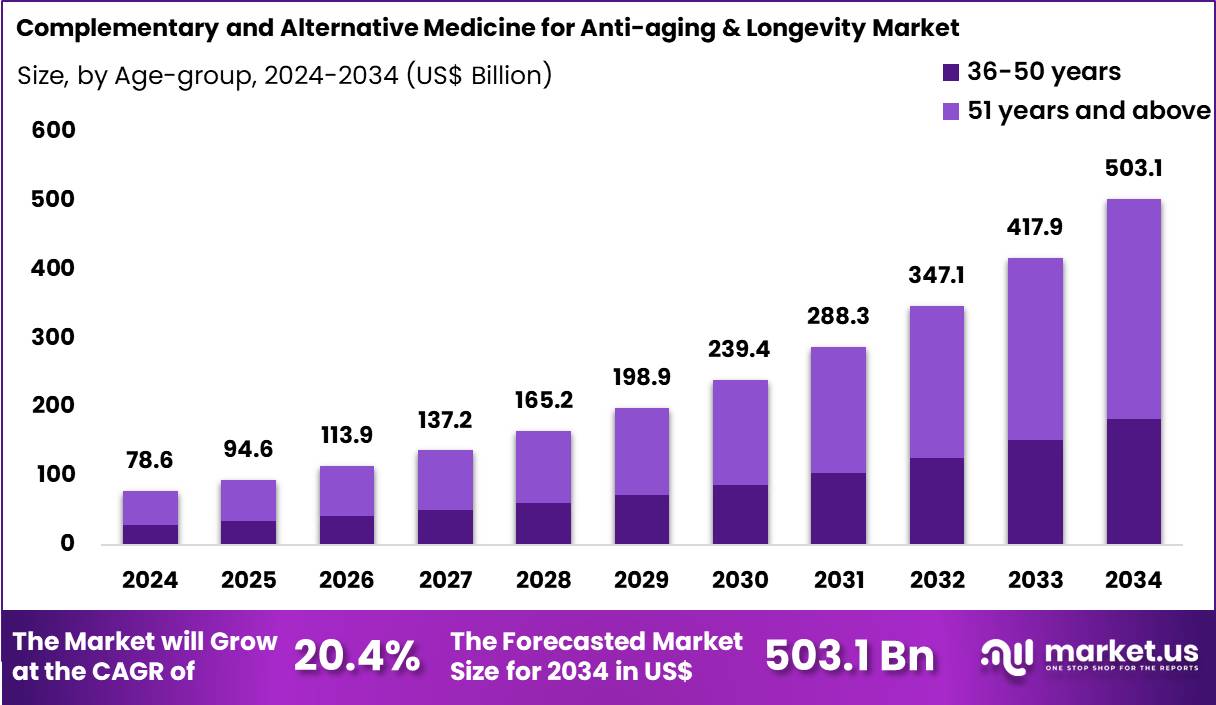
New York, NY – Sep 08, 2026 –The Global Complementary and Alternative Medicine for Anti Aging & Longetivity Market size is expected to be worth around US$ 503.1 Billion by 2034 from US$ 78.6 Billion in 2024, growing at a CAGR of 20.4% during the forecast period 2025 to 2034. In 2024, Europe led the market, achieving over 33.1% share with a revenue of US$ 26.0 Billion.
The Complementary and Alternative Medicine for Anti Aging & Longetivity Market is gaining attention as consumers increasingly explore holistic approaches that support healthy aging, wellness, physical function, and overall quality of life. The sector includes practices such as yoga, meditation, tai chi, acupuncture, traditional medicine, nutritional approaches, and selected natural products.
The growing global focus on healthy aging is creating opportunities for complementary approaches to be incorporated alongside conventional healthcare, particularly for managing age-related symptoms and supporting active lifestyles. According to the World Health Organization (WHO), the global population aged 60 years and older is expected to reach 1.4 billion by 2030, highlighting the expanding need for strategies that promote healthy aging and functional ability.
The National Center for Complementary and Integrative Health (NCCIH) notes that older adults widely use mind-body practices, including yoga, tai chi, qigong, and relaxation techniques, while research continues to evaluate their effectiveness and safety. The National Institute on Aging also recommends at least 150 minutes of moderate-intensity aerobic activity per week for older adults, alongside muscle-strengthening and balance activities.
However, the market faces challenges related to inconsistent clinical evidence, product safety, interactions with prescription medicines, and varying regulatory standards. As healthcare increasingly emphasizes personalized, preventive, and whole-person care, evidence-based complementary approaches may gain greater integration into healthy-aging and longevity programs.
Key Takeaways
- In 2024, the market generated revenue of US$ 78.6 Billion and is projected to reach US$ 503.1 Billion by 2034, expanding at a CAGR of 20.4%.
- By therapy type, the market is segmented into traditional alternative medicine/botanicals, body healing, mind healing, external energy healing and sensory healing. Traditional alternative medicine/botanicals dominated the market in 2024, accounting for a 35.3% share.
- By age group, the market is segmented into 36-50 years and 51 years and above. The 51 years and above segment held the largest share, accounting for 63.7% of the market.
- By end-user, the market is segmented into fitness, yoga & wellness centers, integrative & alternative medicine hospitals, homecare settings, natural skincare clinics, corporate wellness programs and others. Homecare settings dominated the market, holding the largest revenue share of 36.1%.
- Europe led the market in 2024, accounting for a 33.1% share.
Statistical Information
- Growing Adoption of Complementary Medicine Among Older Adults: A U.S. study of adults aged 65 and older found that 60.1% had used at least one complementary or alternative medicine approach during the previous 12 months, demonstrating substantial consumer engagement with complementary healthcare practices among the core aging population.
- Natural Products and Supplements Remain Important to Healthy-Aging Consumers: Among older U.S. adults using complementary approaches, 37.0% reported using herbal products or dietary supplements, highlighting strong consumer interest in natural-product-based approaches that may be incorporated into broader wellness and healthy-aging routines.
- Mind-Body Practices Support Longevity-Oriented Wellness Demand: Research among adults aged 65 and older found that 28.9% used mind-body practices, including approaches such as meditation and related techniques, while 26.6% used bodywork methods. This indicates demand for non-pharmacological approaches focused on physical and mental well-being.
- Older Consumers Prefer Integrating Complementary and Conventional Healthcare: A survey of adults aged 70 and older in Germany found that 64.9% preferred combining complementary medicine with conventional medical care, demonstrating consumer interest in integrated healthcare models rather than relying exclusively on either approach.
- Self-Directed Consumer Decisions Influence Complementary Medicine Adoption: Research among older German adults found that 27.3% of complementary medicine use was initiated independently by consumers, demonstrating the importance of personal health preferences and self-directed wellness decisions in the adoption of complementary and longevity-oriented approaches.
- Healthcare Professionals Influence Complementary Medicine Consumption: In the same study, 25.8% of complementary medicine use was based on physician prescriptions, while 10.4% followed pharmacist recommendations, highlighting the role of healthcare professionals in shaping consumer adoption and potentially increasing demand for clinically guided complementary and integrative solutions.
Regional Analysis
Europe remains a leading region in the Complementary and Alternative Medicine for Anti-Aging & Longevity Market, supported by an aging population and growing interest in preventive, holistic, and personalized healthcare.
The WHO recognizes traditional and complementary medicine as having applications in preventing and managing lifestyle-related chronic diseases and addressing the health needs of aging populations. The region’s established interest in herbal medicines, wellness practices, and integrative healthcare continues to support demand for longevity-focused solutions.
Asia Pacific is expected to register the fastest growth during the forecast period, driven by rapidly aging populations and the deep cultural roots of traditional medicine. WHO highlights the extensive use of traditional and complementary medicine across the Western Pacific, particularly as populations age and noncommunicable diseases increase. Greater integration of traditional medicine into national health systems, alongside rising demand for preventive and person-centred care, is expected to strengthen the region’s growth potential.
Emerging Trends
- Evidence-Based Integrative Care: The market is moving toward combining complementary therapies with conventional healthcare. WHO’s 2025–2034 Traditional Medicine Strategy emphasizes stronger research, safety, quality, and evidence-based integration. This trend supports the development of anti-aging programs that combine traditional practices with clinically supervised preventive and wellness care.
- Personalized Longevity Programs: Personalized wellness is becoming more important as consumers seek anti-aging solutions suited to their individual needs. Programs increasingly combine meditation, yoga, nutrition, herbal practices, and physical activity. CDC recommends older adults complete 150 minutes of moderate-intensity aerobic activity each week, supporting structured healthy-aging programs.
- Digital Complementary Healthcare: Digital platforms are expanding access to complementary and alternative therapies through teleconsultations, mobile applications, virtual yoga, meditation programs, and remote wellness coaching. These services can help older adults access practitioners and maintain personalized routines at home, particularly when local integrative healthcare services are unavailable.
- Stronger Focus on Safety and Quality: Regulatory attention is increasing around the quality, safety, and responsible use of traditional and complementary medicine. WHO’s strategy highlights the importance of evidence, regulation, and qualified practitioners. This is encouraging the market to move away from unsupported anti-aging claims toward safer, standardized, and professionally guided solutions.
- Healthy Aging Over Cosmetic Aging: The focus is gradually shifting from appearance-based anti-aging toward healthy aging, functional ability, and longer independent living. CDC identifies physical activity as beneficial for chronic disease prevention and maintaining physical function among older adults, supporting complementary wellness programs focused on mobility, sleep, stress, and independence.
Use Cases
- Stress and Emotional Well-Being: Meditation, yoga, mindfulness, breathing exercises, and tai chi are increasingly used within longevity programs to support relaxation and emotional well-being. These approaches can be incorporated into wellness centers, senior-care programs, and personalized health plans as non-pharmacological components of broader healthy-aging strategies.
- Sleep and Recovery Support: Complementary therapies are being used to address sleep-related concerns among aging populations. Mindfulness, relaxation techniques, yoga, and selected traditional practices can be incorporated into bedtime and recovery routines. This creates opportunities for integrative wellness programs that combine sleep-support strategies with lifestyle and behavioral interventions.
- Mobility and Physical Function: Yoga, tai chi, therapeutic movement, and other mind-body practices can be used in healthy-aging programs to support flexibility, balance, and physical activity. These approaches are particularly relevant for older adults seeking to remain active and independent, complementing conventional exercise and rehabilitation services.
- Lifestyle-Based Chronic Disease Support: Complementary medicine is increasingly used alongside conventional care for people managing long-term health conditions. Nutrition counseling, mindfulness, yoga, and traditional practices may be incorporated into broader lifestyle programs, with professional supervision, to support overall well-being and improve adherence to healthy behaviors.
- Wellness and Longevity Retreats: Specialized longevity centers and wellness retreats are combining complementary medicine with nutrition, exercise, meditation, stress management, and traditional therapies. These programs provide an integrated consumer experience focused on healthy aging, preventive lifestyle management, and personal well-being rather than treating a single medical condition.
Frequently Asked Questions on Complementary and Alternative Medicine for Anti Aging & Longetivity
- What is the Complementary and Alternative Medicine for Anti-Aging & Longevity Market?
This market includes therapies, products, and wellness practices designed to support healthy aging and longevity. It covers herbal remedies, nutritional approaches, mind-body therapies, traditional medicine, meditation, yoga, and other complementary practices focused on maintaining physical and mental well-being. - What are the major types of CAM used for healthy aging?
Major approaches include traditional herbal medicine, acupuncture, yoga, meditation, massage therapy, nutritional supplements, naturopathy, Ayurveda, traditional Chinese medicine, and mind-body practices. These approaches are commonly used to support relaxation, mobility, stress management, general wellness, and healthy lifestyle habits. - Why is demand for CAM increasing among aging populations?
Demand is increasing as older adults seek personalized and holistic approaches to wellness. Many consumers are interested in maintaining mobility, managing stress, supporting quality of life, and combining conventional healthcare with complementary practices that promote healthier aging. - How does CAM support healthy aging and longevity?
CAM may support healthy aging by encouraging physical activity, relaxation, balanced nutrition, stress reduction, and better lifestyle habits. Depending on the approach, these practices may complement conventional care, although evidence and effectiveness can vary significantly between individual therapies. - Which CAM therapies are commonly associated with anti-aging and longevity?
Commonly associated approaches include herbal medicine, Ayurveda, traditional Chinese medicine, acupuncture, meditation, yoga, massage, nutritional therapies, and mind-body practices. Interest is particularly strong in approaches that focus on stress management, physical activity, nutrition, sleep, and overall wellness.
Conclusion
The Complementary and Alternative Medicine for Anti-Aging & Longevity Market is expanding as consumers increasingly prioritize healthy aging, preventive wellness, and personalized care. Rising adoption among older adults, growing interest in natural products and mind-body practices, and greater acceptance of integrative healthcare are supporting market development. Europe currently leads, while Asia Pacific offers strong future growth potential due to aging populations and established traditional medicine systems.
At the same time, safety, regulatory consistency, and clinical evidence remain important considerations. Overall, the market is expected to benefit from evidence-based integration, digital healthcare access, personalized longevity programs, and a broader shift toward healthy aging and improved quality of life.
Discuss your needs with our analyst
Please share your requirements with more details so our analyst can check if they can solve your problem(s)




