


Overview
New York, NY – Aug 13, 2026 – The Global Central Venous Catheter Market size is expected to be worth around US$ 5.36 Billion by 2034 from US$ 2.75 Billion in 2024, growing at a CAGR of 6.9% during the forecast period from 2025 to 2034. In 2024, North America led the market, achieving over 38.5% share with a revenue of US$ 1.06 Billion.
The global central venous catheter (CVC) sector is witnessing steady expansion due to increasing demand for advanced medical care, including oncology treatment, dialysis, intensive care, and complex surgical procedures. Growing disease burden and rising healthcare infrastructure investments are strengthening the need for reliable vascular access solutions across hospitals and specialty care centers. The increasing prevalence of cancer remains a major growth driver, with approximately 19.3 million new cancer cases reported globally in 2020.
Many oncology patients require long-term venous access for chemotherapy, targeted therapies, and supportive treatments, increasing the adoption of tunneled and implantable central venous catheters. Chronic kidney disease (CKD) is another significant contributor, affecting around 9–10% of adults worldwide, representing nearly 800 million people. Patients requiring hemodialysis often depend on specialized catheter-based access when alternative vascular options are unsuitable.
Additionally, critical care demand continues to support CVC utilization, with OECD countries reporting an average of 16.9 intensive care beds per 100,000 population in 2021, where central access is essential for medication delivery, monitoring, and fluid management. Rising surgical volumes, growing elderly populations, and increased focus on infection prevention are further accelerating market development.
Hospitals are increasingly adopting antimicrobial-coated and advanced CVC technologies to reduce central line–associated bloodstream infections (CLABSIs). According to WHO estimates, sepsis accounted for approximately 48.9 million cases and 11 million deaths globally in 2017, highlighting the continued importance of rapid and effective vascular access in critical care. These factors collectively support sustained growth and innovation in the CVC sector.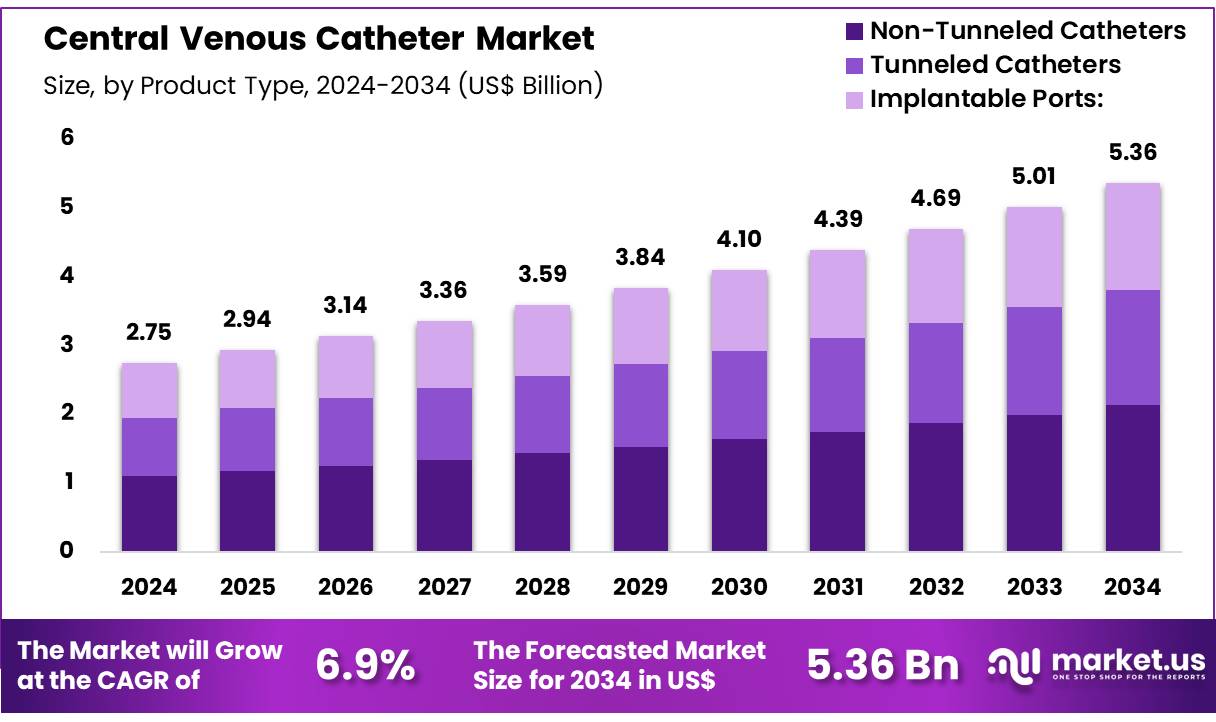
Key Takeaways
- Market Size: The global Central Venous Catheter market is projected to reach approximately US$ 5.36 billion by 2034, increasing from US$ 2.75 billion in 2024.
- Market Growth: The market is expected to expand at a CAGR of 6.9% during the forecast period from 2025 to 2034.
- Product Type Analysis: Non-tunneled catheters held the largest market share in 2024, accounting for approximately 39.8% of the overall market.
- Property Analysis: Non-antimicrobial catheters dominated the market in 2024, representing around 80.4% of the total market share.
- Design Analysis: The multiple lumen catheter segment led the market in 2024, capturing approximately 39.8% of the global market share.
- Material Analysis: Polyurethane-based catheters accounted for the largest share in 2024, contributing around 46.8% of the market.
- End-Use Analysis: Hospitals dominated the market in 2024 with a 59.9% share, driven by their extensive use in critical care, surgical procedures, and long-term patient treatment.
- Regional Analysis: North America held the leading position in the global Central Venous Catheter market in 2024, accounting for more than a 38.5% share and generating a market value of approximately US$ 1.06 billion.
Statistical Information
- Growing Cancer Incidence Increasing Need for Long-Term Venous Access: Cancer treatment remains one of the major clinical areas supporting central venous catheter (CVC) utilization. According to WHO’s International Agency for Research on Cancer (IARC), approximately 20 million new cancer cases and 9.7 million cancer deaths were recorded globally in 2022. Around 53.5 million people were alive within five years after cancer diagnosis, creating a large population requiring repeated intravenous therapies, chemotherapy, and supportive care.
- Future Cancer Growth Supporting Higher Demand for Oncology Catheters: The global cancer burden is expected to increase significantly due to population aging and lifestyle-related risk factors. IARC estimates that annual cancer cases could reach approximately 35 million by 2050, representing nearly a 77% increase compared with 2022 levels. Rising treatment volumes are expected to increase the requirement for implantable ports, tunneled catheters, and other long-term vascular access devices.
- Chronic Kidney Disease Burden Increasing Dialysis Access Requirements: Chronic kidney disease continues to create demand for dialysis-related vascular access solutions. Global health studies estimate that CKD affects approximately 800 million people worldwide, representing nearly 10% of the adult population. Patients with kidney failure often require hemodialysis, and central venous dialysis catheters are used when permanent access options such as arteriovenous fistulas are unavailable or unsuitable.
- Intensive Care Expansion Driving Central Line Usage: Central venous catheters are essential in intensive care units for administering vasopressors, antibiotics, fluids, and medications requiring rapid bloodstream delivery. OECD healthcare data reported an average of 16.9 intensive care beds per 100,000 population across OECD countries in 2021, highlighting significant critical care infrastructure where CVCs are routinely used.
- Sepsis Cases Increasing Need for Emergency Central Access: Severe infections and sepsis management frequently require rapid intravenous therapy through central access. WHO reported approximately 48.9 million sepsis cases and 11 million sepsis-related deaths globally in 2017. The continued burden of severe infections supports the importance of reliable vascular access devices in emergency departments and critical care units.
- Aging Population Increasing Need for Complex Medical Care: Population aging is expected to increase demand for healthcare procedures associated with cancer, kidney disease, cardiovascular disorders, and major surgeries. United Nations demographic projections indicate that the global population aged 65 years and older is expected to reach around 1.6 billion by 2050, compared with approximately 761 million in 2021.
- Increasing Chronic Disease Treatment Complexity Supporting CVC Use: The growing prevalence of chronic illnesses such as cancer, kidney failure, and severe infections is increasing the number of patients requiring repeated intravenous therapies. WHO reports that noncommunicable diseases account for approximately 41 million deaths annually worldwide, representing about 74% of all global deaths, highlighting the expanding need for advanced medical interventions.
- Increasing Use of Chemotherapy and Infusion Therapies Supporting CVC Adoption: The growing number of patients receiving intravenous cancer therapies is increasing the requirement for reliable long-term vascular access. WHO’s IARC reported approximately 20 million new cancer cases globally in 2022, with the number expected to reach nearly 35 million cases annually by 2050. Many chemotherapy regimens require repeated infusions over months, supporting demand for implantable ports and tunneled central venous catheters.
Regional Analysis
North America held a dominant market position, capturing more than a 38.5% share.
North America remains a significant region for central venous catheter adoption due to advanced healthcare infrastructure, high hospital capacity, and increasing demand for critical care services. The United States reported approximately 35.5 million hospital admissions in 2022, creating substantial demand for vascular access devices used in intensive care, surgery, oncology, and emergency care.
The region also faces a high burden of chronic diseases. According to the CDC, 6 in 10 adults in the United States live with at least one chronic disease, while cancer and kidney disease continue to contribute to long-term treatment requirements involving central venous access. The National Kidney Foundation estimates that more than 800,000 Americans have end-stage kidney disease, with many requiring dialysis access solutions.
Strict infection prevention programs and hospital quality initiatives have encouraged adoption of safer catheter technologies. CDC guidelines on central line-associated bloodstream infection (CLABSI) prevention support standardized catheter insertion and maintenance practices, increasing demand for advanced vascular access solutions across healthcare facilities.
Emerging Trends
- Increasing Adoption of Antimicrobial and Infection-Prevention Catheters: Hospitals are increasingly focusing on reducing catheter-related infections through antimicrobial-coated CVCs, improved insertion techniques, and infection-control protocols. CDC guidelines recommend evidence-based practices for preventing intravascular catheter infections. CLABSI reduction programs are becoming a key factor influencing catheter technology selection.
- Growth of Ultrasound-Guided CVC Placement for Safer Procedures: Ultrasound-guided catheter insertion is becoming a standard practice because it improves placement accuracy and reduces complications. CDC recommends ultrasound guidance for central venous catheter placement when available and performed by trained healthcare professionals. This trend supports demand for advanced insertion technologies.
- Rising Demand for Dialysis Catheters Due to Kidney Disease Growth: Increasing kidney failure cases are supporting demand for dialysis-related central venous catheters. CDC highlights that central line catheters are used for hemodialysis when immediate access is required or when other vascular access options are unsuitable. Kidney disease treatment continues to drive long-term vascular access needs.
- Increasing Use of CVCs in Oncology and Long-Term Infusion Therapy: Cancer treatment remains a major application area for central venous access devices because chemotherapy, targeted therapies, and repeated intravenous treatments often require reliable access. National Cancer Institute identifies central venous access catheters as devices used for delivering medicines, fluids, blood products, and collecting blood samples.
- Development of Multi-Lumen Catheters for Critical Care Applications: Multi-lumen CVCs are gaining importance in intensive care settings because critically ill patients often require simultaneous administration of medications, fluids, nutrition, and monitoring therapies. CDC recommends using the minimum number of lumens required for patient management to reduce infection risks.
Use Cases
- Chemotherapy and Cancer Treatment Delivery: Central venous catheters are widely used in oncology care for delivering chemotherapy, immunotherapy, targeted therapies, and supportive medications. CVCs provide reliable long-term vascular access, reducing repeated needle insertion and improving treatment convenience for cancer patients receiving multiple infusion cycles. The National Cancer Institute recognizes central venous access devices as important tools for cancer treatment delivery.
- Hemodialysis and Kidney Failure Management: CVCs are used as temporary or long-term vascular access solutions for patients requiring hemodialysis, especially when arteriovenous fistulas or grafts are unavailable. Dialysis catheters enable rapid blood flow access for kidney replacement therapy and are commonly used in emergency dialysis situations.
- Intensive Care Unit (ICU) Medication Administration: In intensive care units, CVCs are used for delivering critical medications such as vasopressors, antibiotics, sedatives, and fluids. They allow administration of medications that require controlled delivery into large central veins and support continuous monitoring of critically ill patients.
- Sepsis and Emergency Care Management: Central venous catheters play an important role in emergency treatment of severe infections and septic shock. They enable rapid administration of intravenous fluids, antibiotics, and vasopressor medications required to stabilize critically ill patients.
- Total Parenteral Nutrition (TPN): CVCs are used for delivering total parenteral nutrition to patients who cannot receive adequate nutrition through the digestive system. These catheters allow administration of high-concentration nutritional solutions containing carbohydrates, proteins, fats, vitamins, and minerals.
Frequently Asked Questions on Central Venous Catheter
- Why are Central Venous Catheters important in cancer treatment?
Central Venous Catheters provide long-term access for chemotherapy, immunotherapy, and targeted cancer treatments. They reduce repeated needle insertions and allow healthcare providers to deliver complex medications safely and efficiently during prolonged oncology treatment cycles. - How does kidney disease impact demand for Central Venous Catheters?
Growing kidney failure cases increase the requirement for dialysis catheters. Patients needing urgent hemodialysis or those without suitable permanent vascular access often depend on central venous catheter solutions for effective kidney replacement therapy. - Which healthcare facilities use Central Venous Catheters the most?
Hospitals are the primary users of Central Venous Catheters due to extensive applications in intensive care units, operating rooms, oncology departments, emergency care, and dialysis centers. These devices support critical treatments and complex patient management. - What are the different types of Central Venous Catheters?
Major types include non-tunneled catheters, tunneled catheters, implanted ports, and dialysis catheters. Healthcare providers select catheter types based on treatment duration, patient condition, infection risk, and clinical requirements for vascular access. - How are antimicrobial catheters influencing the CVC Market?
Antimicrobial catheters are gaining adoption as hospitals focus on reducing catheter-related bloodstream infections. These advanced devices support infection prevention strategies and improve patient safety, particularly in intensive care environments with high infection risks. - What are the major challenges in the Central Venous Catheter Market?
Key challenges include catheter-related bloodstream infections, insertion complications, maintenance requirements, and strict infection-control practices. Healthcare providers must follow standardized guidelines to reduce risks and improve patient outcomes associated with catheter usage. - Why is North America a leading region for the Central Venous Catheter Market?
North America benefits from advanced healthcare infrastructure, high hospital capacity, strong adoption of medical technologies, and increasing chronic disease burden. The region’s focus on patient safety, infection prevention, and advanced treatment procedures supports higher CVC utilization.
Conclusion
The Central Venous Catheter (CVC) market is experiencing steady growth due to increasing demand for advanced healthcare procedures, including cancer treatment, dialysis, intensive care, and complex surgeries. Rising chronic disease prevalence, aging populations, and expanding hospital infrastructure are creating strong demand for reliable vascular access solutions.
Technological advancements such as antimicrobial coatings, improved catheter materials, and ultrasound-guided placement are enhancing safety and reducing complications. Hospitals remain the primary users due to extensive critical care applications. With continuous focus on infection prevention, patient safety, and innovative catheter technologies, the CVC market is expected to maintain positive development in the coming years.
Discuss your needs with our analyst
Please share your requirements with more details so our analyst can check if they can solve your problem(s)




