


Overview
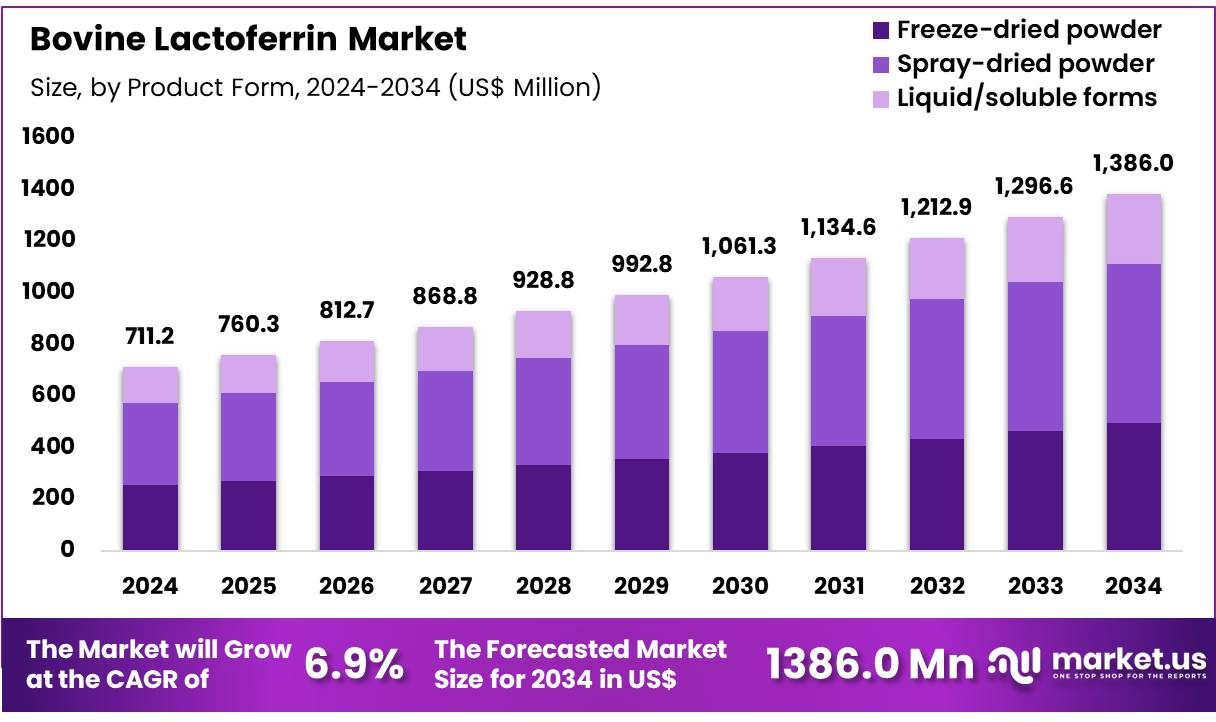
The Global Bovine Lactoferrin Market size is expected to be worth around US$ 1386.0 Million by 2034 from US$ 711.2 Million in 2024, growing at a CAGR of 6.9% during the forecast period from 2025 to 2034. In 2024, North America led the market, achieving over 33.5% share with a revenue of US$238.3 million.
Bovine lactoferrin is a naturally occurring iron-binding glycoprotein found in cow’s milk, particularly in colostrum, the first milk produced after calving. It is widely recognized for its antimicrobial, antiviral, anti-inflammatory, antioxidant, and immune-supporting properties, making it a valuable ingredient in dietary supplements, infant nutrition, functional foods, pharmaceuticals, and personal care products. Due to its ability to bind iron, bovine lactoferrin helps limit the growth of harmful microorganisms while supporting the body’s natural immune defenses. It is also being studied for its potential role in promoting gut health, enhancing iron absorption, and supporting overall wellness.
The growing demand for preventive healthcare, clean-label nutrition, and scientifically supported bioactive ingredients is driving increased adoption of bovine lactoferrin across global markets. Manufacturers are investing in advanced purification technologies to produce high-purity lactoferrin suitable for medical, nutritional, and food applications. Regulatory approvals in several countries and expanding clinical research continue to strengthen confidence in its safety and effectiveness.
In the infant formula sector, bovine lactoferrin is increasingly used to more closely resemble the nutritional composition of human breast milk. Rising consumer awareness of immune health, combined with expanding applications in sports nutrition, elderly care, and clinical nutrition, is expected to support sustained market growth. Continuous innovation in dairy processing and biotechnology is further enhancing production efficiency, product quality, and the availability of bovine lactoferrin for a wide range of commercial and healthcare applications.
Key Takeaways
- Market Size: The global bovine lactoferrin market was valued at US$ 711.2 million in 2024 and is projected to reach US$ 1,386.0 million by 2034.
- Market Growth: The market is anticipated to expand at a compound annual growth rate (CAGR) of 6.9% throughout the 2025–2034 forecast period.
- By Product Form: Spray-dried powder emerged as the leading product form in 2024, accounting for 44.6% of the global market due to its superior stability and ease of incorporation into food and nutraceutical products.
- By Function: The iron-binding and iron-transport function represented the largest segment in 2024, capturing 35.3% of the market, supported by its important role in iron metabolism and immune health.
- By Distribution Channel: Pharmacies and drug stores held the largest distribution channel share in 2024, accounting for 31.0%, reflecting strong consumer preference for purchasing health and nutritional supplements through trusted retail outlets.
- By Region: North America led the global bovine lactoferrin market in 2024, securing a 33.5% market share and generating approximately US$ 238.3 million in revenue, supported by high consumer awareness and robust demand for functional nutrition products.
Statistical Information
- The European Union permits bovine lactoferrin in infant formula at a maximum level of 100 mg per 100 mL of ready-to-drink formula.
- The same 2025 EU regulation allows bovine lactoferrin in processed cereal foods at up to 670 mg per 100 g, defining the technical formulation limit for these products.
- Foods for special medical purposes in the EU may provide bovine lactoferrin at levels of up to 3 g per day according to individual nutritional requirements (2025 consolidated regulation).
- Cheese-based products are permitted to contain up to 2,000 mg of bovine lactoferrin per 100 g under the EU’s 2025 consolidated novel food regulation, representing one of the highest approved concentrations.
- Chewing gum may contain up to 3,000 mg of bovine lactoferrin per 100 g under the updated 2025 EU authorization, the highest permitted concentration among approved food categories.
- A 2025 peer-reviewed Food Bioscience study reported that an optimized membrane filtration process achieved a bovine lactoferrin recovery (yield) of 71.53% during whey separation.
- The same 2025 study found that optimal bovine lactoferrin recovery was achieved using 0.3 M sodium chloride during processing.
- Researchers reported that maintaining processing at 37°C during membrane separation produced the highest bovine lactoferrin transfer efficiency into whey in the optimized manufacturing process.
- The optimized manufacturing process combined two microfiltration stages using 1.4 µm filtration for bacterial removal followed by 0.1 µm filtration for whey separation to preserve lactoferrin bioactivity.
- As of the FDA’s May 2026 GRAS database update, cow’s milk-derived lactoferrin remains authorized for infant formula at approximately 13–14 mg per 100 mL of ready-to-feed formula and 15 mg per 100 mL in follow-on formula.
Regional Analysis
North America dominated the bovine lactoferrin market in 2024, accounting for more than 33.5% of the global market and generating approximately US$ 238.3 million in revenue. The region’s leadership was supported by advanced dairy processing technologies, a reliable supply of high-quality bovine milk, and strong consumer demand for immune-supporting nutritional ingredients. Growing use of bovine lactoferrin in infant formula, dietary supplements, and functional foods further strengthened market growth. Rising health awareness encouraged consumers to choose premium products with scientifically supported bioactive ingredients for immunity and gut health.
Well-established regulatory frameworks for dairy-based nutrition and nutraceutical products also promoted product innovation and commercialization. In addition, investments in research, ingredient purification technologies, and manufacturing capacity enhanced product quality and export potential. The expansion of e-commerce channels and increasing interest in preventive healthcare, sports nutrition, and healthy aging continued to support demand, reinforcing North America’s leading position in the global bovine lactoferrin market.
Emerging Trends
- Rising demand for infant nutrition ingredients: Bovine lactoferrin is increasingly used in infant formula because it closely resembles the immune-supporting protein found in human milk. Regulatory agencies continue to evaluate novel lactoferrin ingredients, while safety studies support intake levels up to 3.4 g/day in adults and animal safety studies up to 2,000 mg/kg body weight/day.
- Expansion of precision fermentation technology: Manufacturers are investing in precision fermentation to produce recombinant lactoferrin and reduce dependence on dairy extraction. Traditional production requires approximately 10,000 liters of cow’s milk to obtain 1 kilogram of lactoferrin, encouraging interest in alternative manufacturing methods that improve supply efficiency.
- Stronger regulatory focus on food safety: Food companies are increasingly seeking regulatory approval for lactoferrin-based ingredients before commercialization. In the European Union, more than 200 novel foods have already been authorized, and EFSA continues updating guidance to improve scientific evaluation and food safety standards for innovative ingredients.
- Growing use in functional nutrition products: Health-focused consumers are driving demand for functional foods containing bioactive dairy proteins. Bovine lactoferrin is being incorporated into nutritional supplements, dairy beverages, and wellness products because of its iron-binding and immune-supporting properties, supported by continuous scientific and regulatory evaluations.
- Investment in sustainable protein production: Companies are expanding production capacity through biotechnology to address future supply shortages. New recombinant manufacturing platforms aim to produce lactoferrin with consistent quality while reducing reliance on large-scale dairy processing, improving long-term sustainability for infant nutrition and dietary supplement applications.
Use Cases
- Infant formula manufacturing: Bovine lactoferrin is widely incorporated into premium infant formula to better match the composition of breast milk. Scientific assessments indicate that proposed infant intake levels remain within the range naturally consumed by breastfed infants, supporting product development under regulatory oversight.
- Dietary supplements for immune health: Manufacturers use bovine lactoferrin in capsules and powders designed for immune support and overall wellness. Human safety evaluations have reported intake levels of up to 3.4 g/day, providing confidence for its inclusion in nutritional supplement formulations.
- Functional dairy and beverage products: Food producers are adding bovine lactoferrin to dairy drinks, yogurt, and fortified nutrition products to increase their functional value. These products target consumers seeking foods with added bioactive proteins while complying with food safety and novel food regulations.
- Medical and clinical nutrition: Healthcare nutrition companies are exploring bovine lactoferrin for specialized nutritional products intended for individuals with increased nutritional needs. Ongoing scientific research and regulatory reviews continue to evaluate its safety and appropriate use across different population groups.
- Next-generation recombinant protein production: Biotechnology companies are developing recombinant bovine lactoferrin using precision fermentation for commercial applications. This production approach aims to improve scalability, reduce raw milk requirements, and support consistent ingredient quality for the food and nutrition industries.
Frequently Asked Questions on Bovine Lactoferrin
- What factors are driving the growth of the bovine lactoferrin market?
The market is expanding due to rising consumer awareness of immune health, increasing demand for premium infant formula, greater use of functional foods, growing nutritional supplement consumption, and continuous research supporting lactoferrin’s role in health and wellness applications. - Which industries use bovine lactoferrin the most?
Bovine lactoferrin is mainly used by infant nutrition manufacturers, dietary supplement companies, food and beverage producers, pharmaceutical firms, cosmetic manufacturers, and animal nutrition companies. These industries value its multifunctional health benefits and natural origin for premium product development. - Which regions are leading the bovine lactoferrin market?
North America and Europe remain major markets due to advanced dairy processing industries and high supplement consumption. Meanwhile, Asia-Pacific is witnessing rapid growth because of expanding infant nutrition demand, rising disposable incomes, and increasing health-conscious consumer populations. - How is bovine lactoferrin produced commercially?
Commercial bovine lactoferrin is extracted from fresh cow’s milk or whey using advanced separation and purification technologies such as membrane filtration and chromatography. These methods ensure high purity while preserving the protein’s biological activity for industrial applications. - What opportunities exist in the bovine lactoferrin market?
Significant opportunities include expanding applications in clinical nutrition, sports nutrition, functional beverages, personalized nutrition, healthy aging products, and premium pet nutrition. Continued research and technological improvements are expected to create additional commercial opportunities over the coming years. - What is the future outlook for the bovine lactoferrin market?
The bovine lactoferrin market is expected to experience steady long-term growth as demand rises for scientifically supported functional ingredients. Innovation in dairy processing, expanding healthcare applications, and increasing consumer preference for natural bioactive proteins will continue supporting market development.
Conclusion
The global bovine lactoferrin market is positioned for steady long-term growth, supported by increasing consumer demand for scientifically backed ingredients that promote immune health, iron absorption, and gut wellness. Rising use in infant nutrition, dietary supplements, pharmaceuticals, and functional foods continues to strengthen market expansion.
Regulatory acceptance of bovine lactoferrin in major markets, along with growing awareness of preventive healthcare and nutrition, is encouraging manufacturers to develop innovative formulations and broaden product applications. Improvements in dairy processing technologies and expanding production capacity are also helping address supply constraints and improve product availability.
Looking ahead, companies are expected to focus on product innovation, sustainable sourcing, and strategic partnerships to meet growing global demand. North America remains a leading regional market due to advanced dairy infrastructure and high consumer awareness, while Asia-Pacific is anticipated to offer significant growth opportunities driven by expanding infant nutrition and nutraceutical industries.
As research continues to validate the health benefits of bovine lactoferrin, its role in clinical nutrition and functional health products is expected to become increasingly important, creating favorable opportunities for manufacturers and investors throughout the forecast period.
Discuss your needs with our analyst
Please share your requirements with more details so our analyst can check if they can solve your problem(s)




