


Overview
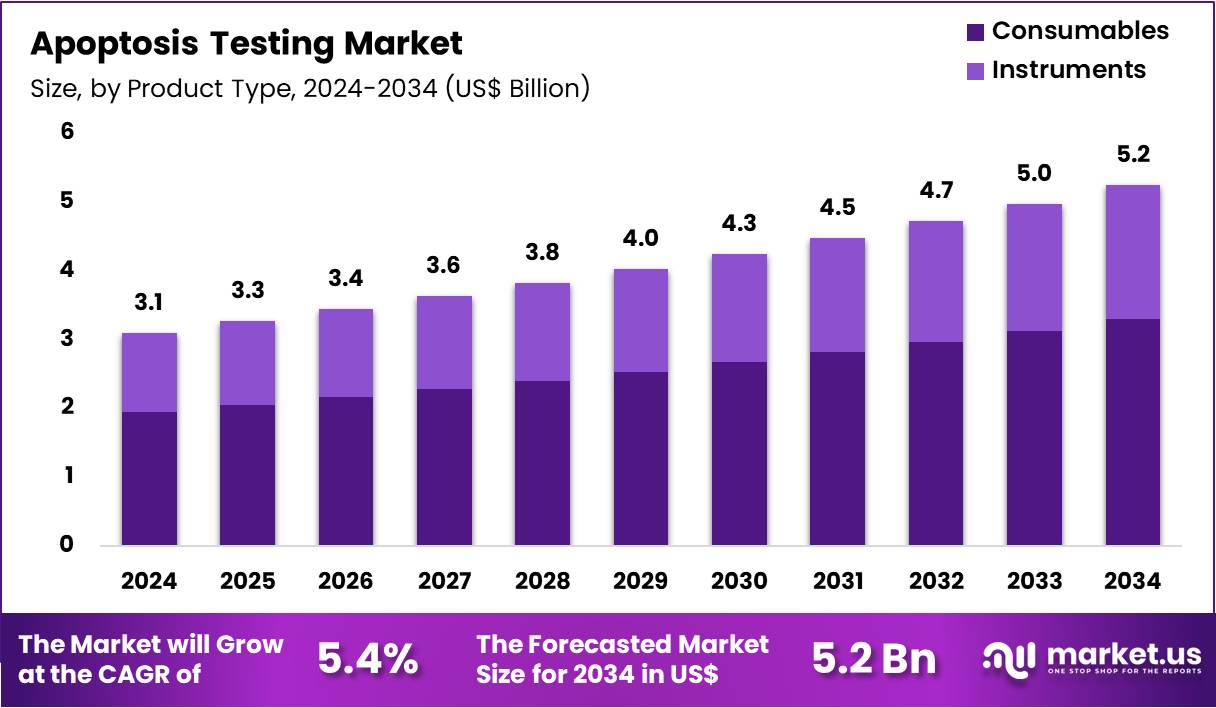
New York, NY – Sep 04, 2026 – The Global Apoptosis Testing Market size is expected to be worth around US$ 5.2 Billion by 2034 from US$ 3.1 Billion in 2024, growing at a CAGR of 5.4% during the forecast period 2025 to 2034. In 2024, North America led the market, achieving over 39.5% share with a revenue of US$ 1.2 Billion.
The global Apoptosis Testing market is witnessing steady growth as researchers and healthcare providers increasingly rely on apoptosis assays to study programmed cell death in cancer, autoimmune disorders, neurodegenerative diseases, and drug development.
The growing emphasis on precision medicine, biomarker discovery, and targeted therapies has significantly increased the demand for advanced apoptosis testing technologies across research laboratories, pharmaceutical companies, and clinical settings.
The market is projected to expand at a healthy pace over the coming decade, driven by rising investments in life science research, increasing oncology studies, and expanding biopharmaceutical pipelines. More than 20 million new cancer cases were diagnosed worldwide in 2022, according to the World Health Organization (WHO), highlighting the growing need for reliable apoptosis testing in cancer biology and therapeutic evaluation.
Additionally, the pharmaceutical industry invests over US$300 billion annually in research and development, creating strong demand for cell-based assays and apoptosis detection platforms.
Technological advancements such as flow cytometry, high-content imaging, ELISA-based assays, caspase activity assays, and Annexin V detection kits are improving testing accuracy, sensitivity, and workflow efficiency. The increasing adoption of automated laboratory systems and AI-supported image analysis is further enhancing research productivity.
Key Takeaways
- The global Apoptosis Testing market was valued at US$ 3.1 billion in 2024 and is projected to reach US$ 5.2 billion by 2034, expanding at a CAGR of 5.4% during the forecast period.
- Based on product type, the market is segmented into consumables and instruments. In 2024, the consumables segment dominated the market, accounting for 62.8% of the total market share.
- By technology, the market is categorized into flow cytometry, spectrophotometry, cell imaging & analysis systems, and others. Among these, flow cytometry emerged as the leading technology, capturing 41.6% of the market share in 2024.
- In terms of application, the market is segmented into cancer, degenerative disorders, chronic inflammation, cardiovascular diseases, and others. The cancer segment held the largest share, contributing 46.2% of the overall market revenue in 2024.
- Based on assay type, the market includes caspase assays, DNA fragmentation assays, mitochondrial assays, cell permeability assays, and Annexin V assays. The caspase assays segment led the market with a 39.3% revenue share.
- By end user, the market is divided into pharmaceutical & biotechnology companies, academic & research institutes, and hospital & diagnostic laboratories. Pharmaceutical & biotechnology companies accounted for the largest market share of 53.4% in 2024.
- North America dominated the global Apoptosis Testing market in 2024, securing the largest regional market share of 39.5%.
Market segmentation
- Product Type Analysis: Consumables accounted for 62.8% of the market and are expected to maintain dominance due to their recurring use in apoptosis testing. Growing cancer research, drug discovery, and high-throughput screening activities continue to increase demand for reagents, assay kits, dyes, probes, and buffers across pharmaceutical companies, research laboratories, and academic institutions.
- Technology Analysis: Flow cytometry held 41.6% of the market and is expected to remain the leading technology because of its high accuracy in detecting apoptotic cells. Its multiparametric analysis, automation, rapid processing, and broad application in oncology, immunology, and pharmaceutical research continue to support widespread adoption.
- Application Analysis: Cancer represented 46.2% of the market and is projected to remain the largest application segment. Rising oncology drug development, biomarker research, personalized medicine, and clinical trials continue to drive demand for apoptosis testing to evaluate treatment response, therapeutic efficacy, and disease progression.
- Assay Type Analysis: Caspase assays captured 39.3% of the market and are expected to retain leadership due to their high specificity in measuring apoptotic pathways. Increasing use in oncology research, drug discovery, toxicity testing, and mechanistic studies continues to strengthen demand for these assays worldwide.
- End-User Analysis: Pharmaceutical and biotechnology companies accounted for 53.4% of the market, driven by expanding drug discovery and preclinical research. Growing investments in oncology, biologics, targeted therapies, and personalized medicine continue to increase the adoption of apoptosis testing technologies and consumables.
Statistical Information
- A 2025 apoptosis detection protocol using PE Annexin V/7-AAD flow cytometry analyzed 1 × 10⁵ cells per sample, providing standardized quantitative apoptosis measurement.
- The same 2025 protocol incubated stained cells for 15 minutes at room temperature before flow cytometric acquisition, reducing sample preparation time.
- A 2025 Cell Bioscience protocol for apoptosis testing seeded 1 × 10⁵ cells per well before Annexin V-FITC/PI analysis, ensuring reproducible assay performance.
- The 2025 Annexin V-FITC/PI apoptosis assay used a 15-minute staining period before flow cytometry analysis.
- The apoptosis testing workflow published in 2025 analyzed data using FlowJo version 10.8.1, reflecting current software implementation in flow cytometry-based apoptosis analysis.
- A 2025 Biotechnology Journal study introduced a high-throughput fluorometric microplate apoptosis detection method, enabling simultaneous analysis of 96-well microplates, improving laboratory throughput.
Regional Analysis
North America dominated the global apoptosis testing market in 2024, accounting for 39.5% of the total market share. The region’s leadership is supported by substantial investments in cancer research, advanced biotechnology infrastructure, and strong pharmaceutical and biopharmaceutical industries. Organizations such as the National Institutes of Health (NIH) and the National Cancer Institute (NCI) continue to fund studies focused on cancer biology, cell signaling, and precision medicine, driving demand for apoptosis assays, flow cytometry, and high-content imaging technologies.
The presence of leading life science companies, academic research centers, and contract research organizations further strengthens market growth. In addition, the widespread adoption of targeted therapies and immuno-oncology research increases the need for reliable apoptosis testing in drug discovery and clinical research.
The Asia-Pacific region is projected to register the fastest growth during the forecast period due to expanding biotechnology industries, increasing pharmaceutical R&D investments, and growing clinical trial activity across China, India, Japan, and South Korea. Government initiatives supporting biomedical research, improved laboratory infrastructure, and rising adoption of advanced cell analysis technologies are expected to accelerate apoptosis testing across research and healthcare applications.
Business Opportunities
The apoptosis testing market offers significant business opportunities as pharmaceutical and biotechnology companies expand investments in oncology drug discovery, immunotherapy, and precision medicine. Increasing demand for reliable cell-death analysis in preclinical research is creating growth potential for manufacturers of assay kits, flow cytometry reagents, imaging systems, and automated analysis software.
The growing adoption of high-throughput screening platforms presents opportunities for companies to develop multiplex apoptosis assays that deliver faster, more accurate results while reducing laboratory workload. Artificial intelligence-based image analysis and automated data interpretation tools are also gaining attention, enabling laboratories to improve productivity and standardize workflows.
Emerging economies in Asia-Pacific, Latin America, and the Middle East provide attractive expansion opportunities due to rising biomedical research funding, increasing clinical trial activity, and improving laboratory infrastructure. Strategic collaborations between diagnostic companies, research institutes, and contract research organizations (CROs) are expected to accelerate product commercialization and technology adoption.
Additionally, increasing demand for apoptosis testing in stem cell research, neurodegenerative disease studies, autoimmune disorders, toxicology screening, and personalized medicine is creating new revenue opportunities. Companies that introduce user-friendly, high-sensitivity, and cost-effective apoptosis testing solutions with integrated digital analytics are well-positioned to strengthen their competitive presence and expand their global customer base.
Emerging Trends
- Growing use of biomarker-guided cancer research: Apoptosis testing is increasingly combined with biomarker testing to support precision oncology. The U.S. National Cancer Institute (NCI) notes that biomarker testing is now routinely recommended for several cancers, helping researchers measure cell death responses and select targeted therapies more accurately.
- Expansion of blood-based apoptosis testing: Researchers are adopting liquid biopsy and circulating tumor DNA (ctDNA) approaches alongside apoptosis assays to monitor treatment response without invasive tissue sampling. Multiple active NCI clinical trials are evaluating blood-based cancer diagnostics, improving patient monitoring and supporting faster therapeutic decisions.
- Higher quality standards for clinical assays: Standardization of apoptosis-related assays is becoming a key trend. In 2026, NCI updated guidance requiring integral biomarker assays used in clinical trials to meet performance and laboratory quality standards, improving reproducibility and regulatory acceptance across research institutions.
- Growth of AI-supported biomarker analysis: Artificial intelligence is increasingly used to analyze apoptosis-related biomarker data. The NCI Diagnostic Biomarkers and Technology Branch supports AI and machine learning for high-dimensional diagnostic data, enabling faster interpretation of complex apoptosis testing results and improving research efficiency.
- Large-scale validation of next-generation diagnostics: Government-supported research is accelerating validation of advanced diagnostic technologies. In 2025, NCI selected 2 multi-cancer detection assays for its Vanguard Study, which plans to enroll up to 24,000 participants, strengthening future integration of apoptosis-related biomarkers into cancer screening research.
Use Cases
- Cancer drug discovery and development: Pharmaceutical companies use apoptosis testing to evaluate whether experimental drugs successfully trigger programmed cell death in cancer cells. These assays help identify promising drug candidates early, reducing development risks and improving selection before costly clinical trials begin.
- Clinical trial patient monitoring: Apoptosis testing is widely used during oncology clinical trials to assess treatment effectiveness. Active NCI studies monitor blood samples from adults aged 45 years and older, generating data that supports evaluation of diagnostic performance and therapeutic response.
- Personalized cancer treatment selection: Hospitals and cancer centers use apoptosis-related biomarker information to identify patients who are more likely to benefit from targeted therapies or immunotherapies. This supports individualized treatment planning and improves clinical decision-making for different tumor types.
- Toxicity testing in biomedical research: Academic laboratories use apoptosis assays to determine whether chemicals, medical devices, or new compounds damage healthy cells. These tests support preclinical safety evaluation, helping researchers identify toxic effects before human studies and reducing development failures.
- Monitoring disease progression after treatment: Apoptosis testing combined with circulating tumor DNA analysis helps detect minimal residual disease and possible cancer recurrence after surgery or therapy. Researchers use these results to guide follow-up care and adjust treatment strategies before visible disease progression occurs.
Recent development
- In April 2025, Promega partnered with EditCo Bio to advance biologically relevant cell-based research using Promega technologies, strengthening solutions used in apoptosis, gene editing, and functional cell analysis.
- In April 2025, Promega launched the HiBiT-PsVLP Bioassay, a new cell-based assay supporting vaccine and virology research that complements live-cell and apoptosis-related functional assays.
- In October 2025, Merck (MilliporeSigma in the U.S.) partnered with Promega to advance 3D cell drug discovery technologies, enhancing physiologically relevant cell models widely used for apoptosis and oncology research.
Frequently Asked Questions on Apoptosis Testing
- Why is apoptosis testing important in cancer research?
Apoptosis testing helps researchers determine whether cancer treatments effectively destroy tumor cells through programmed cell death. It supports drug discovery, biomarker identification, and personalized treatment strategies, enabling pharmaceutical companies and research institutions to develop safer and more effective oncology therapies. - What are the major technologies used in apoptosis testing?
Common apoptosis testing technologies include flow cytometry, fluorescence microscopy, ELISA, caspase activity assays, TUNEL assays, and Annexin V staining. These techniques provide accurate measurement of cell death, allowing researchers to evaluate treatment effectiveness and investigate disease progression. - Which industries are the largest users of apoptosis testing?
Pharmaceutical and biotechnology companies are the primary users of apoptosis testing, followed by academic research institutes, contract research organizations (CROs), hospitals, and diagnostic laboratories. These organizations use apoptosis assays for drug development, toxicity studies, and biomedical research applications. - What factors are driving the apoptosis testing market?
The apoptosis testing market is growing due to increasing cancer prevalence, rising investments in pharmaceutical research, expanding precision medicine initiatives, and greater demand for cell-based assays. Advances in biomarker research and laboratory automation are also supporting wider adoption of apoptosis testing technologies. - Which region leads the apoptosis testing market?
North America leads the apoptosis testing market because of strong biomedical research funding, advanced healthcare infrastructure, and the presence of major biotechnology and pharmaceutical companies. High adoption of innovative laboratory technologies and government-supported cancer research further strengthen regional market growth. - What opportunities exist in the apoptosis testing market?
Growing investments in precision oncology, personalized medicine, immunotherapy research, and advanced cell biology are creating new opportunities for apoptosis testing. Increasing use of artificial intelligence, automated laboratory platforms, and multiplex assays is expected to expand future market applications. - What is the future outlook for the apoptosis testing market?
The apoptosis testing market is expected to experience steady growth as demand increases for advanced cancer diagnostics, targeted therapies, and cell-based research. Continuous technological innovation, expanding clinical research, and greater adoption of biomarker-driven healthcare will support long-term market expansion.
Conclusion
The global Apoptosis Testing Market is poised for steady growth, driven by increasing cancer research, expanding pharmaceutical drug discovery, and rising adoption of precision medicine. Growing demand for reliable cell death assays, advanced flow cytometry, and high-throughput screening technologies is encouraging continuous product innovation among leading life science companies.
Consumables continue to dominate due to their recurring use in research laboratories, while pharmaceutical and biotechnology companies remain the largest end users. North America leads the market because of strong research funding and advanced laboratory infrastructure.
Continued investments in biomarker research, automation, and next-generation assay technologies are expected to create significant opportunities, supporting sustained market expansion through 2034.
Discuss your needs with our analyst
Please share your requirements with more details so our analyst can check if they can solve your problem(s)




