


Overview
The Global Antioxidants Reagent Market size is expected to reach around US$ 5.8 Billion by 2034, up from US$ 2.7 Billion in 2024, growing at a CAGR of 7.9% during the forecast period 2025 to 2034. In 2024, North America led the market, achieving over 38.3% market share with revenue of US$ 1.0 Billion.
Antioxidant reagents are experiencing notable expansion due to rising demand from pharmaceutical research, biotechnology, clinical diagnostics, food safety testing, and chemical analysis applications. Antioxidant reagents play a crucial role in detecting oxidative stress biomarkers and evaluating antioxidant activity in biological and industrial samples.
The market was valued at approximately USD 1.2 billion in 2024 and is projected to reach nearly USD 2.0 billion by 2032, registering a compound annual growth rate (CAGR) of around 6.5% during 2025–2032. Increasing investment in life science research, growing prevalence of oxidative stress-related disorders, and rising demand for advanced diagnostic technologies are among the major factors driving market growth.
The pharmaceutical and biotechnology sectors represent the largest application segment, accounting for nearly 45% of total market demand in 2024. Research laboratories and academic institutions are also contributing significantly, supported by increasing funding for molecular biology and biomedical studies. The food and beverage testing segment is expected to grow at a CAGR of approximately 7%, driven by regulatory requirements for quality and nutritional analysis.
North America held an estimated 38% market share in 2024, supported by advanced healthcare infrastructure and high research expenditure. Europe accounted for nearly 28%, while Asia-Pacific is projected to be the fastest-growing region with a CAGR of approximately 8% due to expanding biotechnology facilities and increasing laboratory investments in countries such as China, India, and Japan.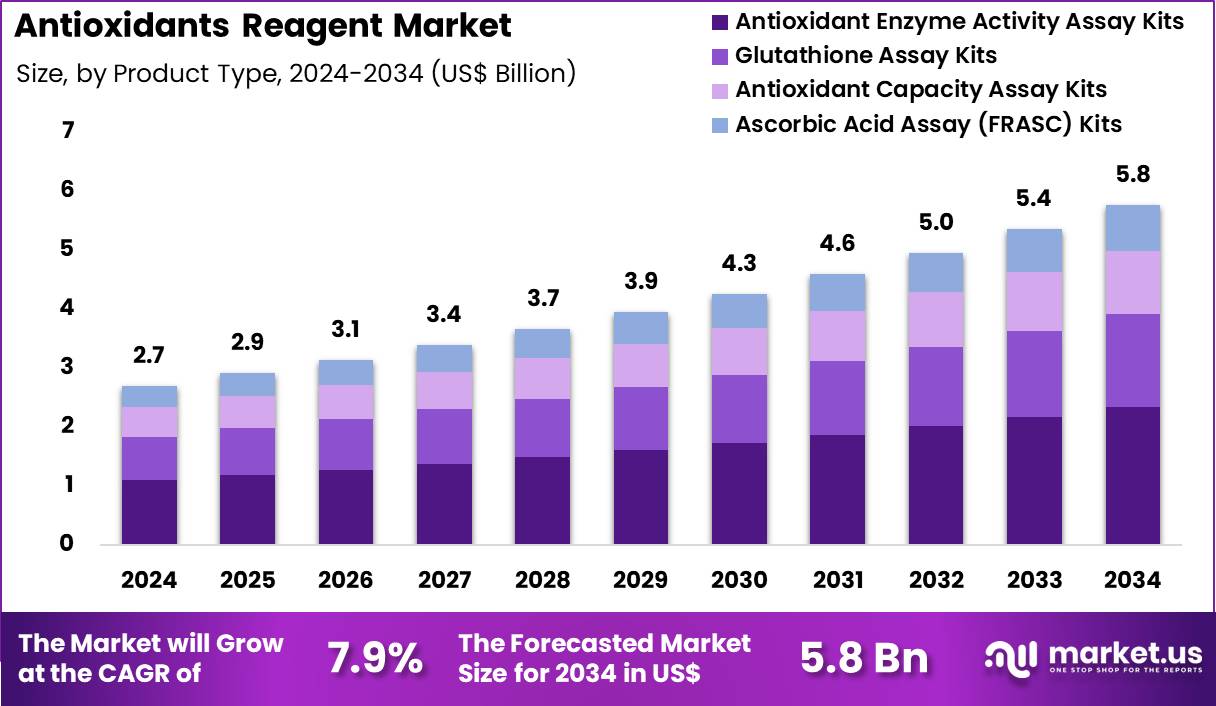
Key Takeaways
- In 2024, the Antioxidants Reagent Market generated revenue of approximately US$ 2.7 billion and is projected to expand at a CAGR of 7.9% from 2025 to 2034, reaching an estimated US$ 5.8 billion by 2034.
- Based on product type, the market is segmented into antioxidant enzyme activity assay kits, glutathione assay kits, antioxidant capacity assay kits, and ascorbic acid assay (FRASC) kits. Among these, antioxidant enzyme activity assay kits dominated the market in 2024, accounting for a significant 40.5% revenue share.
- By sample type, the market is categorized into blood plasma, serum, urine, and tissue extracts. The blood plasma segment emerged as the leading segment in 2024, capturing a substantial 45.2% market share.
- In terms of end users, the market is divided into hospitals, diagnostic laboratories, and ambulatory surgical centers. The hospitals segment held the largest market position in 2024, contributing 47.8% of the total revenue share.
- Regionally, North America dominated the global antioxidants reagent market in 2024, accounting for a significant 38.3% market share, driven by advanced healthcare infrastructure, strong research activities, and increasing adoption of diagnostic technologies.
Market Segmentation Overview
- Product Type Analysis: Antioxidant enzyme activity assay kits dominated the product type segment with a 40.5% market share in 2024. Their growth is driven by increasing demand for measuring antioxidant enzymes such as SOD, catalase, and glutathione peroxidase. Rising research on oxidative stress-related diseases, including cancer and cardiovascular disorders, along with advancements in assay sensitivity and automation, is expected to support continued segment growth.
- Sample Analysis: Blood plasma emerged as the leading sample type, accounting for 45.2% of the market share in 2024. Its dominance is attributed to its extensive application in clinical diagnostics and research for evaluating oxidative stress biomarkers. Easy sample collection, broad systemic representation, and increasing use in clinical trials and pharmaceutical studies are expected to drive demand for blood plasma-based antioxidant testing.
- End-User Analysis: Hospitals represented the largest end-user segment with a 47.8% revenue share in 2024. The segment growth is supported by increasing adoption of antioxidant reagent kits for diagnosing and monitoring oxidative stress-related conditions such as cancer, diabetes, cardiovascular diseases, and neurodegenerative disorders. Growing demand for rapid diagnostics and advanced healthcare technologies will further strengthen hospital adoption through the forecast period.
Statistical Information
- Growing Laboratory Testing Demand in Healthcare Systems: The increasing requirement for disease diagnosis and monitoring is driving laboratory testing demand worldwide. The U.S. Centers for Medicare & Medicaid Services reported that U.S. healthcare spending reached approximately US$4.9 trillion in 2023, representing about 17.6% of the national GDP, reflecting continued investment in healthcare services and diagnostics.
- Neurological Disease Research Supporting Oxidative Stress Studies: Growing neurological disease prevalence is increasing research activities focused on oxidative damage and antioxidant mechanisms. The World Health Organization estimates that more than 55 million people worldwide are living with dementia, with nearly 10 million new cases occurring every year, creating demand for advanced biological research methods.
- Aging Population Increasing Demand for Disease Biomarker Testing: The expansion of the elderly population is supporting the need for advanced diagnostic technologies, as aging is associated with higher risks of chronic diseases and oxidative stress-related conditions. According to the United Nations, the global population aged 65 years and older reached 761 million in 2021 and is expected to increase to approximately 1.6 billion by 2050.
- Increasing Diabetes Prevalence Supporting Oxidative Stress Research: The growing global diabetes burden is increasing research interest in oxidative stress-related biomarkers and antioxidant defense mechanisms. According to the International Diabetes Federation (IDF), approximately 537 million adults aged 20–79 years were living with diabetes in 2021, and this number is projected to reach 643 million by 2030 and 783 million by 2045, increasing demand for advanced disease monitoring approaches.
- Growing Healthcare Expenditure Supporting Diagnostic Technology Adoption: Higher healthcare spending is increasing investment in advanced diagnostic and monitoring technologies. The CDC reported that the United States spent approximately US$5.3 trillion annually on healthcare, with around 90% of healthcare expenditures linked to people with chronic and mental health conditions.
- Increasing Global Disease Burden Supporting Oxidative Stress Research: The rising prevalence of chronic diseases is increasing the need for biomarker-based testing and oxidative stress analysis. According to WHO, noncommunicable diseases caused 43 million deaths globally in 2021, representing 75% of all non-pandemic-related deaths, with cardiovascular diseases alone responsible for more than 19 million deaths.
- Rising Cardiovascular Disease Cases Supporting Biomarker Research: The growing impact of cardiovascular diseases is increasing research demand for oxidative stress-related biomarkers. WHO reported that cardiovascular diseases caused approximately 19.8 million deaths globally in 2022, representing nearly 32% of all global deaths, encouraging the adoption of advanced laboratory testing methods.
- Growing Burden of Chronic Diseases Driving Antioxidant Testing Demand: The increasing prevalence of chronic diseases is supporting the need for oxidative stress analysis and antioxidant biomarker testing. According to the World Health Organization (WHO), noncommunicable diseases caused 43 million deaths globally in 2021, accounting for approximately 75% of non-pandemic-related deaths worldwide, increasing the importance of advanced diagnostic and research tools.
Regional Analysis
North America led the market by securing a market share of 38.3% in 2024.
North America holds a strong position in the antioxidants reagent market due to advanced healthcare infrastructure, high investment in biomedical research, and increasing adoption of laboratory-based diagnostic technologies. The growing burden of chronic diseases is supporting demand for oxidative stress analysis and biomarker testing. According to the CDC, 6 in 10 U.S. adults have at least one chronic disease, driving the need for improved disease monitoring solutions.
Asia Pacific is expected to experience significant growth due to expanding healthcare systems, rising awareness of preventive healthcare, and increasing research activities. The WHO reported that the Western Pacific region has more than 220 million adults living with diabetes, creating demand for advanced diagnostic and monitoring technologies. Growing biotechnology development, healthcare investments, and increasing focus on disease prevention in countries such as China, Japan, and South Korea are further supporting regional growth.
Business Opportunities
The antioxidants reagent market offers significant business opportunities due to increasing demand for advanced biomarker testing, pharmaceutical research, and clinical diagnostics. Growing investment in biotechnology and life science research is creating opportunities for manufacturers to develop high-sensitivity antioxidant assay kits, automated testing solutions, and customized laboratory products.
The expansion of precision medicine and personalized healthcare is increasing the need for reliable oxidative stress biomarkers in disease monitoring and drug development. Additionally, rising chronic disease prevalence, including cardiovascular diseases and diabetes, is encouraging healthcare providers and research institutions to adopt advanced antioxidant testing technologies.
Companies can also explore opportunities in food safety testing, nutritional research, and cosmetic formulation analysis, where antioxidant evaluation plays an important role. Strategic partnerships with hospitals, research institutes, and biotechnology companies can further support market expansion and innovation.
Emerging Trends
- Growing Adoption of Biomarker-Based Testing: Antioxidant reagents are increasingly used in biomarker research for evaluating oxidative stress, disease progression, and treatment response. The FDA supports biomarker qualification programs to improve clinical research applications and drug development processes.
- Increasing Use in Chronic Disease Research: Rising cases of cardiovascular diseases, diabetes, and neurological disorders are driving oxidative stress research. WHO reported that noncommunicable diseases caused 43 million deaths globally in 2021, increasing demand for advanced laboratory testing methods.
- Expansion of Precision Medicine Applications: Precision healthcare is increasing demand for reliable biomarkers to support personalized diagnosis and treatment decisions. The FDA recognizes biomarkers as measurable indicators for disease conditions and responses to medical interventions.
- Rising Demand for Advanced Laboratory Assays: Biotechnology and pharmaceutical researchers are adopting sensitive antioxidant assays for molecular studies and clinical trials. ClinicalTrials.gov has registered more than 500,000 clinical studies worldwide, increasing the requirement for accurate laboratory analysis.
- Growing Focus on Preventive Healthcare and Nutrition Research: Increasing awareness of diet-related health risks is supporting antioxidant evaluation in functional foods and nutritional studies. WHO states that unhealthy diets contribute significantly to noncommunicable disease risks worldwide.
Use Cases
- Oxidative Stress Research in Chronic Diseases: Antioxidant reagents are widely used in laboratories to measure oxidative damage markers and enzyme activity in diseases such as cardiovascular disorders, diabetes, and cancer. WHO reported that noncommunicable diseases caused 43 million deaths globally in 2021, increasing research demand for disease-related biomarkers.
- Drug Discovery and Pharmaceutical Development: Pharmaceutical companies use antioxidant assays to evaluate oxidative damage, drug effects, and biological responses during preclinical and clinical research. The FDA recognizes biomarkers as important tools for improving medical product development and clinical trial evaluation.
- Clinical Diagnosis and Patient Monitoring: Hospitals and diagnostic laboratories use antioxidant testing methods to study biomarkers related to inflammation, aging, and chronic disease progression. CDC reports that 6 in 10 U.S. adults have at least one chronic disease, increasing demand for advanced diagnostic technologies.
- Nutritional and Functional Food Testing: Antioxidant reagents are used to evaluate antioxidant capacity in food products, dietary supplements, and nutritional formulations. WHO identifies unhealthy diets as a major contributor to noncommunicable disease risks, supporting research into healthier food solutions.
- Biotechnology and Molecular Biology Research: Research institutes use antioxidant enzyme assays to study cellular mechanisms, metabolism, aging, and disease pathways. The NIH supports extensive biomedical research programs focused on understanding molecular processes linked to human health and disease.
Recent Development
- In 2026, Thermo Fisher Scientific, Inc. completed the acquisition of Clario Holdings, Inc. for approximately US$ 8.875 billion, strengthening its clinical research and biopharma service capabilities through advanced data solutions and supporting pharmaceutical research workflows.
- In 2026, Merck KGaA reported strong performance in its Life Science business, supported by demand across research, development, manufacturing, and regulated laboratory applications. The company reported €5.1 billion in first-quarter 2026 group sales, highlighting continued expansion in science-driven markets.
- In 2026, Thermo Fisher Scientific, Inc. expanded its analytical technology portfolio by introducing new capabilities in Orbitrap mass spectrometry, research workflows, and AI-enabled laboratory solutions to support life science and biopharma applications.
- In 2026, Thermo Fisher Scientific, Inc. announced an agreement to divest its microbiology business to Astorg for approximately US$1.075 billion, allowing the company to focus more on strategic life science, diagnostics, and research technology areas.
- In 2026, Bio-Rad Laboratories, Inc. continued strengthening its life science and diagnostics portfolio through ongoing product development and financial investments supporting research laboratories and healthcare applications.
- In 2026, Agilent Technologies, Inc. continued advancing analytical laboratory solutions focused on improving research productivity, pharmaceutical testing, and biotechnology workflows through innovation in measurement technologies.
Frequently Asked Questions on Antioxidants Reagent
- Which industries use antioxidants reagents the most?
Antioxidants reagents are widely used in pharmaceutical companies, biotechnology organizations, hospitals, diagnostic laboratories, academic research institutes, and food testing laboratories. These industries apply antioxidant assays for disease research, drug development, nutritional analysis, and product quality evaluation. - How are antioxidants reagents used in pharmaceutical research?
Pharmaceutical researchers use antioxidants reagents to evaluate oxidative damage, analyze drug effects, and study biological responses during drug discovery and development. These reagents help measure biomarkers related to inflammation, cellular stress, and therapeutic effectiveness in laboratory studies. - What are the major types of antioxidants reagent products?
Major antioxidants reagent products include antioxidant enzyme activity assay kits, glutathione assay kits, antioxidant capacity assay kits, and ascorbic acid assay kits. These products help researchers analyze antioxidant levels and enzyme activity in different biological samples. - Why are antioxidant enzyme activity assay kits important?
Antioxidant enzyme activity assay kits are important because they measure enzymes such as superoxide dismutase, catalase, and glutathione peroxidase. These enzymes provide valuable information about oxidative stress conditions and are widely used in biomedical and clinical research. - What samples are commonly analyzed using antioxidants reagents?
Common samples analyzed using antioxidants reagents include blood plasma, serum, urine, and tissue extracts. Blood-based samples are frequently used because they provide measurable biomarkers that help researchers evaluate oxidative stress levels and biological responses. - Which regions are expected to experience growth in the antioxidants reagent market?
North America remains a significant region due to strong healthcare infrastructure and biotechnology research. Asia Pacific is expected to experience growth due to expanding healthcare systems, increasing research activities, and rising demand for advanced laboratory testing technologies. - What are the future opportunities in the antioxidants reagent market?
Future opportunities include development of automated assay platforms, integration with advanced laboratory systems, expansion in precision medicine, and increasing applications in pharmaceutical research. Companies focusing on innovative and highly sensitive reagent solutions can benefit from growing scientific research demand.
Conclusion
The antioxidants reagent market is expected to witness steady growth due to increasing demand for oxidative stress analysis, biomarker testing, and advanced laboratory solutions across healthcare, pharmaceutical, and biotechnology sectors. Rising chronic disease prevalence, expanding clinical research activities, and growing adoption of precision medicine are creating new opportunities for market participants.
Antioxidant enzyme assays, blood-based testing, and pharmaceutical research applications remain key areas of development. North America continues to benefit from strong healthcare infrastructure, while Asia Pacific shows significant potential due to expanding healthcare investments and research capabilities. Continuous innovation in assay technologies will further support market growth and adoption.
Discuss your needs with our analyst
Please share your requirements with more details so our analyst can check if they can solve your problem(s)




