
Overview
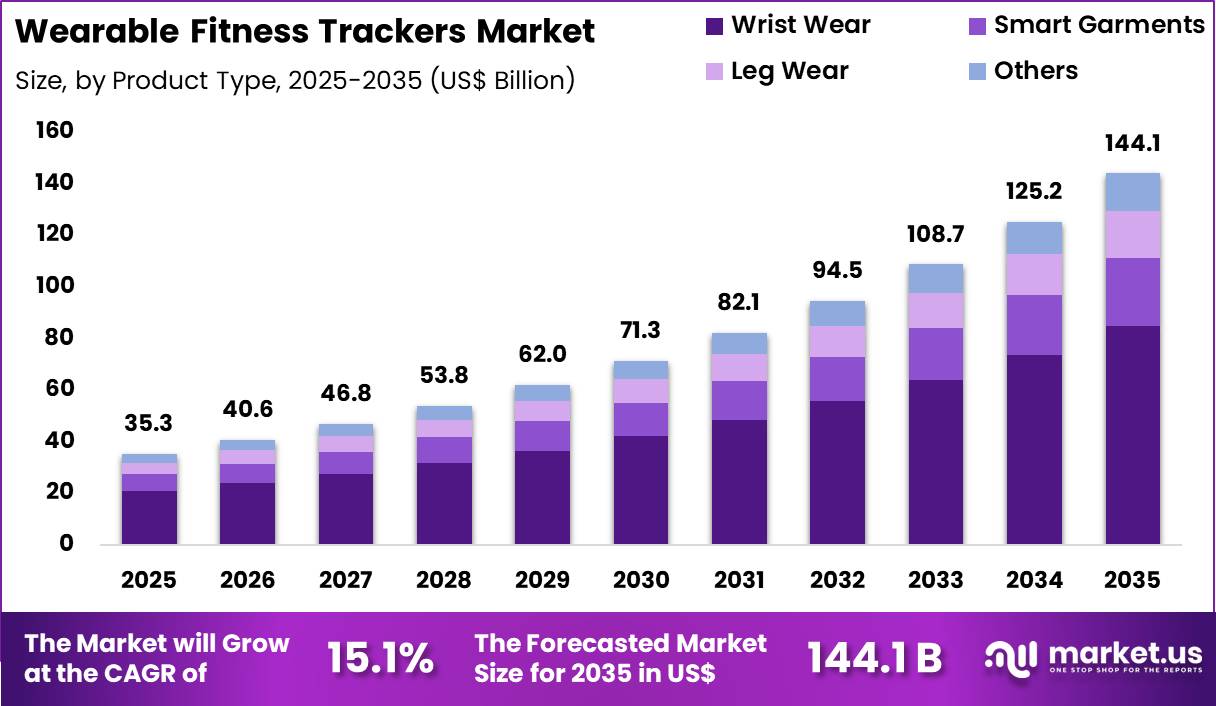
New York, NY – Oct 29, 2026 – The Global Wearable Fitness Trackers Market size is expected to be worth around US$ 144.1 Billion by 2035 from US$ 35.3 Billion in 2025, growing at a CAGR of 15.1% during the forecast period 2026 to 2035. In 2025, North America led the market, achieving over 42.7% share with a revenue of US$ 15.1 Billion.
Wearable fitness trackers are electronic devices designed to monitor physical activity, fitness performance, and selected health-related metrics. These devices include smartwatches, fitness bands, smart rings, and other wearable technologies equipped with sensors to collect real-time user data.
The growing focus on health awareness, preventive healthcare, and personal fitness management is supporting the adoption of wearable fitness trackers worldwide. Common features include step counting, heart rate monitoring, sleep tracking, calorie estimation, distance measurement, and activity tracking. Advanced models also offer blood oxygen monitoring, stress tracking, GPS connectivity, and selected health alerts, depending on the device.
Technological advancements in sensor accuracy, battery performance, connectivity, and artificial intelligence are further improving product functionality and user experience. Integration with smartphones, fitness applications, and digital health platforms is enabling users to monitor activity patterns and make informed lifestyle decisions.
The market is also benefiting from rising participation in sports and fitness activities, increasing demand for personalized wellness solutions, and the growing use of connected devices. However, data privacy concerns, device pricing, battery limitations, and questions regarding the accuracy of certain health measurements may influence purchasing decisions.
Going forward, continued product innovation, expanding digital health ecosystems, and increasing consumer interest in health monitoring are expected to create new opportunities for manufacturers and technology providers in the wearable fitness trackers market.
Key Takeaways
- In 2025, the market was valued at US$ 35.3 billion and is projected to reach US$ 144.1 billion by 2035, growing at a CAGR of 15.1%.
- By product type, the market is segmented into wrist wear, smart garments, leg wear, and others. Wrist wear dominated the segment, accounting for 58.9% of the market share.
- By application, the market is categorized into pedometers, daily activity trackers, heart rate monitors, and others. The pedometer segment held a significant market share of 34.6%.
- By distribution channel, the market is divided into e-commerce and retail stores. E-commerce emerged as the leading channel, capturing 62.3% of the total market revenue.
- Regionally, North America dominated the market, accounting for 42.7% of the global market share.
Key Market Segments
- Product Type Analysis: Wrist wear accounted for 58.9% of the market, supported by its convenience, familiar design, and multifunctional capabilities. Features such as step counting, heart rate monitoring, sleep tracking, and smartphone connectivity drive consumer adoption. Continuous improvements in sensor technology, battery life, design, and affordability are expected to support the segment’s continued dominance.
- Application Analysis: Pedometers accounted for 34.6% of the market, driven by increasing awareness of physical activity and daily fitness goals. Their simple operation, clear step-counting functions, and accessibility appeal to a broad consumer base. Integration with mobile applications, wellness programs, and activity-based rewards is further supporting adoption and strengthening demand for step-tracking solutions.
- Distribution Channel Analysis: E-commerce accounted for 62.3% of the market, supported by broad product availability, convenient purchasing, competitive pricing, and easy product comparisons. Online reviews, promotional offers, direct-to-consumer sales, and digital marketing are further encouraging purchases. Growing mobile commerce and digital payment adoption are expected to reinforce e-commerce’s position as the leading distribution channel.
Regional Analysis
North America Wearable Fitness Trackers Market
North America accounted for 42.7% of the wearable fitness trackers market in 2024, supported by rising health awareness and growing demand for preventive healthcare solutions. Consumers increasingly use wearable devices to monitor heart rate, sleep quality, physical activity, and stress levels.
Employer wellness programs, insurance incentives, and integration with smartphones and digital health platforms further support adoption. According to the Centers for Disease Control and Prevention, more than 41% of U.S. adults had obesity in 2023, highlighting the importance of health monitoring.
Asia Pacific Wearable Fitness Trackers Market
Asia Pacific is expected to register the highest CAGR during the forecast period, driven by increasing health awareness, rising disposable incomes, and expanding smartphone penetration. Affordable products from regional manufacturers are improving accessibility across emerging economies.
Government initiatives promoting physical activity and preventive healthcare are further supporting market growth. The World Health Organization reported that insufficient physical activity affects over 30% of adults in the Western Pacific Region, highlighting opportunities for wearable fitness tracking solutions.
Emerging Trends
- Growing focus on preventive healthcare: Wearable fitness trackers are increasingly being used to monitor daily activity, heart rate, and sleep patterns. These measurements can help users identify changes in their routines and support healthier lifestyle choices before health problems become more serious.
- Expansion of sleep monitoring features: Sleep tracking is becoming an important product feature. Wearable devices can estimate sleep duration and patterns, helping users understand their rest habits. The information can support personal sleep management, although consumer trackers are not substitutes for clinical sleep assessments.
- Integration with mobile health applications: Fitness trackers are increasingly connected to smartphone applications and digital health platforms. This allows users to review activity records over time, set personal goals, and share selected information with healthcare professionals when appropriate.
- Greater attention to remote health monitoring: Connected wearable devices can collect health-related measurements outside traditional healthcare settings. This creates opportunities for remote patient monitoring, particularly when devices are integrated into clinically supervised care programmes and used for appropriate medical purposes.
- Increasing use of personalized activity insights: Fitness tracking software can turn collected measurements into activity summaries, progress reports, and personalized goals. These features can help users adapt exercise routines to their individual habits and encourage regular physical activity.
- Use of wearables in population health research: Public health researchers are exploring wearable devices to measure physical activity and sedentary behaviour across population groups. The data can support health studies and improve the understanding of activity patterns, provided that collection methods are consistent and privacy is protected.
- Development of clinically validated wearable devices: Greater attention is being given to devices that meet relevant medical standards for specific health measurements. This trend supports the use of suitable wearables in healthcare, while highlighting the need to distinguish general fitness products from authorized medical devices.
Use Cases
- Personal fitness and exercise management: Individuals use fitness trackers to count steps, measure workout duration, monitor heart rate, and review daily activity levels. These features help users set exercise targets, measure progress, and maintain more consistent physical activity habits.
- Corporate wellness programmes: Employers can include fitness trackers in voluntary workplace wellness initiatives. Employees may use them to monitor activity, join step-count challenges, and build healthier routines. Participation should remain voluntary, with clear rules for protecting employee health data.
- Remote patient monitoring: Healthcare providers may use suitable connected wearable devices to collect selected health measurements between appointments. When integrated into a clinical care plan, these readings can help professionals review changes and decide whether further assessment is needed.
- Sports training and performance improvement: Athletes and fitness coaches use wearable trackers to review exercise intensity, training duration, heart rate, and recovery-related patterns. The information can support training adjustments and help compare performance over time, although measurement accuracy varies by device and activity.
- Public health studies and population monitoring: Researchers can use wearable activity data to study movement patterns, sedentary behaviour, and differences in physical activity across population groups. Standard measurement methods can improve data comparison and support evidence-based public health planning.
Frequently Asked Questions About Wearable Fitness Trackers
- How do wearable fitness trackers work?
Wearable fitness trackers use sensors to measure body movement and, depending on the device, estimate heart rate and other indicators. Software processes the collected information and displays activity summaries, trends, and progress through the device or a connected application. - What are the main benefits of wearable fitness trackers?
Wearable fitness trackers help users understand daily activity, establish exercise goals, and monitor progress over time. They may also support better awareness of sleep habits and exercise routines, although results depend on consistent use and the accuracy of measurements. - Are wearable fitness trackers accurate?
Accuracy varies according to the device, sensor, activity, and measurement being recorded. Step counts and heart rate estimates may be useful for routine tracking, but calorie expenditure and sleep-stage estimates can be less reliable than clinical measurements. - Can wearable fitness trackers detect health problems?
Some specialized wearables can identify patterns that may require medical review, while ordinary fitness trackers mainly support general wellness. Measurements are not definitive diagnoses, and unexpected readings should be assessed in context by a qualified healthcare professional. - How do wearable fitness trackers protect personal data?
Data protection depends on device security, application permissions, storage practices, and the provider’s privacy policy. Users should review data-sharing settings, use strong account security, and understand how health information may be collected, stored, or shared. - What factors are driving growth in the wearable fitness trackers market?
Market demand is supported by growing health awareness, interest in preventive care, increasing smartphone use, and demand for convenient activity monitoring. Improvements in sensor technology and connected applications are also expanding the range of potential users and applications. - What opportunities exist for manufacturers in this market?
Manufacturers can explore opportunities in affordable devices, longer battery life, improved sensor accuracy, personalized activity insights, and accessible designs. Partnerships with healthcare providers and fitness platforms may also expand applications, provided that product claims and data practices remain appropriate. - What is the future outlook for the wearable fitness trackers market?
The market’s outlook will depend on consumer adoption, product innovation, pricing, and the demonstrated usefulness of wearable data. Greater integration with digital health services may create additional opportunities, although sustained growth will require trust, reliable measurements, and clear user benefits.
Conclusion
The wearable fitness trackers market is poised for substantial growth, supported by increasing health awareness, rising fitness participation, and advancements in sensor technology and connected health applications. Valued at US$ 35.3 billion in 2025, the market is projected to reach US$ 144.1 billion by 2035, at a CAGR of 15.1%. Wrist-worn devices, pedometers, and e-commerce remain key market segments.
North America leads the market, while Asia Pacific is expected to record the fastest growth. Continued innovation, personalized wellness solutions, and remote health monitoring are expected to create opportunities, although privacy concerns, pricing, and measurement accuracy remain important challenges.
Discuss your needs with our analyst
Please share your requirements with more details so our analyst can check if they can solve your problem(s)