
Overview
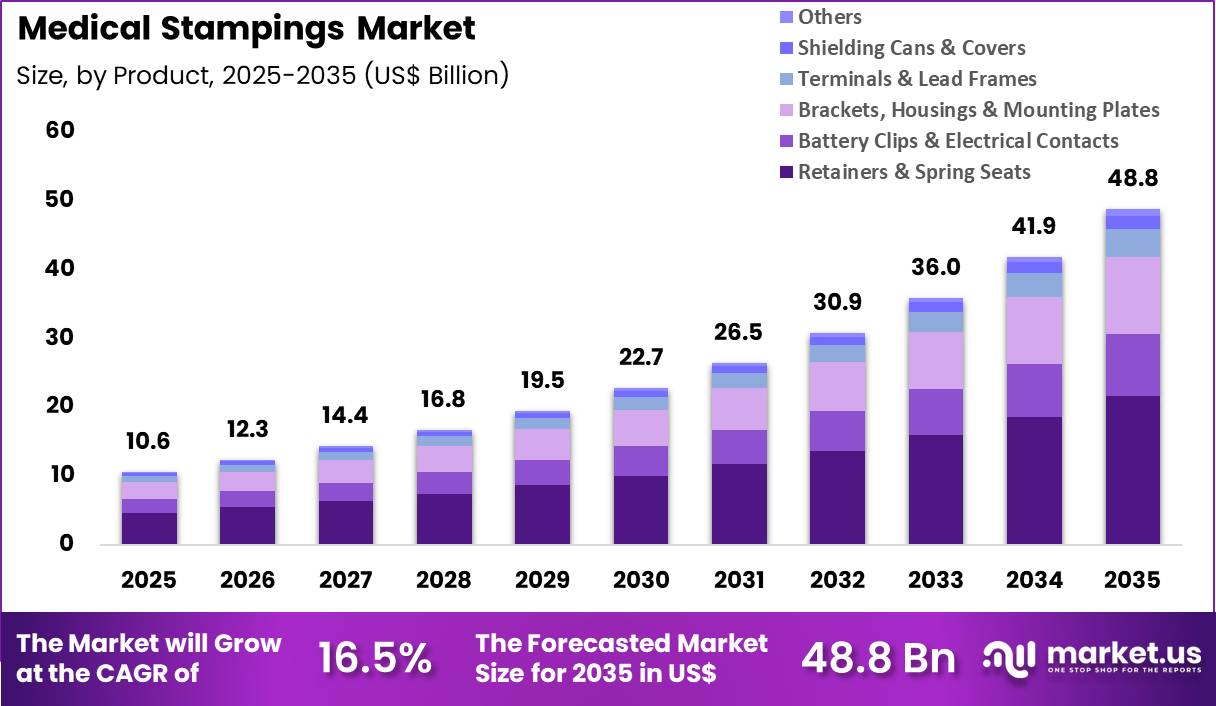
New York, NY – Nov 18 2026 – The Global Medical Stampings Market size is expected to be worth around US$ 48.8 Billion by 2035 from US$ 10.6 Billion in 2025, growing at a CAGR of 16.5% during the forecast period 2026-2035. In 2025, North America led the market, achieving over 47.1% share with a revenue of US$ 5.0 Billion.
Medical stampings represent an important segment of the medical device manufacturing industry, involving the production of precision-engineered metal components used in various healthcare applications. These components are manufactured through specialized metal stamping processes, including progressive die stamping, deep drawing, blanking, punching, and forming.
Medical stampings are widely used in surgical instruments, diagnostic equipment, implantable medical devices, drug delivery systems, cardiovascular devices, and patient monitoring equipment. Commonly used materials include stainless steel, titanium, aluminum, copper, and other specialized metal alloys, selected based on their strength, durability, corrosion resistance, and biocompatibility.
The growing demand for advanced medical devices, increasing surgical procedures, and rising adoption of minimally invasive technologies are supporting the development of the medical stampings market. Additionally, technological advancements in precision manufacturing, automation, and micro-stamping are improving product quality, manufacturing efficiency, and dimensional accuracy.
Key market participants are focusing on technological innovation, production capacity expansion, strategic partnerships, and quality improvements to strengthen their competitive positions. Stringent regulatory requirements and increasing demand for reliable medical components are further encouraging manufacturers to adopt advanced manufacturing processes.
Overall, the medical stampings market is expected to benefit from continuous advancements in healthcare technology and the growing demand for high-precision medical components.
Key Takeaways
- In 2025, the medical stampings market was valued at US$ 10.6 Billion and is projected to reach US$ 48.8 Billion by 2035, expanding at a CAGR of 16.5%.
- By product, the market comprises retainers & spring seats, battery clips & electrical contacts, brackets, housings & mounting plates, terminals & lead frames, shielding cans & covers, and others. Retainers & spring seats dominated with a 44.2% market share.
- By application, the market includes injector pens, CGM devices, autoinjectors, injection pumps, wearable injectors, and others. Injector pens held the leading share of 76.0%.
- Regionally, North America dominated the medical stampings market, accounting for a market share of 47.1%.
Key Market Segments
- Product Analysis: Retainers and spring seats accounted for 44.2% of growth within the product segment, driven by their critical role in ensuring mechanical precision in drug delivery devices. Rising adoption of insulin pens, autoinjectors, and wearable injectors is increasing demand for durable, high-precision stamped components that support consistent force delivery, dose accuracy, and device reliability.
- Application Analysis: Injector pens accounted for 76.0% of growth within the application segment, supported by increasing demand for reliable drug delivery systems. Rising diabetes prevalence and growing adoption of self-administration therapies are driving production of insulin pens. Consequently, manufacturers are increasingly adopting precision-stamped components to improve dosing accuracy, mechanical performance, and device reliability.
Regional Analysis
North America Dominates the Medical Stampings Market
North America accounted for 47.1% of the medical stampings market in 2025, driven by strong demand for precision metal components used in surgical instruments, implantable devices, and diagnostic equipment. The presence of established medical device manufacturers in the United States and Canada, coupled with advanced healthcare infrastructure, supports regional growth.
Increasing production of minimally invasive surgical instruments, catheters, and implant systems is further driving demand for high-precision stamped components. Additionally, investments in domestic manufacturing capabilities, advanced materials, and medical technology innovation are strengthening the regional market.
Asia Pacific Expected to Register the Highest CAGR
Asia Pacific is projected to record the highest CAGR during the forecast period, supported by expanding medical device manufacturing and healthcare infrastructure. Countries such as China, Japan, South Korea, and India are investing in advanced manufacturing technologies and domestic medical technology production.
Rising demand for surgical instruments, orthopedic implants, and diagnostic equipment is encouraging manufacturers to adopt precision metal stamping processes. Additionally, government initiatives, growing research activities, and increasing investments by international medical technology companies are expected to accelerate regional market growth.
Emerging Trends
- Increasing Demand for Miniature and High-Precision Components: The development of smaller medical devices is increasing the need for precision metal stamping. Manufacturers are focusing on producing small, thin, and complex metal components with accurate dimensions for compact surgical instruments, diagnostic equipment, and implantable devices.
- Growing Use of Biocompatible Metals: The use of stainless steel, titanium, and cobalt-chromium alloys is gaining importance in medical component manufacturing. These materials are selected for their strength, corrosion resistance, and suitability for specific medical applications. The FDA also provides material safety information for commonly used implant materials.
- Adoption of Automated Stamping Technologies: Manufacturers are increasingly adopting automated presses, precision tooling, and computer-controlled production systems. These technologies help improve production consistency, reduce manual errors, and support the large-scale manufacturing of medical metal components with complex shapes and tight dimensional requirements.
- Greater Focus on Quality Control and Regulatory Compliance: Medical component manufacturers are placing greater emphasis on inspection, process validation, and quality management. The FDA’s Quality Management System Regulation (QMSR), effective February 2, 2026, incorporates ISO 13485:2016 requirements, strengthening the importance of controlled manufacturing processes.
- Improved Product Traceability and Manufacturing Records: The need for better product identification is encouraging manufacturers to improve production records and traceability systems. FDA’s Unique Device Identification (UDI) system supports the identification of medical devices from manufacturing through distribution and patient use.
Use Cases
- Surgical Instruments and Medical Tools: Medical stampings are used to manufacture metal components for surgical instruments, including forceps, clamps, scissors, retractors, and instrument handles. Stamped components provide the required shape, strength, and dimensional consistency for instruments used in medical procedures.
- Implantable Medical Devices: Precision-stamped metal components can be incorporated into selected implantable medical devices, including structural parts, fixation components, and small supporting elements. Stainless steel, titanium, and cobalt-chromium are important material options, subject to application-specific biological safety evaluation.
- Diagnostic and Monitoring Equipment: Medical stampings are used in diagnostic and monitoring equipment to manufacture metal housings, brackets, connectors, shielding parts, and internal support components. These parts help protect sensitive electronic systems and maintain reliable equipment assembly.
- Cardiovascular and Orthopedic Medical Equipment: Stamped metal components can be used in selected cardiovascular and orthopedic device assemblies, including clips, brackets, connectors, and fixation-related parts. Their strength and dimensional accuracy support the construction of medical equipment requiring dependable mechanical performance.
- Medical Electronics and Patient Monitoring Devices: The production of patient monitoring systems, diagnostic electronics, and medical control equipment requires small metal contacts, terminals, shields, and connector components. Precision stamping supports the production of these parts with consistent dimensions and electrical performance.
Frequently Asked Questions About Medical Stampings
- What materials are commonly used in medical stampings?
Stainless steel, titanium, aluminum, and cobalt-chromium alloys are commonly considered for medical stamping applications. Material selection depends on strength, corrosion resistance, weight, manufacturing requirements, and whether the finished component contacts human tissue. - What are the major applications of medical stampings?
Medical stampings are used in surgical instruments, orthopedic equipment, cardiovascular devices, diagnostic machines, and medical electronics. Common components include clips, brackets, connectors, housings, terminals, shields, and other precision-engineered metal parts. - What is driving the growth of the medical stampings market?
Market growth is supported by increasing demand for medical devices, advancements in surgical technologies, expanding diagnostic equipment production, and the need for precision-engineered components. Growing investments in healthcare manufacturing are also creating opportunities for specialized stamping suppliers. - How is automation influencing the medical stampings market?
Automation is improving manufacturing efficiency by reducing manual operations, supporting consistent production, and minimizing manufacturing errors. Automated stamping systems also help manufacturers manage higher production volumes while maintaining dimensional accuracy and quality standards. - Why is stainless steel important in medical stampings?
Stainless steel is widely considered for medical stamping because of its strength, durability, and corrosion resistance. Depending on its grade and application, it can be used in surgical instruments, medical equipment housings, and selected implantable components. - Which industries are creating demand for medical stampings?
Medical device manufacturing, surgical equipment production, diagnostic equipment manufacturing, orthopedic device production, and medical electronics are important end-use industries. Demand is influenced by the need for reliable metal components across various healthcare equipment categories. - What opportunities exist for manufacturers in the medical stampings market?
Opportunities are emerging from the development of compact medical devices, advanced surgical instruments, implantable equipment, and diagnostic technologies. Manufacturers offering specialized materials, complex component designs, and reliable quality systems can address these evolving requirements. - What is the future outlook for the medical stampings market?
The market outlook is supported by continued medical device innovation, increasing precision requirements, and improvements in metal-forming technologies. Automation, material advancements, and stronger quality management practices are expected to influence future manufacturing developments.
Conclusion
The medical stampings market is poised for significant growth, driven by increasing demand for advanced medical devices, minimally invasive procedures, and precision-engineered components. Valued at US$ 10.6 billion in 2025, the market is projected to reach US$ 48.8 billion by 2035, registering a CAGR of 16.5%.
Retainers and spring seats, along with injector pens, represent key market segments. While North America holds the leading regional position, Asia Pacific is expected to experience the fastest growth. Furthermore, advancements in automation, micro-stamping, biocompatible materials, and quality control are expected to create new opportunities for manufacturers and strengthen the market’s long-term growth prospects.
Discuss your needs with our analyst
Please share your requirements with more details so our analyst can check if they can solve your problem(s)