


Overview
New York, NY – Sep 15, 2026 –The Global Vitamin B Test Market size is expected to be worth around US$ 1003.6 Million by 2034, up from US$ 539.7 Million in 2024, growing at a CAGR of 6.4% during the forecast period 2025 to 2034. In 2024, North America led the market, achieving over 39.7% share with a revenue of US$ 214.3 Million.
Vitamin B Test is experiencing consistent growth, driven by the increasing burden of vitamin deficiencies, expanding preventive healthcare programs, and greater awareness of nutritional screening. According to the World Health Organization (WHO), anemia affects approximately 1.92 billion people globally, with vitamin B12 and folate deficiencies among the major nutritional causes.
The U.S. Centers for Disease Control and Prevention (CDC) estimates that nearly 6% of adults younger than 60 years and about 20% of adults aged 60 years and older have vitamin B12 deficiency, highlighting the growing need for routine diagnostic testing.
Rising incidences of gastrointestinal disorders, diabetes, bariatric surgeries, and long-term use of proton pump inhibitors are further increasing demand for Vitamin B testing across hospitals and diagnostic laboratories.
The adoption of advanced diagnostic technologies, including chemiluminescent immunoassays, high-performance liquid chromatography (HPLC), and liquid chromatography-mass spectrometry (LC-MS), has improved testing accuracy by more than 95% while reducing laboratory turnaround times by approximately 30–40%. Automated laboratory platforms are also capable of processing 200–500 samples per hour, significantly enhancing testing efficiency.
Globally, healthcare expenditure exceeded US$ 9.8 trillion, representing nearly 10% of world GDP, creating favorable conditions for investments in advanced diagnostic infrastructure. Furthermore, the growing elderly population is expected to surpass 1.4 billion people by 2030, increasing the population at risk of vitamin B deficiencies and related neurological disorders.
Supported by expanding preventive health checkups, improved laboratory automation, and increasing physician awareness, the Vitamin B Test Market is expected to maintain strong long-term growth, with diagnostic testing becoming an integral component of personalized nutrition and preventive healthcare strategies worldwide.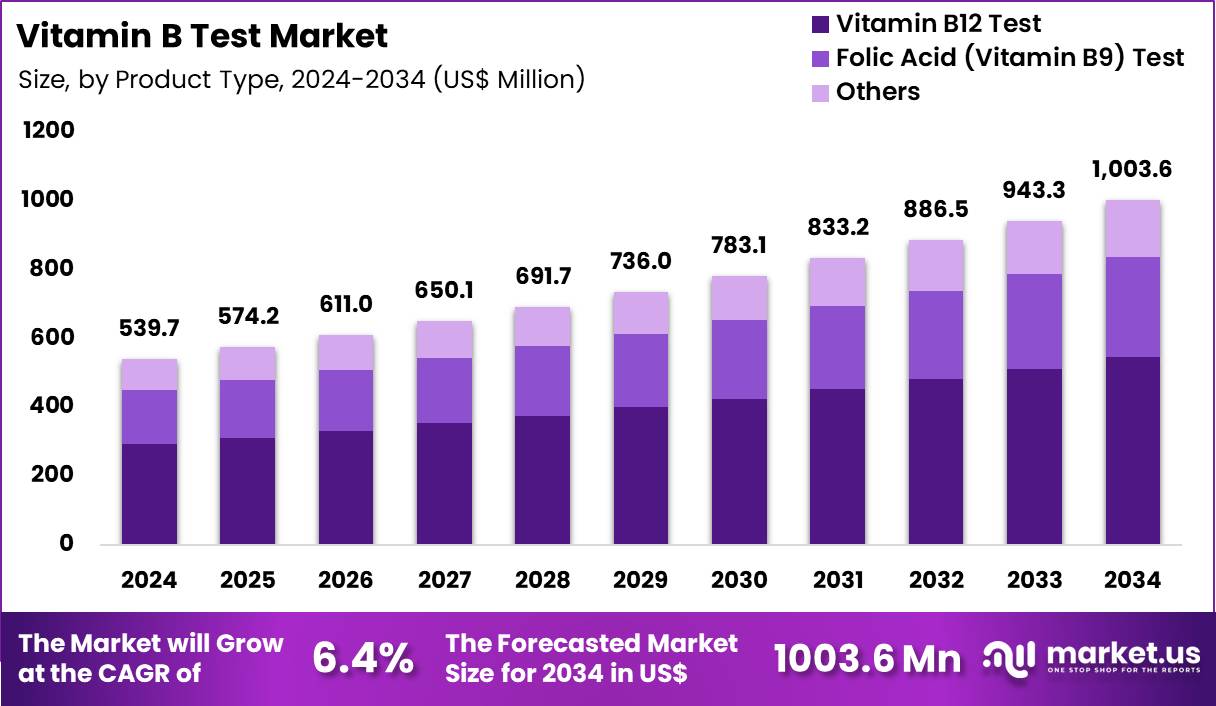
Key Takeaways
- In 2024, the Vitamin B Test Market generated US$ 539.7 million in revenue and is projected to reach US$ 1,003.6 million by 2034, expanding at a CAGR of 6.4% during the forecast period.
- By product type, the market is segmented into Vitamin B12 Test, Folic Acid (Vitamin B9) Test, and Others. Among these, the Vitamin B12 Test segment dominated the market in 2024, accounting for 54.3% of the total market share.
- Based on application, the market is categorized into ELISA, Lateral Flow Assay, and High-Performance Liquid Chromatography (HPLC). The ELISA segment emerged as the leading application, capturing 48.7% of the market share in 2024.
- In terms of end user, the market is classified into Hospitals & Clinics, Diagnostic Centers, and Homecare Settings. Hospitals & Clinics held the largest share, contributing 52.1% of the overall market revenue in 2024.
- North America dominated the global Vitamin B Test Market in 2024, securing the highest regional market share of 39.7%.
Market Segmentation Overview
- Product Type Analysis: Vitamin B12 Test accounted for 54.3% of the market in 2024, making it the leading product segment. Its dominance is driven by the rising prevalence of vitamin B12 deficiency, particularly among older adults and individuals with restricted diets. Increasing screening for anemia, neurological disorders, and cognitive impairment, along with improved diagnostic technologies, continues to support strong demand for Vitamin B12 testing.
- Application Analysis: ELISA captured 48.7% of the market share in 2024 due to its high sensitivity, reliability, and ability to process large sample volumes efficiently. The method is widely adopted across hospitals and diagnostic laboratories for vitamin B testing. Growing laboratory automation, faster turnaround times, and cost-effective testing solutions continue to strengthen ELISA’s position as the preferred diagnostic application.
- End-User Analysis: Hospitals & Clinics held the largest market share of 52.1% in 2024, supported by their high patient volume and comprehensive diagnostic capabilities. These facilities routinely perform vitamin B12 and folic acid tests for anemia, neurological disorders, and preventive health screenings. Expanding healthcare infrastructure, increasing chronic disease management, and rising preventive care initiatives continue to drive demand in this segment.
Statistical Information
- Rising Burden of Anemia Increases Demand for Vitamin B Testing: According to the World Health Organization (WHO), 1.92 billion people worldwide were affected by anemia in 2021, representing approximately 23.9% of the global population. Vitamin B12 and folate deficiencies are recognized nutritional causes of megaloblastic anemia, increasing the need for laboratory testing to identify the underlying deficiency.
- Older Adults Are a High-Risk Population for Vitamin B12 Testing: The U.S. National Institutes of Health (NIH) reports that 3.6% of U.S. adults aged 19 years and older have vitamin B12 deficiency, while 12.5% have vitamin B12 insufficiency. Older adults are among the highest-risk groups because reduced stomach acid and gastrointestinal disorders impair vitamin B12 absorption, increasing physician recommendations for routine screening.
- Vitamin B12 Deficiency Increases with Age: A large population study involving 3,511 adults aged 65 years and above found that vitamin B12 deficiency increased from approximately 1 in 20 people (5%) among those aged 65–74 years to 1 in 10 (10% or more) among adults aged 75 years and older. These findings support higher diagnostic testing rates in elderly populations.
- Fortification Policies Increased Consumer Awareness of Vitamin B Status: CDC researchers reported that following mandatory folic acid fortification in the United States, the prevalence of marginal vitamin B12 deficiency decreased from 25.1% to 20.7% among older adults, while vitamin B12 deficiency remained closely monitored through laboratory testing programs.
- Atrophic Gastritis Increases Testing Need in Elderly Patients: NIH estimates that 8%–9% of adults aged 65 years and older have atrophic gastritis compared with about 2% of the general population. This condition significantly reduces vitamin B12 absorption and increases physician-ordered diagnostic testing.
- Vitamin B12 Stores Can Delay Symptoms for Years: The NIH states that the human body stores approximately 1–5 mg of vitamin B12, equivalent to roughly 1,000–2,000 times the average daily intake. As a result, deficiency symptoms may take several years to appear, reinforcing the importance of laboratory screening
- Average Daily Vitamin B12 Intake Exceeds Recommended Levels: NHANES 2017–2020 data show that average vitamin B12 intake from foods was 5.84 mcg/day for men and 3.69 mcg/day for women, both above the recommended 2.4 mcg/day for adults. Despite this, deficiency persists because absorption disorders remain common.
- Long-Term Acid Suppression Raises Vitamin B12 Deficiency Risk: A large PubMed study found that patients receiving proton pump inhibitors (PPIs) for two years or longer had a 65% higher risk of vitamin B12 deficiency (OR 1.65; 95% CI 1.58–1.73). Higher daily doses increased the risk further to OR 1.95.
- Meta-Analysis Included More Than 30,000 Participants: A systematic review and meta-analysis covering 25 clinical studies involving 2,852 PPI users and 28,070 non-users found that PPI users had a 42% higher likelihood of vitamin B12 deficiency (OR 1.42).
Regional Analysis
North America led the market by securing a market share of 39.7% in 2024.
North America dominated the global Vitamin B Test Market, accounting for 39.7% of the market share in 2024. The region’s leadership is supported by advanced healthcare infrastructure, widespread preventive screening programs, and high awareness of nutritional deficiencies. According to the National Institutes of Health (NIH), 3.6% of U.S. adults have vitamin B12 deficiency, while 12.5% have vitamin B12 insufficiency, driving routine laboratory testing.
The Centers for Disease Control and Prevention (CDC) also recommends 400 mcg of folic acid daily for women of reproductive age, supporting increased folate testing. The growing elderly population, expanding use of automated immunoassay platforms, and strong presence of leading diagnostic companies further strengthen regional demand. Asia Pacific is projected to register the fastest growth during the forecast period due to improving healthcare access, rising awareness of vitamin deficiencies, and expanding diagnostic infrastructure.
The World Health Organization (WHO) identifies anemia as a major public health challenge across many countries in the region, with vitamin B12 and folate deficiencies contributing significantly. Increasing healthcare investments, growing aging populations, and greater adoption of preventive health screening programs are expected to accelerate vitamin B testing demand across hospitals and diagnostic laboratories.
Business Opportunities
The Vitamin B Test Market offers significant growth opportunities as preventive healthcare and nutritional screening gain greater importance worldwide. Rising awareness of vitamin B12 and folate deficiencies among aging populations, pregnant women, and patients with chronic diseases is increasing the demand for routine diagnostic testing.
Manufacturers can capitalize on this trend by developing advanced automated immunoassay systems, high-sensitivity reagents, and multiplex assays that simultaneously measure multiple nutritional biomarkers. The growing popularity of at-home diagnostic kits and digital health platforms also presents opportunities to expand consumer access to vitamin B testing.
Strategic collaborations with hospitals, diagnostic laboratories, and primary care networks can improve product adoption and strengthen market reach. In addition, expanding healthcare infrastructure and laboratory capacity across emerging economies create favorable conditions for market expansion.
Investments in AI-enabled laboratory workflow solutions, cloud-based reporting systems, and personalized nutrition diagnostics are expected to enhance testing efficiency, improve patient outcomes, and generate long-term revenue opportunities for diagnostic manufacturers and healthcare service providers.
Emerging Trends
- Preventive Health Screening is Increasing: Healthcare providers are including vitamin B12 and folate tests in routine wellness check-ups. According to the NIH, 12.5% of U.S. adults have vitamin B12 insufficiency and 3.6% have deficiency, increasing demand for early nutritional screening.
- Growing Focus on Maternal Nutrition Testing: The CDC recommends 400 mcg of folic acid daily for women who can become pregnant. Adequate folic acid intake can prevent about 70% of neural tube defects, encouraging wider use of folate testing during prenatal care.
- Advanced Biomarker Testing is Expanding: Clinical laboratories are increasingly using holotranscobalamin (active vitamin B12) and methylmalonic acid (MMA) testing to detect deficiencies earlier than conventional serum vitamin B12 tests, improving diagnostic accuracy for high-risk patients.
- Laboratory Automation is Growing: Diagnostic laboratories are adopting automated immunoassay platforms to improve testing speed and efficiency. Roche Diagnostics reports that its cobas e 801 analyzer can perform up to 300 immunoassay tests per hour, supporting higher testing volumes.
- Nutrition Monitoring Programs are Expanding: The CDC continues to monitor nutritional biomarkers through the NHANES program, helping healthcare providers assess vitamin B status and improve preventive healthcare strategies using nationally representative health data.
Use Cases
- Diagnosis of Vitamin B12 Deficiency: Hospitals and diagnostic laboratories routinely perform vitamin B12 tests to identify deficiency in older adults, vegetarians, and patients with gastrointestinal disorders. The NIH reports 3.6% of U.S. adults have vitamin B12 deficiency.
- Prenatal Folate Assessment: Folate testing is widely used during pregnancy planning and prenatal care. The CDC recommends 400 mcg of folic acid daily before pregnancy to reduce the risk of neural tube defects and improve maternal health outcomes.
- Monitoring Long-Term Medication Users: Patients receiving long-term metformin or proton pump inhibitors are regularly monitored for vitamin B12 deficiency because these medicines can reduce vitamin absorption, making laboratory testing an essential part of chronic disease management.
- Anemia and Neurological Disorder Diagnosis: Vitamin B testing helps diagnose megaloblastic anemia, numbness, memory loss, and other neurological symptoms. The WHO estimates 1.92 billion people globally are affected by anemia, supporting increased nutritional deficiency testing.
- Routine Health and Wellness Programs: Hospitals and preventive health centers increasingly include vitamin B testing in annual health packages to evaluate nutritional status, especially for older adults and high-risk individuals, supporting early diagnosis and timely nutritional intervention.
Recent Development
- In 2026, Roche Diagnostics showcased its next-generation laboratory innovations at ADLM 2026, introducing the cobas® Mass Spec solution, AXELIOS 1 sequencing platform, and AI-enabled digital laboratory solutions to improve automation, testing efficiency, and workflow integration.
- In 2026, Abbott Laboratories strengthened its diagnostics business through the acquisition of Exact Sciences, expanding its cancer diagnostics portfolio while reporting US$12.6 billion in second-quarter sales and continued growth in its Core Laboratory business.
- In 2026, Siemens Healthineers continued enhancing its Atellica laboratory diagnostics portfolio by expanding automation capabilities and digital workflow solutions, helping clinical laboratories improve productivity, increase testing capacity, and reduce turnaround times for immunoassay testing.
- In 2026, Thermo Fisher Scientific, Inc. continued expanding its clinical diagnostics and laboratory automation portfolio, focusing on advanced analytical instruments, high-throughput workflows, and precision testing solutions to support hospitals, research institutes, and diagnostic laboratories worldwide.
- In 2026, Bio-Rad Laboratories, Inc. reported its first-quarter 2026 financial results and continued investing in life science research and clinical diagnostics, strengthening its quality control and immunoassay product portfolio for hospital and reference laboratories.
- In 2026, DiaSorin S.p.A. continued expanding its LIAISON immunodiagnostic platform and specialty testing menu, strengthening automated laboratory diagnostics through new assay development and broader adoption of integrated immunoassay solutions.
- In 2026, Beckman Coulter, Inc. continued advancing its automated clinical laboratory systems by improving analyzer performance, workflow automation, and operational efficiency, enabling hospitals and diagnostic laboratories to manage growing testing volumes with greater accuracy.
Frequently Asked Questions on Vitamin B Test
- What are the major factors driving the Vitamin B Test Market growth?
Growth is driven by increasing awareness of nutritional deficiencies, rising elderly populations, higher prevalence of anemia, growing preventive healthcare adoption, and increasing demand for accurate laboratory testing. Healthcare providers are increasingly recommending vitamin B testing for early diagnosis and better patient management. - Which product type dominates the Vitamin B Test Market?
Vitamin B12 testing dominates the market due to its importance in identifying deficiency-related conditions such as anemia, fatigue, cognitive impairment, and neurological problems. Increasing screening among elderly individuals, patients with chronic diseases, and people with dietary restrictions continues to increase demand. - Why is vitamin B12 testing important in healthcare?
Vitamin B12 testing helps detect deficiency before severe complications occur, including nerve damage, memory problems, and megaloblastic anemia. Healthcare professionals use these tests to monitor high-risk groups such as older adults, vegetarians, patients with gastrointestinal disorders, and individuals using certain medications. - What technologies are used in Vitamin B testing?
Common technologies include ELISA, chemiluminescent immunoassays, lateral flow assays, and high-performance liquid chromatography. These methods provide accurate measurement of vitamin B biomarkers while improving laboratory efficiency, automation, and turnaround times for hospitals and diagnostic laboratories. - What role do diagnostic centers play in the Vitamin B Test Market?
Diagnostic centers contribute significantly by providing accessible testing services for vitamin B12 and folate deficiencies. Increasing consumer awareness, preventive health packages, and demand for faster laboratory results are encouraging more patients to utilize independent diagnostic facilities. - How does the aging population influence vitamin B testing demand?
Aging populations have a higher risk of vitamin B12 deficiency due to reduced absorption capacity and chronic health conditions. Increasing elderly populations worldwide are driving demand for regular vitamin B screening to prevent anemia, neurological complications, and cognitive decline. - How are chronic diseases affecting the Vitamin B Test Market?
Chronic conditions such as diabetes, gastrointestinal disorders, and autoimmune diseases increase the risk of vitamin B deficiencies. Long-term medication use, including metformin therapy, can reduce vitamin B12 absorption, encouraging healthcare providers to recommend regular diagnostic monitoring.
Conclusion
The Vitamin B Test Market is expected to witness steady growth due to increasing awareness of nutritional deficiencies, rising demand for preventive healthcare, and growing adoption of advanced diagnostic technologies. The rising prevalence of vitamin B12 and folate deficiencies among elderly individuals, pregnant women, and patients with chronic diseases is encouraging routine screening.
Hospitals, diagnostic centers, and laboratories are increasingly adopting automated testing solutions to improve accuracy and efficiency. Expanding healthcare infrastructure, personalized nutrition approaches, and the development of home-based testing solutions are creating new growth opportunities. Overall, technological advancements and increasing focus on early diagnosis will continue driving market expansion.
Discuss your needs with our analyst
Please share your requirements with more details so our analyst can check if they can solve your problem(s)




