


Overview
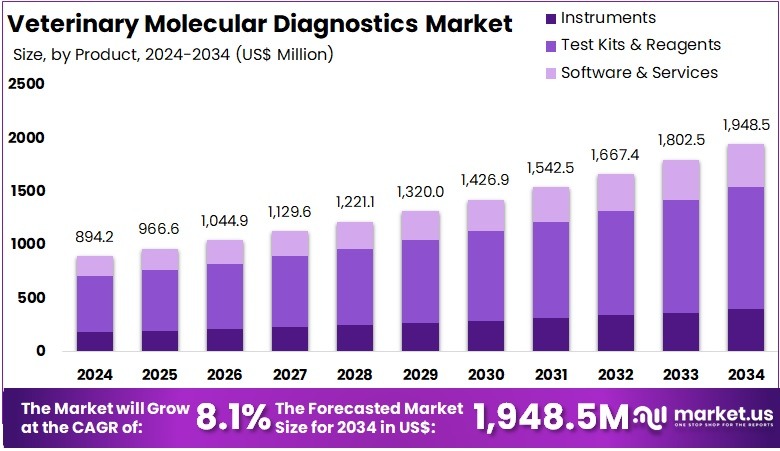
The Global Veterinary Molecular Diagnostics Market Size is expected to be worth around US$ 1948.5 Million by 2034, from US$ 894.2 Million in 2024, growing at a CAGR of 8.1% during the forecast period from 2025 to 2034. North America held a dominant market position, capturing more than a 39.3% share and holding US$ 351.4 Million market value for the year.
Veterinary molecular diagnostics is an advanced testing approach that detects the genetic material (DNA or RNA) of pathogens and inherited disorders in animals. These tests provide highly accurate and rapid identification of bacteria, viruses, parasites, and genetic mutations, helping veterinarians make informed treatment decisions. Technologies such as polymerase chain reaction (PCR), real-time PCR (qPCR), next-generation sequencing (NGS), and microarrays are widely used in veterinary laboratories and research centers. Molecular diagnostics support disease surveillance, livestock health management, food safety, and companion animal care.
The demand for veterinary molecular diagnostics is increasing due to the growing animal population, rising pet ownership, and the need to control zoonotic diseases. According to the American Pet Products Association (APPA), around 94 million U.S. households owned at least one pet in 2023–2024. The Food and Agriculture Organization (FAO) estimates that the global cattle population exceeds 1.5 billion, while the chicken population is over 29 billion, highlighting the importance of effective disease monitoring in food-producing animals. In addition, the World Organisation for Animal Health (WOAH) continues to emphasize early molecular detection to reduce the spread of infectious animal diseases.
Molecular diagnostic tests can deliver results within 2–24 hours, significantly faster than many conventional culture-based methods that may require several days. Their high sensitivity and specificity improve disease detection, reduce unnecessary antibiotic use, and support precision veterinary medicine. As governments strengthen animal health surveillance programs and livestock producers focus on disease prevention, veterinary molecular diagnostics is expected to remain an essential component of modern veterinary healthcare and global biosecurity.
Key Takeaways
- The global veterinary molecular diagnostics market is projected to grow from USD 894.2 million in 2024 to USD 1,948.5 million by 2034, registering a CAGR of 8.1% during the forecast period.
- In 2024, test kits and reagents dominated the product segment, accounting for more than 58.7% of the global market due to their widespread use in molecular diagnostic testing.
- PCR technologies, including real-time PCR and multiplex PCR, held the largest share of the technology segment in 2024, contributing over 55.2% of the market.
- The companion animals segment led the animal type category in 2024 with a 66.8% market share, supported by growing demand for advanced diagnostic solutions in pet healthcare.
- Infectious diseases remained the leading application area in 2024, representing more than 70.8% of the market, driven by increasing disease surveillance and zoonotic infection monitoring.
- Veterinary hospitals and clinics emerged as the largest end-user segment in 2024, capturing over 52.3% of the global market, owing to improved diagnostic capabilities and clinical adoption.
- North America held the leading regional position in 2024, accounting for more than 39.3% of the global veterinary molecular diagnostics market, with a market value of USD 351.4 million.
Statistical Information
- As of 2025, the WOAH global veterinary diagnostics regulations database includes regulatory information from 121 countries, improving international coordination and standardization of veterinary molecular diagnostic testing.
- PCR-based molecular diagnostics demonstrated diagnostic sensitivity ranging from 85% to 100% for canine leishmaniosis in the 2025 WOAH Terrestrial Manual, depending on sample type and laboratory protocols.
- PCR testing achieved diagnostic specificity greater than 95% for canine leishmaniosis according to WOAH’s 2025 laboratory recommendations.
- Culture-based confirmation methods reported sensitivity between 60% and 90% with approximately 100% specificity, serving as reference methods alongside molecular diagnostics.
- Traditional cytology methods showed only 30%–70% sensitivity but over 90% specificity, highlighting the improved detection capability of molecular PCR assays.
- A 2025 droplet digital PCR (ddPCR) study achieved 99.05% image-analysis accuracy for automated droplet recognition during molecular diagnostic analysis.
- The same 2025 ddPCR system detected DNA concentrations as low as 90.32 copies per microliter, demonstrating very high analytical sensitivity for molecular diagnostics.
- WOAH’s 2025 laboratory guidance recommends veterinary rabies rapid molecular/lateral-flow diagnostic methods achieve at least 90% sensitivity and 95% specificity before field implementation.
- During 2025, WOAH Collaborative Centres analyzed and submitted 198 pathogen genome sequences using molecular diagnostic and sequencing technologies for global animal disease surveillance.
Regional Analysis
North America maintained its leading position in the veterinary molecular diagnostics market in 2024, accounting for over 39.3% of the global market and generating approximately US$ 351.4 million in revenue. The region’s leadership is supported by advanced veterinary healthcare infrastructure, broad access to molecular diagnostic technologies, and a high rate of companion animal ownership across the United States and Canada.
Increasing expenditure on pet healthcare has encouraged veterinary clinics and hospitals to adopt PCR- and DNA-based diagnostic methods for early disease detection. Strong livestock industries also rely on molecular testing to monitor infectious diseases, improve herd health, and reduce economic losses. Government support for animal disease surveillance and zoonotic disease monitoring has further strengthened diagnostic adoption.
In addition, collaborations between biotechnology companies, veterinary laboratories, and research institutions continue to accelerate innovation in molecular testing platforms. Growing awareness of preventive animal healthcare and the availability of rapid, accurate diagnostic solutions continue to reinforce North America’s dominant position in this market.
Emerging Trends
- Growing Use of Multiplex PCR Testing: Veterinary laboratories are increasingly adopting multiplex real-time PCR because it detects multiple pathogens from a single sample, reducing testing time and improving disease surveillance. In 2025, the World Organisation for Animal Health (WOAH) expanded training programs focused on multiplex PCR for priority animal and zoonotic diseases across laboratories in Asia and Africa.
- Expansion of Next-Generation Sequencing (NGS): NGS is becoming an important tool for identifying new disease strains and monitoring pathogen evolution in livestock and companion animals. WOAH reported the analysis and public release of 198 pathogen genome sequences in 2025, supporting faster outbreak investigation and improved molecular surveillance worldwide.
- Rise of CRISPR and Digital PCR Technologies: Advanced molecular technologies such as CRISPR-based diagnostics and digital PCR are gaining attention for delivering highly sensitive and rapid detection. WOAH highlighted validation of digital PCR, CRISPR diagnostics, and high-throughput molecular detection methods to strengthen regulatory veterinary diagnostics and disease monitoring programs.
- Integration of One Health Surveillance: Veterinary molecular diagnostics are increasingly linked with public health surveillance under the One Health approach. FDA’s Vet-LIRN network included 30 source laboratories and 6 whole-genome sequencing laboratories as of 2024, strengthening antimicrobial resistance monitoring and molecular disease surveillance across North America.
- Support for Innovative Molecular Technologies: Government agencies are encouraging innovation in veterinary diagnostics through dedicated regulatory programs. The U.S. FDA continues expanding its Veterinary Innovation Program to accelerate the development of genomic technologies, genome editing, and advanced molecular diagnostic products that improve animal health and disease detection.
Use Cases
- Early Detection of Livestock Diseases: Molecular diagnostics enable rapid identification of diseases such as African swine fever, avian influenza, and peste des petits ruminants before widespread transmission. In 2025, WOAH supported laboratories with PCR reagents, controls, and SOPs to improve surveillance of multiple transboundary animal diseases.
- Companion Animal Infection Diagnosis: PCR-based molecular testing helps veterinarians quickly diagnose bacterial, viral, and parasitic infections in dogs and cats, enabling timely treatment. Faster diagnosis reduces unnecessary antibiotic use and improves recovery outcomes while supporting antimicrobial stewardship programs promoted by regulatory authorities.
- Food Safety and Zoonotic Disease Monitoring: Veterinary molecular diagnostics support food safety by detecting zoonotic pathogens before they enter the food chain. Molecular testing is widely used to monitor livestock diseases, helping protect both animal and human health through coordinated One Health surveillance systems.
- Monitoring Antimicrobial Resistance (AMR): Veterinary laboratories increasingly use molecular diagnostics and whole-genome sequencing to identify antimicrobial-resistant bacteria. FDA’s Vet-LIRN network collaborates with national surveillance programs, using 6 sequencing laboratories to improve monitoring of resistant pathogens in sick animals and strengthen public health preparedness
Frequently Asked Questions on Veterinary Molecular Diagnostics
- What factors are driving the growth of the veterinary molecular diagnostics market?
The market is expanding due to rising pet ownership, increasing livestock disease outbreaks, greater awareness of zoonotic diseases, and growing demand for early disease detection. Continuous improvements in PCR, sequencing technologies, and government-supported animal disease monitoring programs also contribute to market growth. - Which technologies are commonly used in veterinary molecular diagnostics?
Polymerase Chain Reaction (PCR), real-time PCR (qPCR), multiplex PCR, DNA sequencing, microarrays, and next-generation sequencing (NGS) are widely used technologies. These methods provide accurate, rapid, and sensitive detection of infectious diseases, genetic disorders, and antimicrobial resistance in animals. - What are the major applications of veterinary molecular diagnostics?
Veterinary molecular diagnostics is used to diagnose infectious diseases, monitor zoonotic pathogens, detect genetic disorders, identify antimicrobial resistance, and support disease surveillance programs. It also plays an important role in livestock health management, food safety, and veterinary research activities. - Which animals benefit the most from molecular diagnostic testing?
Companion animals such as dogs and cats, along with livestock including cattle, poultry, swine, sheep, and goats, benefit from molecular diagnostics. Horses, aquatic animals, and wildlife are also increasingly tested to improve disease control, animal welfare, and agricultural productivity. - Which region dominates the veterinary molecular diagnostics market?
North America currently leads the veterinary molecular diagnostics market due to advanced veterinary healthcare infrastructure, high pet healthcare spending, widespread adoption of molecular testing technologies, and strong government support for animal disease surveillance and research programs across the United States and Canada. - Who are the key end users of veterinary molecular diagnostics products?
Major end users include veterinary hospitals, diagnostic laboratories, research institutes, academic institutions, livestock producers, animal breeding centers, and government animal health agencies. These organizations rely on molecular diagnostics to improve disease detection, treatment planning, and animal health management. - What is the future outlook for the veterinary molecular diagnostics market?
The market is expected to experience steady growth as demand for rapid and accurate animal disease diagnosis increases. Advancements in portable molecular testing, automation, artificial intelligence integration, and expanding veterinary healthcare investments are likely to create new opportunities over the coming years.
Conclusion
The veterinary molecular diagnostics market is positioned for significant growth as animal healthcare systems increasingly prioritize early detection, disease prevention, and precision diagnostics. Advancements in PCR, DNA sequencing, and multiplex testing are improving diagnostic accuracy and supporting better management of infectious and genetic disorders.
The market’s expansion is driven by rising pet healthcare spending, livestock disease surveillance, and growing One Health initiatives addressing zoonotic threats. North America maintains a strong market position due to advanced veterinary infrastructure and research capabilities. Future growth will be supported by portable testing solutions, automation, and integration of digital technologies in veterinary diagnostic workflows.
Discuss your needs with our analyst
Please share your requirements with more details so our analyst can check if they can solve your problem(s)




