


Overview
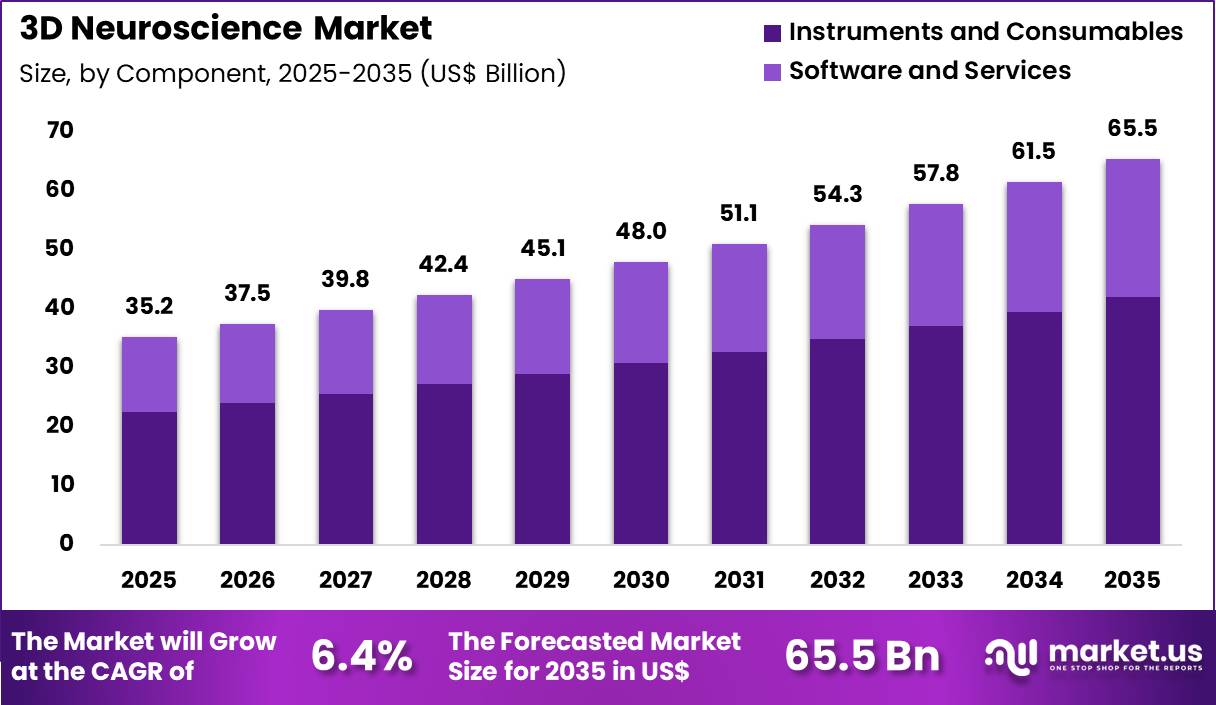
New York, NY – Nov 17 2026 – The Global 3D Neuroscience Market size is expected to be worth around US$ 65.5 Billion by 2035 from US$ 35.2 Billion in 2025, growing at a CAGR of 6.4% during the forecast period 2026-2035. In 2025, North America led the market, achieving over 38.5% share with a revenue of US$ 13.6 Billion.
3D Neuroscience is an emerging field that focuses on understanding the structure, function, and development of the human brain using advanced three-dimensional imaging, modelling, and visualization technologies. It combines neuroscience with innovations such as 3D microscopy, brain mapping, computational modelling, and artificial intelligence to provide a more detailed understanding of complex neural networks.
Unlike traditional two-dimensional research methods, 3D neuroscience enables researchers to examine brain structures, neural connections, and cellular interactions in their natural spatial context. These technologies support improved analysis of brain development, neurological disorders, and nervous system functions.
The growing adoption of 3D neuroscience is creating new opportunities in drug discovery, disease modelling, neuroimaging, and personalized medicine. It is increasingly being applied in research related to Alzheimer’s disease, Parkinson’s disease, epilepsy, brain tumours, and other neurological conditions.
Advancements in 3D cell culture, organoids, high-resolution imaging, and digital brain reconstruction are further strengthening research capabilities. Increasing investments in neuroscience research, rising neurological disease prevalence, and continuous technological innovation are expected to support the development of this field.
Overall, 3D neuroscience is emerging as an important approach for advancing brain research, improving disease understanding, and supporting the development of innovative diagnostic and therapeutic solutions.
Key Takeaways
- In 2025, the global 3D Neuroscience Market was valued at US$ 35.2 Billion and is projected to grow at a CAGR of 6.4%, reaching US$ 65.5 Billion by 2035.
- Based on component, the market is segmented into instruments & consumables and software & services. Instruments & consumables dominated the segment, accounting for 64.2% of the total market share.
- By technology, the market is categorized into brain imaging, neuro-microscopy, electrophysiology, and neuroproteomic analysis. Brain imaging emerged as the leading segment, capturing 42.0% of the market share.
- Based on application, the market is divided into drug discovery and lead screening, neurotoxicity and safety assessment, disease modelling, and others. Drug discovery and lead screening dominated the segment, accounting for 47.6% of total market revenue.
- By end-user, the market is segmented into hospitals, diagnostic laboratories, and research and academic institutes. Diagnostic laboratories held the leading position, accounting for 39.9% of the market revenue.
- Regionally, North America dominated the global 3D Neuroscience Market, accounting for 38.5% of the total market share.
Key Market Segments
- Component Analysis: Instruments and consumables dominated the component segment, accounting for 64.2% of the market share. Their leadership is driven by increasing demand for advanced laboratory equipment, imaging systems, electrophysiology platforms, and specialized reagents. Growing adoption of 3D neural cultures and organoid models, alongside rising neuroscience research investments, is further supporting segment expansion.
- Technology Analysis: Brain imaging dominated the technology segment, accounting for 42.0% of the market share. Its leading position is attributed to increasing demand for advanced imaging techniques to examine neural activity, brain connectivity, and disease progression. Continuous advancements in high-resolution imaging, microscopy, and artificial intelligence integration are further accelerating adoption across neuroscience research.
- Application Analysis: Drug discovery and lead screening emerged as the leading application segment, accounting for 47.6% of the market share. Growth is primarily driven by increasing pharmaceutical investments in neurological drug development and preclinical testing. The adoption of 3D neural cultures and organoid models is improving compound screening capabilities and supporting more reliable drug evaluation.
- End-User Analysis: Diagnostic laboratories dominated the end-user segment, accounting for 39.9% of the market share. Their leadership is supported by increasing demand for advanced neurological testing, biomarker identification, and molecular diagnostics. Rising neurological disease prevalence and growing investments in specialized diagnostic technologies are further encouraging laboratories to adopt advanced 3D neuroscience platforms.
Regional Analysis
North America Dominates the 3D Neuroscience Market
North America dominated the 3D Neuroscience Market in 2025, accounting for 38.5% of the global market share. Regional growth is driven by strong investments in neuroscience research, advanced healthcare infrastructure, and increasing adoption of 3D neural culture and brain organoid technologies.
The United States and Canada are witnessing growing research activities focused on neurodegenerative diseases and advanced drug discovery. Additionally, funding through initiatives such as the US National Institutes of Health BRAIN Initiative has supported the development of innovative brain research technologies. Increasing collaborations between academic institutions, biotechnology companies, and pharmaceutical firms are further strengthening regional market growth.
Asia Pacific Expected to Register the Highest CAGR
Asia Pacific is projected to record the highest CAGR during the forecast period, supported by increasing government investments in neuroscience research and biotechnology innovation. Countries such as China, Japan, South Korea, and Singapore are expanding research programs focused on brain mapping, neural tissue engineering, and organoid development.
China’s Brain Project is further supporting regional research capabilities. Additionally, rising pharmaceutical investments, expanding biotechnology infrastructure, and growing neurological disease prevalence are expected to accelerate the adoption of 3D neuroscience technologies across the region.
Emerging Trends
- Growing adoption of non-thermal ablation technology: PFA uses short electrical pulses to damage targeted heart tissue instead of relying on heat or freezing. This approach may reduce injury to nearby structures, such as the oesophagus and nerves, making it an important alternative to conventional ablation methods.
- Development of advanced catheter and mapping systems: Manufacturers are developing catheter designs and integrated mapping technologies to improve treatment accuracy, tissue coverage, and ease of use. Better integration of electrical mapping and energy delivery may help hospitals improve procedure consistency and support wider clinical adoption.
- Increasing focus on shorter procedure times: PFA systems can deliver treatment rapidly, and clinical studies have reported improved procedural efficiency compared with some thermal ablation approaches. Hospitals may benefit from better laboratory utilisation, although actual time savings depend on the device, workflow, and patient condition.
- Expansion of regulatory approvals and clinical evidence: Regulatory authorisations and ongoing clinical studies are strengthening the evidence base for PFA. For example, the US FDA approved the PulseSelect system in December 2023 and the Globe Pulsed Field System in August 2025 for specified atrial fibrillation indications.
- Research into broader cardiac applications: Research is examining PFA for additional heart rhythm disorders, including ventricular arrhythmias and more complex atrial fibrillation cases. These applications could expand future demand, but commercial opportunities will depend on clinical validation, regulatory clearance, and evidence of long-term safety and effectiveness.
Use Cases
- Treatment of paroxysmal atrial fibrillation: PFA is used to treat intermittent atrial fibrillation, in which abnormal heart rhythms start and stop. The procedure commonly targets tissue around the pulmonary veins to prevent abnormal electrical signals from triggering irregular heartbeats.
- Treatment of selected persistent atrial fibrillation cases: Some PFA systems are approved for selected patients with persistent atrial fibrillation. Treatment aims to control abnormal electrical activity and reduce arrhythmia recurrence. Patient selection depends on clinical assessment, disease duration, and the system’s authorised indications.
- Pulmonary vein isolation: Pulmonary vein isolation is a central application of PFA. Electrical pulses create targeted lesions around the pulmonary vein openings to block abnormal signals entering the left atrium. This procedure is a key driver of clinical demand for PFA catheters and generators.
- Additional lesion creation for complex atrial fibrillation: Researchers are evaluating PFA for additional treatment areas, including posterior wall isolation, in selected patients with persistent atrial fibrillation. These strategies may address more complex electrical pathways, but their added benefits and long-term outcomes remain under investigation.
- Emerging use in ventricular arrhythmias: PFA is being explored for ventricular arrhythmias, including abnormal rhythms originating in the lower chambers of the heart. Its ability to target cardiac tissue selectively is of research interest, but its suitability and availability depend on further evidence and specific regulatory authorisations.
Frequently Asked Questions About 3D Neuroscience
- How does pulsed field ablation work?
PFA uses a process called irreversible electroporation, which disrupts cell membranes through electrical pulses. This creates lesions in targeted heart tissue without relying on heat or freezing, potentially reducing damage to nearby structures compared with conventional thermal techniques. - What conditions can pulsed field ablation treat?
PFA is primarily used for atrial fibrillation, including selected paroxysmal and persistent cases, depending on device approval. Researchers are also examining its potential for ventricular arrhythmias and more complex cardiac rhythm disorders. - What are the main benefits of pulsed field ablation?
PFA offers rapid energy delivery and may reduce injury to nearby structures, particularly the oesophagus. Clinical evidence indicates that its effectiveness can be comparable to thermal ablation, although outcomes depend on the device, treatment strategy, and patient characteristics. - Is pulsed field ablation safer than traditional ablation?
PFA may reduce certain heat-related complications, but it is not risk-free. Potential complications include bleeding, stroke, cardiac injury, and procedure-specific effects such as haemolysis or coronary artery spasm. Comparative safety and long-term outcomes continue to be evaluated. - How long does a pulsed field ablation procedure take?
Procedure duration varies according to the patient’s condition, catheter system, treatment plan, and hospital workflow. PFA can shorten some ablation procedures because electrical energy is delivered rapidly, but preparation, mapping, anaesthesia, and recovery still require additional time. - What factors are driving the pulsed field ablation market?
Market development is supported by demand for atrial fibrillation treatment, interest in non-thermal technologies, clinical evidence, and regulatory approvals. Potential improvements in procedure efficiency and reduced injury to nearby tissues are also encouraging hospitals to evaluate PFA systems. - What is the future outlook for the pulsed field ablation market?
The market outlook will depend on clinical adoption, technological improvements, long-term patient outcomes, pricing, and reimbursement. Research into additional cardiac applications may create new opportunities, but sustained growth will require reliable evidence, appropriate regulation, and wider access to specialised treatment facilities.
Conclusion
The global 3D Neuroscience Market is witnessing steady growth, driven by advancements in brain imaging, 3D cell culture, organoid technologies, and artificial intelligence. Valued at US$ 35.2 billion in 2025, the market is projected to reach US$ 65.5 billion by 2035, growing at a CAGR of 6.4%.
Increasing investments in neuroscience research, rising neurological disorders, and growing demand for advanced drug discovery solutions are expected to support market expansion. North America currently dominates the market, while Asia Pacific is anticipated to register the highest growth. Continuous technological innovation is expected to create significant future opportunities.
Discuss your needs with our analyst
Please share your requirements with more details so our analyst can check if they can solve your problem(s)



