
Overview
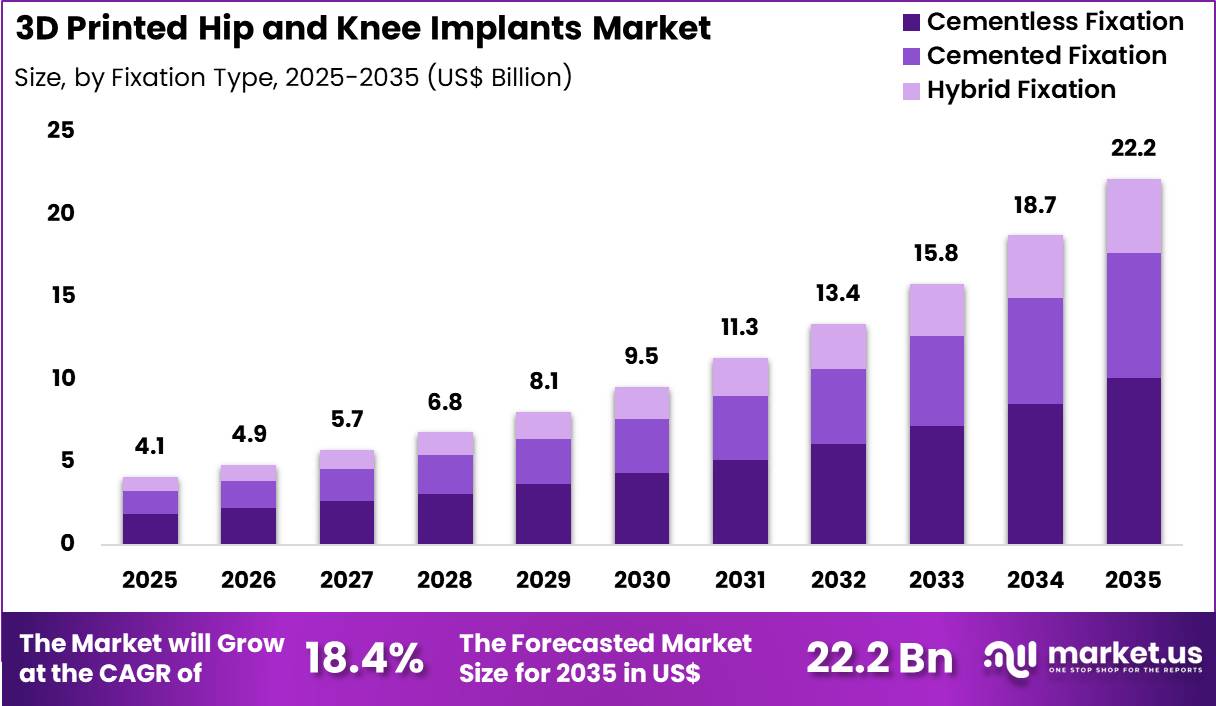
New York, NY – Nov 17 2026 – The Global 3D Printed Hip and Knee Implants Market size is expected to be worth around US$ 22.2 Billion by 2035 from US$ 4.1 Billion in 2025, growing at a CAGR of 18.4% during the forecast period 2026-2035. In 2025, North America led the market, achieving over 43.8% share with a revenue of US$ 1.8 Billion.
3D Printed Hip and Knee Implants refer to advanced orthopedic implants manufactured using three-dimensional (3D) printing, also known as additive manufacturing technology. This technology enables the production of standard-sized, patient-matched, and customized implants designed to address different joint conditions and anatomical requirements. These implants are increasingly being used in hip and knee replacement procedures, particularly in patients with complex bone defects, deformities, and revision surgery requirements.
The manufacturing process involves advanced imaging techniques, such as CT and MRI scans, computer-aided design (CAD), and specialized 3D printing systems. Materials such as titanium alloys, cobalt-chromium alloys, and tantalum are commonly used due to their strength, durability, and biocompatibility. Porous and lattice-based implant structures can support bone ingrowth and improve implant fixation.
The growing prevalence of osteoarthritis, increasing demand for joint replacement surgeries, rising geriatric population, and advancements in personalized orthopedic solutions are supporting market development. Furthermore, continuous innovations in additive manufacturing, implant design, and surgical planning are creating new opportunities. However, high manufacturing costs, regulatory requirements, and the need for long-term clinical evidence remain important considerations for wider adoption.
Key Takeaways
- In 2025, the global market was valued at US$ 4.1 Billion and is projected to grow at a CAGR of 18.4%, reaching US$ 22.2 Billion by 2035.
- Based on material type, the market is segmented into metallic implants, ceramic implants, polymeric implants, composite implants, and others. Among these, metallic implants dominated the segment, accounting for 71.3% of the total market share.
- By fixation type, the market is categorized into cemented fixation, cementless fixation, and hybrid fixation. Cementless fixation emerged as the leading segment, capturing 45.6% of the market share.
- Based on end user, the market is segmented into hospitals, orthopedic clinics, and ambulatory surgical centers (ASCs). Hospitals dominated the segment, accounting for 55.9% of total market revenue.
- By surgery type, the market is divided into total hip replacement, partial hip replacement, total knee replacement, partial knee replacement, and others. Total knee replacement emerged as the leading segment, capturing 48.2% of market revenue.
- Regionally, North America dominated the global market, accounting for 43.8% of the total market share.
Key Market Segments
- Material Type Analysis: Metallic implants dominated the material type segment, accounting for 71.3% of the market share. Their leadership is driven by superior mechanical strength, durability, and excellent osseointegration properties. Increasing adoption of titanium and cobalt-chromium alloys, along with advancements in porous implant designs, is further supporting segment growth.
- Fixation Type Analysis: Cementless fixation dominated the fixation type segment, accounting for 45.6% of the market share. Its growth is supported by increasing preference for natural bone integration without bone cement. Advancements in 3D printed porous surfaces and lattice structures are improving implant stability, bone ingrowth, and long-term fixation.
- End User Analysis: Hospitals dominated the end-user segment, accounting for 55.9% of the market share. Their leading position is attributed to the availability of specialized orthopedic departments, advanced imaging systems, and skilled surgical teams. Rising joint replacement procedures and increasing investments in advanced surgical technologies are further supporting segment growth.
- Surgery Type Analysis: Total knee replacement dominated the surgery type segment, accounting for 48.2% of the market share. Segment growth is driven by the rising prevalence of osteoarthritis, aging populations, and increasing demand for effective mobility restoration. Growing adoption of customized 3D printed implants is further improving anatomical fit and surgical precision.
Regional Analysis
North America Dominates the 3D Printed Hip and Knee Implants Market
North America dominated the market in 2025, accounting for 43.8% of the global market share. Regional growth is driven by rising joint replacement procedures, advanced healthcare infrastructure, and increasing adoption of additive manufacturing technologies.
High demand for customized implants, robotic-assisted surgeries, and digital surgical planning is further supporting market expansion across the United States and Canada.
Asia Pacific Expected to Register the Highest CAGR
Asia Pacific is projected to record the highest CAGR during the forecast period, supported by an aging population, increasing osteoarthritis prevalence, and expanding orthopedic healthcare infrastructure. Countries such as China, Japan, South Korea, and India are investing in advanced surgical technologies and medical device manufacturing.
Growing healthcare expenditure, rising joint replacement procedures, and increasing adoption of patient-specific 3D printed implants are expected to accelerate regional market growth.
Emerging Trends
- Increasing Adoption of Patient-Specific Implants: The use of patient-specific implants is increasing as 3D printing allows manufacturers to develop devices based on individual bone structures and medical imaging data. This approach supports better anatomical fitting, particularly in patients with complex joint conditions.
- Development of Highly Porous Titanium Implants: Manufacturers are increasingly developing porous titanium implants using additive manufacturing. These structures allow bone tissue to grow into the implant surface, supporting biological fixation. Research is also examining their potential to reduce implant loosening and improve long-term stability.
- Growing Demand for Cementless Implant Technologies: The development of 3D printed porous surfaces is supporting the adoption of cementless hip and knee implants. These designs encourage natural bone attachment without requiring bone cement for fixation. Improved initial stability and bone integration remain important areas of clinical development.
- Integration of Medical Imaging and Digital Design Technologies: The integration of CT scans, MRI data, computer-aided design, and 3D printing is improving implant development. These technologies allow manufacturers and surgeons to study bone structures, create digital implant models, and develop designs for complicated joint replacement procedures.
- Advancements in Additive Manufacturing Quality and Regulatory Testing: Greater attention is being given to manufacturing consistency, material properties, surface quality, and mechanical testing. Regulatory authorities are emphasizing product validation and manufacturing controls to ensure that 3D printed medical implants meet required safety and performance standards.
Use Cases
- Total Hip Replacement Procedures: 3D printed hip implants are used in total hip replacement procedures to replace damaged joint structures caused by osteoarthritis, injuries, and other bone conditions. Porous titanium components can support bone attachment and provide fixation for suitable patients undergoing hip replacement surgery.
- Revision Hip Replacement and Severe Bone Loss: Patient-specific 3D printed acetabular components and reconstruction implants can be used in complex revision hip surgeries. These devices help address significant bone loss, irregular bone structures, and damaged implant support areas where standard implant shapes may be insufficient.
- Total Knee Replacement Procedures: 3D printed components can be incorporated into knee replacement systems, including highly porous structures designed to support bone integration. These technologies are being applied to improve implant fixation and address the anatomical and mechanical requirements of knee joint reconstruction.
- Reconstruction of Complex Knee Bone Defects: Custom 3D printed knee implants and augmentation components can help surgeons manage complex bone defects during revision procedures. Patient-specific designs can be developed using medical imaging to match irregular bone surfaces and provide structural support during joint reconstruction.
- Treatment Planning for Complex Joint Replacement Surgeries: Three-dimensional anatomical models and patient-matched surgical guides can support planning for complicated hip and knee replacement procedures. These tools help surgeons understand bone geometry, assess implant positioning, and prepare for procedures involving unusual anatomical structures.
Frequently Asked Questions About 3D Printed Hip and Knee Implants
- Which materials are commonly used in 3D printed hip and knee implants?
Titanium alloys are commonly used in 3D printed orthopedic implants because of their strength, corrosion resistance, and compatibility with the human body. Cobalt-chromium alloys and other specialized materials are also used in joint replacement systems. - How do 3D printed implants improve bone integration?
3D printed implants can feature porous surfaces and interconnected structures that encourage natural bone growth into the implant. This process, known as osseointegration, helps establish biological fixation and may improve implant stability over time. - What is the difference between traditional and 3D printed orthopedic implants?
Traditional implants are generally manufactured using conventional machining, casting, or molding processes. In comparison, 3D printed implants allow greater design flexibility, complex porous structures, and patient-specific geometries based on individual anatomical requirements. - Are 3D printed hip and knee implants safe?
3D printed hip and knee implants must undergo appropriate regulatory evaluation and performance testing before marketing. Their safety depends on material quality, manufacturing controls, mechanical strength, sterilization, and clinical suitability for the intended medical application. - Who are the major end users of 3D printed hip and knee implants?
Hospitals, orthopedic specialty centers, ambulatory surgical centers, and specialized healthcare facilities represent important end users. These institutions use advanced joint replacement technologies to treat patients with severe joint damage, bone defects, and complex orthopedic conditions. - How does 3D printing support innovation in the orthopedic implant industry?
3D printing supports orthopedic innovation by enabling complex implant geometries, customized designs, and porous structures. It also reduces the need for certain conventional tooling processes, allowing manufacturers to develop specialized implant designs for challenging surgical applications. - What is the future outlook for the 3D Printed Hip and Knee Implants Market
The market is expected to benefit from continued advances in titanium printing, patient-specific implant development, and digital surgical planning. Increasing clinical experience and further evidence of long-term implant performance may support broader adoption across orthopedic healthcare facilities.
Conclusion
The 3D Printed Hip and Knee Implants Market is expected to witness strong growth, supported by increasing joint replacement procedures, rising osteoarthritis cases, and advancements in additive manufacturing. Valued at US$ 4.1 billion in 2025, the market is projected to reach US$ 22.2 billion by 2035, at a CAGR of 18.4%. Growing demand for patient-specific implants, porous titanium structures, and cementless fixation is creating new opportunities.
North America currently leads the market, while Asia Pacific is expected to record the fastest growth. However, manufacturing costs, regulatory requirements, and long-term clinical validation remain important considerations.
Discuss your needs with our analyst
Please share your requirements with more details so our analyst can check if they can solve your problem(s)