
Overview
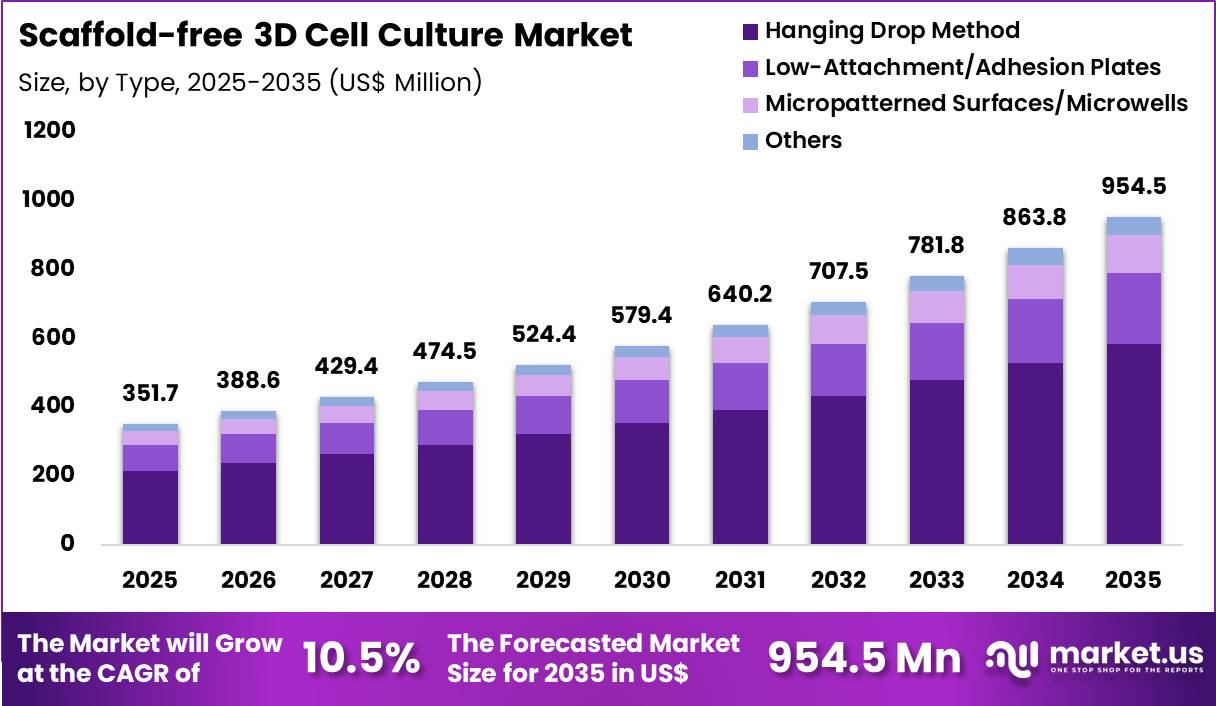
New York, NY – Nov 17 2026 – The Global Scaffold-free 3D Cell Culture Market size is expected to be worth around US$ 954.5 Million by 2035 from US$ 351.7 Million in 2025, growing at a CAGR of 10.5% during the forecast period 2026-2035. In 2025, North America led the market, achieving over 39.6% share with a revenue of US$ 139.3 Million.
Scaffold-free 3D cell culture is an advanced cell culture technique that enables cells to grow, organize, and interact in three-dimensional structures without the use of external scaffolding materials. Unlike traditional two-dimensional (2D) cell culture systems, where cells grow on flat surfaces, this approach allows cells to form natural cellular aggregates, spheroids, and tissue-like structures.
The technology supports improved cell-to-cell interactions and more realistic cellular microenvironments, closely replicating key characteristics of human tissues and organs. Common techniques used in scaffold-free 3D cell culture include hanging drop methods, low-adhesion plates, magnetic levitation, and bioreactor-based systems.
The growing adoption of scaffold-free 3D cell culture is being driven by increasing demand for physiologically relevant in-vitro models in drug discovery, cancer research, toxicity testing, regenerative medicine, and personalized medicine. These models provide valuable insights into cellular behavior, drug responses, disease mechanisms, and therapeutic effectiveness.
Furthermore, advancements in automation, high-throughput screening, and cell culture technologies are supporting the development of scalable and reproducible scaffold-free 3D culture systems.
As the pharmaceutical, biotechnology, and life sciences industries continue to prioritize more predictive preclinical research models, scaffold-free 3D cell culture is expected to play an increasingly important role in advancing biomedical research and next-generation therapeutic development.
Key Takeaways
- In 2025, the global scaffold-free 3D cell culture market was valued at US$ 351.7 Million and is projected to grow at a CAGR of 10.5%, reaching US$ 954.5 Million by 2035.
- Based on type, the market is segmented into hanging drop method, low-attachment/adhesion plates, micropatterned surfaces/microwells, and others. Among these, the hanging drop method dominated the market, accounting for a 61.3% share.
- Based on application, the market is categorized into stem cell research & tissue engineering, cancer research, drug development & toxicity testing, and others. The stem cell research & tissue engineering segment accounted for a significant market share of 34.6%.
- Based on end use, the market is classified into biotechnology & pharmaceutical companies, academic & research institutes, hospitals, and others. Biotechnology & pharmaceutical companies emerged as the leading end-use segment, capturing 49.6% of the total market revenue.
- Regionally, North America dominated the global scaffold-free 3D cell culture market, accounting for the largest revenue share of 39.6%.
Key Market Segments
- Type Analysis: The hanging drop method dominated the type segment with a 61.3% market share, driven by its simplicity, reproducibility, and effectiveness in uniform spheroid formation. Its ability to maintain cell-to-cell interactions and replicate in-vivo conditions has increased its adoption across stem cell research, drug screening, and preclinical studies.
- Application Analysis: Stem cell research and tissue engineering led the application segment with a 34.6% market share, supported by growing demand for biologically relevant 3D models. Scaffold-free platforms enable improved cell differentiation, self-organization, and tissue-like development, supporting their increasing application in regenerative medicine, tissue engineering, and cell-based therapeutic research.
- End-Use Analysis: Biotechnology and pharmaceutical companies dominated the end-use segment with a 49.6% market share, driven by increasing adoption of advanced cell culture models for drug discovery, toxicity testing, and preclinical research. Scaffold-free systems support more realistic disease modelling, improve screening capabilities, and contribute to more predictive therapeutic development.
Regional Analysis
North America Dominates the Scaffold-Free 3D Cell Culture Market
North America dominated the scaffold-free 3D cell culture market in 2025, accounting for 39.6% of the global market share. This leadership can be attributed to strong biotechnology research infrastructure, increasing pharmaceutical R&D investments, and widespread adoption of advanced in-vitro models across the United States and Canada.
Growing applications of spheroid and organoid models in cancer research, regenerative medicine, and drug discovery have further supported regional market growth. Additionally, substantial funding for stem cell research, expanding academic-industry collaborations, and technological advancements in microfluidics and automated cell analysis have strengthened the adoption of scaffold-free culture platforms.
The growing focus on predictive drug testing and physiologically relevant disease models is expected to sustain North America’s leading position.
Asia Pacific Expected to Register the Highest CAGR
Asia Pacific is projected to record the highest CAGR during the forecast period, supported by increasing government investments in biotechnology, stem cell research, and regenerative medicine. Countries such as China, Japan, South Korea, and Singapore are strengthening biomedical research infrastructure and expanding advanced cell culture capabilities.
Rising pharmaceutical R&D activities, growing adoption of 3D models for drug screening, and increasing research collaborations are further supporting market expansion. Additionally, investments in tissue engineering, organoid development, and automated screening technologies are expected to accelerate regional adoption.
Emerging Trends
- Growing Adoption of Spheroid-Based Cell Culture: The use of spheroid-based cell culture is increasing as researchers seek models that better represent natural tissue structures. These models allow cells to grow through natural cell-to-cell interactions without external support materials, supporting more realistic biological studies.
- Integration of Microfluidic Technologies: Microfluidic technology is being integrated with scaffold-free cell culture to improve control over nutrient supply, oxygen levels, and cell growth conditions. This combination supports the development of advanced cell models and enables more controlled drug testing and disease research.
- Increasing Demand for High-Throughput Screening: Pharmaceutical and biotechnology researchers are increasingly adopting scalable spheroid culture platforms for testing multiple drug candidates. Automated culture plates and microwell systems are supporting faster experimental processes, consistent sample handling, and improved screening efficiency.
- Expansion of Patient-Derived Cell Models: Patient-derived cells are receiving greater attention in scaffold-free culture research. These models can help researchers study individual disease characteristics and compare treatment responses, supporting the development of personalized approaches in cancer research and drug evaluation.
- Development of Advanced Stem Cell Culture Techniques: Scaffold-free techniques are increasingly being explored for stem cell expansion, cell differentiation, and tissue regeneration research. Methods that encourage cells to assemble naturally are supporting investigations into cell-based therapies and the development of tissue-like structures.
- Increasing Use of Scaffold-free Microfluidic Spheroid Platforms: Microfluidic platforms are being developed to produce and maintain multiple spheroids under controlled conditions. These systems can support real-time monitoring and improve the study of cellular responses to different compounds.
Use Cases
- Drug Discovery and Development: Scaffold-free 3D cell culture is used in pharmaceutical research to evaluate the effectiveness of potential drug candidates. Spheroids provide a more realistic cellular environment than conventional flat cultures, helping researchers examine drug penetration, cell survival, and treatment responses.
- Cancer Research and Tumour Modelling: Cancer researchers use scaffold-free spheroids to study tumour growth, cell interactions, and treatment resistance. These models help reproduce certain features of solid tumours, including differences in oxygen and nutrient availability, supporting investigations into cancer progression and new treatment approaches.
- Toxicity Testing and Safety Assessment: Scaffold-free cell models are used to examine how chemical compounds and pharmaceutical substances affect cell health. Researchers can assess cell damage, survival, and biological responses, supporting early-stage safety evaluation and the identification of potentially harmful substances.
- Stem Cell Research and Regenerative Medicine: Scaffold-free culture techniques support the formation of stem cell aggregates and tissue-like structures. Researchers use these models to investigate cell differentiation, tissue development, and regenerative processes, including the potential development of cell-based therapies.
- Disease Modelling and Personalized Medicine: Patient-derived cells can be grown into three-dimensional structures to investigate disease-related biological changes. These models can help researchers compare individual treatment responses and understand disease mechanisms, particularly in cancer and other complex conditions.
Frequently Asked Questions About Scaffold-free 3D Cell Culture
- How does scaffold-free 3D cell culture work?
This technique encourages cells to come together through cell-to-cell interactions rather than attaching to a supporting structure. Methods such as hanging drops, low-attachment plates, and magnetic levitation are used to produce three-dimensional cellular aggregates. - What are the main types of scaffold-free 3D cell culture techniques?
The major techniques include hanging drop culture, ultra-low attachment plates, forced aggregation, magnetic levitation, and dynamic suspension culture. Each method uses different physical conditions to encourage cell aggregation and spheroid formation in laboratory environments. - What are the advantages of scaffold-free 3D cell culture?
Scaffold-free culture supports natural cell interactions, reduces dependence on external materials, and enables the formation of tissue-like structures. It also provides useful models for studying biological processes and evaluating responses to pharmaceutical compounds. - What is the difference between scaffold-based and scaffold-free 3D cell culture?
Scaffold-based culture uses external materials such as hydrogels or polymers to support cell growth. In contrast, scaffold-free culture encourages cells to assemble naturally through cellular interactions, without requiring an external supporting framework. - What is the role of scaffold-free 3D cell culture in drug discovery?
It helps pharmaceutical researchers evaluate drug effectiveness, cellular responses, and potential toxicity using three-dimensional cell models. These experiments can provide additional biological information before promising drug candidates proceed to more advanced preclinical investigations. - Are scaffold-free 3D cell culture models suitable for high-throughput screening?
Yes, certain scaffold-free platforms, particularly ultra-low attachment plates and microwell systems, can support high-throughput screening. Automation and standardized culture procedures can improve sample processing, although spheroid uniformity remains an important consideration. - What factors are driving the scaffold-free 3D cell culture market?
Market growth is supported by increasing pharmaceutical research, demand for advanced drug screening models, rising cancer research activities, and growing interest in personalized medicine. The need for more representative laboratory models is also supporting technology adoption. - Which technologies are commonly used in the scaffold-free 3D cell culture market?
Common technologies include hanging drop systems, ultra-low attachment plates, magnetic levitation, forced aggregation, and dynamic suspension culture. Microfluidic platforms are also being developed to improve spheroid formation, monitoring, and experimental control.
Conclusion
The global scaffold-free 3D cell culture market is expected to experience significant growth, driven by increasing demand for physiologically relevant in-vitro models in drug discovery, cancer research, toxicity testing, and regenerative medicine. Valued at US$ 351.7 million in 2025, the market is projected to reach US$ 954.5 million by 2035, growing at a CAGR of 10.5%.
Technological advancements in automation, microfluidics, and high-throughput screening are further supporting market expansion. While North America maintains its leading position, Asia Pacific is expected to emerge as a high-growth region, creating new opportunities for industry participants.
Discuss your needs with our analyst
Please share your requirements with more details so our analyst can check if they can solve your problem(s)