


Overview
New York, NY – July 31, 2026 – The Global Topical Pain Relief Market Size is expected to be worth around US$ 18.4 Billion by 2034 from US$ 11.1 Billion in 2024, growing at a CAGR of 5.2% during the forecast period 2025 to 2034. North America held a dominant market position, capturing more than a 39.7% share and holding a US$ 4.4 Billion market value for the year.
The global topical pain relief market is experiencing steady growth due to the rising burden of musculoskeletal disorders, increasing preference for self-care treatments, and demand for non-invasive pain management solutions. Topical pain relief products, including gels, creams, sprays, and patches, offer localized relief with fewer systemic side effects compared with oral pain medications.
According to the Centers for Disease Control and Prevention (CDC), around 60 million US adults (approximately 24.3%) experience chronic pain, with many cases linked to joint, muscle, and back-related conditions.
The growing prevalence of arthritis is also strengthening market demand. The CDC estimates that nearly 1 in 4 US adults, or about 58.5 million people, have doctor-diagnosed arthritis, creating a large consumer base for topical pain management products. Additionally, musculoskeletal conditions contribute to significant healthcare utilization, with the National Institutes of Health (NIH) reporting more than 130 million patient visits annually in the United States for these conditions.
Market growth is further supported by product innovation and expansion strategies. Manufacturers are introducing advanced formulations such as fast-absorbing gels, long-lasting patches, and targeted sprays. For example, Abbott launched Brufen Power spray in March 2022 to provide rapid physical pain relief, while Troy Healthcare expanded its Stopain Clinical topical pain relief products into Canada in June 2022.
Increasing consumer interest in natural ingredients, including menthol, capsaicin, and camphor, is creating new growth opportunities. Rising awareness of pain management options, sports injuries, and active lifestyles continues to drive demand for convenient topical solutions worldwide.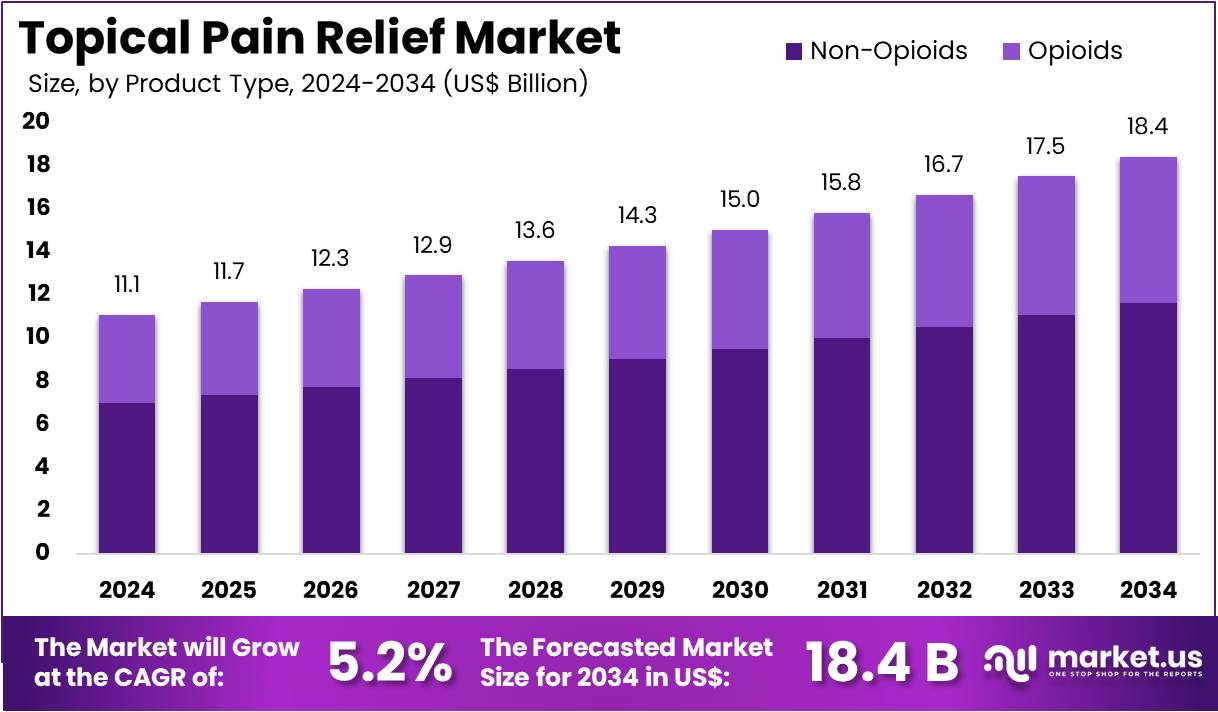
Key Takeaways
- In 2024, the Topical Pain Relief Market generated revenue of US$ 11.1 billion and is projected to grow at a CAGR of 5.2%, reaching US$ 18.4 billion by 2034.
- Based on product type, the market is segmented into non-opioids and opioids. The non-opioids segment dominated in 2023, accounting for a 63.2% market share.
- By formulation, the market is categorized into cream, spray, patch, gel, and others. Among these, the cream segment held a leading position with a 35% market share.
- By distribution channel, the market is divided into pharmacies & drug stores, retail & grocery stores, and e-commerce. The pharmacies & drug stores segment dominated the market, capturing the largest revenue share of 41.3%.
- Based on type, the market is segmented into prescription and over-the-counter products. The prescription segment led the market with a revenue share of 55.9%.
- Regionally, North America dominated the Topical Pain Relief Market in 2023, accounting for a 39.7% market share.
Statistical Information
- Rising Burden of Chronic Pain Increasing Demand for Topical Pain Management Solutions: Chronic pain is a major healthcare concern in the United States, creating a large consumer base for topical pain relief products. According to the CDC National Center for Health Statistics, 24.3% of US adults experienced chronic pain in 2023, while 8.5% experienced high-impact chronic pain that limited daily activities or work. This indicates that millions of people require continuous pain management options, including localized topical therapies.
- Arthritis Prevalence Supporting Long-Term Demand for Topical Pain Relief Products: Arthritis remains one of the largest contributors to joint pain and mobility issues, supporting demand for topical creams, gels, patches, and sprays. The CDC estimates that 58.5 million US adults aged 18 years and older have arthritis, and approximately 25.7 million people experience arthritis-related activity limitations. By 2040, arthritis cases are projected to reach nearly 78 million US adults, increasing the need for accessible pain relief solutions.
- Musculoskeletal Disorders Creating High Healthcare Utilization and Pain Management Needs: Musculoskeletal conditions such as back pain, joint disorders, and muscle injuries contribute significantly to healthcare visits and increase demand for non-invasive pain relief products. Data from the National Institutes of Health (NIH) and National Academies indicates that musculoskeletal disorders account for approximately 130 million healthcare encounters annually in the United States, including outpatient, hospital, and emergency room visits.
- Chronic pain prevalence and need for topical options: In 2021, an estimated 20.9% of U.S. adults, about 51.6 million people, experienced chronic pain, and 6.9% (17.1 million) had high‑impact chronic pain that substantially restricted daily activities.
- Preference for non‑opioid and topical NSAID therapies in guidelines: CDC’s 2022 clinical practice guideline states that non‑opioid therapies are preferred for subacute and chronic pain and recommends maximizing non‑pharmacologic and non‑opioid pharmacologic options before considering opioids.
- OTC analgesic use and risk perception: In the 2002 NCL survey, 44% of respondents reported consuming more than the recommended dose on the label at least sometimes, and 49% were not concerned about potential side effects, suggesting substantial misuse risk and an opportunity for safer, localized topical formulations.
- Consumer pain and OTC pain‑reliever behavior (U.S.): A 2022 online survey commissioned by the Consumer Healthcare Products Association (CHPA) among 1,250 U.S. consumers who had taken acetaminophen‑containing OTC or prescription pain medication in the last six months found that 66% reported ongoing pain, up from 54% in 2019.
Regional Analysis
North America led the market by securing a market share of 39.7% in 2023.
North America remains a major region in the topical pain relief market due to the high burden of chronic pain, arthritis, and sports-related injuries. According to the CDC, approximately 58.5 million US adults have doctor-diagnosed arthritis, creating strong demand for localized pain management products such as creams, gels, sprays, and patches. Additionally, the National Safety Council reported more than 4.4 million sports and recreational injury-related emergency department visits in 2024, supporting the need for convenient pain relief solutions.
Asia Pacific is expected to witness significant growth due to its aging population and expanding healthcare access. The WHO reports that the population aged 65 years and above in Asia and the Pacific increased from 168 million in 1990 to 503 million in 2024, increasing demand for pain management therapies. Rising healthcare investments and consumer interest in natural topical formulations further support regional market expansion.
Emerging Trends
- Growing Preference for Non-Opioid Pain Relief Solutions: Healthcare providers and consumers are increasingly choosing non-opioid topical treatments due to opioid-related safety concerns. The CDC reported that 24.3% of US adults experienced chronic pain in 2023, increasing demand for localized pain relief products such as topical NSAIDs, lidocaine, menthol, and capsaicin formulations.
- Rising Demand for Natural and Plant-Based Formulations: Consumers are showing higher interest in topical pain relief products containing natural ingredients such as menthol, camphor, and capsaicin. FDA-approved external analgesic products support the use of these active ingredients in creams, gels, and sprays for temporary relief of muscle and joint discomfort.
- Increasing Adoption Among Aging Populations: The growing elderly population is driving demand for topical pain management products due to higher rates of arthritis and mobility-related conditions. The CDC estimates that 58.5 million US adults have arthritis, creating a large consumer base for topical creams, gels, and patches.
- Innovation in Advanced Topical Delivery Formats: Manufacturers are focusing on innovative formats such as fast-absorbing gels, sprays, roll-ons, and extended-release patches. These products aim to provide targeted application, improved convenience, and longer-lasting relief for consumers managing localized pain conditions.
- Expansion of Self-Care and Home-Based Pain Management: Consumers are increasingly using over-the-counter topical products to manage common conditions such as muscle soreness, back pain, arthritis discomfort, and minor injuries at home. Growing awareness of self-care practices is supporting wider adoption of topical pain relief solutions.
- Growing Use in Sports Injury Recovery: Increasing sports and fitness participation is boosting demand for quick-acting topical pain relief products. The National Safety Council reported more than 4.4 million sports and recreation-related injury emergency department visits in 2024, creating demand for sprays, creams, and patches.
Use Cases
- Arthritis and Joint Pain Management: Topical pain relief products are widely used for managing arthritis-related joint discomfort, stiffness, and inflammation. The CDC reports that 58.5 million US adults have diagnosed arthritis, creating significant demand for localized treatments such as creams, gels, and patches that support daily mobility and symptom relief.
- Muscle Pain and Back Pain Relief: Topical analgesics are commonly used for temporary relief from muscle aches, strains, and back pain. The high burden of musculoskeletal conditions contributes to increased demand for non-invasive pain management options. NIH reports that musculoskeletal disorders result in approximately 130 million healthcare encounters annually in the United States.
- Sports Injury Recovery and Athletic Applications: Athletes and physically active individuals use topical pain relief products for minor injuries, muscle soreness, sprains, and strains. The National Safety Council reported over 4.4 million sports and recreation-related injury emergency department visits in 2024, supporting demand for quick-acting sprays, gels, and creams.
- Post-Exercise Muscle Recovery: Fitness users increasingly apply topical pain relief products after workouts to manage temporary muscle soreness and fatigue. Products containing menthol, camphor, and capsaicin provide cooling or warming sensations, making them popular among consumers seeking convenient recovery solutions.
- Chronic Pain Self-Management at Home: Consumers use topical pain relief products as part of home-based care for chronic pain conditions. CDC data shows 24.3% of US adults experienced chronic pain in 2023, increasing the need for accessible, easy-to-use treatment options that support daily activities.
- Pain Relief for Older Adults: Elderly populations commonly use topical products for age-related conditions such as arthritis, joint stiffness, and mobility challenges. The increasing number of older adults worldwide is creating demand for simple, localized therapies that can be applied without complex administration methods.
Frequently Asked Questions on Topical Pain Relief
- What are the major factors driving the Topical Pain Relief Market growth?
The market is driven by rising chronic pain prevalence, increasing arthritis cases, growing preference for non-invasive treatments, and higher adoption of self-care products. Consumers are increasingly choosing topical solutions due to convenience, targeted application, and reduced systemic side effects. - Which product type dominates the Topical Pain Relief Market?
Non-opioid topical pain relief products represent a leading product category due to increasing demand for safer pain management options. Products containing menthol, capsaicin, lidocaine, and NSAIDs are widely used for managing muscle, joint, and arthritis-related pain. - What are the common formulations available in the Topical Pain Relief Market?
The market offers multiple formulations, including creams, gels, sprays, patches, roll-ons, and ointments. Creams and gels remain popular due to easy application, quick absorption, and suitability for treating localized pain caused by injuries, arthritis, and muscle soreness. - Why are consumers preferring topical pain relief products over oral medications?
Consumers prefer topical pain relief products because they provide localized treatment directly at the affected area. These products are considered convenient for managing mild to moderate pain while reducing concerns associated with systemic exposure from frequently used oral pain medications. - What are the major applications of topical pain relief products?
Topical pain relief products are commonly used for arthritis, back pain, muscle strains, sports injuries, joint stiffness, and minor injuries. Increasing cases of musculoskeletal disorders and active lifestyles are expanding the application scope among different consumer groups. - What role do natural ingredients play in the Topical Pain Relief Market?
Natural ingredients such as menthol, camphor, and capsaicin are gaining attention due to consumer interest in plant-based and perceived safer pain relief options. Manufacturers are developing formulations that combine traditional ingredients with modern delivery technologies for improved effectiveness. - Which region is leading the Topical Pain Relief Market?
North America holds a significant position in the topical pain relief market due to high chronic pain prevalence, advanced healthcare infrastructure, strong retail networks, and increasing consumer adoption of over-the-counter pain management products for arthritis, muscle pain, and injuries. - What are the future growth opportunities in the Topical Pain Relief Market?
Future opportunities include development of advanced delivery systems, expansion of e-commerce channels, rising demand for natural formulations, and increasing adoption among athletes and elderly consumers. Innovation in long-lasting patches, sprays, and targeted therapies is expected to support market growth.
Conclusion
The Topical Pain Relief Market is witnessing steady growth due to the rising prevalence of chronic pain, arthritis, sports injuries, and increasing consumer preference for convenient self-care solutions. Non-opioid formulations, natural ingredients, and advanced delivery formats such as gels, sprays, and patches are driving product innovation.
North America continues to hold a strong market position due to high pain-related healthcare demand, while Asia Pacific shows significant growth potential due to aging populations and expanding healthcare access. Increasing awareness of localized pain management, pharmacy availability, and digital distribution channels will continue to create new opportunities for manufacturers in the coming years.
Discuss your needs with our analyst
Please share your requirements with more details so our analyst can check if they can solve your problem(s)




