


Overview
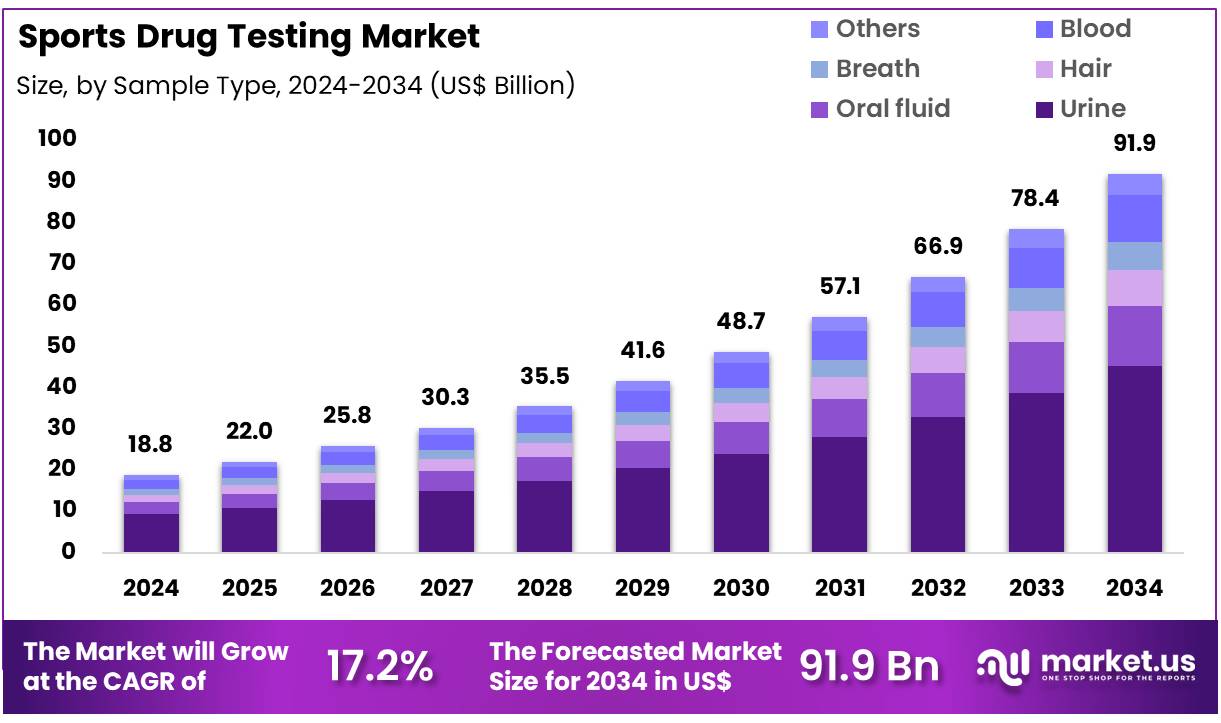
The global Sports Drug Testing Market size is expected to be worth around US$ 91.9 Billion by 2034 from US$ 18.8 Billion in 2024, growing at a CAGR of 17.2% during the forecast period 2025 to 2034. In 2024, North America led the market, achieving over 41.3% share with a revenue of US$ 7.8 Billion.
Sports drug testing is a scientific process used to detect prohibited substances and methods in athletes to ensure fair competition, athlete safety, and compliance with anti-doping regulations. Testing is conducted across professional, amateur, collegiate, and international sporting events, as well as during out-of-competition periods.
Samples, primarily urine and blood, are analyzed in accredited laboratories using advanced technologies such as liquid chromatography-mass spectrometry (LC-MS), gas chromatography-mass spectrometry (GC-MS), and isotope ratio mass spectrometry (IRMS) to identify banned performance-enhancing drugs (PEDs), stimulants, narcotics, peptide hormones, anabolic agents, and masking substances.
The growing emphasis on clean sports, increasing participation in competitive athletics, and stricter anti-doping policies are driving demand for reliable drug testing services worldwide. Sports governing bodies continue to strengthen testing programs through athlete biological passports, intelligence-led investigations, and year-round sample collection. Technological advancements have significantly improved the sensitivity, accuracy, and turnaround time of testing, enabling laboratories to detect even trace levels of prohibited substances.
The market is also benefiting from increased investments in laboratory infrastructure, digital sample tracking systems, and next-generation analytical platforms that enhance testing efficiency while maintaining chain-of-custody integrity. Major international sporting events and expanding anti-doping education initiatives further support the adoption of comprehensive testing programs. As governments, sports organizations, and regulatory authorities continue to prioritize transparency and athlete welfare, sports drug testing remains an essential component of maintaining integrity, public trust, and fairness across the global sports ecosystem.
Key Takeaways
- In 2024, the market was valued at US$ 81.8 billion and is projected to reach US$ 91.9 billion by 2034, expanding at a CAGR of 17.2% during the forecast period.
- Among product types, equipment emerged as the leading segment, accounting for a 44.8% market share in 2023.
- By sample type, urine dominated the market with a 49.3% share in 2023.
- Based on end users, drug testing laboratories held the largest market share, contributing 52.1% of total revenue.
- North America led the global market, capturing a 41.3% market share in 2023.
Statistical Information
- The U.S. Anti-Doping Agency (USADA) completed 10,590 doping-control tests during 2025, including 7,584 out-of-competition tests and 3,006 in-competition tests, demonstrating the continued emphasis on year-round athlete monitoring.
- USADA conducted 2,611 doping-control tests during Q1 2026, consisting of 1,906 out-of-competition tests and 705 in-competition tests, reflecting sustained operational testing activity across Olympic and Paralympic sports.
- Cycling athletes received 580 USADA tests during 2025, including 396 out-of-competition and 184 in-competition tests, making cycling one of the most intensively monitored sports.
- Biathlon athletes underwent 134 USADA tests during 2025, comprising 114 out-of-competition tests and 20 competition tests, illustrating extensive off-season monitoring.
- WADA reported that 288,865 anti-doping samples were analyzed by accredited laboratories worldwide, with 2,313 Adverse Analytical Findings (0.80%) and 456 Atypical Findings (0.16%), resulting in an overall findings rate of 0.96%.
- For Olympic sports, WADA laboratories analyzed 238,827 samples, identifying 1,373 Adverse Analytical Findings (0.57%) and 359 Atypical Findings (0.15%).
- For non-Olympic sports, WADA analyzed 50,038 samples, producing 940 Adverse Analytical Findings (1.88%), considerably higher than the Olympic-sport rate.
- A 2026 anti-doping analytics study evaluated more than 1.6 million athletics performances collected from over 19,000 competitions, benchmarking eight different anomaly-detection methods to support targeted anti-doping investigations.
- The same 2026 study reported that laboratory anti-doping testing costs exceed US$800 per sample, highlighting why computational screening methods are being investigated to improve testing efficiency.
- During the 2026 Tour de France, the International Testing Agency (ITA) collected blood samples from all 166 remaining riders on the second rest day, while planning approximately 600 anti-doping tests throughout the race to strengthen Athlete Biological Passport monitoring.
Regional Analysis
North America Leads the Sports Drug Testing Market
North America dominated the sports drug testing market in 2024, accounting for 41.3% of the global market. The region’s leadership is supported by strong anti-doping regulations, well-established testing laboratories, and widespread adoption of advanced analytical technologies. Organizations such as the U.S. Anti-Doping Agency (USADA) and national sports bodies continue to expand in-competition and out-of-competition testing programs to ensure fair play.
The growing use of sophisticated methods, including liquid chromatography-mass spectrometry (LC-MS) and biological passport monitoring, has improved the detection of prohibited substances. Increased investments in athlete education, stricter compliance with the World Anti-Doping Agency (WADA) Code, and preparations for major international sporting events have further strengthened testing activities.
In addition, collaboration between sports organizations, accredited laboratories, and government agencies continues to support innovation in sample collection, analysis, and result management, reinforcing North America’s position as the leading regional market.
Asia Pacific Expected to Register the Fastest Growth
Asia Pacific is projected to record the highest CAGR during the forecast period due to expanding sports participation and increasing adoption of international anti-doping standards. Countries such as China, Japan, India, South Korea, and Australia are strengthening testing infrastructure through investments in accredited laboratories and advanced screening technologies.
National anti-doping organizations are increasing athlete testing programs while promoting awareness of clean sport initiatives. Governments and sports authorities are also enhancing collaboration with WADA to improve regulatory compliance and testing quality. Rising participation in international competitions, growing professional sports leagues, and continuous modernization of laboratory capabilities are expected to drive demand for sports drug testing services across the region in the coming years.
Emerging Trends
- Expansion of Out-of-Competition Testing: Sports organizations are increasing surprise testing to improve fair competition. The U.S. Anti-Doping Agency (USADA) completed 10,590 tests in 2025, including 7,584 out-of-competition tests and 3,006 in-competition tests, showing a strong focus on year-round athlete monitoring rather than event-only screening.
- Growing Adoption of Athlete Biological Passport (ABP): The Athlete Biological Passport is becoming a standard tool for long-term monitoring. During the 2026 Tour de France, all 166 remaining riders submitted blood samples under the ABP program, while the International Testing Agency planned around 600 anti-doping tests during the race to detect biological changes over time.
- Digital Transformation of Anti-Doping Operations: National anti-doping agencies are introducing digital platforms to improve testing efficiency. India’s National Anti-Doping Agency launched the NIDAMS digital system in 2025 while increasing planned dope-control tests from 5,794 (2023) to 7,474 (2024) and 7,751 (2025), improving transparency and workflow management.
- Increased Use of Multiple Sample Types: Modern anti-doping programs now collect urine, whole blood, serum blood, and dried blood spot (DBS) samples during a single testing session when required. USADA has included DBS testing since 2022 and serum blood reporting since 2023, enabling broader detection capabilities for prohibited substances.
- Risk-Based and Intelligence-Led Testing: Anti-doping organizations are shifting from random testing toward intelligence-based strategies. During the 2026 Tour de France, targeted biological passport monitoring and selective night-time testing were used to strengthen detection of sophisticated doping methods while maintaining the integrity of elite competitions.
Use Cases
- Olympic and International Sports Events: Anti-doping testing is widely used before and during international competitions to ensure fair play. In preparation for the 2026 Commonwealth Games, Indian athletes underwent two rounds of dope testing, including athletes training overseas through cooperation with international anti-doping organizations.
- Professional League Athlete Monitoring: professional athletes undergo continuous testing throughout the year. USADA carried out 10,590 tests in 2025, covering Olympic, Paralympic, Pan American, and multiple national sports programs, demonstrating the importance of regular monitoring beyond competition periods.
- Long-Term Blood Profile Monitoring: The Athlete Biological Passport is used to detect abnormal biological changes instead of searching only for banned substances. During the 2026 Tour de France, 166 riders provided blood samples, supporting continuous health and performance monitoring across the competition.
- National Anti-Doping Program Management: Governments use digital systems to organize athlete testing, assign doping control officers, and manage laboratory workflows. India’s NIDAMS platform supports planning, mission orders, and sample collection while helping NADA oversee 7,751 planned tests in 2025 under WADA standards.
- Multi-Sample Laboratory Analysis: Anti-doping laboratories increasingly analyze different biological samples from one athlete. USADA records include urine, whole blood, serum blood, and dried blood spot samples, allowing laboratories to improve detection accuracy and support Athlete Biological Passport monitoring across multiple sports.
Frequently Asked Questions on Sports Drug Testing
- Why is the sports drug testing market growing?
The Sports Drug Testing Market is expanding due to stricter anti-doping regulations, increased participation in professional and amateur sports, technological advancements in laboratory testing, and rising investments by sports organizations. Growing awareness about fair play and athlete safety also continues to increase demand worldwide. - Which samples are commonly used in sports drug testing?
Urine remains the most frequently collected sample because it detects a wide range of prohibited substances over longer periods. Blood testing is increasingly used for biological passports and hormone analysis, while saliva and dried blood spot testing provide convenient alternatives for specific screening applications. - What technologies are used in sports drug testing?
Modern sports drug testing laboratories use immunoassays for initial screening and advanced technologies such as liquid chromatography-mass spectrometry (LC-MS/MS) and gas chromatography-mass spectrometry (GC-MS) for confirmatory analysis. These methods provide high sensitivity, accuracy, and reliable identification of prohibited substances in athlete samples. - Which regions dominate the Sports Drug Testing Market?
North America currently leads the Sports Drug Testing Market because of strong anti-doping regulations, advanced laboratory infrastructure, and high investments in sports medicine. Europe also holds a significant share due to extensive testing programs, while Asia-Pacific is experiencing rapid growth through expanding sporting events and infrastructure. - How does artificial intelligence support sports drug testing?
Artificial intelligence helps laboratories analyze complex datasets, improve testing efficiency, identify unusual biological patterns, and prioritize high-risk samples. Combined with automation and advanced analytics, AI enhances decision-making while reducing turnaround times and improving the effectiveness of anti-doping programs. - What is the future outlook for the Sports Drug Testing Market?
The future of the Sports Drug Testing Market is expected to be driven by portable testing technologies, expanded athlete biological passport programs, improved biomarker research, and digital laboratory solutions. Continued international collaboration and innovation will strengthen anti-doping efforts while supporting fair and transparent sports competitions. - Why is sports drug testing important for athletes and sports organizations?
Sports drug testing protects athletes’ health, discourages unfair performance enhancement, preserves public confidence in sporting events, and ensures equal competition. It also helps sports organizations comply with international anti-doping rules while maintaining the credibility and reputation of tournaments and athletic competitions.
Conclusion
The global sports drug testing market is expected to witness strong long-term growth as governments, sports organizations, and anti-doping agencies continue to strengthen efforts to ensure fair competition and athlete safety. Rising investments in advanced analytical technologies such as mass spectrometry, immunoassays, and AI-supported detection systems are improving the accuracy and speed of identifying prohibited substances. Continuous updates to anti-doping regulations, including revisions to the World Anti-Doping Agency (WADA) Prohibited List, are encouraging laboratories to adopt innovative testing solutions and expand their capabilities.
The market is also benefiting from increasing participation in international sporting events, greater adoption of out-of-competition testing programs, and growing awareness of clean sport initiatives. While challenges remain, including the emergence of designer drugs and evolving doping methods, ongoing research collaborations and regulatory harmonization are expected to strengthen testing frameworks worldwide.
As sports integrity becomes an even greater priority, demand for reliable, rapid, and highly sensitive drug testing technologies is likely to remain strong, creating new opportunities for diagnostic companies, accredited laboratories, and technology providers across the global sports ecosystem.
Discuss your needs with our analyst
Please share your requirements with more details so our analyst can check if they can solve your problem(s)




