


Overview
New York, NY – Sep 21, 2026 – The Global Sexually Transmitted Diseases Diagnostics Market size is expected to be worth around US$ 34.4 Billion by 2034 from US$ 17.3 Billion in 2024, growing at a CAGR of 7.1% during the forecast period 2025 to 2034. In 2024, North America led the market, achieving over 40.5% share with a revenue of US$ 7.0 Billion.
Sexually Transmitted Diseases (STDs) Diagnostics is expanding as the global burden of sexually transmitted infections (STIs) continues to increase demand for early, accurate, and accessible testing. The World Health Organization (WHO) estimates that more than 1 million STIs are acquired every day worldwide, demonstrating the substantial need for diagnostic services and screening technologies.
WHO reports that approximately 374 million new infections with chlamydia, gonorrhea, syphilis, and trichomoniasis occur annually among people aged 15–49 years. In 2020, there were an estimated 129 million new chlamydia cases, 82 million gonorrhea cases, 7.1 million syphilis cases, and 156 million trichomoniasis cases globally. These infections represent a major target population for laboratory and point-of-care diagnostics.
The market is increasingly driven by molecular diagnostics, PCR, nucleic acid amplification tests (NAATs), immunoassays, rapid diagnostic tests, and multiplex platforms. Molecular testing provides high sensitivity and enables simultaneous detection of multiple pathogens. The growing use of rapid and decentralized testing is also helping improve access to diagnosis and support faster treatment decisions.
Additionally, WHO estimated approximately 8 million new syphilis infections among adults aged 15–49 years in 2022, while congenital syphilis remains an important public-health concern. Increasing STI screening, government prevention programs, technological improvements, and demand for self-testing and point-of-care solutions are expected to create new opportunities for diagnostic manufacturers.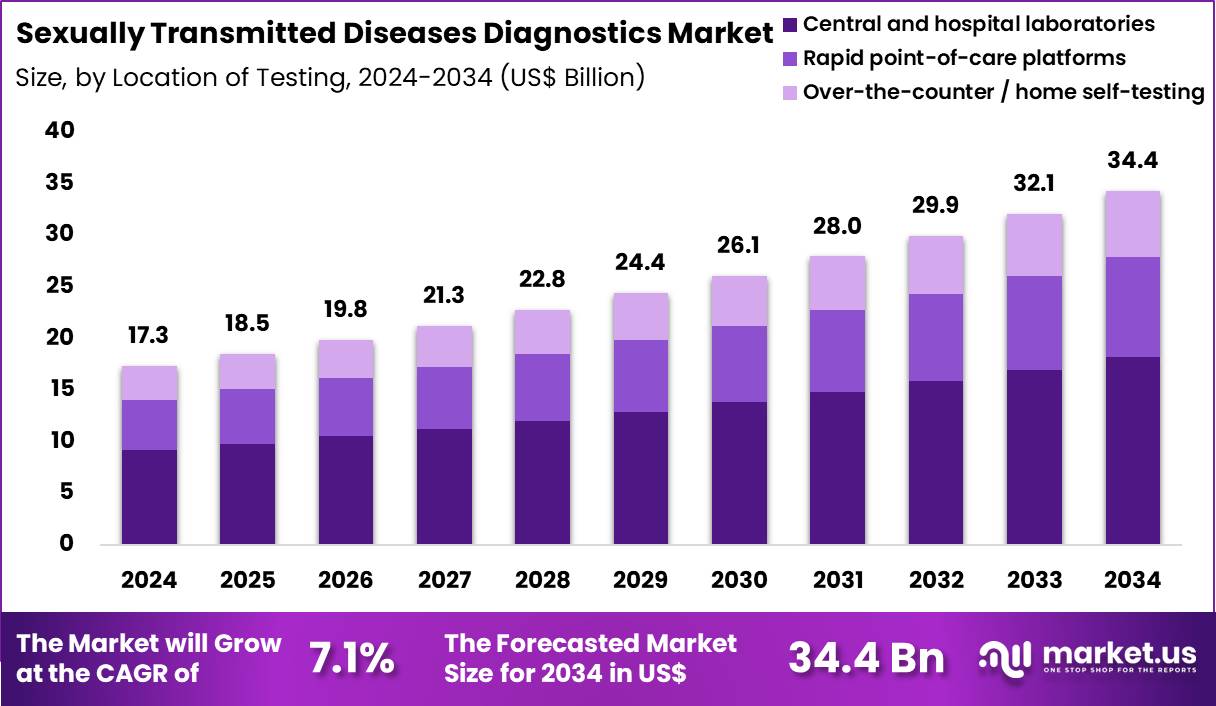
Key Takeaways
- In 2024, the Sexually Transmitted Diseases Diagnostics Market generated revenue of US$ 17.3 billion and is projected to reach US$ 34.4 billion by 2034, expanding at a CAGR of 7.1% during the forecast period.
- By test type, the market is segmented into syphilis testing, HIV testing, HPV testing, HSV testing, and others. Among these, syphilis testing dominated the market in 2024, accounting for a 34.6% market share.
- Based on technology, the market is categorized into immunoassay-based methods, biosensor/microfluidics, molecular diagnostics, and next-generation sequencing. Immunoassay-based methods held the leading position in 2024, representing 41.8% of the market.
- By location of testing, the market is segmented into central & hospital laboratories, over-the-counter/home self-testing, and rapid point-of-care platforms. Central & hospital laboratories dominated the segment, capturing the largest revenue share of 52.9% in 2024.
- Based on end user, the market is divided into hospitals & clinics, home care/OTC users, and diagnostic laboratories. Hospitals & clinics accounted for the largest share, generating 56.1% of the total market revenue in 2024.
- North America held the leading position in the global market in 2024, accounting for a significant 40.5% market share, supported by established healthcare infrastructure, widespread diagnostic testing, and increasing STI screening initiatives.
Market Segmentation Overview
- Test Type Analysis: Syphilis testing, accounting for 34.6% of the market, is expected to remain dominant due to rising syphilis infections and increasing screening initiatives. Mandatory prenatal screening, growing awareness, and early diagnosis requirements are supporting demand. Rapid immunochromatographic tests also enable faster point-of-care detection, particularly among high-risk populations and in regions with elevated infection rates.
- Technology Analysis: Immunoassay-based methods, holding 41.8% of the market, are projected to maintain leadership because of their suitability for high-volume STD screening. Hospitals and diagnostic laboratories favor immunoassays for efficient workflows, strong sensitivity, and broad test availability. Automation, cost efficiency, and expanded applications across HIV, syphilis, and other infections further strengthen technology adoption.
- Location of Testing Analysis: Central and hospital laboratories, representing 52.9% of the market, are expected to maintain dominance because they provide comprehensive testing and confirmatory diagnosis. These facilities support government screening programs, disease surveillance, and complex clinical cases. Increasing laboratory automation, improved turnaround times, and growing demand for accurate testing further strengthen their role in STD diagnostics.
- End-User Analysis: Hospitals and clinics, accounting for 56.1% of the market, are projected to remain the leading end-user segment. Patients commonly seek professional evaluation, diagnosis, counseling, and treatment through clinical facilities. Antenatal screening, pre-surgical testing, and rising sexual-health awareness increase diagnostic volumes, while automated testing platforms improve efficiency and accuracy in hospital settings.
Statistical Information
- Herpes Affects Thirteen Per cent Of Adults Aged Fifteen To Forty-Nine: An estimated 520 million people, or 13% of people aged 15–49 globally, have herpes simplex virus type 2 (HSV-2), the main cause of genital herpes. WHO also estimates that 846 million people aged 15–49, or more than 1 in 5, have genital herpes caused by either HSV-2 or HSV-1. These figures demonstrate the scale of demand for accurate sexual-health assessment, confirmatory testing where clinically appropriate, counselling, and prevention services.
- Syphilis Affected Eight Million Adults In Twenty Twenty Two: WHO estimates that 8 million adults aged 15–49 acquired syphilis in 2022. In 2022, there were an estimated 1.1 million maternal syphilis infections, contributing to 523 congenital syphilis cases per 100,000 live births. This supports the importance of early screening, particularly in pregnancy, along with reliable testing access and rapid connection to treatment.
- Reported US STI Cases Exceeded Two Million In Twenty Twenty Four: The United States reported more than 2.2 million cases of chlamydia, gonorrhoea, and syphilis in 2024. This total was 9% lower than in 2023, but the combined reported case burden remained 13% higher than a decade earlier. By infection, reported chlamydia cases fell 8%, gonorrhoea 10%, and primary and secondary syphilis 22% versus 2023.
- Congenital Syphilis Reached Nearly Four Thousand Reported Cases: Nearly 4,000 congenital syphilis cases were reported in the United States in 2024, a 2% increase from 2023. This was the 12th consecutive annual increase, and the reported level was approximately 700% higher than a decade earlier. The statistic underlines the diagnostic priority of syphilis screening during pregnancy and timely follow-up of positive results.
- Only One In Five Sexually Active High School Students Reported Recent Testing: In the 2019 US Youth Risk Behaviour Survey, only 20.4% of sexually active high-school students said they had been tested for an STI in the previous 12 months. Testing was reported by 26.1% of female students versus 13.7% of male students, a 12.4-percentage-point gap. This illustrates an important consumer-behaviour barrier: many adolescents who may benefit from testing do not report annual testing
- Testing Increases With Age Among Female High School Students: Among sexually active female high-school students, past-year STI-testing uptake rose from 12.6% at age 15 or younger to 22.8% at age 16, 28.5% at age 17, and 36.9% among those aged 18 or older. Even in the oldest group, nearly 63.1% did not report testing during the previous year. This trend suggests that awareness, autonomy, access, or perceived risk may increase testing with age, while substantial unmet testing need remains.
- Many Men Who Have Sex With Men Do Not Receive Recommended Testing: A large US national survey found that only 42% of sexually active men who have sex with men reported receiving any STI test in the preceding 12 months. Only 16% reported receiving any extragenital test, despite the importance of throat and rectal testing based on exposure. Among people who received extragenital screening, 87% received throat swabs and 82% received rectal swabs.
- Sexual Health Clinics Remain the Primary Testing Location: Between 2010 and 2018, 64.8% of sexually experienced US adolescents and young adults received their most recent STI test in a private doctor’s office. Among females aged 15–24 attending selected STI clinics, chlamydia screening coverage rose from 88.6% in 2010 to 90.6% in 2018. However, the number tested declined from 14,249 to 4,507, a decrease of approximately 68%, because fewer young women attended those clinics.
- Global Syphilis Infections Increased By Nearly One Million: WHO estimates that new syphilis infections among adults aged 15–49 increased from 7.1 million in 2020 to 8.0 million in 2022, an increase of approximately 900,000 cases, or 12.7%. Active syphilis prevalence in 2022 was estimated at 0.6% in both women and men aged 15–49.
- Women Accounted For Nearly Two-Thirds Of Curable STI Infections: Women accounted for approximately 64% of the estimated 374 million annual new infections from chlamydia, gonorrhoea, syphilis, and trichomoniasis among people aged 15–49. That equates to roughly 239 million infections in women, compared with approximately 135 million in men. This burden supports diagnostic access designed around women’s health, reproductive health, antenatal care, and confidential community testing.
Regional Analysis
North America led the market by securing a market share of 40.5% in 2024.
North America remains a major region for sexually transmitted diseases diagnostics, supported by advanced healthcare infrastructure, established screening programs, and growing demand for early detection.
In the United States, more than 2.5 million cases of chlamydia, gonorrhea, and syphilis were reported in 2022, highlighting the continued need for diagnostic testing. Increasing use of rapid tests, laboratory diagnostics, and targeted screening among high-risk populations is strengthening regional demand.
Asia Pacific represents a significant opportunity for sexually transmitted diseases diagnostics due to its large population, improving healthcare access, and substantial STI burden. WHO estimated approximately 86 million new cases of four curable STIs chlamydia, gonorrhea, syphilis, and trichomoniasis in the Western Pacific Region in 2020.
Expanding public-health programs, rising awareness, improved laboratory infrastructure, and greater availability of rapid diagnostic technologies are supporting testing adoption. Increased access to affordable screening can further improve early detection and treatment across underserved communities.
Business Opportunities
The Sexually Transmitted Diseases Diagnostics Market offers significant business opportunities as the global STI burden increases demand for accessible, accurate, and rapid testing. WHO estimates that more than 1 million STIs are acquired daily worldwide, creating opportunities for diagnostic manufacturers to expand screening solutions. Rapid point-of-care platforms can address testing needs in community clinics and underserved locations, while multiplex technologies can enable detection of multiple infections from a single sample.
Home and self-testing also present opportunities, particularly for consumers seeking privacy and convenience. FDA-authorized HIV self-testing products demonstrate the growing availability of decentralized testing options in the United States. Partnerships with hospitals, laboratories, public-health organizations, and telehealth providers can support wider diagnostic deployment.
Companies can also develop affordable molecular and immunoassay platforms for high-volume screening. Increasing prenatal screening requirements create additional opportunities for syphilis and HIV testing solutions. Furthermore, digital connectivity, automated reporting, and data integration can strengthen disease surveillance and improve diagnostic workflows.
Emerging Trends
- Multiplex STI Testing: Multiplex diagnostic platforms are gaining attention because they can identify multiple infections from one testing encounter. WHO prequalified the first triple rapid diagnostic test for HIV, hepatitis B, and syphilis in 2025, supporting integrated screening and simpler testing workflows.
- Rapid Point-of-Care Diagnostics: Rapid testing is becoming increasingly important for STI management because results can be available during the same healthcare visit. WHO recommends dual HIV/syphilis rapid diagnostic tests for antenatal screening, helping healthcare providers identify 2 infections quickly.
- At-Home Self-Testing: Home-based testing is expanding as consumers seek greater privacy and convenience. In 2025, FDA approved the INSTI HIV Self Test for over-the-counter use among adults aged 18 years and older, providing another decentralized option for HIV screening.
- Frequent Screening Programs: Regular screening is increasingly emphasized for populations with higher STI risks. CDC recommends sexually active MSM receive screening at least annually, while people at increased risk may benefit from testing every 3–6 months.
- Integrated STI Screening: Integrated screening is becoming an important approach for improving disease detection, particularly during pregnancy. WHO supports testing for HIV, syphilis, and hepatitis B during antenatal care, helping healthcare systems identify multiple infections and support timely treatment.
Use Cases
- Antenatal Screening: STI diagnostics are widely used during pregnancy to identify infections that can affect mothers and newborns. WHO recommends testing for HIV, syphilis, and hepatitis B during pregnancy, supporting early treatment and helping reduce mother-to-child transmission and related complications.
- High-Risk Population Screening: Diagnostic testing is used for populations with higher STI exposure risks. CDC recommends sexually active MSM receive screening at least annually, while individuals with increased risk may require testing every 3–6 months for timely infection detection.
- Point-of-Care Testing: Rapid STI diagnostics are used in community clinics, sexual-health centers, and other decentralized settings where laboratory access may be limited. WHO supports dual HIV/syphilis rapid testing, allowing 2 infections to be screened during one testing encounter.
- Home-Based Testing: Self-testing provides consumers with a private and convenient way to check their health without visiting a healthcare facility. FDA approved the INSTI HIV Self Test in 2025 for OTC use by adults aged 18 years and older.
- Disease Surveillance: STI diagnostics support public-health surveillance by identifying infections and providing information for monitoring transmission patterns. In the United States, more than 2.5 million cases of chlamydia, gonorrhea, and syphilis were reported in 2022, demonstrating the importance of continuous testing.
Recent Development
- In 2026, Abbott Laboratories continued advancing HIV diagnostics through its testing portfolio, with assays designed to detect HIV antigens and antibodies earlier. Abbott notes that combined antigen-antibody testing can identify HIV infection up to 20 days earlier than antibody-only testing, supporting earlier diagnosis and treatment.
- In 2026, Roche Diagnostics expanded its point-of-care STI testing portfolio with cobas liat CT/NG and CT/NG/MG assays. The PCR-based tests can provide results in approximately 20 minutes, helping healthcare providers make faster treatment decisions for chlamydia, gonorrhea, and Mycoplasma genitalium.
- In 2026, Hologic, Inc. highlighted new findings from its Global Women’s Health Index showing that only 10% of women surveyed reported receiving an STI test during the previous year. The company emphasized routine screening and its molecular diagnostic portfolio for improving sexual and vaginal health testing.
- In 2026, Becton, Dickinson & Co. continued offering molecular STI testing through its BD MAX platform, including assays capable of detecting 2 or 3 infections from a single specimen. The BD CTGCTV2 assay detects chlamydia, gonorrhea, and trichomoniasis in one test.
- In 2026, QuidelOrtho Corporation continued supporting syphilis screening through its diagnostic portfolio, including the VITROS Syphilis Assay. The solution is designed to support laboratory detection of syphilis and can contribute to screening approaches recommended for populations including pregnant women.
- In 2026, Cepheid (Danaher Corporation) continued expanding its GeneXpert molecular testing approach for sexual health, supporting detection of infections including chlamydia, gonorrhea, and trichomoniasis. Its molecular platforms are designed to provide rapid diagnostic information to support timely clinical decisions.
Frequently Asked Questions About Sexually Transmitted Diseases Diagnostics
- What is driving the Sexually Transmitted Diseases Diagnostics Market?
Rising STI infections, increasing screening programs, greater sexual-health awareness, improved diagnostic technologies, and demand for early detection are driving market development. Rapid, molecular, multiplex, and decentralized testing are also improving diagnostic accessibility. - Which region leads the market?
North America led the global market with a reported 40.5% share in 2024. Advanced healthcare infrastructure, established screening programs, molecular diagnostic adoption, and increased STI awareness are supporting demand for diagnostic solutions across the region. - Why is syphilis testing important?
Syphilis testing is important because WHO estimated approximately 8 million new syphilis infections among adults aged 15–49 years in 2022. Early diagnosis enables treatment and helps reduce complications, transmission, and mother-to-child infection. - What role do rapid diagnostic tests play?
Rapid diagnostic tests provide results quickly and support testing during healthcare visits. WHO supports dual HIV/syphilis rapid testing, particularly during antenatal care, helping healthcare providers screen for two infections through an integrated testing approach. - Is home-based STI testing becoming more important?
Yes. Home-based testing is gaining attention because it provides greater privacy and convenience. In 2025, FDA approved the INSTI HIV Self Test for over-the-counter use among adults aged 18 years and older. - What are the major trends in STI diagnostics?
Major trends include multiplex testing, rapid point-of-care platforms, molecular diagnostics, home testing, self-collection, laboratory automation, and integrated screening. These developments aim to make STI diagnosis faster, more accessible, convenient, and efficient. - What are the major opportunities in the market?
Major opportunities include affordable rapid tests, multiplex platforms, home-testing solutions, molecular diagnostic systems, and connected technologies. Partnerships with hospitals, laboratories, public-health organizations, and telehealth providers can further expand access to sexually transmitted disease diagnostics. - What is the future outlook for the market?
The market is expected to expand as STI screening, infection burdens, technological innovation, and decentralized testing increase. Multiplex diagnostics, rapid molecular platforms, self-testing, integrated screening, and point-of-care solutions are expected to remain important development areas.
Conclusion
The Sexually Transmitted Diseases Diagnostics Market is positioned for continued growth, supported by rising STI prevalence, increasing screening awareness, and advances in diagnostic technologies. The market is projected to grow from US$17.3 billion in 2024 to US$34.4 billion by 2034, at a 7.1% CAGR. Syphilis testing, immunoassay-based methods, central and hospital laboratories, and hospitals and clinics remain leading segments.
North America holds a significant market position, while Asia Pacific offers strong future opportunities. Rapid point-of-care testing, multiplex diagnostics, molecular platforms, and home-based testing are emerging trends. Leading companies are focusing on faster, accessible, and integrated diagnostic solutions to improve early detection and treatment.
Discuss your needs with our analyst
Please share your requirements with more details so our analyst can check if they can solve your problem(s)




