


Overview
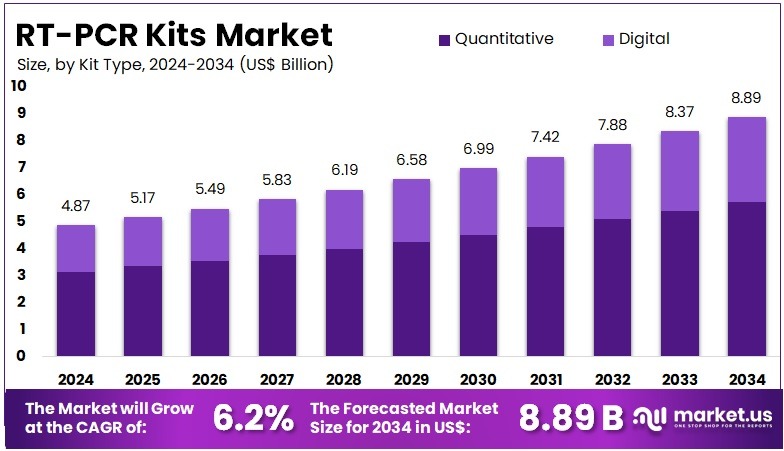
New York, NY – Sep 02, 2026 – The RT-PCR Kits Market Size is expected to be worth around US$ 8.89 Billion by 2034 from US$ 4.87 Billion in 2024, growing at a CAGR of 6.2% during the forecast period 2025 to 2034. In 2024, North America held a dominant market position, capturing more than a 41.20% share and holds US$ 2.01 Billion market value for the year.
The RT-PCR Kits Market is witnessing steady growth due to increasing demand for rapid molecular diagnostics, infectious disease testing, and advanced genetic analysis. Reverse Transcription Polymerase Chain Reaction (RT-PCR) kits are widely used for detecting RNA-based pathogens by converting RNA into complementary DNA (cDNA) and amplifying target genetic sequences with high accuracy. These kits remain a critical tool in clinical laboratories, research institutes, and public health testing programs.
The market growth is supported by the rising prevalence of respiratory infections, the expansion of molecular diagnostic infrastructure, and the increasing adoption of precision medicine. According to global health surveillance programs, respiratory viruses continue to contribute significantly to diagnostic testing volumes, creating sustained demand for RT-PCR technologies. The growing use of multiplex RT-PCR kits, which can detect multiple pathogens in a single test, is further improving testing efficiency.
Technological advancements have enhanced RT-PCR kit performance through improved sensitivity, faster turnaround times, and compatibility with automated laboratory platforms. In 2025, many diagnostic manufacturers focused on developing next-generation molecular assays with simplified workflows and improved scalability for hospitals and diagnostic centers.
The increasing investment in biotechnology research is also supporting market expansion. Global biotechnology and life science companies are strengthening their molecular diagnostic portfolios through product launches, partnerships, and laboratory automation solutions.
With rising healthcare spending and growing demand for accurate disease detection, the RT-PCR Kits Market is expected to maintain strong growth momentum, driven by applications in infectious disease diagnostics, oncology research, and genomic testing.
Key Takeaways
- In 2024, the market was valued at US$ 8.7 billion and is projected to reach US$ 8.89 billion by 2034, expanding at a CAGR of 6.2% during the forecast period.
- By Kit Type, the market is segmented into Quantitative and Digital kits. The Quantitative segment dominated in 2024, accounting for 64.7% of the total market share
- By Application, the market is categorized into Infectious Diseases Testing, Oncology Testing, Human Genetic Testing, Blood Screening, Forensic Applications, and Others. Among these, Infectious Diseases Testing held the largest share at 42.3% in 2024.
- By End User, the market is segmented into Hospitals and Diagnostic Centres, Stand-alone Diagnostic Laboratories, Research Laboratories, and Pharmaceutical & Biotechnology Companies. Hospitals and Diagnostic Centres emerged as the leading segment, capturing 48.3% of the market in 2024.
- North America dominated the global market in 2024, holding the largest regional market share of 41.2%.
Market segmentation
- Kit Type Analysis: Quantitative RT-PCR kits dominated the market with a 64.7% share in 2024 due to their high sensitivity, accurate nucleic acid quantification, and broad clinical applications. They are extensively used for infectious disease diagnosis, oncology testing, viral load monitoring, and genetic research, while automation compatibility and regulatory support further strengthen market leadership.
- Application Analysis: Infectious disease testing accounted for the largest application segment, capturing 42.3% of the market in 2024. RT-PCR is widely used to detect respiratory and viral infections with high accuracy. Growing adoption in oncology for mutation detection, tumor profiling, companion diagnostics, and personalized treatment decisions further supported segment expansion globally.
- End-User Analysis: Hospitals and diagnostic centres held the largest market share of 48.3% in 2024, driven by high patient volumes and routine RT-PCR testing for infectious diseases and cancer diagnostics. Reference laboratories supported large-scale screening, while research institutions expanded demand through molecular biology studies, biomarker discovery, and gene expression research.
Statistical Information
- Roche LightCycler® PRO supports 7-channel multiplexing, allowing laboratories to perform up to 7 fluorescence detection channels in a single run, increasing multiplex assay capability and laboratory efficiency.
- Roche LightCycler® PRO offers heating rates of 4.4°C/second (96-well block) and 4.8°C/second (384-well block), enabling faster thermal cycling and improved workflow efficiency for RT-PCR testing.
- Roche LightCycler® PRO supports reaction volumes ranging from 5–20 μL (384-well format) and 10–100 μL (96-well format), providing flexibility for both research and clinical molecular diagnostics.
- A 2025 peer-reviewed evaluation of the DiaRD HCV RNA RT-qPCR kit demonstrated quantitative performance across clinical samples, validating its use for HCV RNA measurement in diagnostic laboratories. The study reported numerical analytical performance supporting clinical implementation.
- Bio-Rad’s iTaq Universal One-Step RT-qPCR Kit detects as few as 10 target copies in duplex reactions, demonstrating high analytical sensitivity for low-copy RNA detection.
- Bio-Rad’s iTaq Universal One-Step RT-qPCR Kit accepts sample inputs ranging from 100 femtograms to 100 nanograms, supporting a broad range of RNA concentrations without changing workflow.
- A 2025 multiplex RT-PCR assay published in the Journal of Virological Methods was designed to identify 13 upper respiratory pathogens in a single assay, demonstrating expanded multiplex detection capability for respiratory diagnostics.
- India’s 2025 ICMR–CDSCO draft evaluation protocol for multiplex respiratory RT-PCR kits specifies performance evaluation against 9 major respiratory virus groups, providing standardized numerical requirements for kit validation in India.
Regional Analysis
North America dominated the RT-PCR Kits market in 2024 due to its well-established molecular diagnostics infrastructure, strong reimbursement systems, and extensive adoption of RT-PCR across hospitals, public health laboratories, and research institutions.
The United States continues to rely on RT-PCR as the preferred nucleic acid amplification method for diagnosing influenza, COVID-19, RSV, and other respiratory infections because of its high sensitivity and specificity.
Federal organizations including the CDC and FDA support the use of validated molecular assays, while leading manufacturers such as Thermo Fisher Scientific, Abbott, Bio-Rad Laboratories, and Roche maintain strong manufacturing, innovation, and distribution capabilities across the region.
Asia Pacific is projected to register the fastest growth, driven by expanding healthcare infrastructure, increasing investments in molecular diagnostics, and strengthening infectious disease surveillance programs. Countries including China, India, Japan, and South Korea are expanding laboratory capacity and integrating RT-PCR into routine clinical diagnostics, oncology testing, and public health monitoring.
Growing biotechnology research, government support for diagnostic modernization, and increasing availability of locally manufactured RT-PCR kits are further accelerating regional adoption.
Business opportunities
The RT-PCR Kits market offers significant business opportunities as demand for accurate molecular diagnostics continues to expand across clinical, research, and public health applications. Growing adoption of multiplex RT-PCR kits, which can detect multiple pathogens in a single test, is improving laboratory efficiency and creating opportunities for product innovation. The increasing use of RT-PCR in precision oncology, companion diagnostics, and genetic testing is further expanding its clinical value.
Rising investments in healthcare infrastructure and laboratory modernization across emerging economies are driving demand for affordable and automated RT-PCR solutions. In addition, pharmaceutical and biotechnology companies are increasing the use of RT-PCR for vaccine development, gene expression analysis, biomarker research, and clinical trials.
Opportunities are also emerging through portable point-of-care RT-PCR platforms, laboratory automation, AI-enabled workflow integration, and government-supported infectious disease surveillance programs. Continuous monitoring of respiratory viruses, antimicrobial resistance, and newly emerging pathogens is expected to sustain long-term demand for advanced RT-PCR kits worldwide.
Emerging Trends
- Multiplex RT-PCR testing is becoming the standard for respiratory disease diagnosis: The CDC’s Flu SC2 Multiplex Assay simultaneously detects influenza A, influenza B, and SARS-CoV-2 in a single RT-PCR test, helping laboratories conserve testing materials and process more samples efficiently.
- High-plex RT-PCR instruments are improving molecular testing capacity: Roche’s LightCycler PRO platform supports 7 fluorescence detection channels and 384-well throughput, enabling laboratories to perform more multiplex assays while increasing workflow flexibility and reducing turnaround time for complex diagnostics.
- Laboratories are adopting faster thermal cycling technology: Modern RT-PCR systems now achieve heating rates of 4.8°C per second, allowing quicker amplification cycles and higher daily sample processing without compromising analytical performance in clinical molecular laboratories.
- Respiratory pathogen panels are expanding beyond single-virus detection: A 2025 peer-reviewed study developed a multiplex RT-PCR assay capable of detecting 13 respiratory pathogens in one reaction, supporting comprehensive diagnosis during seasonal outbreaks and improving laboratory efficiency.
- Governments are strengthening standardized RT-PCR evaluation: India’s 2025 ICMR-CDSCO draft protocol introduced performance evaluation requirements covering 9 respiratory virus groups, promoting consistent validation of multiplex RT-PCR kits before wider clinical adoption.
Use Cases
- National influenza and COVID-19 surveillance programs: increasing use of multiplex RT-PCR kits that identify three viruses (influenza A, influenza B, and SARS-CoV-2) from a single patient sample, supporting faster outbreak monitoring and more efficient use of laboratory resources.
- Clinical oncology laboratories: use quantitative RT-PCR to measure gene expression and detect low-level genetic abnormalities with highly sensitive workflows. Modern RT-PCR platforms support 5–100 µL reaction volumes, enabling flexible testing across research and diagnostic applications.
- Public health laboratories: use high-throughput RT-PCR platforms equipped with 96-well and 384-well blocks to process large testing volumes during infectious disease surveillance, improving operational efficiency while maintaining standardized molecular diagnostic performance.
- Biopharmaceutical companies: employ RT-PCR throughout vaccine development and biologics manufacturing for RNA quantification, biomarker validation, and quality control. Modern platforms supporting 7-color multiplex detection enable simultaneous analysis of multiple molecular targets in a single assay.
- Hospital molecular diagnostics: Laboratories increasingly implement syndromic respiratory testing using RT-PCR assays capable of identifying 13 pathogens in one analysis, enabling clinicians to distinguish infections quickly and support appropriate treatment decisions during respiratory disease seasons.
Recent development
- February 2025 – Thermo Fisher Scientific announced the acquisition of Solventum’s Purification & Filtration business for approximately US$4.1 billion, strengthening its bioprocessing and life sciences portfolio that supports molecular diagnostics and RT-PCR workflows.
- 2025 – QIAGEN expanded its molecular diagnostics portfolio by promoting the QIAcuityDx digital PCR system, designed for IVD applications to improve automated nucleic acid detection and quantification in clinical laboratories, complementing PCR-based diagnostic workflows
- November 2025 – Roche Diagnostics continued the global rollout of its LightCycler PRO System, a next-generation real-time PCR platform featuring improved automation, multiplexing capability, and workflow efficiency for molecular diagnostic laboratories.
Frequently Asked Questions on RT-PCR Kits
- What is driving the growth of the RT-PCR Kits Market?
The RT-PCR Kits Market is growing due to the increasing prevalence of infectious diseases, expanding cancer diagnostics, and rising demand for molecular testing. Governments and healthcare providers are investing in laboratory infrastructure, while biotechnology research and personalized medicine continue to increase the use of RT-PCR technologies worldwide. - Which industries are the largest users of RT-PCR kits?
Hospitals, diagnostic laboratories, pharmaceutical companies, biotechnology firms, academic institutions, and public health agencies are the primary users of RT-PCR kits. These organizations rely on RT-PCR for disease diagnosis, gene expression studies, biomarker discovery, drug development, and infectious disease surveillance programs. - What role do RT-PCR kits play in infectious disease testing?
RT-PCR kits are considered the gold standard for detecting many viral and bacterial infections because they identify genetic material with high accuracy. They support early diagnosis, outbreak monitoring, disease surveillance, and treatment decisions for infections such as influenza, RSV, hepatitis, and emerging respiratory diseases. - What technological trends are shaping the RT-PCR Kits Market?
The market is witnessing growing adoption of multiplex assays, automated sample preparation, digital PCR integration, high-throughput testing platforms, and AI-supported laboratory workflows. These innovations improve testing efficiency, reduce turnaround time, and enable laboratories to process larger sample volumes with greater accuracy. - Which region currently leads the RT-PCR Kits Market?
North America currently leads the RT-PCR Kits Market due to its advanced healthcare infrastructure, strong molecular diagnostics capabilities, extensive laboratory networks, and significant investments in biotechnology research. The region also benefits from leading manufacturers and widespread adoption of RT-PCR across clinical and research applications. - What is the future outlook for the RT-PCR Kits Market?
The RT-PCR Kits Market is expected to benefit from expanding molecular diagnostics, increasing infectious disease surveillance, growing precision medicine, and rising investments in biotechnology research. Continued innovation in multiplex testing, automation, and portable RT-PCR systems is likely to support sustained long-term market growth.
Conclusion
The RT-PCR Kits Market continues to play a critical role in modern molecular diagnostics by supporting accurate detection of infectious diseases, oncology biomarkers, and genetic disorders. Growing demand for high-sensitivity testing, laboratory automation, and multiplex PCR technologies is driving continuous product innovation among leading manufacturers.
Expanding applications in personalized medicine, pharmaceutical research, and public health surveillance further strengthen market potential. North America remains the leading regional market, while Asia-Pacific is experiencing rapid adoption due to improving healthcare infrastructure and diagnostic capacity. Strategic investments in advanced RT-PCR platforms, workflow automation, and research collaborations are expected to sustain long-term market growth and technological advancement.
Discuss your needs with our analyst
Please share your requirements with more details so our analyst can check if they can solve your problem(s)




