


Overview
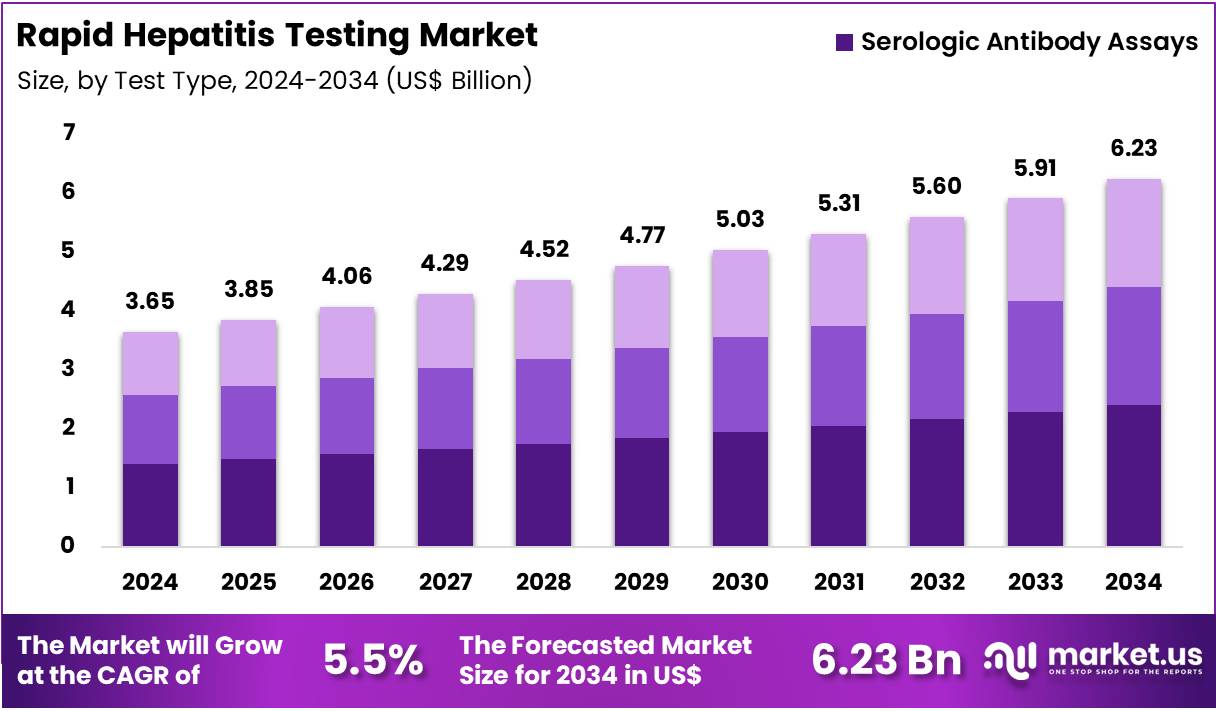
New York, NY – Sep 02, 2026 – Global Rapid Hepatitis Testing Market size is expected to be worth around US$ 6.23 Billion by 2034 from US$ 3.65 Billion in 2024, growing at a CAGR of 5.5% during the forecast period 2025 to 2034. In 2024, North America led the market, achieving over 36.7% share with a revenue of US$ 1.34 billion.
The global Rapid Hepatitis Testing Market is witnessing steady growth as healthcare systems increasingly prioritize early diagnosis and timely treatment of hepatitis infections. Rapid hepatitis tests provide results within 15–30 minutes, enabling healthcare professionals to make faster clinical decisions and improve patient management. These tests are widely used for detecting hepatitis B (HBV) and hepatitis C (HCV) infections in hospitals, diagnostic laboratories, blood banks, community health centers, and point-of-care settings.
According to the World Health Organization (WHO), an estimated 304 million people were living with chronic hepatitis B or C globally in 2022, while approximately 1.3 million deaths occurred due to hepatitis-related liver disease and liver cancer each year.
The WHO also estimates that 2.2 million new hepatitis infections occur annually, highlighting the need for expanded screening programs. Growing government initiatives aimed at achieving the WHO target of eliminating viral hepatitis as a public health threat by 2030 are increasing the adoption of rapid diagnostic technologies.
Technological advancements, including lateral flow immunoassays, multiplex rapid tests, and digital point-of-care platforms, are improving testing accuracy and accessibility. Increased screening of pregnant women, blood donors, high-risk populations, and patients with liver disease is further supporting market expansion.
North America currently leads the market due to advanced healthcare infrastructure and high testing awareness, while Asia-Pacific is expected to register strong growth because of its large patient population, improving healthcare access, and expanding public health screening initiatives.
Key Takeaways
- In 2024, the Rapid Hepatitis Testing Market generated revenue of US$65 billion and is projected to grow at a CAGR of 5.5%, reaching approximately US$6.23 billion by 2034.
- The Test Type segment includes Serologic Antibody Assays, Molecular HCV RNA Tests, and Immunoassays for HCV Core Antigen. Among these, Serologic Antibody Assays dominated the market in 2024, accounting for a 38.6% share due to their widespread use in hepatitis screening and diagnosis.
- The Indication segment is categorized into Hepatitis A, Hepatitis B, and Hepatitis C. Hepatitis C emerged as the leading segment in 2024, capturing a 44.9% market share, driven by increasing screening initiatives and demand for early detection.
- The Application segment is classified into Infectious Diseases, Sexually Transmitted Infections, and Others. Infectious Diseases held the largest market share in 2024, accounting for 79.5%, supported by the growing need for rapid viral infection diagnosis.
- The End-User segment is divided into Hospital Pharmacies, Retail Pharmacies, and Online Pharmacies. Hospital Pharmacies led the market in 2024 with a 55.2% share, supported by higher adoption of diagnostic services in clinical settings.
- North America dominated the Rapid Hepatitis Testing Market in 2024, accounting for a 36.7% share, attributed to advanced healthcare infrastructure, increased hepatitis screening programs, and strong adoption of rapid diagnostic technologies.
Market segmentation
- Test Type Analysis: Serologic Antibody Assays lead the Rapid Hepatitis Testing Market due to their extensive use in initial hepatitis screening. These tests offer quick results, low costs, simple operation, and suitability for large-scale programs, blood screening, maternal care, and community-based testing initiatives.
- Indication Analysis: Hepatitis C holds a leading market position due to increasing screening programs, availability of effective antiviral treatments, and global elimination efforts. Rapid anti-HCV tests support early identification, especially among high-risk groups, enabling faster confirmation, treatment access, and improved disease management outcomes.
- Distribution Channel Analysis: Hospital Pharmacies dominate the distribution channel due to their important role in providing rapid hepatitis tests for emergency care, inpatient screening, antenatal testing, and surgical assessments. Strong healthcare infrastructure, trained professionals, and government programs support their continued market leadership.
Statistical Information
- WHO prequalified hepatitis C rapid diagnostic tests demonstrate ≥99% specificity performance for anti-HCV antibody detection, supporting reliable screening applications in decentralized healthcare settings.
- WHO hepatitis C testing guidance indicates that anti-HCV antibody rapid diagnostic tests can provide screening results within approximately 20–30 minutes, enabling same-visit testing and linkage to care.
- WHO recommends that countries work toward testing 90% of people living with hepatitis C and treating 80% of eligible infected individuals as part of global elimination targets, increasing demand for rapid screening approaches.
- Hepatitis B surface antigen (HBsAg) rapid diagnostic tests evaluated by WHO programs commonly demonstrate sensitivity above 90% and specificity above 95% for screening applications.
- WHO reports that simplified hepatitis C testing algorithms using rapid diagnostic tests can reduce the number of required healthcare visits from multiple appointments to a single testing and linkage visit.
- CDC recommends hepatitis C screening with a one-time test for all adults aged 18 years and older, creating a large operational need for accessible rapid testing services.
- WHO reported that approximately 254 million people were living with chronic hepatitis B infection globally in 2022, highlighting the operational need for expanded HBV rapid testing programs.
Regional Analysis
North America Leads the Rapid Hepatitis Testing Market
North America holds a leading position in the rapid hepatitis testing market due to well-established healthcare infrastructure, widespread diagnostic accessibility, and strong public health screening programs. The region benefits from advanced laboratory networks, high adoption of point-of-care testing, and government-supported hepatitis elimination initiatives.
In the United States, the CDC recommends universal hepatitis B screening during pregnancy and hepatitis C screening for all adults, supporting increased demand for rapid diagnostic solutions. Hospitals, blood banks, correctional facilities, and community healthcare centers widely use rapid hepatitis tests for early detection and prevention programs.
Asia Pacific Expected to Register the Fastest Growth
Asia Pacific is projected to witness significant growth due to the high burden of hepatitis infections, expanding healthcare access, and increasing government efforts toward viral hepatitis elimination.
Countries including India, China, and Indonesia are strengthening screening programs through primary healthcare centers, mobile clinics, and community-based testing initiatives. Rising awareness and adoption of affordable rapid diagnostic technologies are further supporting regional expansion.
Business Opportunities
The Rapid Hepatitis Testing Market offers significant business opportunities as healthcare systems increasingly prioritize early diagnosis and decentralized infectious disease screening. Growing government-led hepatitis elimination programs, expanding point-of-care testing, and increasing investments in public health infrastructure are driving demand for rapid diagnostic solutions.
Manufacturers have strong opportunities to develop affordable, easy-to-use testing kits for hospitals, community clinics, pharmacies, blood banks, and home healthcare settings. Technological advancements such as multiplex assays capable of detecting hepatitis B, hepatitis C, and other infectious diseases from a single sample are creating new avenues for product innovation.
Emerging markets across Asia-Pacific, Africa, and Latin America present substantial growth potential due to expanding healthcare access and rising screening initiatives. In addition, integrating rapid tests with digital health platforms, electronic medical records, and telemedicine services can improve disease surveillance and patient management.
Strategic partnerships with governments, international health organizations, and local distributors, along with investments in regional manufacturing and supply chain capabilities, are expected to further strengthen market expansion and create long-term commercial opportunities.
Emerging Trends
- Multiplex rapid testing is gaining momentum: In July 2025, the WHO prequalified the first rapid diagnostic panel that simultaneously detects HIV, hepatitis B, and syphilis. This three-in-one test reduces testing time, simplifies antenatal screening, and improves access to early diagnosis in low-resource healthcare settings.
- Universal hepatitis screening is increasing the demand: The CDC’s 2025 guidance recommends hepatitis C screening for all adults aged 18 years and older and all pregnant women during every pregnancy, expanding routine use of rapid hepatitis tests in primary care and community screening programs.
- Greater focus on accessible rapid diagnostics: In 2025, the WHO released new accessibility guidance covering rapid diagnostic tests, including hepatitis B and C. The guidance promotes user-friendly designs for professional and self-testing, helping improve diagnostic access for people with disabilities and underserved populations.
- Simplified testing pathways are improving healthcare delivery: The 2026 WHO hepatitis implementation handbook recommends simplified hepatitis B and C testing strategies integrated with treatment services. These streamlined approaches reduce patient visits, improve linkage to care, and support national hepatitis elimination programs.
- Governments are strengthening hepatitis surveillance: The CDC 2025 Viral Hepatitis National Progress Report monitors 10 national performance indicators to track hepatitis infections and deaths. These measurable indicators are encouraging wider adoption of rapid diagnostic testing to improve surveillance and disease control.
Use Cases
- Antenatal screening for pregnant women: Rapid hepatitis B testing is increasingly used during prenatal care. Following WHO’s 2025 triple-test prequalification, healthcare providers can simultaneously screen for three infections—HIV, hepatitis B, and syphilis—during a single antenatal visit, improving maternal and newborn health outcomes.
- Community-based hepatitis screening programs: Rapid hepatitis tests support outreach programs, mobile clinics, and rural health campaigns because results are available in about 20–30 minutes, allowing healthcare workers to identify infected individuals and refer them for treatment during the same visit.
- Primary healthcare and physician offices: The CDC’s 2025 recommendations encourage routine hepatitis C testing for adults 18 years and older, making rapid diagnostic kits valuable in family practices, urgent care centers, and community health clinics where immediate screening is needed.
- Blood donation and infection prevention: Rapid hepatitis testing is widely used in blood collection centers to identify hepatitis B and C infections before transfusion. Fast screening supports safer blood supplies while reducing delays in donor processing and improving operational efficiency.
- National hepatitis elimination initiatives: Countries implementing WHO hepatitis elimination strategies increasingly rely on rapid testing to identify undiagnosed infections. The 2026 WHO implementation handbook supports integrating rapid diagnostics with treatment services, improving patient follow-up and expanding testing coverage in high-risk populations.
Recent development
- In February 2025, Danaher-owned Cepheid continued expanding access to its GeneXpert molecular testing platform through new infectious disease menu enhancements and global deployment initiatives, supporting broader decentralized testing capabilities, including hepatitis-related molecular diagnostics.
- In February 2025, Qiagen launched the QIAprep& Plasmodium Kit and expanded its infectious disease sample preparation portfolio, strengthening its molecular diagnostics capabilities that also support hepatitis testing workflows in clinical laboratories.
- In April 2026, QuidelOrtho Corporation completed the acquisition of LEX Diagnostics, adding an ultra-fast molecular point-of-care testing platform that strengthens its infectious disease diagnostics portfolio and complements rapid hepatitis testing applications
Frequently Asked Questions on Rapid Hepatitis Testing
- Which hepatitis infections can be detected using rapid tests?
Rapid hepatitis tests are commonly designed to detect hepatitis B surface antigen (HBsAg), hepatitis C antibodies (anti-HCV), and, in some cases, hepatitis A antibodies. These tests help healthcare professionals identify infections quickly and determine whether additional laboratory confirmation is required. - What factors are driving the Rapid Hepatitis Testing Market?
The market is expanding due to increasing hepatitis awareness, government-funded screening campaigns, rising blood donation testing, improved healthcare infrastructure, and growing demand for fast, affordable diagnostic tools. Technological advancements and point-of-care testing are also contributing to sustained market growth. - What are the advantages of rapid hepatitis testing?
Rapid hepatitis tests deliver results within minutes, require minimal equipment, are easy to use, and can be performed outside traditional laboratories. These benefits improve access to screening in rural areas, community health programs, emergency departments, and mobile healthcare clinics. - Who are the major end users in the Rapid Hepatitis Testing Market?
Hospitals, diagnostic laboratories, blood banks, community health centers, physician clinics, pharmacies, and public health agencies are the primary users of rapid hepatitis tests. These organizations rely on rapid diagnostics for early disease detection, infection prevention, and routine screening programs. - Which region leads the Rapid Hepatitis Testing Market?
North America leads the market due to strong healthcare infrastructure, high awareness of viral hepatitis, widespread screening programs, and advanced diagnostic technologies. Asia-Pacific is expected to experience rapid growth because of increasing healthcare investments and expanding hepatitis elimination initiatives. - How are new technologies improving rapid hepatitis testing?
Manufacturers are introducing multiplex assays, digital readers, smartphone-connected diagnostics, and improved lateral flow technologies. These innovations increase testing accuracy, simplify result interpretation, enhance workflow efficiency, and support faster clinical decision-making in both healthcare facilities and community settings.
Conclusion
The Rapid Hepatitis Testing Market is expected to experience steady growth as healthcare systems continue to prioritize early diagnosis, decentralized testing, and hepatitis elimination programs. Rising awareness of hepatitis B and C, expanding point-of-care testing, and increasing government screening initiatives are driving demand for rapid diagnostic solutions.
Technological advancements in immunoassays and molecular testing are improving accuracy, accessibility, and operational efficiency across hospitals, clinics, blood banks, and community healthcare settings.
With growing investments in public health infrastructure and stronger adoption of affordable diagnostic technologies, the market is well-positioned for sustained expansion, supporting improved patient outcomes and broader access to timely hepatitis screening worldwide.
Discuss your needs with our analyst
Please share your requirements with more details so our analyst can check if they can solve your problem(s)




