


Overview
New York, NY – Sep 09, 2026 – The Global Prostate-Specific Antigen Testing Market size is expected to be worth around US$ 19.7 Billion by 2034 from US$ 6.3 Billion in 2024, growing at a CAGR of 12.1% during the forecast period 2025 to 2034. In 2024, North America led the market, achieving over 42.1% share with a revenue of US$ 2.7 Billion.
Prostate-Specific Antigen (PSA) Testing is growing steadily due to the increasing prevalence of prostate cancer, rising awareness about early diagnosis, and growing demand for accurate biomarker-based testing. PSA tests are blood-based diagnostic tools used for prostate cancer screening, treatment monitoring, and detection of disease recurrence after therapy.
According to the World Health Organization, prostate cancer caused approximately 1.4 million new cases and more than 375,000 deaths globally in 2022, making it one of the most commonly diagnosed cancers among men. The rising aging male population is a major factor driving demand, as prostate cancer risk increases significantly after the age of 50 years, with most cases occurring among men aged 65 years and above.
The PSA Testing Market includes total PSA tests, free PSA tests, complexed PSA tests, and advanced PSA assays. Hospitals, diagnostic laboratories, and specialty clinics are increasingly adopting automated immunoassay platforms to improve testing efficiency and accuracy. In the United States, the American Cancer Society estimated around 299,010 new prostate cancer cases and 35,250 deaths in 2024.
North America remains a leading region due to advanced healthcare infrastructure, higher screening awareness, and widespread access to diagnostic services. Growing investments in personalized medicine, digital diagnostics, and improved PSA-based technologies are expected to create new growth opportunities. The increasing focus on early cancer detection and preventive healthcare will continue to support expansion of the PSA Testing Market worldwide.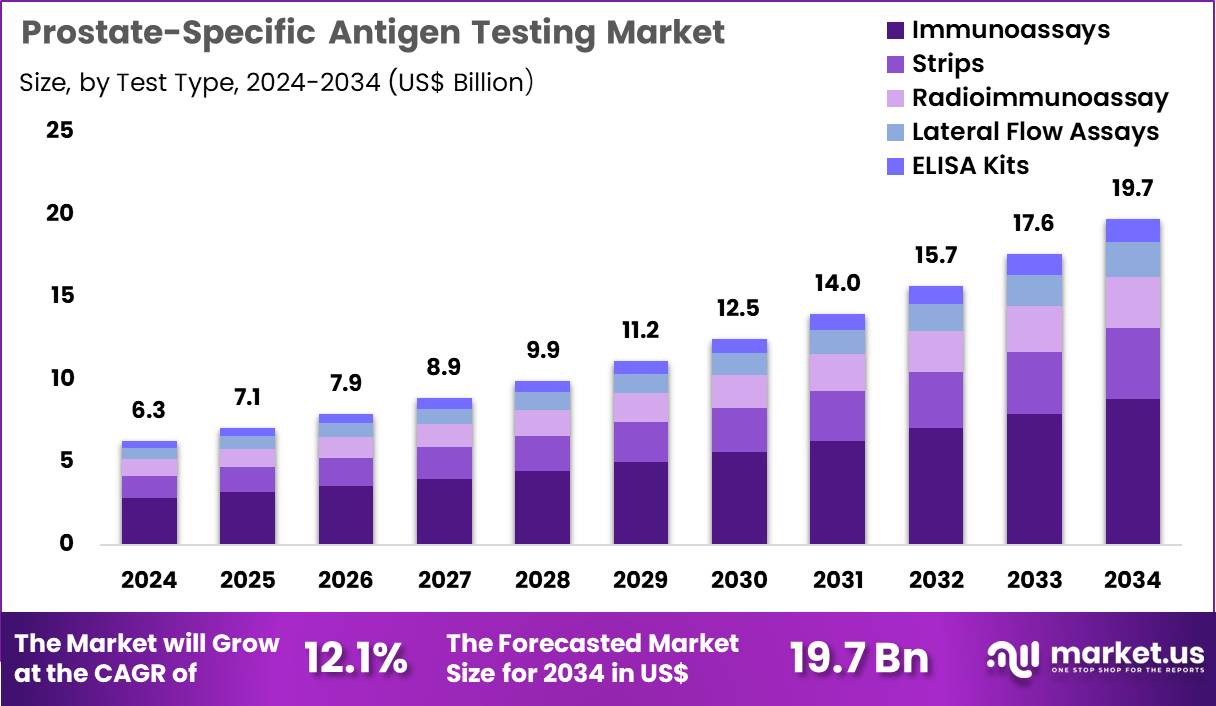
Key Takeaways
- In 2024, the Prostate-Specific Antigen (PSA) Testing Market generated a revenue of US$ 6.3 billion and is projected to grow at a CAGR of 12.1%, reaching approximately US$ 19.7 billion by 2034.
- Based on test type, the market is segmented into immunoassays, strips, radioimmunoassay, lateral flow assays, and ELISA kits. The immunoassay segment dominated in 2024, accounting for a market share of 44.9%.
- By sample type, the PSA Testing Market is categorized into serum, whole blood, and plasma. The serum segment held the leading position in 2024, capturing a significant market share of 52.4%.
- Based on end-user, the market is segmented into hospitals, specialty clinics, diagnostic laboratories, research institutes, and others. The hospitals segment emerged as the largest contributor, holding the highest revenue share of 46.3% in 2024.
- Regionally, North America dominated the PSA Testing Market in 2024, accounting for a leading market share of 42.1% due to advanced healthcare infrastructure, high diagnostic adoption, and increased prostate cancer screening activities.
Statistical Information
- Prostate cancer burden driving PSA testing demand: Global epidemiologic data show prostate cancer as one of the most commonly diagnosed cancers in men. For example, GLOBOCAN 2020 estimated over 1.4 million new prostate cancer cases and 375,000 deaths worldwide, creating a large clinical need for early detection, monitoring, and follow‑up, for which PSA remains a central laboratory tool.
- Age- and risk-based PSA screening guidance: StatPearls and USPSTF guidance indicate no PSA screening before age 40, and individualized decisions for ages 55–69. High‑risk men (African descent, strong family history, BRCA2) may start PSA testing at age 40–45, with 2–4‑year intervals in low‑risk men. Screening is not recommended for men ≥70 years, shaping the addressable testing population.
- Baseline PSA and repeat testing intervals: Guidelines suggest a single baseline PSA for men 40–45 years men with PSA <1 ng/mL at 40 or <2 ng/mL at 60 are considered low risk and can be screened every 2 years or less frequently. A PSA rise >0.75 ng/mL/year or >25% is suspicious and prompts repeat testing or further diagnostic work.
- Overall sensitivity and specificity ranges for PSA testing: StatPearls and meta‑analyses describe PSA as highly sensitive but poorly specific. Sensitivity for prostate cancer at PSA >4 ng/mL can reach 91%, but overall specificity ranges 9–33%, meaning up to 91% of elevated PSA results are false positives, and actual cancer risk is 30% among men with elevated PSA
- Sensitivity–specificity trade-offs at common PSA cut-offs: One study found that at PSA cut‑offs of 3, 4, and 5 ng/mL, sensitivity was 59%, 44%, and 33%, while specificity was 87%, 92%, and 95%, respectively. This demonstrates how lowering the threshold increases detection but also false positives, directly affecting test volume and biopsy workload.
- Meta-analytic sensitivity and false-negative concerns: A meta‑analysis estimated PSA sensitivity 72.1% and specificity 93.2% for prostate cancer, yet retrospective data show 15–38% of prostate cancers occur in men with PSA <4 ng/mL, indicating a substantial false‑negative rate. This limits reliance on PSA alone and encourages complementary markers or imaging, influencing how PSA testing is positioned in diagnostic pathways.
Regional Analysis
North America led the market by securing a market share of 42.1% in 2024.
North America holds a significant position in the PSA Testing Market due to high prostate cancer prevalence, advanced diagnostic infrastructure, and widespread access to screening services. In the United States, prostate cancer remains a major health concern, with the National Cancer Institute estimating approximately 299,010 new prostate cancer cases in 2024. Increased awareness, urology care expansion, and adoption of PSA-based monitoring methods continue to support regional demand.
Healthcare systems are also focusing on personalized screening approaches based on age, risk factors, and clinical history. Asia Pacific is expected to experience notable growth due to rising prostate cancer awareness, aging populations, and improving healthcare access.
Countries are expanding cancer screening programs and strengthening diagnostic laboratory capabilities. Japan and South Korea have reported increasing prostate cancer cases, creating demand for early detection technologies and PSA testing services.
Emerging Trends
- Increasing Adoption of Personalized PSA Screening Approaches: Healthcare providers are shifting from routine PSA testing toward personalized screening strategies based on age, family history, risk factors, and PSA levels. The CDC recommends shared decision-making for men aged 55–69 years before PSA screening, supporting individualized diagnostic pathways.
- Growth of Advanced PSA Biomarker Tests for Better Accuracy: Advanced PSA technologies, including free PSA and combined biomarker assays, are gaining importance for improving cancer risk assessment. The FDA has authorized free PSA assays for men aged 50 years and older with PSA levels between 4–10 ng/mL to help differentiate prostate cancer risk from benign conditions.
- Integration of Digital Health and Remote Cancer Monitoring: Digital healthcare platforms and telemedicine services are supporting easier follow-up consultations after PSA testing. Remote healthcare adoption helps patients discuss PSA results with urologists and improves continuity of care, especially for older men requiring regular monitoring and risk evaluation. The CDC emphasizes discussing PSA screening decisions with healthcare professionals.
- Expansion of Automated Laboratory Testing Platforms: Clinical laboratories are increasingly adopting automated PSA testing systems to improve testing speed, accuracy, and workflow efficiency. FDA-cleared PSA diagnostic platforms support quantitative measurement of PSA from human serum and plasma samples, helping laboratories manage increasing prostate cancer screening demand.
- Rising Focus on Early Detection Due to Increasing Prostate Cancer Cases: Growing prostate cancer incidence is increasing demand for PSA testing worldwide. In the United States, 255,395 new prostate cancer cases were reported in 2022, with approximately 70% diagnosed at the localized stage, highlighting the importance of early detection and screening programs.
Use Cases
- Prostate Cancer Screening in High-Risk Male Populations: PSA testing is widely used to evaluate prostate health among men at increased risk due to age, family history, or other factors. Healthcare organizations recommend PSA discussions for men aged 55–69 years to balance screening benefits and risks.
- Monitoring Treatment Response in Prostate Cancer Patients: PSA testing plays an important role after prostate cancer diagnosis by tracking changes in PSA levels during treatment and follow-up care. Regular PSA measurement helps physicians evaluate treatment effectiveness and identify potential disease progression or recurrence.
- Supporting Clinical Decisions Before Prostate Biopsy: Advanced PSA assays are increasingly used to help physicians identify patients who may require further evaluation. FDA-approved tests such as IsoPSA assist in assessing men aged 50 years and older with PSA levels of 4–10 ng/mL before biopsy decisions.
- Use in Hospital and Diagnostic Laboratory Workflows: Hospitals and diagnostic laboratories use PSA tests as part of prostate cancer evaluation pathways. Blood-based PSA measurement provides a simple diagnostic approach, with commonly used PSA tests measuring antigen levels in serum or plasma samples through laboratory analyzers.
- Supporting Population-Level Cancer Surveillance Programs: PSA testing contributes to prostate cancer surveillance by helping identify disease trends and screening outcomes. CDC cancer surveillance data showed prostate cancer was the most commonly reported cancer among men in the United States in 2022, emphasizing the continued need for effective diagnostic monitoring.
Frequently Asked Questions on Prostate-Specific Antigen Testing
- Which sample type is commonly used for PSA testing?
Serum is the most commonly used sample type for PSA testing because it provides reliable measurement of PSA concentration. Blood samples collected from patients are processed in laboratories using immunoassay-based technologies for accurate prostate cancer screening and monitoring. - What are the key applications of PSA testing?
PSA testing is mainly used for prostate cancer screening, diagnosis support, monitoring treatment response, and detecting cancer recurrence. Healthcare providers also use PSA levels to evaluate prostate conditions and determine whether additional diagnostic procedures may be required. - Which end users contribute to PSA Testing Market growth?
Hospitals, diagnostic laboratories, specialty clinics, and research institutes are major end users of PSA testing technologies. Hospitals account for significant adoption due to their role in cancer diagnosis, treatment monitoring, urology care, and patient management services. - How does PSA testing help in prostate cancer detection?
PSA testing helps identify elevated PSA levels that may indicate prostate abnormalities, including prostate cancer. Although PSA results require clinical interpretation, the test assists physicians in deciding whether further evaluation, imaging, or biopsy procedures are necessary. - What role do advanced PSA assays play in healthcare?
Advanced PSA assays improve prostate cancer risk assessment by providing additional information beyond traditional total PSA measurements. Free PSA and other biomarker-based tests help physicians differentiate between cancer risks and benign prostate conditions, supporting better clinical decisions. - Which region dominates the PSA Testing Market?
North America holds a leading position in the PSA Testing Market due to advanced healthcare infrastructure, high prostate cancer awareness, strong diagnostic laboratory networks, and widespread adoption of cancer screening and monitoring technologies across hospitals and specialty healthcare centers. - What is the future outlook for the PSA Testing Market?
The future of the PSA Testing Market is expected to be supported by advanced biomarker development, digital healthcare integration, automated testing platforms, and increasing focus on personalized medicine. These advancements are likely to improve accuracy and accessibility of prostate cancer diagnostics.
Conclusion
The Prostate-Specific Antigen (PSA) Testing Market is expected to witness continued growth due to rising prostate cancer prevalence, increasing awareness of early detection, and growing adoption of advanced diagnostic technologies. The demand for PSA-based screening, monitoring, and risk assessment is expanding across hospitals, diagnostic laboratories, and specialty clinics.
Innovations in immunoassays, biomarker-based testing, and personalized screening approaches are improving diagnostic accuracy and patient outcomes. North America remains a leading region due to strong healthcare infrastructure and screening adoption, while emerging regions are strengthening diagnostic capabilities. Overall, increasing focus on preventive healthcare and cancer management will support future market development.
Discuss your needs with our analyst
Please share your requirements with more details so our analyst can check if they can solve your problem(s)




