


Overview
The Global Pneumococcal Testing Market size is expected to be worth around US$ 4.4 Billion by 2034 from US$ 1.5 Billion in 2024, growing at a CAGR of 11.3% during the forecast period 2025 to 2034. North America held a dominant market position, capturing more than a 43.2% share and a US$ 0.6 Billion market value for the year.
Pneumococcal testing is an essential diagnostic tool for identifying infections caused by Streptococcus pneumoniae, a bacterium responsible for pneumonia, meningitis, bacteremia, and sinus and ear infections. Early and accurate diagnosis enables timely treatment, reduces complications, and supports appropriate antibiotic use.
According to the World Health Organization (WHO), pneumococcal disease causes more than 300,000 deaths annually among children under five years of age, despite the availability of effective vaccines. Older adults aged 65 years and above, along with individuals with chronic illnesses or weakened immune systems, remain at the highest risk of severe disease.
Diagnostic methods include blood culture, sputum culture, cerebrospinal fluid (CSF) analysis, urine antigen testing, rapid antigen detection, and polymerase chain reaction (PCR) assays. Traditional culture-based methods generally require 24–72 hours to confirm infection, whereas PCR-based molecular tests can deliver highly accurate results in less than 6 hours. According to the U.S. Centers for Disease Control and Prevention (CDC), pneumococcal disease results in approximately 150,000 hospitalizations for pneumococcal pneumonia every year in the United States, highlighting the importance of rapid diagnostic testing.
Growing awareness of antimicrobial resistance, increasing adoption of molecular diagnostics, and expanding vaccination programs are driving demand for advanced pneumococcal testing solutions. Continuous improvements in laboratory automation, multiplex PCR technologies, and point-of-care diagnostic platforms are enhancing testing accuracy and efficiency.
These innovations are expected to strengthen infectious disease surveillance, improve patient outcomes, and support better clinical decision-making across hospitals, diagnostic laboratories, and public health systems worldwide.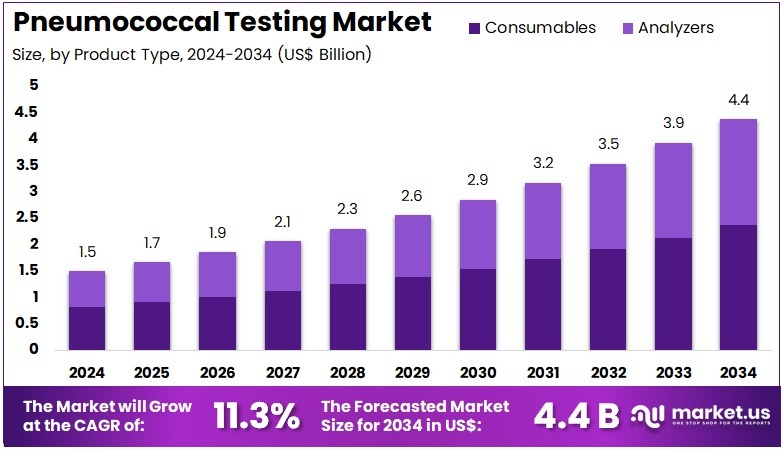
Key Takeaways
- The global pneumococcal testing market was valued at US$ 1.5 billion in 2024 and is projected to reach US$ 4.4 billion by 2034, expanding at a CAGR of 11.3% during the forecast period.
- By product type, the market is segmented into consumables and analyzers. The consumables segment dominated the market, accounting for 54.2% of the total market share.
- Based on technology, the market includes ELISA, western blot test, polymerase chain reaction (PCR), immunohistochemistry, immunofluorescence, and others. Among these, ELISA held the largest market share of 41.7%.
- By application, the market is categorized into immunodiagnostics, point-of-care testing, and molecular diagnostics. The immunodiagnostics segment led the market with a 46.9% revenue share.
- Based on end user, the market is segmented into hospitals & clinics, ambulatory surgical centers, and diagnostic centers. The hospitals & clinics segment held the leading position with a 51.8% market share.
- North America emerged as the leading regional market, capturing a 43.2% share of the global pneumococcal testing market.
Statistical Information
- Global Burden of Invasive Pneumococcal Disease Supports Testing Demand: The United States reported 27,770 invasive pneumococcal disease (IPD) cases in 2022, with an overall incidence of 8.3 cases per 100,000 population. Adults aged 85 years and older had the highest incidence (27.4 per 100,000), highlighting the need for rapid pneumococcal diagnostic testing in older populations.
- Pneumococcal Pneumonia Remains a Major Cause of Hospitalization: CDC estimates that approximately 150,000 adults are hospitalized annually in the United States because of pneumococcal pneumonia. Before the COVID-19 pandemic, the country also experienced about 30,000 invasive pneumococcal disease cases and 3,000 related deaths each year, supporting continued demand for hospital-based diagnostic testing.
- Childhood Vaccination Has Reduced Disease but Surveillance Continues: According to CDC surveillance, IPD rates among children younger than 5 years declined by 95% between 1998 and 2021, while disease caused by PCV13-covered serotypes decreased by 99%. Continuous laboratory testing remains essential to detect emerging non-vaccine serotypes.
- Children Under Five Continue to Face High Pneumonia Burden: CDC reports that the incidence of all-cause pneumonia in U.S. children under five ranged from 2,250 to 3,990 cases per 100,000 person-years, demonstrating the importance of accurate laboratory diagnosis and surveillance in pediatric healthcare.
- Urine Antigen Testing Demonstrates Strong Clinical Utility: Data presented during the 2024 ACIP meeting showed that among 2,917 hospitalized community-acquired pneumonia patients, 12.1% had pneumococcal infection detected through diagnostic testing. Approximately 85% of pneumococcal pneumonia cases were non-invasive, emphasizing the value of rapid urine antigen and molecular testing.
- Rising Burden in Older Adults Drives Hospital Testing: CDC surveillance shows that adults aged 65–74 years experienced 15.8 IPD cases per 100,000, adults aged 75–84 years had 16.4 cases per 100,000, and those aged 85 years and older reached 27.4 cases per 100,000 in 2022. These figures support continued demand for pneumococcal testing in hospitals and clinics.
- Global Pneumonia Prevention Requires Better Diagnostic Access: WHO reports that pneumonia caused approximately 740,000 deaths among children under five globally in 2021, representing around 14% of all deaths in this age group. Improved diagnostic capacity remains essential for early treatment and disease surveillance.
- Older Adults Represent a High-Value Testing Population: CDC surveillance data shows invasive pneumococcal disease incidence increases significantly with age, reaching 27.4 cases per 100,000 population among adults aged 85 years and older in 2022. This demographic continues to drive demand for accurate diagnostic testing.
Regional Analysis
North America led the market by securing a market share of 43.2% in 2023.
North America held a significant position in the pneumococcal testing market due to advanced healthcare infrastructure, high adoption of molecular diagnostics, and strong disease surveillance programs. The region benefits from widespread use of PCR-based assays, urine antigen tests, and rapid diagnostic platforms for detecting Streptococcus pneumoniae infections. According to the CDC, the United States reported 27,770 invasive pneumococcal disease cases in 2022, with an incidence rate of 8.3 cases per 100,000 population, highlighting continued diagnostic demand.
Increasing pneumococcal vaccination coverage and updated adult immunization recommendations have strengthened the need for serotype identification and monitoring of emerging strains. Hospitals and diagnostic laboratories are focusing on faster pathogen detection to support antibiotic stewardship and improve patient outcomes. Government-supported surveillance networks and investments in infectious disease preparedness continue to enhance pneumococcal testing capabilities across the region.
Asia Pacific is expected to register strong growth in the pneumococcal testing market due to rising pneumonia cases, improving healthcare infrastructure, and increasing government initiatives for infectious disease control. Countries across the region are expanding access to molecular diagnostics, antigen testing, and portable diagnostic platforms to improve early detection, particularly in rural and underserved areas. According to UNICEF, pneumonia remains a major health concern, with more than 700,000 deaths among children under five globally in 2021, emphasizing the need for effective diagnosis and treatment.
Healthcare systems are strengthening laboratory networks and integrating pneumococcal surveillance with vaccination programs to monitor disease patterns and emerging serotypes. Growing awareness about antimicrobial resistance and the importance of rapid pathogen identification is further driving adoption of advanced pneumococcal testing technologies across hospitals, clinics, and public health facilities in the region.
Emerging Trends
- Increasing Adoption of Molecular PCR-Based Diagnostics: Healthcare systems are increasingly adopting PCR-based pneumococcal testing because it provides faster and more accurate pathogen identification compared with traditional culture methods. CDC-supported surveillance programs use molecular methods for detecting Streptococcus pneumoniae serotypes, improving vaccine monitoring and antibiotic treatment decisions. The CDC reported 27,770 invasive pneumococcal disease cases in the United States in 2022, highlighting the need for advanced diagnostics.
- Growth of Multiplex Respiratory Testing Platforms: Hospitals are increasingly using multiplex respiratory panels that detect multiple pathogens, including Streptococcus pneumoniae, from a single patient sample. These systems help differentiate bacterial and viral infections, supporting faster clinical decisions. The FDA has cleared multiple multiplex respiratory diagnostic platforms for improved respiratory infection management in hospitals and laboratories.
- Expansion of Serotype Surveillance After Vaccine Programs: Pneumococcal testing is increasingly focused on identifying circulating serotypes to evaluate vaccine effectiveness and monitor non-vaccine strains. More than 100 pneumococcal serotypes have been identified, while vaccines target selected high-risk strains. CDC surveillance programs use laboratory testing to track changes in pneumococcal populations after vaccination programs.
- Rising Demand for Rapid Point-of-Care Pneumococcal Tests: Point-of-care pneumococcal testing is expanding because emergency departments and outpatient clinics require faster diagnosis for pneumonia cases. Rapid antigen detection and molecular tests help healthcare providers begin appropriate treatment earlier. The FDA continues approving new diagnostic technologies that support decentralized testing and faster respiratory infection management.
- Integration of Pneumococcal Testing With Antimicrobial Stewardship Programs: Healthcare providers are increasingly linking pneumococcal testing with antibiotic stewardship initiatives to reduce unnecessary antibiotic use. Rapid identification of bacterial infections helps physicians select targeted therapies instead of broad-spectrum antibiotics. CDC estimates that improved antibiotic stewardship programs can significantly reduce inappropriate antibiotic prescribing across healthcare settings.
Use Cases
- Diagnosis of Community-Acquired Pneumonia in Hospitals: Pneumococcal testing plays an important role in diagnosing community-acquired pneumonia (CAP), especially among hospitalized patients. Molecular assays and urine antigen tests help identify bacterial causes quickly and improve treatment decisions. Approximately 1 million adults receive hospital care for pneumonia annually in the United States, creating strong demand for accurate diagnostics.
- Testing High-Risk Elderly Populations: Older adults represent a major application area for pneumococcal diagnostics due to increased infection risk. CDC data shows invasive pneumococcal disease incidence reached 27.4 cases per 100,000 population among adults aged 85 years and older in 2022. Testing supports early detection and reduces severe disease complications.
- Monitoring Pneumococcal Infections in Immunocompromised Patients: Pneumococcal testing is widely used for patients with weakened immune systems, including individuals with cancer, HIV, organ transplantation, and chronic diseases. These populations have higher risks of severe infection. CDC recommends enhanced prevention strategies and monitoring for high-risk groups to reduce disease burden.
- Tracking Antimicrobial Resistance and Emerging Strains: Pneumococcal testing helps public health agencies monitor antibiotic-resistant strains and changing disease patterns. CDC surveillance programs analyze pneumococcal isolates using laboratory methods such as PCR and genomic testing. These data support vaccine strategies, resistance monitoring, and public health planning.
- Supporting Childhood Pneumonia Diagnosis and Surveillance: Pediatric healthcare providers use pneumococcal testing to identify bacterial pneumonia causes and monitor vaccine impact. UNICEF reported that pneumonia caused approximately 740,000 deaths among children under five globally in 2021, representing around 14% of deaths in this age group. Improved testing supports early treatment.
Frequently Asked Questions on Pneumococcal Testing
- Why is pneumococcal testing important?
Pneumococcal testing is important because early detection enables accurate treatment decisions and reduces unnecessary antibiotic use. It also supports disease surveillance, vaccine effectiveness monitoring, and prevention strategies, especially among elderly individuals, children, and immunocompromised patients at higher risk. - What technologies are used in the pneumococcal testing market?
The pneumococcal testing market includes technologies such as polymerase chain reaction (PCR), ELISA, western blot testing, immunofluorescence, immunohistochemistry, and urinary antigen detection. These technologies improve diagnostic accuracy, provide faster results, and support effective management of pneumococcal infections. - What factors are driving the pneumococcal testing market growth?
Market growth is driven by increasing respiratory infections, rising elderly populations, expanding vaccination programs, antimicrobial resistance concerns, and demand for rapid diagnostic solutions. Growing adoption of molecular testing technologies and improved healthcare infrastructure are also contributing to market expansion. - Which product segment dominates the pneumococcal testing market?
The consumables segment dominates the pneumococcal testing market due to continuous demand for diagnostic kits, reagents, and testing materials. Increasing testing volumes, routine disease surveillance programs, and widespread adoption of molecular and immunological assays support the growth of consumable products. - Which region dominates the pneumococcal testing market?
North America leads the pneumococcal testing market due to advanced healthcare infrastructure, strong diagnostic capabilities, and established surveillance systems. High adoption of PCR testing, government-supported healthcare programs, and increased focus on infectious disease monitoring contribute to regional market leadership. - Why is Asia Pacific expected to grow rapidly in the pneumococcal testing market?
Asia Pacific is expected to witness strong growth due to increasing pneumonia cases, improving healthcare infrastructure, rising diagnostic investments, and government initiatives for infectious disease control. Expansion of laboratories and adoption of affordable testing solutions are supporting regional market development. - What is the future outlook of the pneumococcal testing market?
The future outlook of the pneumococcal testing market focuses on advanced molecular diagnostics, portable testing devices, improved serotype detection, and integration with digital healthcare systems. Growing demand for disease surveillance and faster diagnosis will continue encouraging innovation in pneumococcal testing technologies.
Conclusion
The pneumococcal testing market is witnessing strong growth due to increasing respiratory infection burdens, rising awareness of early diagnosis, and advancements in molecular diagnostic technologies. The adoption of PCR, antigen detection, and point-of-care testing solutions is improving infection identification and supporting effective treatment decisions.
North America continues to lead the market due to advanced healthcare infrastructure and strong surveillance programs, while Asia Pacific is expected to experience rapid growth through expanding diagnostic access and healthcare investments. Increasing vaccination programs, antimicrobial resistance concerns, and demand for accurate pathogen detection will continue driving innovation and adoption of pneumococcal testing solutions worldwide.
Discuss your needs with our analyst
Please share your requirements with more details so our analyst can check if they can solve your problem(s)




