


Overview
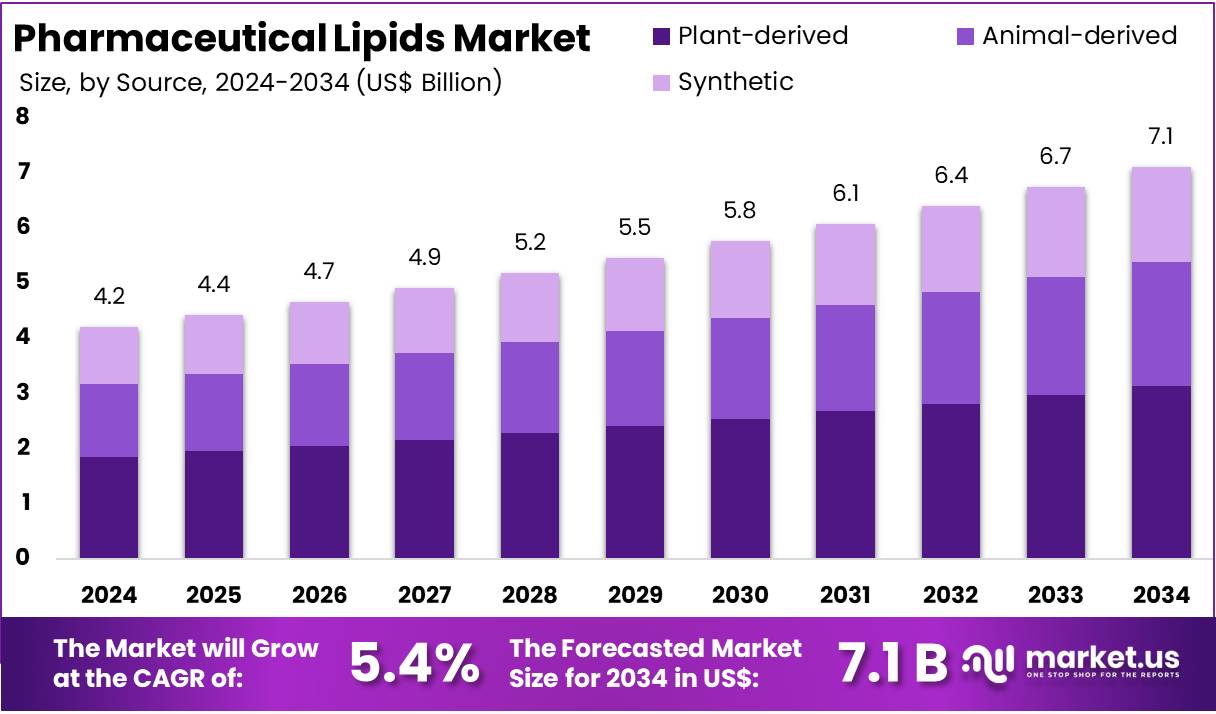
The Global Pharmaceutical Lipids Market size is expected to be worth around US$ 7.1 Billion by 2034, from US$ 4.2 Billion in 2024, growing at a CAGR of 5.4% during the forecast period from 2025 to 2034. North America held a dominant market position, capturing more than a 33.5% share and holds US$ 1.4 Billion market value for the year.
The pharmaceutical lipids market is emerging as a vital component of modern drug development, driven by the rising use of lipid-based delivery platforms, biologics, and advanced therapeutic technologies. Pharmaceutical lipids are widely used in formulations such as lipid nanoparticles, liposomes, lipid emulsions, and drug encapsulation systems to improve drug stability, bioavailability, and targeted delivery. Growing demand for RNA-based medicines, gene therapies, and injectable formulations is significantly increasing the adoption of specialized lipid ingredients.
Pharmaceutical companies are investing heavily in advanced lipid systems, including ionizable lipids, phospholipids, and cholesterol-based carriers, to enhance treatment outcomes. Lipid-based formulations are also gaining importance in oncology, infectious disease treatment, and rare disease therapies due to their ability to provide controlled and targeted drug release.
North America continues to hold a significant position in the market due to strong biotechnology research activities, increasing clinical trials, and established pharmaceutical manufacturing capabilities.
Meanwhile, the Asia-Pacific is experiencing rapid growth supported by expanding healthcare infrastructure, rising drug production, and increasing investments in biopharmaceutical innovation. Ongoing advancements in lipid chemistry and personalized medicine are expected to create new opportunities for market expansion.
Key Takeaways
- The global pharmaceutical lipids market was valued at approximately US$ 4.2 Billion in 2024 and is projected to reach nearly US$ 7.1 Billion by 2034, growing at a CAGR of 5.4% during the forecast period.
- Triglycerides dominated the product category in 2024, accounting for more than 43% of total pharmaceutical lipid demand across various global applications
- Plant-derived lipids emerged as the leading source segment in 2024, capturing over 44.1% of the overall pharmaceutical lipids market share.
- Liposomes represented the dominant delivery system in 2024, contributing more than 31.3% of global pharmaceutical lipid utilization due to their broad use in advanced drug delivery.
- Parenteral administration held the largest share among administration routes in 2024, accounting for over 36.8% of the market, supported by increasing clinical adoption.
- Small-molecule drug delivery and vaccine applications represented the leading application segment in 2024, contributing more than 38.2% of total pharmaceutical lipid usage.
- Pharmaceutical and biopharmaceutical companies were the major end users in 2024, holding over 48% of the global pharmaceutical lipids market share.
- North America maintained its leading regional position in 2024, accounting for more than 33.5% of the global market and generating a revenue of approximately US$ 1.4 billion.
Statistical Information
- A 2025 continuous manufacturing study for mRNA-loaded lipid nanoparticles achieved 95.5 ± 4% encapsulation efficiency, with an average particle size of 105 ± 6 nm and a polydispersity index (PDI) of 0.10 ± 0.02, demonstrating controlled pharmaceutical lipid nanoparticle production.
- The same 2025 lipid nanoparticle manufacturing process achieved 90% recovery of mRNA-LNPs during single-pass tangential flow filtration and reached a 10× concentration factor during purification.
- Continuous pharmaceutical lipid nanoparticle production reported residual ethanol content of only 0.003% after purification, indicating high solvent-removal efficiency in the manufacturing workflow.
- A 2025 study on lipid nanoparticle-based pulmonary drug delivery developed an optimized nanostructured lipid carrier with a particle size of 159.8 ± 3.46 nm and drug encapsulation efficiency of 81.4 ± 7.1%.
- A 2025 solid lipid nanoparticle formulation study achieved drug entrapment efficiency ranging from 61.7% ± 1.3% to 72.8% ± 2.1% using glyceryl monostearate-based lipid systems.
- In the same solid lipid nanoparticle study, optimized formulations achieved production yields between 42.8% ± 3.6% and 76.6% ± 3.8%, showing variation in manufacturing output depending on lipid composition.
- A 2025 pharmaceutical lipid nanoparticle formulation review identified encapsulation efficiency as a critical quality attribute used to evaluate lipid nanoparticle drug loading performance and process effectiveness.
- The continuous lipid nanoparticle manufacturing process achieved 86.2 ± 3% mRNA integrity after encapsulation and purification, indicating preservation of therapeutic payload quality.
- The same process maintained unloaded lipid nanoparticle fractions at only 0.4 ± 0.05%, reflecting efficient cargo incorporation into pharmaceutical lipid carriers.
- A 2025 ACS Nano study demonstrated lipid nanoparticle manufacturing with independent control of nanoparticle size and morphology while maintaining other quality attributes through controlled formulation processes.
Regional Analysis
In 2024, North America dominated the pharmaceutical lipids market, accounting for more than 33.5% share with a market value of approximately US$ 1.4 billion. The region’s growth was driven by increasing adoption of lipid-based drug delivery systems, rising demand for high-quality pharmaceutical excipients, and expanding research activities in advanced therapies. Strong biotechnology infrastructure and the presence of specialized manufacturing facilities supported efficient production of complex lipid formulations.
The region benefited from rapid advancements in lipid nanoparticles (LNPs), particularly for mRNA-based therapies, oncology applications, and metabolic disease treatments. Increased clinical research, supportive regulatory frameworks, and collaborations between pharmaceutical companies and research institutions further strengthened market expansion.
Growing investments in personalized medicine and biologics manufacturing are expected to enhance future demand for pharmaceutical lipids. With continuous innovation, advanced healthcare infrastructure, and strong development capabilities, North America is projected to maintain its leading position in the global pharmaceutical lipids market.
Emerging Trends
- Lipid Nanoparticles (LNPs) Becoming Key Drug Delivery Platforms: Lipid nanoparticles are emerging as a major pharmaceutical lipid trend due to their ability to transport mRNA, RNA therapies, and genetic medicines. Research published in 2025 highlights that LNPs improve nucleic acid protection, cellular uptake, and delivery efficiency. Many LNP systems contain 4 major components: ionizable lipids, phospholipids, cholesterol, and PEG-lipids.
- Rising Demand for mRNA-Based Therapeutics and Vaccines: The expansion of mRNA medicine is increasing demand for specialized pharmaceutical lipids. FDA-reviewed vaccine platforms in 2026 continue using lipid nanoparticle technology for mRNA delivery. These systems enable rapid vaccine development by protecting mRNA molecules and supporting immune response generation with precise lipid formulations.
- Growth of Liposomal Drug Formulations: Liposomal formulations are gaining adoption for improving drug stability, reducing toxicity, and providing controlled release. Pharmaceutical lipids are widely used in oncology, antifungal, and targeted therapies. Advanced lipid carriers are being designed to improve drug loading capacity and enhance therapeutic performance through optimized lipid compositions.
- Development of Targeted Lipid Delivery Systems: Pharmaceutical companies and researchers are focusing on programmable lipid nanoparticles that deliver medicines to specific tissues. These systems are being explored for cancer treatment, gene therapy, and rare disease applications. New lipid designs aim to improve targeting accuracy, reduce side effects, and increase treatment effectiveness.
- Advanced Manufacturing and Quality Control of Lipid Products: Manufacturing innovation is becoming important for pharmaceutical lipid production as demand increases for complex therapies. Researchers are developing improved formulation methods, analytical tools, and scalable production approaches. These technologies help maintain lipid particle size, stability, and consistency during commercial drug manufacturing.
Use Cases
- mRNA Vaccine Delivery Applications: Pharmaceutical lipids are widely used as delivery vehicles for mRNA vaccines because they protect genetic material from degradation and support cellular absorption. FDA-reviewed mRNA vaccine technologies use lipid nanoparticles containing encapsulated mRNA, demonstrating the importance of lipids in next-generation preventive medicines.
- Cancer Treatment and Oncology Drug Delivery: Lipid-based drug delivery systems are increasingly used in cancer therapies to improve drug concentration at tumor sites. Liposomes and lipid nanoparticles help deliver chemotherapy agents, nucleic acids, and targeted molecules while potentially reducing exposure to healthy tissues and improving treatment safety.
- Gene Therapy and RNA Therapeutics: Pharmaceutical lipids support gene therapy development by enabling the delivery of RNA-based medicines such as mRNA and siRNA. LNP technology provides protection against enzymatic breakdown and improves intracellular transport. Research identifies lipid nanoparticles as leading non-viral carriers for nucleic acid therapeutics.
- Controlled Drug Release Formulations: Lipid-based carriers are used to create controlled-release medicines that maintain therapeutic levels for longer durations. Liposomes, solid lipid nanoparticles, and related systems improve drug solubility and bioavailability. These applications support treatments requiring stable and sustained drug delivery profiles.
- Personalized Medicine and Precision Healthcare: Pharmaceutical lipids are supporting personalized medicine by enabling customized delivery systems based on patient-specific therapeutic needs. Researchers are developing adaptable lipid formulations for genetic diseases, immune therapies, and targeted treatments. Advanced lipid platforms aim to improve treatment precision while reducing unwanted biological effects.
Frequently Asked Questions on Pharmaceutical Lipids
- What is the pharmaceutical lipids market?
The pharmaceutical lipids market refers to the global industry involved in manufacturing, supplying, and developing lipid ingredients for pharmaceutical products. The market is expanding due to increasing demand for lipid-based drug delivery, biologics, vaccines, and RNA-based therapeutics across healthcare systems worldwide. - What factors are driving the pharmaceutical lipids market?
Growing use of lipid nanoparticles in RNA therapeutics, increasing biologic drug production, rising demand for poorly soluble drug formulations, and continuous innovation in drug delivery technologies are major growth drivers. Expanding pharmaceutical manufacturing capacity further supports market development globally. - Which types of pharmaceutical lipids are widely used?
Common pharmaceutical lipids include phospholipids, triglycerides, fatty acids, cholesterol, and specialized cationic or ionizable lipids. These materials are selected based on formulation needs, helping improve drug encapsulation, controlled release, bioavailability, and overall therapeutic performance in modern medicines. - How are pharmaceutical lipids used in drug delivery?
Pharmaceutical lipids form carriers such as liposomes, solid lipid nanoparticles, and lipid nanoparticles that protect active ingredients and improve targeted delivery. These systems enhance drug stability, increase absorption, reduce toxicity, and enable controlled release for improved patient outcomes. - Which region leads the pharmaceutical lipids market?
North America currently leads the pharmaceutical lipids market because of its advanced pharmaceutical manufacturing infrastructure, strong biotechnology sector, significant investment in innovative drug development, and widespread adoption of lipid-based formulations for vaccines, biologics, and RNA therapeutics. - Who are the major end users of pharmaceutical lipids?
Major end users include pharmaceutical companies, biotechnology firms, contract development and manufacturing organizations (CDMOs), research institutes, and academic laboratories. These organizations utilize pharmaceutical lipids for drug formulation, clinical research, commercial manufacturing, and development of advanced therapeutics. - What is the future outlook for the pharmaceutical lipids market?
The pharmaceutical lipids market is expected to experience steady growth as demand increases for RNA therapeutics, personalized medicines, lipid nanoparticle technologies, and advanced biologic formulations. Ongoing innovation and expanding pharmaceutical production capacities are likely to create new opportunities worldwide.
Conclusion
The pharmaceutical lipids market is expected to witness steady growth as lipid-based drug delivery becomes increasingly important for biologics, vaccines, gene therapies, and advanced pharmaceutical formulations. Rising demand for improved drug solubility, bioavailability, and targeted delivery continues to support the adoption of high-purity pharmaceutical lipids across multiple therapeutic areas.
Triglycerides, plant-derived lipids, liposomes, and parenteral formulations remain key growth segments, while pharmaceutical and biopharmaceutical companies account for the largest share of demand. Continued investments in lipid nanoparticle technologies, expanding biologics pipelines, and increasing research in precision medicine are expected to create new opportunities.
With strong manufacturing capabilities, regulatory support, and ongoing innovation, North America is expected to maintain its leadership, while Asia-Pacific is likely to emerge as a high-growth region. Overall, the market outlook remains positive, driven by technological advancements and the expanding role of lipid-based therapeutics in modern healthcare.
Discuss your needs with our analyst
Please share your requirements with more details so our analyst can check if they can solve your problem(s)




