


Overview
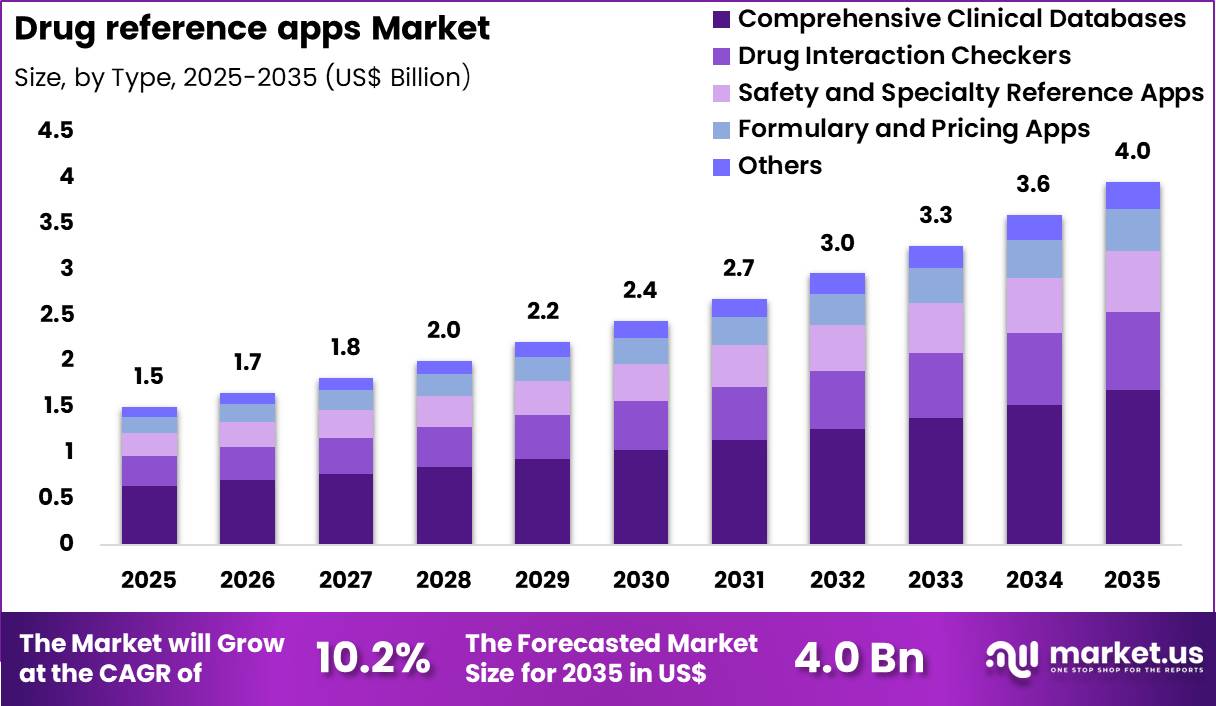
New York, NY – Nov 11 2026 – The Global Drug reference apps Market size is expected to be worth around US$ 4.0 Billion by 2035 from US$ 1.5 Billion in 2025, growing at a CAGR of 10.2% during the forecast period 2026-2035. In 2025, North America led the market, achieving over 41.2% share with a revenue of US$ 0.6 Billion.
Drug reference apps are digital healthcare tools designed to provide quick and convenient access to essential information about medicines, pharmaceutical products, and their safe usage. These applications serve as valuable resources for healthcare professionals, pharmacists, medical students, and patients seeking accurate and updated drug-related information.
Key features of drug reference apps generally include comprehensive drug databases, medication indications, dosage guidelines, side effects, contraindications, drug interactions, safety warnings, and generic and brand-name drug information. Some advanced applications also offer prescription management, medication reminders, clinical decision-support tools, and access to evidence-based medical guidelines.
The growing adoption of smartphones and digital healthcare solutions has increased the importance of mobile drug information platforms. These applications help streamline medication research, support informed clinical decisions, and improve access to pharmaceutical information. Healthcare professionals can use these platforms to verify prescribing information, while patients can better understand their medications and follow prescribed treatment instructions.
With increasing emphasis on medication safety, digital health adoption, and patient awareness, drug reference apps are expected to remain an important component of the evolving healthcare information ecosystem. Continuous improvements in database accuracy, user experience, and clinical integration are further supporting the development of this segment.
Key Takeaways
- In 2025, the global drug reference apps market was valued at US$ 1.5 billion and is projected to grow at a CAGR of 10.2%, reaching US$ 4.0 billion by 2035.
- By type, the market is segmented into comprehensive clinical databases, drug interaction checkers, safety and specialty reference apps, formulary and pricing apps, and others. Among these, comprehensive clinical databases dominated the market, accounting for a 42.5% share.
- Based on end user, the market is categorized into healthcare professionals, patients, pharmacists, researchers and educators, and others. Healthcare professionals represented the leading segment, capturing a 41.0% market share.
- Regionally, North America dominated the global drug reference apps market, accounting for a 41.2% share.
Key Market Segments
- Type Analysis: Comprehensive clinical databases held a dominant 42.5% market share in the drug reference apps market, driven by extensive drug monographs, dosage guidelines, contraindications, and clinical updates. Increasing reliance on evidence-based clinical decisions, rising polypharmacy cases, and integration with electronic health records are further supporting segment growth.
- End-User Analysis: Healthcare professionals dominated the end-user segment with a 41.0% market share, supported by the growing use of drug reference apps among physicians, nurses, and allied practitioners. Increasing demand for accurate medication information, clinical decision support, error reduction, and efficient treatment planning is driving adoption across healthcare settings.
Regional Analysis
North America Dominates the Drug Reference Apps Market
North America accounted for 41.2% of the drug reference apps market in 2024, supported by widespread smartphone adoption, advanced healthcare infrastructure, and increasing digital health engagement. Growing integration of electronic health records with drug reference platforms has encouraged adoption among physicians, pharmacists, and healthcare institutions.
Rising awareness of medication safety, prescription accuracy, and clinical decision-support solutions has further strengthened regional demand. Additionally, collaborations between application developers and healthcare institutions have improved content reliability and clinical relevance, supporting market expansion.
Asia Pacific Drug Reference Apps Market Growth Outlook
Asia Pacific is expected to register the highest CAGR during the forecast period, driven by rapid healthcare digitalization, increasing smartphone penetration, and expanding internet connectivity. Countries such as India, China, and Japan are witnessing growing adoption of mobile health applications.
Government initiatives promoting digital healthcare, rising patient awareness, and increasing demand for medication guidance are supporting regional growth. Furthermore, integration of drug reference applications into clinical workflows and the availability of localized, multilingual platforms are expected to create significant growth opportunities.
Emerging Trends
- Integration of Artificial Intelligence (AI) in Drug Reference Apps: AI is increasingly being applied to improve medicine searches, identify possible drug interactions, and provide relevant medication information. AI-based tools can help healthcare professionals access information faster and support medication-related decisions. However, clinical accuracy and professional review remain essential.
- Growing Demand for Medication Safety and Interaction Checking: Drug reference applications are increasingly incorporating features that identify possible interactions between medicines, allergies, and contraindications. These features help healthcare professionals identify potential medication risks and support safer prescribing practices. The FDA recognises such alerts as clinical decision-support functions.
- Integration with Electronic Health Records (EHRs): Integration with electronic health records is emerging as an important development. Drug reference applications can connect medication information with patient records, helping healthcare professionals review existing prescriptions, allergies, and treatment details during clinical consultations.
- Expansion of Patient-Focused Medication Management Features: Applications are increasingly supporting patients through medication reminders, dose tracking, and medicine-related educational information. These features can help patients understand their prescribed treatments and follow medication schedules, particularly when managing long-term health conditions.
- Development of Standardised and Interoperable Drug Information Systems: Healthcare systems are moving towards standardised drug databases that allow medicine information to be shared across different digital platforms. India’s National Resource Centre for EHR Standards provides Common Drug Codes and a Drug Information Service Bundle to support consistent medicine identification and information exchange.
Use Cases
- Drug Information Search and Identification: Drug reference applications are used to identify medicines through their brand names, generic names, active ingredients, and available formulations. Healthcare professionals and patients can access information about medicine composition, indications, and general usage instructions through these applications.
- Drug Interaction and Allergy Checking: Doctors and pharmacists use these applications to check whether two or more medicines may interact or whether a prescribed medicine may create risks for patients with known allergies. Such checks support safer prescribing and help reduce preventable medication-related problems.
- Dosage and Prescription Verification: Healthcare professionals can use drug reference applications to review recommended dosage information, administration instructions, and prescribing details. These functions help support prescription verification and reduce the possibility of medication errors during treatment planning and dispensing.
- Patient Medication Management and Adherence: Patients can use drug reference applications to review prescribed medicines, set dose reminders, and maintain medication schedules. These features are particularly useful for individuals managing multiple medicines or long-term treatments, as they support more organised medication use.
- Clinical Decision Support in Hospitals and Pharmacies: Hospitals, clinics, and pharmacies can use drug reference applications to access medicine-related clinical information during patient consultations and prescription reviews. These tools can support medication reconciliation, allergy checks, and treatment-related decisions without replacing healthcare professionals’ clinical judgement.
Frequently Asked Questions About Drug reference apps
- Who uses drug reference applications?
Drug reference applications are used by doctors, pharmacists, nurses, medical students, hospitals, and patients. These applications help users access medicine information, review prescriptions, understand potential medication risks, and support informed healthcare decisions. - How do drug reference apps help healthcare professionals?
These applications help healthcare professionals access medicine information during consultations, prescription reviews, and treatment planning. Drug interaction checks, dosage references, and allergy alerts can support clinical decisions and improve medication safety. - Can patients use drug reference apps to manage their medicines?
Yes, patients can use these applications to understand prescribed medicines, review medicine-related information, and manage medication schedules. Some apps also provide dose reminders and tracking features to support regular medication use. - Are drug reference apps reliable for medical information
Drug reference apps can provide useful medical information when their content comes from recognised healthcare sources and is regularly updated. Users should verify information with qualified healthcare professionals rather than independently changing prescribed treatments. - What are the major features of drug reference apps?
Major features include medicine databases, dosage information, drug interaction checkers, allergy alerts, side-effect details, prescription references, and medication reminders. Advanced applications may also offer clinical decision support and integration with electronic health records. - What factors are driving the growth of the drug reference apps market?
Market growth is supported by increasing smartphone adoption, rising healthcare digitisation, growing medication safety requirements, and demand for convenient drug information. The expansion of electronic health records is also creating opportunities for application integration. - How is artificial intelligence influencing the drug reference apps market?
Artificial intelligence is improving medicine searches, information retrieval, and medication risk identification. AI-supported features can help users access relevant drug information faster, while healthcare professionals remain responsible for reviewing clinical recommendations and making final treatment decisions. - What is the role of government initiatives in the drug reference apps market?
Government digital health initiatives support market development by encouraging standardised medical information, digital prescriptions, and healthcare interoperability. India’s Ayushman Bharat Digital Mission and Common Drug Codes initiative provide an important foundation for connected healthcare services.
Conclusion
The global drug reference apps market is witnessing strong growth, driven by increasing healthcare digitalisation, rising smartphone adoption, and growing emphasis on medication safety. The demand for comprehensive clinical databases, drug interaction checkers, and patient-focused medication management solutions is expected to support market expansion.
Healthcare professionals will continue to represent a major user segment, while Asia Pacific is anticipated to offer significant growth opportunities. Furthermore, advancements in artificial intelligence, electronic health record integration, and standardised drug information systems are expected to enhance application capabilities, improve medication management, and strengthen the role of drug reference apps in the evolving digital healthcare ecosystem.
Discuss your needs with our analyst
Please share your requirements with more details so our analyst can check if they can solve your problem(s)



