


Overview
New York, NY – Aug 18, 2026 – The Global Parkinson’s Disease Treatment Market size is expected to reach around US$ 11.28 Billion by 2034, up from US$ 6.42 Billion in 2024, growing at a CAGR of 5.8% during the forecast period from 2025 to 2034. North America held a dominant position in the Parkinson’s Disease Treatment Market, capturing over a 36.9% share and reaching a market value of around US$ 2.37 Billion.
The global Parkinson’s disease (PD) treatment market is witnessing significant growth due to the rising prevalence of neurological disorders, aging populations, and advancements in therapeutic technologies. Parkinson’s disease affects movement and quality of life through symptoms such as tremors, rigidity, and slowed movements. Although current treatments do not provide a cure, medications, surgical interventions, and rehabilitation therapies help manage symptoms and improve patient outcomes.
According to the World Health Organization (WHO), more than 8.5 million people were living with Parkinson’s disease globally in 2019, with approximately 329,000 deaths attributed to the condition. The global disease burden has doubled over the past 25 years, increasing demand for effective treatment options. In 2021, around 1.34 million new cases were reported worldwide, with the age-standardized incidence rate rising from 11.24 per 100,000 in 1990 to 15.63 per 100,000 in 2021.
The market growth is supported by increasing adoption of pharmacological therapies, including levodopa, dopamine agonists, and MAO-B inhibitors, along with advanced solutions such as deep brain stimulation (DBS), infusion therapies, and focused ultrasound procedures. In October 2024, the U.S. FDA approved VYALEV, the first 24-hour subcutaneous levodopa infusion therapy for advanced Parkinson’s patients.
North America remains a key market due to strong healthcare infrastructure, reimbursement support, and high awareness levels. Continuous investment in biomarkers, wearable technologies, gene therapies, and clinical research is expected to accelerate innovation and improve long-term disease management worldwide.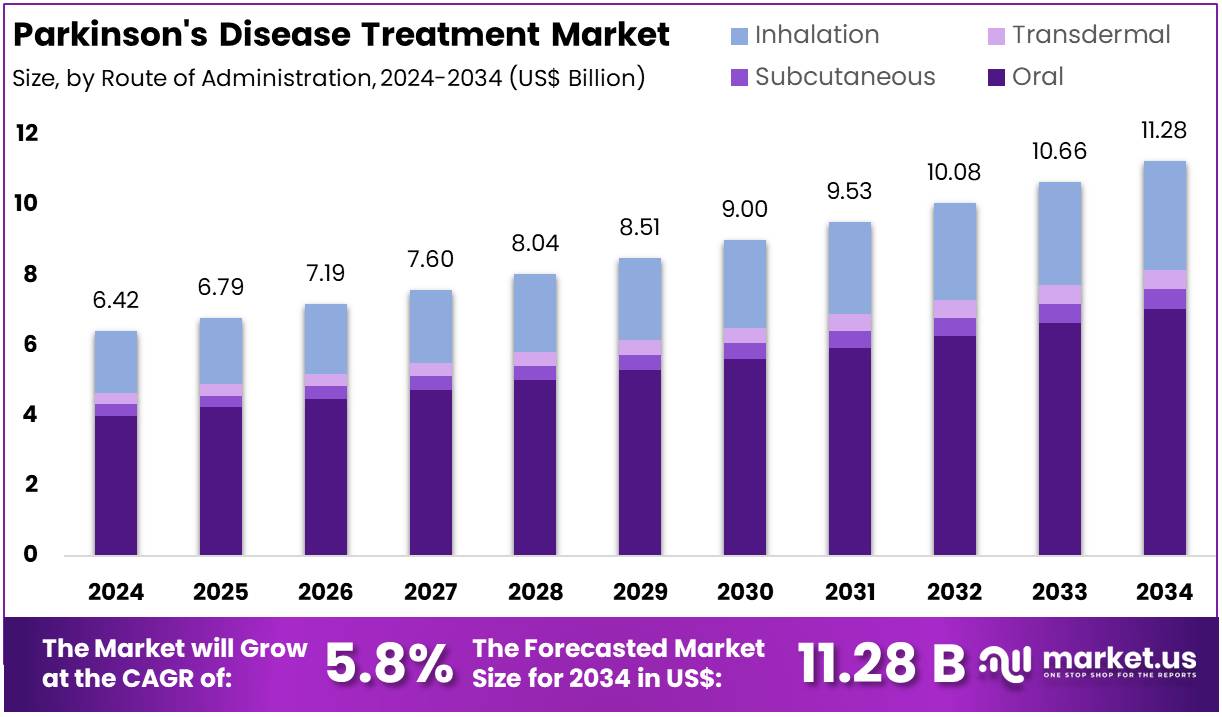
Key Takeaways
- The global Parkinson’s disease treatment market is expected to reach approximately US$ 11.28 billion by 2034, increasing from US$ 6.42 billion in 2024 at a CAGR of 5.8% during the forecast period.
- The Levodopa/Carbidopa segment emerged as the leading drug class category in 2024, accounting for more than 50.9% of the total global Parkinson’s disease treatment market share.
- The advanced-stage disease segment dominated the disease stage category in 2024, representing over 57.5% of the overall Parkinson’s disease treatment market.
- The oral route of administration segment held the largest market share in 2024, capturing approximately 62.4% of the global market, driven by ease of use and widespread patient adoption.
- The hospital pharmacies segment was the leading distribution channel in 2024, contributing more than 45.2% of total Parkinson’s disease treatment sales worldwide.
- North America accounted for the largest regional share of the Parkinson’s disease treatment market in 2024, representing approximately 36.9% of the global market with a valuation of around US$ 2.37 billion.
Statistical Information
- Increasing Global Parkinson’s Disease Burden Is Driving Long-Term Treatment Demand: The rising number of Parkinson’s disease cases is increasing the requirement for medications, rehabilitation services, and advanced treatment solutions. According to the World Health Organization (WHO), more than 8.5 million people were living with Parkinson’s disease globally in 2019. The disease resulted in approximately 5.8 million disability-adjusted life years (DALYs), representing an 81% increase since 2000, while Parkinson’s-related deaths reached 329,000, increasing by more than 100% since 2000.
- Research Focus Is Moving Toward Disease-Modifying Therapies: Current Parkinson’s treatments mainly manage symptoms rather than preventing disease progression. Research organizations are increasing efforts toward therapies that target underlying disease mechanisms. WHO reported that Parkinson’s-related disability increased by 81% between 2000 and 2019, while deaths increased by more than 100% during the same period, highlighting the need for improved treatment approaches.
- Innovation in Parkinson’s Treatment Is Creating New Opportunities for Healthcare Companies: The combination of increasing patient numbers, rising disability burden, and regulatory approvals is encouraging innovation in Parkinson’s medications, infusion systems, biomarkers, and neurological care technologies. WHO estimates indicate that Parkinson’s affected more than 8.5 million people in 2019, caused 329,000 deaths, and generated 5.8 million DALYs, demonstrating the continued need for improved treatment solutions
- Increasing Number of Older Adults Is Expanding the Parkinson’s Treatment Patient Pool: Parkinson’s disease is strongly linked with aging, and the growing elderly population is increasing demand for long-term neurological care. According to the U.S. Census Bureau, the number of Americans aged 65 years and older reached 55.8 million in 2020, representing 16.8% of the total U.S. population. Since Parkinson’s disease commonly develops after age 60, the expansion of the older population is increasing the need for medications, monitoring, and supportive therapies.
- Physical Therapy and Exercise Are Becoming Essential Parts of Parkinson’s Disease Management: Non-drug therapies are gaining importance as Parkinson’s treatment moves toward integrated care models. The Parkinson’s Foundation reported that the Parkinson’s Outcomes Project followed 2,940 people with Parkinson’s disease over two years and found that patients performing at least 2.5 hours of exercise per week showed slower decline in health-related quality of life. Physical therapy focusing on gait, balance, resistance training, and mobility can support symptom management
- Exercise-Based Rehabilitation Shows Measurable Benefits for Parkinson’s Patients: Rehabilitation and physical activity are becoming important components of Parkinson’s disease management because they can support mobility and quality of life. The Parkinson’s Outcomes Project studied more than 13,000 participants across five countries to evaluate treatment outcomes. Research findings showed that patients performing at least 2.5 hours of physical activity per week experienced slower decline in quality of life compared with less active patients.
- Global Parkinson’s Disease Burden Is Increasing Rapidly, Supporting Long-Term Treatment Demand: According to the World Health Organization (WHO), more than 8.5 million people were living with Parkinson’s disease in 2019. The disease caused approximately 329,000 deaths and 5.8 million disability-adjusted life years (DALYs) globally in the same year. WHO reported that Parkinson’s prevalence has doubled during the past 25 years, while disability burden increased by 81% since 2000 and deaths increased by more than 100% since 2000.
- Growing Neurological Disease Burden Supports Future Treatment Innovation: The increasing impact of Parkinson’s disease is encouraging healthcare systems and researchers to develop improved treatment solutions. WHO reported that Parkinson’s disease affected more than 8.5 million people in 2019, caused 329,000 deaths, and contributed to 5.8 million DALYs. These statistics highlight the need for better medicines, rehabilitation programs, infusion technologies, and disease-modifying therapies.
Regional Analysis
North America maintained a dominant regional position in 2024, contributing approximately 36.9% of the market
North America remains a leading region in Parkinson’s disease treatment due to its advanced healthcare infrastructure, high disease awareness, and strong focus on neurological care. According to the National Institute of Neurological Disorders and Stroke (NINDS), Parkinson’s disease affects approximately 500,000 Americans, although the actual number may be higher due to underdiagnosis. The region benefits from early diagnosis, access to specialist care, and widespread availability of medications, rehabilitation services, and advanced therapies such as deep brain stimulation.
The growth of the Parkinson’s treatment landscape in North America is supported by a rapidly aging population, increasing research funding, and continuous innovation in drug development. The U.S. National Institutes of Health (NIH) provides significant support for Parkinson’s research focused on biomarkers, genetics, and disease-modifying therapies. Additionally, regulatory advancements from the U.S. FDA, including approvals of new levodopa formulations and infusion therapies in 2024, are improving treatment options for advanced-stage patients.
Strong collaboration between pharmaceutical companies, academic institutions, and government agencies continues to accelerate clinical trials and personalized medicine approaches. Rising healthcare expenditure, improved reimbursement systems, and growing adoption of digital health technologies are expected to further strengthen North America’s position in Parkinson’s disease management and treatment innovation.
Emerging Trends
- Growth of Continuous Drug Delivery Systems for Advanced Parkinson’s Disease: Treatment approaches are shifting from traditional oral medicines toward continuous drug delivery systems to manage motor fluctuations in advanced Parkinson’s patients. In October 2024, the FDA approved VYALEV, the first 24-hour continuous subcutaneous levodopa infusion therapy, providing a new option for adults experiencing “off” periods despite standard treatment.
- Expansion of Adaptive Deep Brain Stimulation Technologies: Deep brain stimulation (DBS) is evolving with smarter systems that can adjust stimulation according to patient needs. According to NINDS, DBS has been used for Parkinson’s disease since FDA approval in 1997, and newer adaptive DBS systems monitor brain signals to provide targeted stimulation, potentially improving symptom control and reducing side effects.
- Increasing Use of Biomarkers for Early Diagnosis and Personalized Treatment: Biomarker-based Parkinson’s research is becoming a major focus for improving diagnosis and treatment selection. The NIH-supported Parkinson’s Disease Biomarkers Program (PDBP) collects clinical data, genetic information, imaging results, and biological samples to support precision medicine research. In 2024, the FDA supported research on alpha-synuclein seed amplification assays for Parkinson’s clinical studies.
- Increasing Adoption of Digital Health and Wearable Monitoring Solutions: Wearable devices and digital health tools are becoming important for tracking Parkinson’s symptoms outside hospitals. These technologies monitor movement changes, tremors, gait problems, and medication responses continuously. FDA-supported digital health initiatives are encouraging the use of real-world data to improve clinical trials and patient monitoring.
- Development of Disease-Modifying Therapies Through Cell and Gene Therapy Research: Parkinson’s research is increasingly moving beyond symptom control toward therapies that may slow disease progression. Current clinical programs are evaluating cell-based and gene-based approaches targeting dopamine-producing neurons and disease mechanisms. Recent global cell therapy studies have progressed into advanced clinical stages, including trials involving dopamine cell replacement approaches.
Use Cases
- Symptom Management Through Levodopa-Based Medication Therapy: Levodopa combined with carbidopa remains the most widely used approach for improving Parkinson’s motor symptoms such as tremors, stiffness, and slow movement. According to WHO, more than 8.5 million people were living with Parkinson’s disease globally in 2019, creating continued demand for effective long-term symptom management therapies.
- Advanced Disease Management Using Deep Brain Stimulation: DBS is used for Parkinson’s patients whose symptoms are not adequately controlled with medications. According to NINDS, DBS uses implanted electrodes and a pulse generator to regulate abnormal brain signals affecting movement. The technology is applied in movement disorders including Parkinson’s disease, tremor, and dystonia.
- Remote Patient Monitoring Through Digital Technologies: Digital monitoring tools are increasingly used to collect real-time information on Parkinson’s symptoms, helping physicians understand disease progression between clinic visits. Wearable sensors and smartphone-based applications can track gait, tremor severity, movement speed, and treatment response, supporting personalized care approaches.
- Rehabilitation and Physical Therapy for Improving Patient Mobility: Rehabilitation therapies are becoming essential in Parkinson’s care because they support movement, balance, speech, and daily activities. The Parkinson’s Foundation’s Parkinson’s Outcomes Project analyzed data from more than 13,000 participants across five countries and highlighted the importance of exercise and specialized care for improving patient outcomes.
- Clinical Research Platforms Supporting New Parkinson’s Treatments: Clinical research platforms are accelerating the development of new Parkinson’s therapies, including biomarkers, drug candidates, devices, and genetic treatments. Government-supported databases such as ClinicalTrials.gov track more than 1,000 Parkinson’s disease-related studies, supporting innovation in disease management and future treatment options.
Frequently Asked Questions on Parkinson’s Disease Treatment
- What are the major treatments used for Parkinson’s disease?
The major Parkinson’s disease treatments include levodopa/carbidopa, dopamine agonists, MAO-B inhibitors, COMT inhibitors, deep brain stimulation, and rehabilitation therapies. These treatments mainly focus on controlling symptoms, improving mobility, reducing motor fluctuations, and enhancing patients’ quality of life. - Why is the Parkinson’s disease treatment market growing?
The Parkinson’s disease treatment market is growing due to increasing disease prevalence, aging populations, rising healthcare awareness, and advancements in neurological therapies. Growing adoption of infusion systems, biomarkers, digital monitoring tools, and personalized medicine approaches is also supporting market development. - What are the latest innovations in Parkinson’s disease treatment?
Recent innovations include continuous levodopa infusion systems, extended-release medications, wearable monitoring devices, biomarker-based diagnosis, and gene or cell therapies. In 2024, the FDA approved VYALEV, a 24-hour subcutaneous levodopa infusion therapy for advanced Parkinson’s patients. - How does aging affect the Parkinson’s disease treatment market?
Aging is a major factor influencing Parkinson’s disease treatment demand because the condition primarily affects older adults. Increasing elderly populations worldwide are contributing to higher diagnosis rates and greater need for long-term medications, rehabilitation services, and specialized neurological care. - What role do biomarkers play in Parkinson’s disease treatment development?
Biomarkers help researchers identify disease progression, improve diagnosis accuracy, and develop personalized treatments. Programs supported by organizations such as NIH and NINDS collect genetic, imaging, and biological data to improve clinical trials and accelerate development of disease-modifying therapies. - How are digital technologies used in Parkinson’s disease management?
Digital technologies such as wearable sensors, mobile applications, and remote monitoring systems help track symptoms including tremors, gait changes, and movement patterns. These tools provide real-time patient information, allowing healthcare providers to personalize treatment decisions and monitor disease progression. - What is the future outlook for the Parkinson’s disease treatment market?
The future of the Parkinson’s disease treatment market is expected to focus on precision medicine, disease-modifying therapies, advanced drug delivery systems, and digital healthcare solutions. Increasing research investment and regulatory approvals are likely to improve treatment outcomes and patient care worldwide.
Conclusion
The Parkinson’s disease treatment market is experiencing steady advancement due to the rising global disease burden, aging population, and continuous innovation in neurological care. Increasing adoption of levodopa-based therapies, deep brain stimulation, infusion systems, rehabilitation services, and digital health technologies is improving patient management.
Regulatory approvals, biomarker research, and clinical development programs are accelerating the transition toward personalized and disease-modifying treatments. Government initiatives and healthcare investments are further supporting research and accessibility. With growing demand for effective therapies and advanced treatment solutions, the Parkinson’s disease treatment market is expected to continue evolving, creating new opportunities for improved patient outcomes worldwide.
Discuss your needs with our analyst
Please share your requirements with more details so our analyst can check if they can solve your problem(s)




